
Opinion
Limits of Partisan Politics

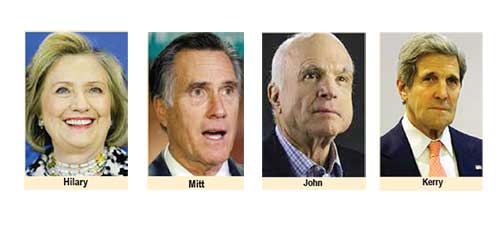
Some examples from American politicians on how to concede defeat and preserve unity
America has just finished another presidential election. (2020). Here is a collection of brief speeches made by previous defeated candidates conceding defeat. (Source: Internet)
1. Hillary Clinton 2016
 “I still believe in America and I always will. And if you do, then we must accept this result and then look to the future. Donald Trump is going to be our president. We owe him an open mind and the chance to lead. Our constitutional democracy enshrines the peaceful transfer of power. And we don’t just respect that, we cherish it.”
2. Mitt Romney 2012
 “I have just called President Obama to congratulate him on his victory. His supporters and his campaign also deserve congratulations. I wish all of them well, but particularly the president, the first lady and their daughters. I so wish that I had been able to fulfill your hopes to lead the country in a different direction. But the nation chose another leader. And so Ann and I join with you to earnestly pray for him and this great nation.”
3. John McCain 2008
 “This is a historic election;and I recognize the special significance it has for African Americans and the special pride that must be theirs tonight. I’ve always believed that America offers opportunities to all who have the industry and the will to seize it. Senator Obama believes that too. But we both recognize that though we have come a long way from the old injustices that once stained our nation’s reputation and denied some Americans the full blessings of American citizenship, the memory of them still had the power to wound. A century ago, President Theodore Roosevelt’s invitation of Booker T. Washington to dine at the White House was taken as an outrage in many quarters. America today is a world away from the cruel and prideful bigotry of that time. There is no better evidence of this than the election of an African American to the Presidency of the United States. I am sorry that we got here a little bit late and a little bit short.”
“Whatever our differences, we are fellow Americans; and please believe me when I say:no association has ever meant more to me than that.”
4. John Kerry 2004
 “Earlier today, I spoke to President Bush and I offered him and Laura our congratulations on their victory. We had a good conversation and we talked about the danger of division in our country and the need, the desperate need for unity, for finding the common ground, coming together. Today, I hope that we can begin the healing.”
5. Al Gore 2000
 “Almost a century and a half ago, Senator Stephen Douglas told Abraham Lincoln, who had just defeated him for the presidency: “Partisan feeling must yield to patriotism. I am with you Mr President and God bless you.” Well, in that same spirit, I say to President-elect Bush that what remains of partisan rancour must now be put aside and may God bless his stewardship of this country. Neither he nor I anticipated this long and difficult road. Certainly neither of us wanted it to happen. Yet it came and now it has ended.Resolved as it must be resolved through the honoured institutions of our democracy.”
6. Bob Dole 1996
 “I’ve said repeatedly in this campaign that the president is my opponent, not my enemy and I wish him well and I pledge my support and whatever advances the cause of a better America. That’s what the race was about in the first place, a better America as we go into the next century.”
7. George H.W.Bush 1992
 “I just called Governor Clinton over in Little Rock and offered my congratulations. He did run a strong campaign. I wish him well in the White House and I want the country to know that our entire administration will work closely with his team to ensure the smooth transition of power. There is important work to be done and America must always come first. So we will get behind this new president and wish him well.”
8. Michael Dukakis 1988
 “Just a few minutes ago, I called Vice-President Bush and congratulated him on his victory. And I know I speak for all of you and for all the American people when I say that he will be our president and we’ll work with him. This nation faces major challenges ahead and we must work together.”
9. Walter Mondale 1984
 “We rejoice in the freedom of a wonderful people and we accept their verdict. I thank the people of America for hearing my case. My loss tonight does not in any way diminish the worth or the importance of our struggle and I am at peace with the knowledge that I gave it everything I’ve got.”
10. Jimmy Carter 1980
 “I have a deep appreciation of the system, however that lets people make a free choice about who will lead them for the next four years. About an hour ago, I called Governor Reagan in California and I told him that I congratulated for a fine victory. I look forward to working closely with him during the next few weeks. We’ll have a very fine transition period. I told him I wanted the best one in history. And I then sent him this telegram and I’ll read it to you: “It is now apparent that the American people have chosen you as the next president. I congratulate you and pledge to you our fullest support and cooperation in bringing about an orderly transition of government in the weeks ahead. My best wishes are with you and your family as you undertake the responsibilities that lie before you and I signed it: Jimmy Carter.”
“The people of the United States have made their choice, and of course I accept that decision.”
11. Betty Ford – Wife of President Gerald Ford 1976
 “The president asked me to tell you that he telephoned President-elect Carter a short time ago and congratulated him on his victory. The president also wants to thank all those thousands of people who worked so hard on his behalf and the millions who supported him with their votes. It’s been the greatest honour of my husband’s life to have served his fellow Americans during two of the most difficult years in our history. The president urges all Americans to join him in giving your united support to President-elect Carter as he prepares to assume his new responsibilities.”
12. George McGovern 1972
 “I have just sent the following telegram to President Nixon: “Congratulations on your victory. I hope that in the next four years you will lead us to a time of peace abroad and justice at home. You have my full support in such efforts. With best wishes to you and your gracious wife Pat, Sincerely George McGovern.”
Sadly for America and the spirit of democratic governance the world over, Donald Trump broke faith when he failed to measure up to the standards set by his predecessors.
Brigadier Ranjan de Silva
Email – rpcdesilva@gmail.com


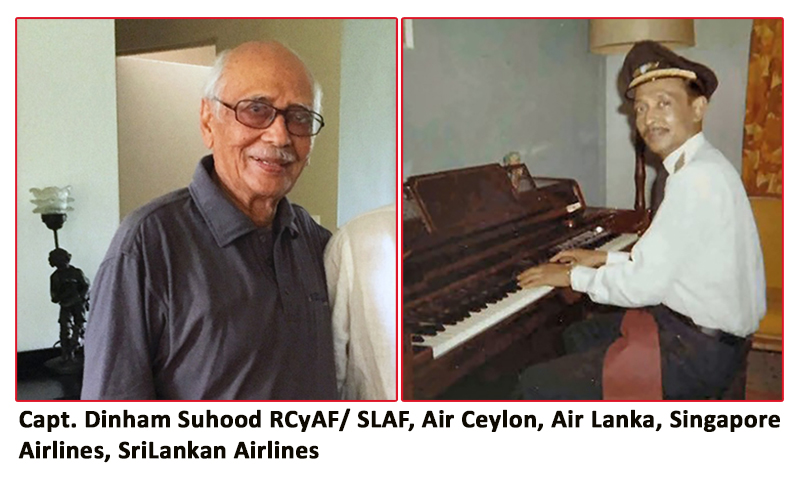
A few days ago, we heard the sad news of the passing on of Capt. Dinham Suhood. Born in 1929, he was the last surviving Air Ceylon Captain from the ‘old guard’.
He studied at St Joseph’s College, Colombo 10. He had his flying training in 1949 in Sydney, Australia and then joined Air Ceylon in late 1957. There he flew the DC3 (Dakota), HS748 (Avro), Nord 262 and the HS 121 (Trident).
I remember how he lent his large collection of ‘Airfix’ plastic aircraft models built to scale at S. Thomas’ College, exhibitions. That really inspired us schoolboys.
In 1971 he flew for a Singaporean Millionaire, a BAC One-Eleven and then later joined Air Siam where he flew Boeing B707 and the B747 before retiring and migrating to Australia in 1975.
Some of my captains had flown with him as First Officers. He was reputed to have been a true professional and always helpful to his colleagues.
He was an accomplished pianist and good dancer.
He passed on a few days short of his 97th birthday, after a brief illness.
May his soul rest in peace!
To fly west my friend is a test we must all take for a final check
Capt. Gihan A Fernando
RCyAF/ SLAF, Air Ceylon, Air Lanka, Singapore Airlines, SriLankan Airlines

The cause of global warming, they claim, is due to ever increasing levels of CO2. This is a by-product of burning fossil fuels like oil and gas, and of course coal. Environmentalists and other ‘green’ activists are worried about rising world atmospheric levels of CO2. Now they want to stop the whole world from burning fossil fuels, especially people who use cars powered by petrol and diesel oil, because burning petrol and oil are a major source of CO2 pollution. They are bringing forward the fateful day when oil and gas are scarce and can no longer be found and we have no choice but to travel by electricity-driven cars – or go by foot. They say we must save energy now, by walking and save the planet’s atmosphere.
THE DEMON COAL
But it is coal, above all, that is hated most by the ‘green’ lobby. It is coal that is first on their list for targeting above all the other fossil fuels. The eminently logical reason is that coal is the dirtiest polluter of all. In addition to adding CO2 to the atmosphere, it pollutes the air we breathe with fine particles of ash and poisonous chemicals which also make us ill. And some claim that coal-fired power stations produce more harmful radiation than an atomic reactor.
STOP THE COAL!
Halting the use of coal for generating electricity is a priority for them. It is an action high on the Green party list.
However, no-one talks of what we can use to fill the energy gap left by coal. Some experts publicly claim that unfortunately, energy from wind or solar panels, will not be enough and cannot satisfy our demand for instant power at all times of the day or night at a reasonable price.
THE ALTERNATIVES
It seems to be a taboo to talk about energy from nuclear power, but this is misguided. Going nuclear offers tried and tested alternatives to coal. The West has got generating energy from uranium down to a fine art, but it does involve some potentially dangerous problems, which are overcome by powerful engineering designs which then must be operated safely. But an additional factor when using URANIUM is that it produces long term radioactive waste. Relocating and storage of this waste is expensive and is a big problem.
Russia in November 2020, very kindly offered to help us with this continuous generating problem by offering standard Uranium modules for generating power. They offered to handle all aspects of the fuel cycle and its disposal. In hindsight this would have been an unbelievable bargain. It can be assumed that we could have also used Russian expertise in solving the power distribution flows throughout the grid.
THORIUM
But thankfully we are blessed with a second nuclear choice – that of the mildly radioactive THORIUM, a much cheaper and safer solution to our energy needs.
News last month (January 2026) told us of how China has built a container ship that can run on Thorium for ten years without refuelling. They must have solved the corrosion problem of the main fluoride mixing container walls. China has rare earths and can use AI computers to solve their metallurgical problems – fast!
Nevertheless, Russia can equally offer Sri Lanka Thorium- powered generating stations. Here the benefits are even more obviously evident. Thorium can be a quite cheap source of energy using locally mined material plus, so importantly, the radioactive waste remains dangerous for only a few hundred years, unlike uranium waste.
Because they are relatively small, only the size of a semi-detached house, such thorium generating stations can be located near the point of use, reducing the need for UNSIGHTLY towers and power grid distribution lines.
The design and supply of standard Thorium reactor machines may be more expensive but can be obtained from Russia itself, or China – our friends in our time of need.
Priyantha Hettige
The Island has recently published various articles on AI, and they are thought-provoking. This article is based on a paper I presented at a London University seminar, 22 years ago.
Will computers ever be intelligent? This question is controversial and crucial and, above all, difficult to answer. As a scientist and student of philosophy, how am I going to answer this question is a problem. In my opinion this cannot be purely a philosophical question. It involves science, especially the new branch of science called “The Artificial Intelligence”. I shall endeavour to answer this question cautiously.
Philosophers do not collect empirical evidence unlike scientists. They only use their own minds and try to figure out the way the world is. Empirical scientists collect data, repeat and predict the behaviour of matter and analyse them.
We can see that the question—”Will computers ever be intelligent?”—comes under the branch of philosophy known as Philosophy of Mind. Although philosophy of mind is a broad area, I am concentrating here mainly on the question of consciousness. Without consciousness there is no intelligence. While they often coincide in humans and animals, they can exist independently, especially in AI, which can be highly intelligent without being conscious.
AI and philosophers
It appears that Artificial Intelligence holds a special attraction for philosophers. I am not surprised about this as Al involves using computers to solve problems that seem to require human reasoning. Apart from solving complicated mathematical problems it can understand natural language. Computers do not “understand” human language in the human sense of comprehension; rather, they use Natural Language Processing (NLP) and machine learning to analyse patterns in data. Artificial Intelligence experts claim certain programmes can have the possibility of not only thinking like humans but also understanding concepts and becoming conscious.
The study of the possible intelligence of logical machines makes a wonderful test case for the debate between mind and brain. This debate has been going on for the last two and a half centuries. If material things, made up entirely of logical processes, can do exactly what the brain can, the question is whether the mind is material or immaterial.
Although the common belief is that philosophers think for the sake of thinking, it is not necessarily so. Early part of the 20th century brought about advances in logic and analytical philosophy in Britain. It was a philosopher (Ludwig Wittgenstein) who invented the truth table. This was a simple analytic tool useful in his early work. But this was absolutely essential to the conceptual basis of early computer science. Computer science and brain science have developed together and that is why the challenge of the thinking machine is so important for the philosophy of mind. My argument so far has been to justify how and why AI is important to philosophers and vice versa.
Looking at computers now, we can see that the more sophisticated the computer, the more it is able to emulate rather than stimulate our thought processes. Every time the neuroscientists discover the workings of the brain, they try to mimic brain activity with machines.
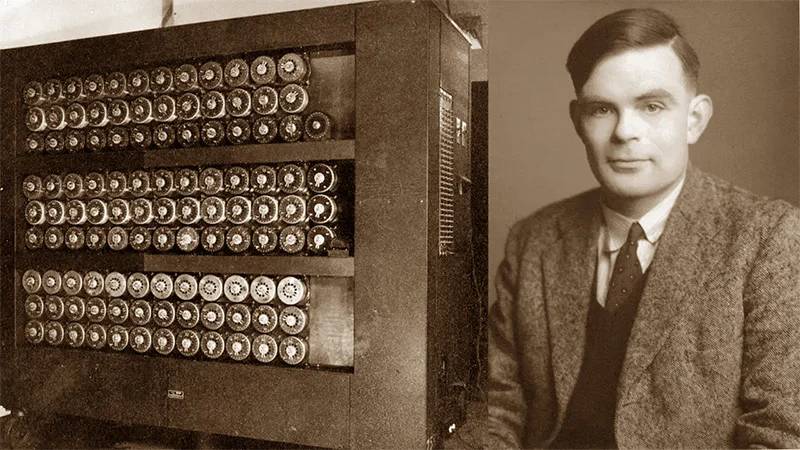
How can one tell if a computer is intelligent? We can ask it some questions or set a test and study its response and satisfy ourselves that there is some form of intelligence inside this box. Let us look at the famous Alan Turing Test. Imagine a person sitting at a terminal (A) typing questions. This terminal is connected to two other machines, (B) and (C). At terminal (B) sits another person (B) typing responses to the questions from person (A). (C) is not a human being, but a computer programmed to respond to the questions. If person (A) cannot tell the difference between person (B) and computer(C), then we can deduce that computer is as intelligent as person (B). Critics of this test think that there is nothing brilliant about it. As this is a pragmatic exercise and one need not have to define intelligence here. This must have amused the scientists and the philosophers in the early days of the computers. Nowadays, computers can do much more sophisticated work.
Chinese Room experiment
The other famous experiment is John Sealer’s Chinese room experiment. *He uses this experiment to debunk the idea that computers could be intelligent. For Searle, the mind and the brain are the same. But he warns us that we should not get carried away with the emulative success of the machines as mind contains an irreducible subjective quality. He claims that consciousness is a biological process. It is found in humans as well as in certain animals. It is interesting to note that he believes that the mind is entirely contained in the brain. And the empirical discovery of neural processes cannot be applied to outside the brain. He discards mind-body dualism and thinks that we cannot build a brain outside the body. More commonly, we believe the mind is totally in the brain, and all firing together and between, and what we call ‘thought’ comes from their multifarious collaboration.
Patricia and Paul Churchland are keen on neuroscientific methods rather than conventional psychology. They argue that the brain is really a processing machine in action. It is an amazing organ with a delicately organic structure. It is an example of a computer from the future and that at present we can only dream of approaching its processing speed. I think this is not something to be surprised about. The speed of the computer doubles every year and a half and in the distant future there will be machines computing faster than human beings. Further, the Churchlands’, strongly believe that through science one day we will replicate the human brain. To argue against this, I am putting forward the following true story.
I remember watching an Open University (London) education programme some years ago. A team of professors did an experiment on pavement hawkers in Bogota, Colombia. They were fruit sellers. The team bought a large number of miscellaneous items from these street vendors. This was repeated on a number of occasions. Within a few seconds, these vendors did mental calculations and came out with the amounts to be paid and the change was handed over equally fast. It was a success and repeatable and predictable. The team then took the sample population into a classroom situation and taught them basic arithmetic skills. After a few months of training they were given simple sums to do on selling fruit. Every one of them failed. These people had the brain structure that of ordinary human beings. They were skilled at their own jobs. But they could not be programmed to learn a set of rules. This poses the question whether we can create a perfect machine that will learn all the human transferable skills.
Computers and human brains excel at different tasks. For instance, a computer can remember things for an infinite amount of time. This is true as long as we don’t delete the computer files. Also, solving equations can be done in milliseconds. In my own experience when I was an undergraduate, I solved partial differential equations and it took me hours and a lot of paper. The present-day students have marvellous computer programmes for this. Let alone a mere student of mathematics, even a mathematical genius couldn’t rival computers in the above tasks. When it comes to languages, we can utter sentences of a completely foreign language after hearing it for the first time. Accents and slang can be decoded in our minds. Such algorithms, which we take for granted, will be very difficult for a computer.
I always maintain that there is more to intelligence than just being brilliant at quick thinking. A balanced human being to my mind is an intelligent person. An eccentric professor of Quantum Mechanics without feelings for life or people, cannot be considered an intelligent person. To people who may disagree with me, I shall give the benefit of the doubt and say most of the peoples’ intelligence is departmentalised. Intelligence is a total process.
Other limitations to AI
There are other limitations to artificial intelligence. The problems that existing computer programmes can handle are well-defined. There is a clear-cut way to decide whether a proposed solution is indeed the right one. In an algebraic equation, for example, the computer can check whether the variables and constants balance on both sides. But in contrast, many of the problems people face are ill-defined. As of yet, computer programmes do not define their own problems. It is not clear that computers will ever be able to do so in the way people do. Another crucial difference between humans and computers concerns “common sense”. An understanding of what is relevant and what is not. We possess it and computers don’t. The enormous amount of knowledge and experience about the world and its relevance to various problems computers are unlikely to have.
In this essay, I have attempted to discuss the merits and limitations of artificial intelligence, and by extension, computers. The evolution of the human brain has occurred over millennia, and creating a machine that truly matches human intelligence and is balanced in terms of emotions may be impossible or could take centuries
*The Chinese Room experiment, proposed by philosopher John Searle, challenges the idea that computers can truly “understand” language. Imagine a person locked in a room who does not know Chinese. They receive Chinese symbols through a slot and use an instruction manual to match them with other symbols to produce correct replies. To outsiders, it appears the person understands Chinese, but in reality, they are only following rules. Searle argues that similarly, a computer may process language convincingly without genuine understanding or consciousness.
by Sampath Anson Fernando

Canada, UAE face each other for only the second time in T20Is

Landslide Early Warnings issued to the Districts of Kandy and Nuwara Eliya

Former Minister Professor Tissa Vitharana has passed away at the age of 91

Buoyant Zimbabwe plot massive upset against depleted Australia

Mexican ships arrive in Cuba with humanitarian cargo amid US oil blockade

Tarique Rahman’s BNP claims majority in Bangladesh election

‘Dates have the highest sugar content to fight Coronavirus’

Sunday Island 27 December – Headlines

#SundayIsland 17th December – Headlines

Sunday Island – 28th March

Sunday Island Headlines – 21 March

Sunday Island – 21st February – Headlines
-
 Features5 days ago
My experience in turning around the Merchant Bank of Sri Lanka (MBSL) – Episode 3
-

 Business6 days ago
Zone24x7 enters 2026 with strong momentum, reinforcing its role as an enterprise AI and automation partner
-

 Business5 days ago
Remotely conducted Business Forum in Paris attracts reputed French companies
-

 Business5 days ago
Four runs, a thousand dreams: How a small-town school bowled its way into the record books
-

 Business5 days ago
ComBank and Hayleys Mobility redefine sustainable mobility with flexible leasing solutions
-

 Business2 days ago
Autodoc 360 relocates to reinforce commitment to premium auto care
-

 Business6 days ago
HNB recognized among Top 10 Best Employers of 2025 at the EFC National Best Employer Awards
-

 Midweek Review2 days ago
A question of national pride