
News
Lankan nuns march for unwed mothers, abuse victims


About 1,000 illegal abortions take place on the island nation daily, media reports say
Hundreds of Catholic nuns took to the streets on Ash Wednesday, the first day of Lent, to call on the government and other groups to protect the rights of unwed mothers and abuse victims. The nuns from Good Shepherd congregation, wearing their religious habits, carried white boxes as they rallied March 5 to collect donations to support victims of rape, abuse, child marriage and unwed mothers.
Sister Rosary Perera, head of the Ave Maria Convent near St. Peter’s Church in Negombo, said the rally was part of a national campaign by her religious order.
“We are organizing this local fundraising campaign across all 12 dioceses, supported by nuns and a few lay people, to care for orphaned children and unwed mothers, aiming to uplift the lives of women and girls in mortal danger,” Perera told UCA News March 5.
Many people generously donated money to support those in need.
A rape victim from Badulla city, who received support from the nuns said the nuns fill voids for abuse victims with protection and care.
“The nuns advise victims not to have abortions but give the children to them. They help parents besides the victims. They encourage those who seek abortion to contact them first,” said the victim, a Hindu, who declined to reveal her identity.
“When an underage girl is raped and becomes pregnant, the rapist often escapes, while the girl faces rejection from her family, community, and society, with some resorting to sex work or suicide,” she said.
“Due to the dedication and support of the compassionate and understanding nuns, both the mother and child are given a new chance at life,” she added.
Between 800 and 1,000 abortions take place in the country daily despite abortion being illegal, media reports say.
The Sri Lankan Penal Code criminalizes abortion except for cases when the mother’s life is at risk.
However, many women, especially victims of sexual abuse, often seek abortion illegally with the help of medical doctors, to escape the social stigma related to rape and children born to unwed women.
Thousands of women and children are raped each year, and many cases go unreported as outdated laws and societal norms fail to protect victims, according to Equality Now, an organization tracking violence against women and girls.
Sister Priyangani Hathurusinghe, principal of Ave Maria Convent, sent a letter to the parents of her students recently, urging them to make generous contributions to support their mission for the poor, needy, and destitute.
“As you are already aware the Convent at Nayakakanda attends to a variety of their needs such as caring for abandoned children, to uplift the lives of women and girls in mortal danger and many others. In order to carry out these works of charity, we need your financial support and help,” the nun’s letter read.
George Dias, a businessman from Negombo who donated cash to the nuns, praised their mission, saying that it serves all religious communities.
“Their call for action transcends religious boundaries, with the nuns not only raising awareness but also seeking practical support to provide unwed mothers and children from traumatic situations with safe spaces and a better future,” he said.

Latest News
Heat Index at ‘Caution level’ at some places in the Western, Sabaragamuwa, Southern and North-western provinces and in Monaragala and Mannar districts

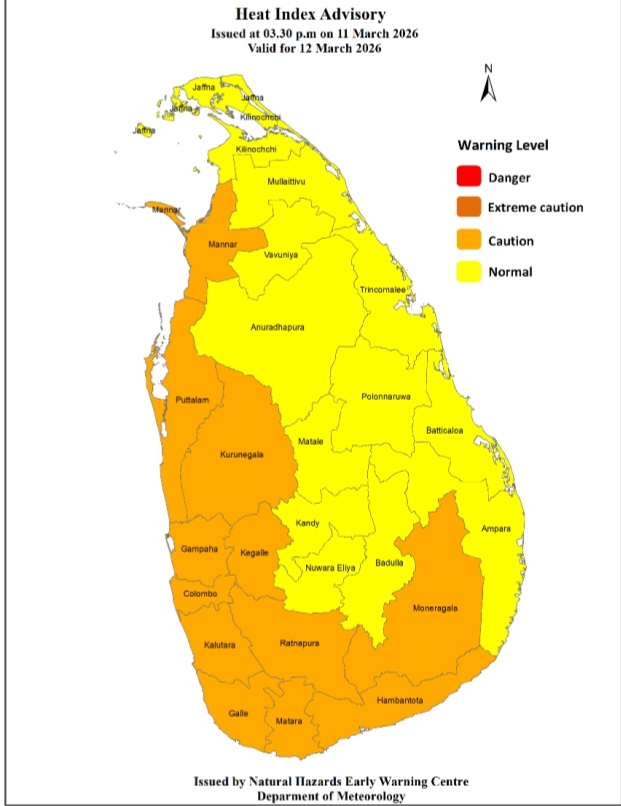
Warm Weather Advisory
Issued by the Natural Hazards Early Warning Centre of the Department of Meteorology at 3.30 p.m. on 11 March 2026, valid for 12 March 2026.
The public are warned that the Heat index, the temperature felt on human body is likely to increase up to ‘Caution level’ at
some places in the Western, Sabaragamuwa, Southern and North-western provinces and in Monaragala and Mannar districts.
The Heat Index Forecast is calculated by using relative humidity and maximum temperature and this is the condition that is felt on your body. This is not the forecast of maximum temperature. It is generated by the Department of Meteorology for the next day period and prepared by using global numerical weather prediction model data.

Effect of the heat index on human body is mentioned in the above table and it is prepared on the advice of the Ministry of Health and Indigenous Medical Services.
ACTION REQUIRED
Job sites: Stay hydrated and takes breaks in the shade as often as possible.
Indoors: Check up on the elderly and the sick.
Vehicles: Never leave children unattended.
Outdoors: Limit strenuous outdoor activities, find shade and stay hydrated.
Dress: Wear lightweight and white or light-colored clothing.
Note:
In addition, please refer to advisories issued by the Disaster Preparedness & Response Division, Ministry of Health in this regard as well.
For further clarifications please contact 011-744649


The government’s sweeping electricity sector restructuring programme ran into fresh turbulence yesterday, with authorities warning that meeting a 40 percent salary increase, demanded by striking power sector unions, could push electricity tariffs up by nearly 100 percent.
Chairman of the National Transmission Network Service Provider (NTNSP), Nusith Kumaratunga, issuing the warning at a media briefing, said the additional salary burden would significantly escalate operating costs in the newly formed power sector companies.
According to Kumaratunga, granting the 40 percent salary increase would raise the monthly wage bill by about Rs. 1.8 billion, amounting to nearly Rs. 22 billion annually, placing enormous pressure on the already fragile financial position of the electricity sector.
“If that additional burden is passed on to consumers, electricity tariffs may have to increase by close to 100 percent,” he said.
The briefing was organised by the management of the successor companies created following the restructuring of the Ceylon Electricity Board (CEB).
Kumaratunga said electricity sector trade unions had presented 64 demands in the wake of the restructuring exercise.
“Out of the 64 demands, 62 have already been agreed to,
while the remaining two have been referred to President Anura Kumara Dissanayake for discussion,” he said.
He explained that the majority of the demands related to the continuation of privileges previously enjoyed by employees under the CEB structure.
“During the initial round of discussions itself, the boards of directors agreed to 59 of those demands,” he noted.
Among the concessions already granted was the continuation of bonus payments, similar to those previously paid by the CEB, at least temporarily, until a performance-based incentive system is introduced.
The management had also agreed to grant an allowance of Rs. 11,000, in addition to the existing cost-of-living allowance, bringing the average additional monthly benefit to around Rs. 17,000 per employee, he said.
Kumaratunga stressed that management had approved all demands that could be granted at the ministerial level.
However, he said the proposed 40 percent salary increase would be difficult to justify, particularly at a time when other segments of the public service were not receiving similar benefits.
He also revealed that unions had requested that a 25 percent salary adjustment, granted to senior executives in 2024, be extended to all employees, with retrospective effect from January 1, 2024.
Granting such a request would require amending an existing Cabinet decision, which the boards of directors of the newly established companies do not have the authority to do, Kumaratunga explained.
He pointed out that the newly created electricity sector companies had only commenced operations on Monday, and their work had already been disrupted by the ongoing trade union action.
“It is difficult to understand why the strike continues when the vast majority of demands have already been addressed,” he said.
However, the Ceylon Electricity Board Engineers’ Union clarified that the 40 percent salary increase was not their primary demand.
Union representatives said that the electricity sector employees were originally due for a salary revision in January 2027, but the ongoing restructuring had raised concerns that the scheduled increase might not materialise.
“That is why we requested at least a reasonable percentage increase in order to secure some form of salary revision,” a senior electrical engineer said.
The dispute comes at a critical moment as the government presses ahead with the unbundling of the CEB into separate generation, transmission and distribution entities, a reform programme, officials say, is aimed at improving efficiency and attracting investment to Sri Lanka’s troubled power sector.
However, the restructuring has been strongly opposed by trade unions, which argue that the reforms could undermine employee security and weaken state control over a strategic national utility.
With industrial action continuing and tariff hikes looming as a possibility, the confrontation between the government and electricity sector unions appears set to intensify in the coming days.
By Ifham Nizam

A UN vessel arrived in Colombo yesterday (11) to conduct a month-long marine scientific survey in Sri Lanka’s Exclusive Economic Zone (EEZ). This is the first foreign scientific research vessel here since President Ranil Wickremesinghe banned such visits on January 1, 2024, for a period of one year. However, the ban remains in place with the NPP government yet to announce its new decision on the issue.
The following is the text of statement issued by the Foreign Ministry yesterday: “On the invitation of the Government of Sri Lanka, the United Nations-flagged vessel R/V Dr. Fridtjof Nansen, under the Food and Agriculture Organisation (FAO), is scheduled to arrive in Sri Lanka today to conduct a marine scientific survey in Sri Lanka’s Exclusive Economic Zone (EEZ) in collaboration with the Ministry of Fisheries, Aquatic and Ocean Resources and the National Aquatic Resources Research and Development Agency (NARA).
R/V Dr. Fridtjof Nansen supports countries in collecting critical scientific data for sustainable fisheries management and in understanding how climate change is affecting marine ecosystems. The survey, spanning 32 days, will focus on assessing marine living resources and marine ecosystems, providing updated scientific data that will support Sri Lanka’s sustainable fisheries management and ocean governance. During the mission, scientists will undertake a range of activities, including hydro-acoustic surveys to estimate the biomass and distribution of key fish stocks in Sri Lankan waters; assessment of marine pollution levels; and biodiversity monitoring.
An important component of the programme is capacity building. The mission will bring together Sri Lankan scientists from NARA and other national institutions with international experts, promoting scientific collaboration and knowledge exchange.
Sri Lanka previously hosted the R/V Dr. Fridtjof Nansen in 2018, when the vessel conducted a comprehensive survey of Sri Lanka’s continental shelf and upper slope, in collaboration with national institutions. Earlier, Nansen surveys were also carried out in Sri Lankan waters in 1978–1980, reflecting a long-standing scientific partnership under the Nansen programme.
Sri Lanka’s participation in this survey reflects the country’s continued commitment to sustainable fisheries, marine ecosystem protection, and international scientific cooperation in the Indian Ocean region.”

Heat Index at ‘Caution level’ at some places in the Western, Sabaragamuwa, Southern and North-western provinces and in Monaragala and Mannar districts

Showers or thundershowers will occur at several places in the Western and Sabaragamuwa provinces and in Galle, Matara, Kandy and Nuwara-Eliya districts after 2.00 pm.

Power sector reforms jolted by 40% pay hike demand

UN scientific research ship here amidst ban on such vessels

Prez assures energy supplies for the time being

Historic address by BASL President at the Supreme Court of India

‘Dates have the highest sugar content to fight Coronavirus’

Sunday Island 27 December – Headlines

#SundayIsland 17th December – Headlines

Sunday Island – 28th March

Sunday Island Headlines – 21 March

Sunday Island – 21st February – Headlines
-
 News6 days ago
University of Wolverhampton confirms Ranil was officially invited
-

 News5 days ago
Peradeniya Uni issues alert over leopards in its premises
-

 News6 days ago
Female lawyer given 12 years RI for preparing forged deeds for Borella land
-

 News3 days ago
Repatriation of Iranian naval personnel Sri Lanka’s call: Washington
-
 News6 days ago
Library crisis hits Pera university
-

 News5 days ago
Wife raises alarm over Sallay’s detention under PTA
-

 News6 days ago
‘IRIS Dena was Indian Navy guest, hit without warning’, Iran warns US of bitter regret
-
 Latest News6 days ago
Sri Lanka evacuates crew of second Iranian vessel after US sunk IRIS Dena