
News
Lanka needs to end unlawful crackdown on peaceful dissent – Human Rights Watch


The New York based Human Rights Watch has called on Lankan government to end arbitrary arrests, harassment of protesters, activists and journalists immediately.An HRW statement issued from New York says: The Sri Lankan government is using emergency regulations to harass and arbitrarily detain activists seeking political reform and accountability for the country’s economic crisis, Human Rights Watch said today. Since Ranil Wickremesinghe was sworn in as president on July 21, 2022, the police and military have sought to curtail protests through the intimidation, surveillance, and arbitrary arrests of demonstrators, civil society activists, lawyers, and journalists.
Anti-government protests in Colombo and elsewhere in the country led then-President Gotabaya Rajapaksa to flee the country before resigning on July 15. On July 22, President Wickremesinghe ordered security forces to disperse protesters and break up their main site in central Colombo. The police have subsequently targeted perceived protest leaders for arrest and detention.
“The Sri Lankan government’s crackdown on peaceful dissent appears to be a misguided and unlawful attempt to divert attention from the need to address the country’s urgent economic crisis,” said Meenakshi Ganguly, South Asia director at Human Rights Watch. “Sri Lanka’s international partners should be clear that they need to be working with a rights-respecting administration to address Sri Lanka’s deeply rooted economic problems.”
Security forces injured more than 50 people in the July 22 early morning raid on the main janatha aragalaya (people’s struggle) site in Colombo. Security forces assaulted and beat three journalists from Xposure News – Chaturanga Pradeep Kumara, Rasika Gunawardana, and Shabeer Mohammed – and at least one other journalist, Jareen Samuel of the BBC, during the raid. Wickremesinghe berated foreign diplomats for criticizing the security forces’ use of excessive force and took no action to hold those responsible to account.
A number of Buddhist monks and Christian clergy had joined the protests. The media reported that the Colombo Magistrates’ Court on July 25 had issued a travel ban on Father Jeewantha Peiris, a Catholic priest who had been prominent in the protests, and several others. Two days later police visited Father Peiris’s church and said that they had orders to arrest him. In a July 31 statement, 1,640 members of the Catholic clergy condemned targeting the priest, saying that they had all backed the protests.
On July 26, the authorities arrested another prominent protester, Dhaniz Ali, from an international flight about to depart from Colombo. On July 27, unidentified men in civilian clothes abducted Veranga Pushpika, a former student activist and journalist who had also been active in the protests, from a bus in Colombo. Police did not disclose his whereabouts to lawyers or the Human Rights Commission for several hours before acknowledging his arrest.
Human rights defenders said that the police sought to obstruct defense lawyers from meeting with four protesters who had been arrested after they handed over to the police a large sum of money taken from the president’s official residence after protesters had occupied it.
Lawyers and media organizations told Human Rights Watch that they have experienced increased intimidation, including threats of violence and surveillance. In one episode, a group of men claiming to be police officers, but not wearing uniform, visited the office of an online publication, Xposure News, on July 27 and demanded that a security guard identify people shown in photographs and show them CCTV footage.
On July 31, a student protester said in a statement on Facebook that he had been detained and interrogated for three hours by security force personnel who warned him that they could plant drugs on him and arrest him. Police summoned the social media activist Rathidu Senarathna, known as “Ratta,” on August 1 and arrested him after questioning. A Colombo magistrate also issued a foreign travel ban on Senarathna and 11 others suspected of illegal assembly and causing damage to property. On August 2, the authorities seized the passport of a British national, Kayleigh Fraser, who had posted about the protests on social media.
The authorities arrested at least seven people for the July 9 arson attack on Wickremesinghe’s private residence. Activists said that at least some of those detained were known to have been bystanders. Police are investigating a hotel that allegedly provided food to protesters and have raided, sometimes without warrants, the homes or workplaces of several protesters who are in hiding.
In a statement, 175 Sri Lankan human rights defenders and civil society organizations expressed concern about “disturbing developments of abduction, arrest, intimidation, and reprisals against protesters.” Members of the Catholic clergy said the government should “stop the repression of those involved and supporting the Aragalaya and focus on listening to grievances and aspirations of people and take actions to address both immediate and long-term problems.”
Under the state of emergency that President Wickremesinghe declared on July 18, the period that a person may be detained before being brought before a magistrate has been increased from 24 to 72 hours. The authorities have been granted sweeping additional powers of search and arrest, and the military has been empowered to detain people for up to a day without disclosing their detention. These provisions increase the risk of torture and enforced disappearance.
Under international human rights law, protections against torture, the excessive use of force, and other fundamental rights must never be violated, including during a state of emergency. Provisions of the state of emergency contrary to international standards should be immediately revoked, Human Rights Watch said.
The emergency regulations also introduce extreme new sentencing rules for several offenses, including damage to property and trespassing, which can now result in a life sentence and carry a minimum term of 20 years in prison. Among the offenses subject to harsher sentencing is a provision of the penal code that has previously been used to prosecute same-sex conduct. The decree provides that bail will not be available for those accused of offenses under the emergency regulations.
The state of emergency also gives the president and the police broad powers to ban public gatherings, allows the police or military to order anyone to leave any public place or face arrest, and makes it an offense to cause “disaffection” or to spread “rumors.” These provisions are vague, overly broad, and disproportionate in violation of the rights to freedom of expression, peaceful assembly, association, and movement.
In a statement following the assault on protesters on July 22, the European Union noted that it “expects the new Government to work in full compliance” with its human rights commitments, made in exchange for tariff free access to the EU market under the bloc’s GSP+ program. The World Bank said in a statement that the government should address “the root structural causes that created this crisis to ensure that Sri Lanka’s future recovery and development is resilient and inclusive.” Earlier, the United States Senate Foreign Relations Committee stated that any agreement with the International Monetary Fund “must be contingent on … strong anti-corruption measures and promotion of the rule of law.”
“The people of Sri Lanka are reeling under an economic crisis that has plunged millions into food insecurity, the closure of schools, and shortages of medicine, fuel, and other necessities,” Ganguly said. “The government needs to end its repressive policies and practices and act urgently to address people’s basic needs, win public trust, and uphold the rule of law by holding those responsible to account.”

Latest News
Heat Index likely to increase up to ‘Caution level’ at some places in the Western, Sabaragamuwa, Southern and North-western provinces and in Monaragala and Mannar districts

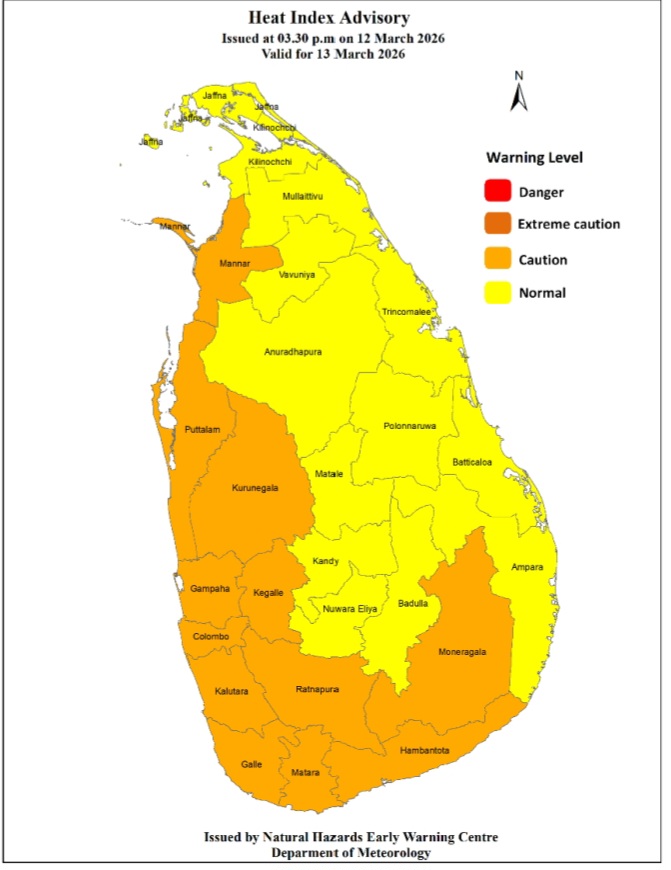
Warm Weather Advisory
Issued by the Natural Hazards Early Warning Centre of the Department of Meteorology at 3.30 p.m. on 12 March 2026, valid for 13 March 2026.
Heat index, the temperature felt on human body is likely to increase up to ‘Caution level’ at some places in Western, Sabaragamuwa, Southern and North-western provinces and in
Monaragala and Mannar districts.
The Heat Index Forecast is calculated by using relative humidity and maximum temperature and this is the condition that is felt on your body. This is not the forecast of maximum temperature. It is generated by the Department of Meteorology for the next day period and prepared by using global numerical weather prediction model data.

Effect of the heat index on human body is mentioned in the above table and it is prepared on
the advice of the Ministry of Health and Indigenous Medical Services.
ACTION REQUIRED
Job sites: Stay hydrated and takes breaks in the shade as often as possible.
Indoors: Check up on the elderly and the sick.
Vehicles: Never leave children unattended.
Outdoors: Limit strenuous outdoor activities, find shade and stay hydrated.
Dress: Wear lightweight and white or light-colored clothing.
Note:
In addition, please refer to advisories issued by the Disaster Preparedness & Response Division, Ministry of Health in this regard as well. For further clarifications please contact 011-7446491.

The Frontline Socialist Party (FSP) yesterday accused the government of trying to award another tender to the Indian company that supplied low-grade coal to the Norochcholai Power Plant and failed to deliver the stipulated amount of coal according to schedule.
The allegation was made by the Education Secretary of the Progressive Socialist Party, Pubudu Jayagoda, during media briefing at the party office in Nugegoda last afternoon.
Jayagoda said that in September 2025, the government had awarded a tender to the Indian company Trident Chemphar to supply 25 coal shipments for electricity generation in 2026.
In August 2025, it was confirmed that the coal delivered by the company was substandard. The company also failed to supply coal on schedule. Although the first shipment was expected in the second week of December 2025, it arrived at the end of the month. By mid-March, only 12 ships had arrived, and biweekly deliveries have been disrupted, putting Sri Lanka at risk of a severe energy shortage.
On 11 March, the government called a sudden spot tender for five coal shipments. Four companies submitted bids, and they include Trident Chemphar. FSP criticiced awarding the tender to the same discredited company, saying it was unethical and could trigger a major national crisis, as the company had failed to supply quality coal reliably in the past.
Previously, coal quality was strictly measured, with a “Reject Value”. But now to help the errant supplier the term of Reject Value has now been omitted altogether and replaced with a new term ‘Minimum Value’ setting it as the minimum calorific threshold—coal producing less than 5,900 kilocalories per kilogram was rejected, and coal with ash content above 16% was also discarded.
However, the government is now reportedly lowering these standards, accepting substandard coal, and changing tender specifications to accommodate the company.
Jayagoda castigated the latest stunt coming especially at a time when the world faces war and oil shortages. Diesel meant for electricity generation is being diverted to school buses, public transport, and emergency vehicles, leaving households at risk of prolonged blackouts. Even if diesel is imported, electricity tariffs could skyrocket.

The Indian Ministry of External Affairs has said it is considering requests for diesel supplies from neighbouring countries, including Sri Lanka, Bangladesh and the Maldives.
Speaking to the Press Trust of India, Ministry Spokesperson Randhir Jaiswal noted that India was a major exporter of refined petroleum products in the region. He confirmed that Bangladesh had formally requested a diesel supply, which is currently under review.
He said that diesel exports to Bangladesh had largely continued since 2017, but any new allocations would take into account India’s refining capacity, domestic demand, and overall fuel availability.
Jaiswal added that similar requests from Sri Lanka and the Maldives were also being considered, with India’s own energy requirements forming a key part of the decision-making process.

Heat Index likely to increase up to ‘Caution level’ at some places in the Western, Sabaragamuwa, Southern and North-western provinces and in Monaragala and Mannar districts

showers above 50 mm can be expected at some places in the Western and Sabaragamuwa provinces and in the Galle and Matara districts

Govt. bends rules, lowers coal standards in favour of errant company: FSP

Lanka requests diesel from India

Gas shortage pushes up electricity demand, night peak rises: CEB

Navy seizes narcotics haul, lethal weapons in two vessels, arrests 10 suspects

‘Dates have the highest sugar content to fight Coronavirus’

Sunday Island 27 December – Headlines

#SundayIsland 17th December – Headlines

Sunday Island – 28th March

Sunday Island Headlines – 21 March

Sunday Island – 21st February – Headlines
-

 News6 days ago
Peradeniya Uni issues alert over leopards in its premises
-

 News4 days ago
Repatriation of Iranian naval personnel Sri Lanka’s call: Washington
-

 News6 days ago
Wife raises alarm over Sallay’s detention under PTA
-

 News3 days ago
Prof. Dunusinghe warns Lanka at serious risk due to ME war
-
 Features4 days ago
Winds of Change:Geopolitics at the crossroads of South and Southeast Asia
-

 Latest News6 days ago
Heat Index at ‘Caution Level’ in the Sabaragamuwa province and, Colombo, Gampaha, Kurunegala, Anuradhapura, Vavuniya, Hambanthota and Monaragala districts
-

 Features6 days ago
The final voyage of the Iranian warship sunk by the US
-

 Sports2 days ago
Royal start favourites in historic Battle of the Blues