
Sports
Killer Whale Aquatics account for five national records


After a Covid-induced hiatus of two years, Killer Whale Aquatics, a pillar of absolute dominance in Sri Lankan swimming, faced their first defeat since 2015 at the recently concluded 2022 LC National and Junior National Aquatic Championships. This year’s champion in the Men’s category, the seasoned and well-experienced SL Army Aquatics, won the title by just 12 points, highlighting a hard-fought battle between the two teams which served as a call back to the days of intense rivalry between SL Navy Aquatics and KWA that spearheaded Sri Lankan swimming’s rapid growth in the early 2010s. This championship ended a seven-year reign with five consecutive national titles for KWA, and though they will certainly not be content in this loss, the outcome was not without its merits.
Due to a halt on Sri Lankan swimming’s regularly scheduled operations over the past two years, the team competing for KWA was remarkably young, comprised mostly of those with little to no experience at the senior national level. Getting back to a semblance of normalcy within the swimming community has been a painstakingly laborious process, but despite the extreme hardships faced by all athletes around the country over these past few years, the results of this year’s Long Course Nationals are nothing if not an encouraging sign of progress.
A total of five new national and junior national records were established by KWA. In the Men’s 800m Freestyle, Anusara Abeygunawardane, the current KWA Men’s Captain, bettered his own national record by nearly five seconds, finishing with an incredible time of 8:49.80. He also became the newest member of the ‘sub-2-minute-mark club’ in the 200m Freestyle, a feat which would have placed him in extremely rare air (or more pertinently put, rare water) less than ten years ago. Abeygunawardane is the unassuming product of KWA’s Long Term Athlete Development (LTAD) model; proving, yet again, that an investment of patience in the early stages of an athlete’s journey is crucial to one’s long-term success and will pay vast dividends as they grow older.
Adeetha Siriwardena, a young and prodigious member of KWA, broke two junior national records. One came in the Boy’s 50m Backstroke with a time of 29.23 seconds, erasing an eight-year-old record set by the current Sri Lankan national record holder, Akalanka Pieris, back in 2014. Adeetha’s other record was in the Boy’s 100m Backstroke, breaking Shevinda De Silva’s (St. Joseph’s College) six-year-old record by almost two seconds, finishing in a blistering time of 1:04.06. Subsequently, to honour his achievements, Adeetha was awarded a full athletic scholarship by his school, Wesley College Colombo, a gracious act that must be commended in this time of financial uncertainty.
Ramudi Samarakoon, a member of KWA since its inception in 2010, where she began her journey in KWA’s Learn-To-Swim Program, Swim America, broke Mineka Karunaratne’s 14-year-old record in the Women’s 100m Breaststroke by a very narrow margin, finishing with a time of 1:14.54. Samarakoon, former Women’s captain at KWA, has been one of Sri Lanka’s most consistently successful athletes in the pool since 2016. This was her first personal best time in over six years, a triumph over personal tribulations and a tale of both perseverance and determination. In quite an admirable effort, she also led the KWA women’s team to second place this year; a team of four young women, severely outnumbered and outgunned by the victors of this year’s women’s championship, Visakha Vidyalaya. In the 4x50m Medley Relay, Samarakoon led her teammates (Akithmi Wasalathanthri, Minuri Bartholamuse, and Anithra Johnpillai) to victory, breaking KWA’s fifth and final national record at this year’s LC Nationals, with a time of 2:10.24.
Aside from the unique success Anusara, Adeetha and Ramudi shared, the rest of the swimmers at KWA, whether representing school or club, capped off their season with almost all of them having recording best times in each of their events. That is both a testament to the fortitude of these swimmers, as well as a product of the hard work of the KWA coaching staff, headed by Manoj Abeysinghe. Under these trying circumstances, the performances of these athletes are noteworthy. One can only look to the future and wonder what else these young champions have in store.



Sri Lanka Cricket (SLC) has appointed former Australian cricketer Jamie Siddons as the new head coach of the the women’s team. Siddons, a Level 3 qualified coach, will officially begin his one-year tenure on March 16, 2026.
Siddons takes over from outgoing coach Rumesh Ratnayake, who had quietly concluded his tenure at the end of 2025. And he will be building on some solid foundations.
Appointed in February 2023, Ratnayake oversaw the transformation of the women’s team from bottom-of-the-table scrappers to a regularly competitive force.
While they remain a notch below top tier sides such as Australia and India in terms of consistency, under his guidance, Sri Lanka secured their best-ever return – a historic Asia Cup title in 2024, defeating India in the final.
The inconsistency of the side however was on display throughout his term, as the team struggled at the 2024 T20 World Cup, exiting in the group stage without a win. And despite other highs, including series wins against South Africa and England, the side seemed to have plateaud following a middling home 50-over home World Cup in October.
Siddons however will be taking over a youthful side in the midst of a good run of form, with them this month completing ODI and T20I series wins against West Indies.
His immediate focus will be preparing the squad for the Women’s T20 World Cup set to be held in England this June. His first official assignment is a tour of Bangladesh in April-May.
He brings over two decades of high-level coaching experience to the role, most notably serving as the head coach of the Bangladesh men’s side from 2007-2011, where he lead them to their first overseas Test series win against West Indies.
“Siddons has also served as Head Coach of the South Australia Cricket Team (Redbacks) from 2015 to 2020 and Head Coach of the Wellington Firebirds, New Zealand, from 2011 to 2015,” added an SLC media release.
In his playing career Siddons was a prolific run-scorer in Australian domestic cricket, captaining both South Australia and Victoria, finishing his career with over 10,000 Sheffield Shield runs.
(Cricinfo)
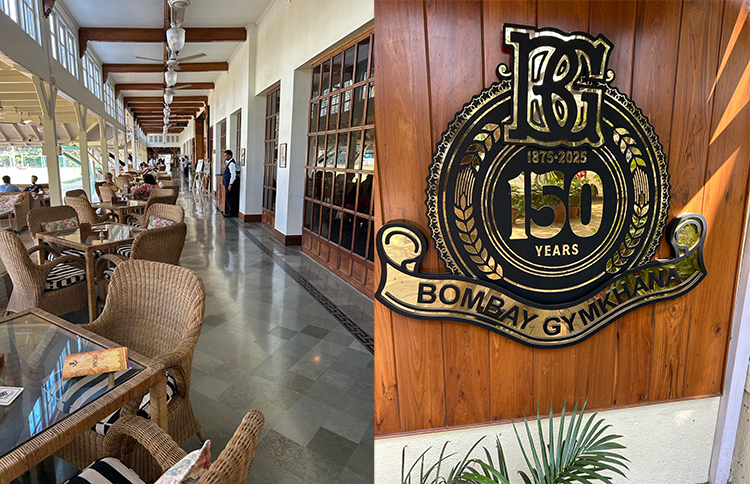
Bombay cannot quite match Colombo when it comes to Test venues. Colombo boasts four Test grounds, while Bombay has three. India’s first ever Test match in 1933 was staged at the historic Bombay Gymkhana, but international cricket soon shifted down the road to the Cricket Club of India, a stone’s throw away, before finally settling along the sweeping Marine Drive at the Wankhede Stadium, which now hosts all men’s international fixtures. Gymkhana and the CCI, meanwhile, play host largely to women’s internationals and domestic cricket.
All three venues are top-notch facilities and there is plenty Sri Lankan clubs could learn from these Indian institutions. Our clubs carry rich traditions and colourful histories, but when it comes to member comfort and modern amenities, there is room to raise the bar.
Bombay Gymkhana, established in 1875, celebrated its 150th anniversary last year and the ground is steeped in history. In its early days it was a club reserved strictly for Europeans, with locals permitted only as workers. That rule had to be bent for India’s inaugural Test in 1933 so that Indian cricketers could walk through its gates. The policy was finally scrapped in 1947 following India’s independence.
Today, membership at the Gymkhana does not come cheap. The entry fee is eye-watering, and corporate entities rather than individuals are the ones who can comfortably afford it.
The club offers a smorgasbord of sporting activities, cricket and rugby among them, although India has yet to make serious strides in the latter. Indoor pursuits such as badminton and table tennis are also available, while those who prefer a quieter afternoon can retreat to rooms dedicated to card games. The billiards and snooker room, immaculately maintained with more than a dozen tables, remains one of the club’s prized attractions. There was a time when Sri Lanka’s own M.J.M. Lafir held court here, the cynosure of all eyes with cue in hand.
For book lovers there is a splendid library and for those who fancy forty winks there is even a siesta room. Several bars and coffee shops dot the premises, while a mini-supermarket caters to members’ daily needs. A well-stocked wine store sells both local and foreign beer and spirits at reasonable prices.
The food, of course, is a feast for the senses, an impressive spread of vegetarian and non-vegetarian dishes that would make even the most seasoned diner loosen the belt a notch.
It is remarkable that such facilities exist right in the heart of the city. That people had the foresight a century and a half ago to set aside acres of prime land purely for recreation speaks volumes of the wisdom of those who were calling the shots.
Bombay as a city too has come on in leaps and bounds over the last two decades. New highways have sprung up, including one that cuts across the sea. An underground tunnel emerges just a stone’s throw away from Wankhede Stadium, easing what was once nightmarish traffic. The metro network now connects most key parts of the city and continues to expand.
For a metropolis that never stops moving, Bombay’s infrastructure push deserves a tip of the cap.
Rex Clementine in Bombay

Royal fought back on the back of a valuable five wicket haul by Himaru Deshan to earn first innings points against Richmond in the Under 19 Division I Tier ‘A’ match at Reid Avenue on Thursday.
In their second essay, the home team posted 209 for one wicket at close with Rehan Peiris producing an unbeaten century.
Rehan and Hirun Liyanarachchi added 163 runs for the first wicket.
Rehan’s unbeaten 102 runs came in 112 balls and it included ten fours and a six.
Hirun’s aggressive knock of 75 runs was scored in 76 balls. He scored 12 fours and a six.
Earler on Richmond struggled to post 204 in reply to Royal’s 254 runs. Open batsman Risinu Rupasinghe (62) was the top scorer, while Ameesha Rasanjana and Tenusha Nimsara made 20s.
For Royal, Mihiru Kodituwakku (2/22) and Dushen Udawela (3/36) were the other two bowlers to take wickets.

Cost to US for war on Iran is $3.7bn in first 100 hours, says think tank

More than 120 killed in Israel’s Lebanon attacks as Beirut, south, east hit

Hungary confirms it is holding seven Ukrainian bank workers and $80m

US and Venezuela agree to resume diplomatic ties after Maduro capture

Jamie Siddons appointed Sri Lanka Women head coach

Showers or thundershowers are likely at a few places in the Southern province and in Rathnapura, and Kaluthara districts during evening or night.

‘Dates have the highest sugar content to fight Coronavirus’

Sunday Island 27 December – Headlines

#SundayIsland 17th December – Headlines

Sunday Island – 28th March

Sunday Island Headlines – 21 March

Sunday Island – 21st February – Headlines
-
 Features4 days ago
Brilliant Navy officer no more
-

 Opinion4 days ago
Sri Lanka – world’s worst facilities for cricket fans
-

 Features4 days ago
A life in colour and song: Rajika Gamage’s new bird guide captures Sri Lanka’s avian soul
-

 Business2 days ago
Cabinet nod for the removal of Cess tax imposed on imported good
-

 Features5 days ago
Overseas visits to drum up foreign assistance for Sri Lanka
-
 Features5 days ago
Sri Lanka to Host First-Ever World Congress on Snakes in Landmark Scientific Milestone
-

 News1 day ago
Legal experts decry move to demolish STC dining hall
-

 Latest News2 days ago
Around 140 people missing after Iranian navy ship sinks off coast of Sri Lanka