
News
Karu J. warns AKD of obstacles and challenges


…stresses importance of adhering to IMF programme
By Shamindra Ferdinando
Former Speaker Karu Jayasuriya has warned President Anura Kumara Dissanayake that he should be mindful of the fact that the number of voters opposed to him at the recently concluded Presidential Election was very much higher than the number of people who exercised their franchise in support of his party Jathika Jana Balawegaya (JJB)/National People’s Power (NPP).
One-time UNP Deputy Leader Jayasuriya who served as the Speaker, from Sept. 2015 to August 2020, issued the warning in an interview with Thushal Vithanage, carried in the Sept. 29th edition of Annidda.
Jayasuriya, in his present capacity as Chairman, National Movement for Social Justice (NMSJ), emphasized that Dissanayake couldn’t obtain 50%+1 vote of the valid vote, even after the second count.
Dissanayake polled over 5.7 mn votes whereas Wickremesinghe polled more than 2.2 mn, Sajith Premadasa over 4.4 mn and Namal Rajapaksa over 340,000, and, collectively, they secured more than the winner.
Acknowledging that Dissanayake and his team had earned the faith of the public in the run-up to the Sept. 21 Presidential Election, Jayasuriya underscored the importance of addressing debt restructuring. Jayasuriya, who had been with the UNP, as well as the SLFP-led UPFA, said that the post-Aragalaya economic recovery process could suffer irreparable damage in case of a change in the direction of the Finance Ministry and the Central Bank. Jayasuriya stressed the pivotal importance of the Governor of the Central Bank, Dr. Nandalal Weerasinghe, and Finance Secretary Mahinda Siriwardena continued their role in the process.
Responding to another query, the ex-parliamentarian asserted that the failure on the part of the Wickremesinghe-Rajapaksa government to take tangible measures against waste, corruption, irregularities and mismanagement, even after Aragalaya forced Gotabaya Rajapaksa out of office, in July 2022, influenced the electorate. Declaring that the growing public sentiment against the established order greatly contributed to Dissanayake’s unprecedented victory, Jayasuriya found fault with the then President Wickremesinghe and his Justice Minister Dr. Wijeyadasa Rajapakshe, PC, for failing to implement the anti-corruption law, enacted during their time.
Jayasuriya said that the public expected Dissanayake to go all-out against corruption. Commending Dissanayake for conducting a simple swearing in ceremony, thereby saving taxpayers’ money, Jayasuriya said that the vast majority hated extravagant lifestyles of people’s representatives. Jayasuriya said that as a member of Parliament Dissanayake never sought police protection. However, during the presidential campaign Dissanayake received heavy police guard, including the elite Special Task Force (STF).
Referring to efforts made by the NMSJ to improve relations between the North and the South and the Global Tamil Forum (GTF)-led bid to promote post-war national reconciliation, the ex-Speaker said the new administration should address public grievances expeditiously. Jayasuriya discussed some of the NMSJ proposals that dealt with education, with the focus on the need to allocate 30% of total school admissions to children who weren’t followers of the majority community in any particular school. Jayasuriya emphasized the urgent need for far reaching reforms in the education sector.
Jayasuriya also dealt with some of the contentious issues that had contributed to the collapse of the national economy and the declaration of bankruptcy status in April 2022.
The one-time private sector CEO identified the top heavy public sector as one of the major culprits. Jayasuriya questioned the need to maintain, what he called, the world’s largest public service in terms of availability of public servants for respective populations. “We have a public servant for 14 people whereas the accepted ratio is one public servant for 250 people,” Jayasuriya said, while expressing concern over the inefficient public sector, granted with so many holidays. The ex-Speaker pointed out that public servants have to work for a maximum of 180-190 days annually.
He asserted that the Army was too big for Sri Lanka’s requirements, hence a burden.
Without admitting his own failure as a former Speaker, Jayasuriya attacked Parliament, alleging that the House neglected one of its primary responsibilities. Pointing out that the failure on the part of Parliament to issue policy directives by enactment of laws and ensure financial discipline contributed to the overall deterioration, Jayasuriya said that the country couldn’t overcome the continuing crisis by side-stepping overwhelming challenges.
The one-time Sri Lankan Ambassador to Germany, after he retired from the Mercantile sector, emphasized the need to follow the strategies adopted by the previous government in response to the economic-political-social crisis. The former Minister said that the Parliament should change its attitude towards the challenges faced by the people.
Urging the electorate to choose suitable people as MPs at the forthcoming parliamentary election, Jayasuriya said that those who spearheaded Aragalaya should launch political careers by first contesting Local Government polls, then Provincial Councils before seeking the opportunity to serve people as MPs.
Jayasuriya also called for significant increase in women’s representation in Parliament. Commenting on the often repeated public declarations that the Parliament, consisting of 225 members, should be held accountable for the developing crisis, Jayasuriya said that leaders of political parties and the electorate should ensure the people were served by responsible lawmakers. Jayasuriya said that he expected political parties and the electorate to ensure a responsible Parliament at the forthcoming parliamentary election.
Jayasuriya reiterated the need for a modified electoral system and a new Constitution. According to him, the new Constitution-making process, undertaken by the Yahapalana government, could have succeeded if not for one group representing Parliament claiming a government bid to divide the country on ethnic lines. Jayasuriya said that for want of consensus political parties, due to petty reasons, sabotaged the effort made by President Chandrika Bandaranaike Kumaratunga to introduce a new Constitution in 2000.
The ex-lawmaker pointed out how the country suffered due to various political parties pursuing different agendas. The enactment of the 18th Amendment at the expense of the 17th Amendment was cited as a glaring example of reversing policy direction of a previous government. Jayasuriya said that though they brought 19th Amendment as a remedy, Gotabaya Rajapaksa’s government again reversed the situation by enacting the 20th Amendment to the Constitution, Jayasuriya said.

Latest News
Heat Index at Caution level’ in the Northern, North-central, North-western, Western and Southern provinces and in Trincomalee district.


Warm Weather Advisory
Issued by the Natural Hazards Early Warning Centre
Issued at 3.30 p.m. on 12 April 2026, valid for 13 April 2026.
Heat index, the temperature felt on human body is likely to increase up to ‘Caution level’ at some places in the Northern, North-central, North-western, Western and Southern provinces and in Trincomalee district.
The Heat Index Forecast is calculated by using relative humidity and maximum temperature and this is the condition that is felt on your body. This is not the forecast of maximum temperature. It is generated by the Department of Meteorology for the next day period and prepared by using global numerical weather prediction model data.

Effect of the heat index on human body is mentioned in the above table and it is prepared on the advice of the Ministry of Health and Indigenous Medical Services.
ACTION REQUIRED
Job sites: Stay hydrated and takes breaks in the shade as often as possible.
Indoors: Check up on the elderly and the sick.
Vehicles: Never leave children unattended.
Outdoors: Limit strenuous outdoor activities, find shade and stay hydrated.
Dress: Wear lightweight and white or light-colored clothing.
Note:
In addition, please refer to advisories issued by the Disaster Preparedness & Response Division, Ministry of Health in this regard as well. For further clarifications please contact 011-7446491.

On the apparent northward relative motion of the sun, it is going to be directly over the latitudes of Sri Lanka from 05th to 15th of April in this year.
The nearest areas of Sri Lanka over which the sun is overhead today (13th) are Pesalai, Mankulam and Nedunkerny about 12:11 noon.
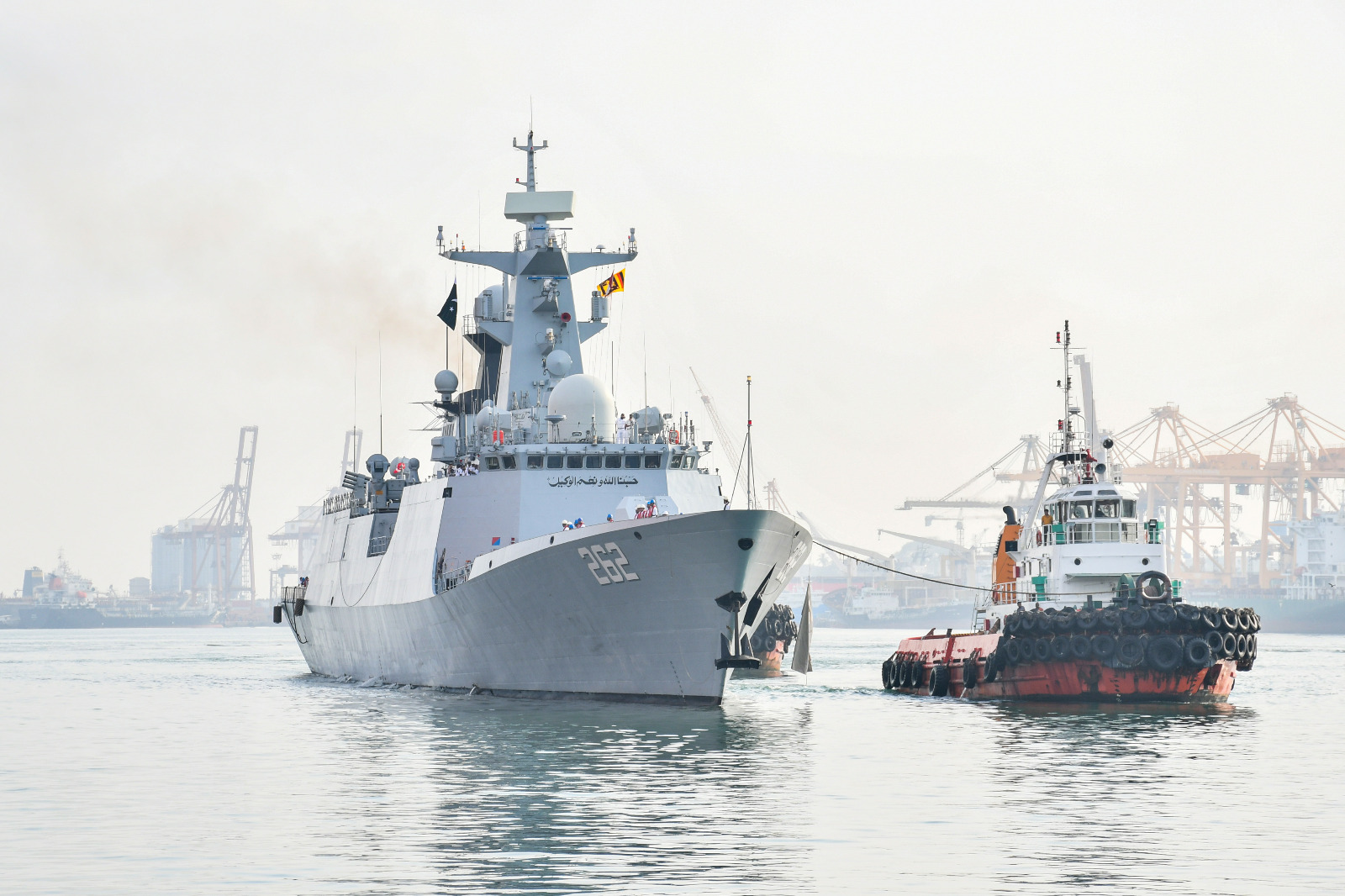
The Pakistan Navy Ship (PNS) TAIMUR and ASLAT arrived at the Port of Colombo on a goodwill visit on 12 Apr 26.
The visiting ships were welcomed by the Sri Lanka Navy in
compliance with naval traditions.
The duo of ships is commanded by Captain NIAMAT SAEED KHAN (PNS TAIMUR) and Captain NADIR MATEEN AFRIDI (PNS ASLAT).
Meanwhile, the ships are expected to conduct a Bilateral Naval Exercise LION STAR V with the Sri Lanka Navy in Colombo seas.

Salt and Patidar power RCB past Mumbai Indians

Prasidh, Buttler set up comfortable win for Gujarat Titans

Heat Index at Caution level’ in the Northern, North-central, North-western, Western and Southern provinces and in Trincomalee district.

Showers above 75 mm are likely at some places in the Western, Sabaragamuwa, Central, Southern and North-western provinces.

Sun directly overhead Pesalai, Mankulam and Nedunkerny about 12:11 noon

PNS TAIMUR & ASLAT arrive in Colombo

‘Dates have the highest sugar content to fight Coronavirus’

Sunday Island 27 December – Headlines

#SundayIsland 17th December – Headlines

Sunday Island – 28th March

Sunday Island Headlines – 21 March

Sunday Island – 21st February – Headlines
-

 News6 days ago
Lankan-origin actress Subashini found dead in India
-

 News1 day ago
CEB orders temporary shutdown of large rooftop solar systems
-

 News4 days ago
AG: Coal procurement full of irregularities
-

 Business3 days ago
Israeli attack on Lebanon triggers local stock market volatility
-

 Business4 days ago
Hayleys Mobility introduces Premium OMODA C9 PHEV
-

 Business3 days ago
HNB Assurance marks 25 years with strategic transformation to ‘HNB Life’
-

 News6 days ago
UN Regional Director launches SL’s first Country Gender Equality Profile during official visit
-

 News6 days ago
Dialog Launches ‘GanuDenu QR’, Making Cashless Transfers Free for All with eZ Cash and Dialog Finance