
News
Karu blames weak governance for economic crisis

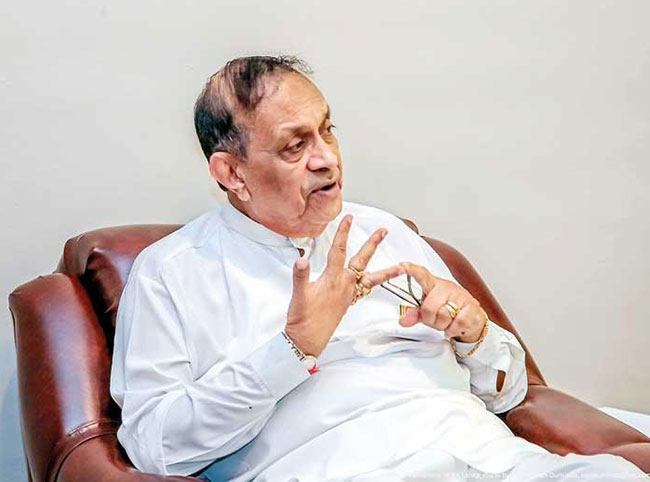
Weak governance, the polticisation of the public service and their ill-effects had led to an economic crisis, Chairman of the National Movement for Social Justice (NMSJ) and former Speaker Karu Jayasuriya says.
Jayasuriya said yesterday that competent administrative officers had been sidelined and retired military officers appointed to top positions in the state service. Excerpts of his statement:
“This is why government decisions are constantly changing. Public administration requires experience,” Jayasuriya said.
“We listened to the address by the President on the country’s Independence Day with great interest. I wish him the strength to fulfil his promises to the country. Even though the current plight of the people, especially that of the farmers has been raised before, it is imperative to once again remind that it is the duty of the President to address these issues and provide solutions to their woes. We must accept that the people are suffering and acknowledge their pain and anger.
“We believe weak Governance, a politicized public service and its ensuing collapse has led to this economic crisis faced by the country today. One key reason identified is the decision to disregard talented administrative officers and appointed retired military officers Instead. It is for this reason that government decisions are constantly changing and then reversed. Administration requires experience.
“The government must acknowledge that the 20th Amendment and the two-thirds majority no longer benefit the people. The government must correct these shortcomings. Even though this year’s Independence Day celebration was held with great pomp and pageantry, it was evident that public interest in the event was lacking. This must be taken as a message from the people to the government.
The Forex Crisis
“The hit taken by the foreign exchange reserves was also the result of administrative failures. Local and foreign economists say this has been caused by large scale corruption in the country, lack of a long term plan and large scale looting of assets. This is more commonly known as Plundering National Wealth.
“If the Bribery Commission had sprung into action and law enforcement officials took the necessary steps this day light robbery could have been averted. However, the Bribery Commission is withdrawing certain cases filed against powerful people.
The Prevention of Terrorism Act
“Currently there is an ongoing discussion on the possible amendment of the PTA. The international community has continuously voiced their dissent at the gross misuse of the PTA in Sri Lanka while the UN Human Rights Council has also mentioned this on various occasions. In Sri Lanka, this act is used to take revenge on opponents. Many similar cases have been reported to us.
“We appreciate the steps taken to change this Act after 43 years and we feel that it would be more appropriate to bring in the most appropriate legislation or to make the necessary amendments to suit the developing world, as seen in the world’s democracies. We believe a broader discussion on the issue will be fruitful. It also must be noted that certain proposed amendments may be taken into consideration at the upcoming UNHRC sessions in Geneva.
Levying of taxes on the EPF
“A significant number of Sri Lankans not serving in the public service are members of the EPF. Their only hope is to use the fund to either build a home, fund their children’s education or spend on their child’s marriage at the end of their retirement.
“Therefore, it is the view of the National Movement for Social Justice that the attempt to steal from the Employees’ Provident Fund, the only asset of helpless workers, is an inhumane act. We know of many instances where certain powerful individuals have used this fund to make money in the stock market. There are many instances where millionaires were born out of the money of these helpless people. Therefore, we request the government to refrain from imposing a tax on the EPF.
The ‘One Country, One Law’
policy and granting a pardon to Ranjan Ramanayake
“The people of this country had hoped MP Ranjan Ramanayake would receive a Presidential pardon on Independence Day. We are saddened that it was not to be. As crime bosses, drug dealers and murderers are set free while a popular artistes such as Rajan Ramanayake continues to languish in prison, it is evident that the government’s so-called ‘One Country, One Law’ policy is not a reality in Sri Lanka.
“I hope that the authorities will pay attention to these facts we have raised today in good faith for the betterment of the country and the people.”

Latest News
Heat Index at Caution level’ in the Northern, North-central, North-western, Western and Southern provinces and in Trincomalee district.


Warm Weather Advisory
Issued by the Natural Hazards Early Warning Centre
Issued at 3.30 p.m. on 12 April 2026, valid for 13 April 2026.
Heat index, the temperature felt on human body is likely to increase up to ‘Caution level’ at some places in the Northern, North-central, North-western, Western and Southern provinces and in Trincomalee district.
The Heat Index Forecast is calculated by using relative humidity and maximum temperature and this is the condition that is felt on your body. This is not the forecast of maximum temperature. It is generated by the Department of Meteorology for the next day period and prepared by using global numerical weather prediction model data.

Effect of the heat index on human body is mentioned in the above table and it is prepared on the advice of the Ministry of Health and Indigenous Medical Services.
ACTION REQUIRED
Job sites: Stay hydrated and takes breaks in the shade as often as possible.
Indoors: Check up on the elderly and the sick.
Vehicles: Never leave children unattended.
Outdoors: Limit strenuous outdoor activities, find shade and stay hydrated.
Dress: Wear lightweight and white or light-colored clothing.
Note:
In addition, please refer to advisories issued by the Disaster Preparedness & Response Division, Ministry of Health in this regard as well. For further clarifications please contact 011-7446491.

On the apparent northward relative motion of the sun, it is going to be directly over the latitudes of Sri Lanka from 05th to 15th of April in this year.
The nearest areas of Sri Lanka over which the sun is overhead today (13th) are Pesalai, Mankulam and Nedunkerny about 12:11 noon.
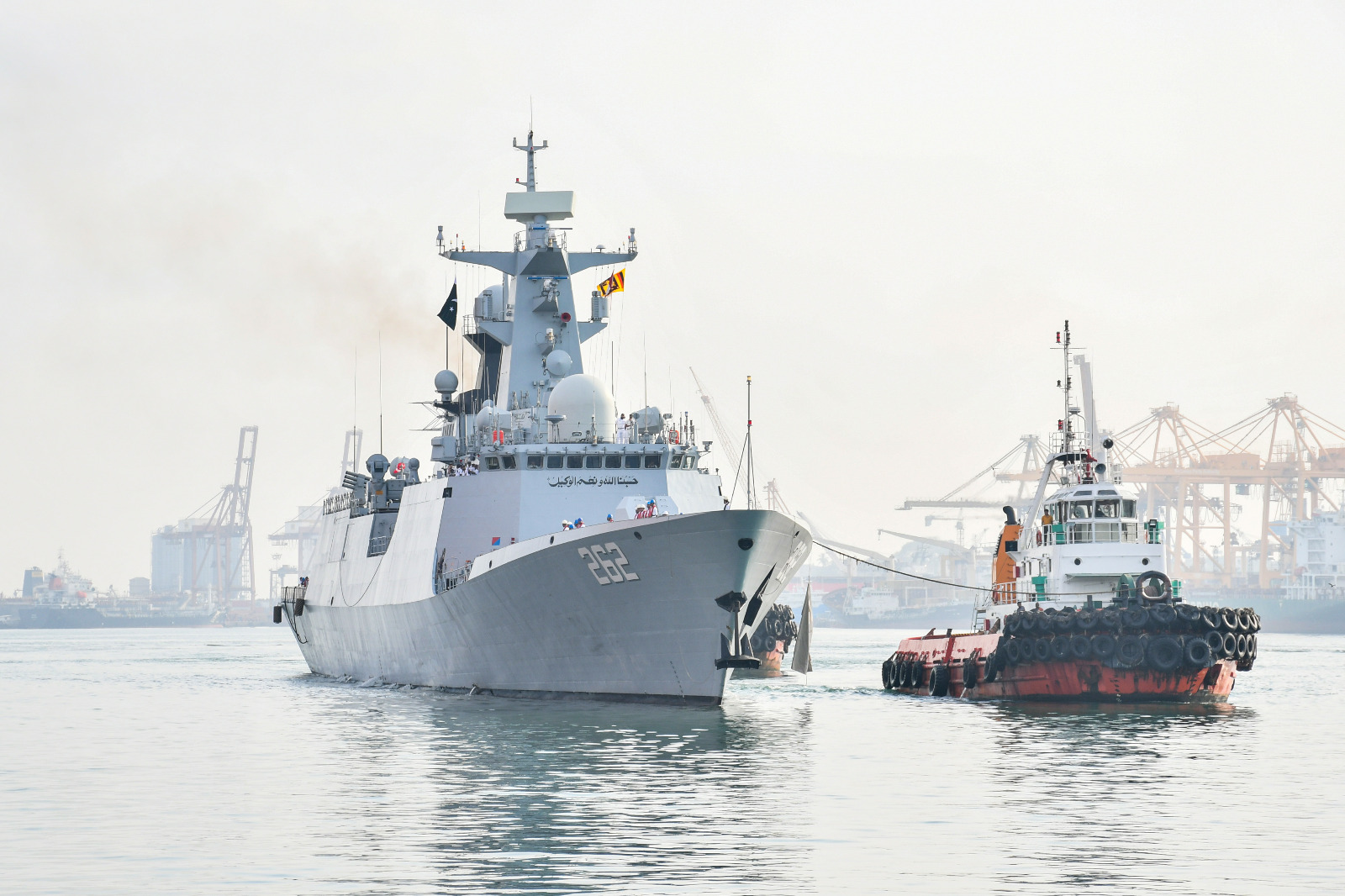
The Pakistan Navy Ship (PNS) TAIMUR and ASLAT arrived at the Port of Colombo on a goodwill visit on 12 Apr 26.
The visiting ships were welcomed by the Sri Lanka Navy in
compliance with naval traditions.
The duo of ships is commanded by Captain NIAMAT SAEED KHAN (PNS TAIMUR) and Captain NADIR MATEEN AFRIDI (PNS ASLAT).
Meanwhile, the ships are expected to conduct a Bilateral Naval Exercise LION STAR V with the Sri Lanka Navy in Colombo seas.

Salt and Patidar power RCB past Mumbai Indians

Prasidh, Buttler set up comfortable win for Gujarat Titans

Heat Index at Caution level’ in the Northern, North-central, North-western, Western and Southern provinces and in Trincomalee district.

Showers above 75 mm are likely at some places in the Western, Sabaragamuwa, Central, Southern and North-western provinces.

Sun directly overhead Pesalai, Mankulam and Nedunkerny about 12:11 noon

PNS TAIMUR & ASLAT arrive in Colombo

‘Dates have the highest sugar content to fight Coronavirus’

Sunday Island 27 December – Headlines

#SundayIsland 17th December – Headlines

Sunday Island – 28th March

Sunday Island Headlines – 21 March

Sunday Island – 21st February – Headlines
-

 News2 days ago
CEB orders temporary shutdown of large rooftop solar systems
-

 News7 days ago
Lankan-origin actress Subashini found dead in India
-

 News5 days ago
AG: Coal procurement full of irregularities
-

 Business4 days ago
Israeli attack on Lebanon triggers local stock market volatility
-

 Business5 days ago
Hayleys Mobility introduces Premium OMODA C9 PHEV
-

 News7 days ago
UN Regional Director launches SL’s first Country Gender Equality Profile during official visit
-

 News7 days ago
Dialog Launches ‘GanuDenu QR’, Making Cashless Transfers Free for All with eZ Cash and Dialog Finance
-

 Business4 days ago
HNB Assurance marks 25 years with strategic transformation to ‘HNB Life’