
Sports
Kandy down a fighting CR team to win Clifford Cup at rugby

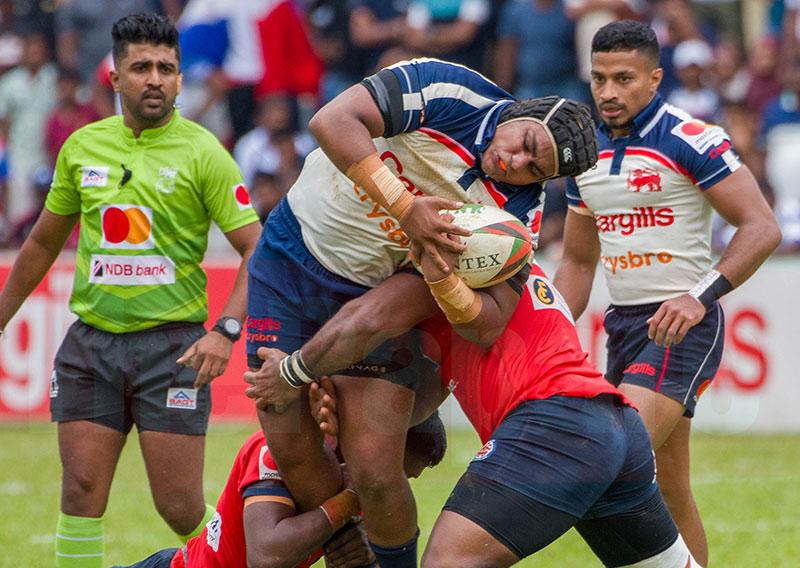
Kandy Sports Club survived some anxious moments against a fighting CR&FC outfit before winning the Clifford Cup final with a 41 points to 33 win in the decider which was worked off at Nittawela grounds in Kandy on Sunday (yesterday).
Kandy SC played attacking rugby in both halves of the game and scored five tries, five conversions and a penalty, but CR were hot on the heels of the Kandy side and responded with five tries and four conversions. Kandy led 17-14 at half time.
The game began with a bang with Kandy SC scoring early in the game with a try by Diluksha Dange and a penalty and conversion by Nigel Ratwatte. But that lead for Kandy was short lived because CR’s Chamod Muthunayake sliced through the Kandy defence with a jinxing run and ended up under the posts. Murshid Doray’s conversion coming right gave indications that it would be a long day for Kandy.
CR pressed with their forwards and earned a try through Omalka Guneratne. But Kandy were in no surrendering mood and snatched the lead back with a peach of a try by Ratwatte, who retired from rugby on Sunday after playing his final game.
Kandy kept rolling with their forwards and earned their third try after half time when Kenula Hettiarachchi went over off a forwards rush. Ratwatte’s conversion put the winners ahead by ten points with the scores reading Kandy 24 as against CR’s14.
CR hit back strongly at this stage of the game and produced two vital tries through Omalka Guneratne and Murshid Doray and saw that their team was only trailing Kandy by a point. It was at this stage that the game got a bit out of hand in the middle, but referee Gihan Yatawara steadied proceedings by offering two yellow cards to CR and one to Kandy. The referee was clearly heard barking out orders to both sides to maintain discipline.
Kandy’s replacement player Dilshad Fareed smashed his way to a try with the game eight minutes away from full time. Zumry made a classis touchline conversion. But CR made one last gasp attempt to wrestle control of the game with a try by Manika Ruberu. Doray added the extra points and gave some hope for CR who were now just point behind Kandy. But when it seemed like everyone was struggling to produce the next try, scrum half Heshan Jansen ran through the CR defence to score close to the posts and seal the game for Kandy.
By A Special Sports Correspondent



Former fast bowler Pramodya Wickremasinghe will head Sri Lanka’s new national selection committee, which picks both men’s and women’s senior squads. Also in the committee are former cricketers Vinothan John, Indika de Saram, Rasanjali de Alwis and Tharanga Paranavithana.
While the committee headed by Upul Tharanga is now defunct, there is some continuity for this fresh committee, with Paranavitana and de Saram also having served under Tharanga. Wickramasinghe has been chief selector before – between 2021 and 2023 – with Sri Lanka men’s poor performance in the 2023 World Cup prompting his removal. He was also part of a selection committee headed by Sanath Jayasuriya – now head coach – between 2013 and 2015.
The change in selectors was announced by Sri Lanka’s sports ministry. SLC chief executive Ashley de Silva said the board had been involved in the process. Sri Lanka’s Sports Law dictates that such appointments go through the sports ministry.
“Sri Lanka Cricket sends a list of about ten names to the ministry, and they have chosen from that,” de Silva told ESPNcricinfo. “There is no term as such. The appointment is until further notice.”
De Silva also said that the Tharanga-led committee had simply come to the end of its term. Internally, there had been no push towards extending their term until the end of the men’s T20 World Cup in February and March. In fact, it had been a little over three weeks ago that Tharanga suggested captain Charith Asalanka may be replaced in the coming weeks. That decision now passes to the new committee, whose first major assignment will be to select the World Cup squad.
All five members of this new committee have represented Sri Lanka at the highest level. Both Paranavitana and de Saram played domestic cricket into this decade. John is the oldest selector among them, having played his last match for Sri Lanka in 1987.
[Cricinfo]


Astonishingly, this Ashes series is just seven days old, but it remains in no mood to slow down and take stock of its surroundings. This opening day at Adelaide Oval was, in its own way, every bit as chaotic as the six that had gone before it. By its close, a cricket-record crowd of 56,298 was none the wiser as to whether England were in the process of clawing themselves back from the brink in this series, or whether Alex Carey’s brilliant maiden Ashes hundred had already pitched them most of the way through the exit.
Arguably, the day’s only moment of stillness came in the minutes before the first ball was bowled, when the teams and crowd united in a pitch-perfect tribute to the victims of the Bondi terror atrocity. Either side of that serene moment, it was turmoil – starting with Steven Smith’s shock withdrawal, 45 minutes before the toss, due to vertigo, a moment which, in turn, granted Usman Khawaja a reprieve, not only for this contest, but arguably his Test career.
The madness continued through an opening gambit in which England’s bowlers threatened to lose the plot on a sweltering morning in the field – only for Australia to hand it straight back to them with a run of five culpable dismissals in a row, and six out of eight all told. The most damning of these were the two wickets in three balls, immediately after the lunch break, with which Joffra Archer ignited England’s revival as part of a very personal response to the criticism he had attracted in the wake of the Brisbane loss.
As if that was not sufficient, there was also space in the narrative for Khawaja’s career prospects to turn on a dime, thanks to a drop at slip from Harry Brook on 5 that persuaded him to shed the reticence and feast on numerous freebies from a toiling but deeply flawed attack. And in the final session, another DRS drama also reared its head, with Carey’s reprieve for a caught-behind on 72 subsequently declared by Simon Taufel, the former ICC umpire, to be another failure of “technology calibration”. Carey himself conceded at the close that he thought he’d heard a nick.
The upshot was another Ashes day conducted at warp speed. That Australia’s run-rate ended up shy of 4 an over was due entirely to the hard-lined discipline, and intermittent raw speed, of Archer, whose 3 for 29 in 16 overs made him as much of a lone wolf in England’s attack as Mitchell Starc had been for Australia in each of his first innings at Perth and Brisbane.
And in the same way that Starc’s superiority had drawn nervy errors from England’s batters in those games, so Australia were the team that frittered away a chance for a choke-hold on this contest, and potentially the series.
Only once this century had the hosts scored less than 439 after winning the toss and batting first at Adelaide – and that innings of 245 had come in England’s epochal victory on their triumphant tour in 2010-11. With that nemesis Starc still in situ at the close on 29 not out, it’s not out of the question that he’ll be able to marshal the tail on the second morning, as he did so effectively at the Gabba. But against a three-over-old ball, and against an England team who are in the process of showing their “dog”, flawed and feral though it may be, it ought to be over to England’s batters soon enough, to show if they’ve heeded any lessons from their frivolity to date.
Despite all the apparent hard talk since Brisbane, the opening exchanges gave the impression that certain members of England’s attack were still living it up in their beach bar in Noosa. Brydon Carse, promoted to the new ball in the absence of Gus Atkinson, started with real purpose … for all of five balls, before sacrificing his threatening seam and swing for a diet of half-trackers that Jake Weatherald in particular was delighted to cash in on.
It took a barely acknowledged moment of brilliance to blast England their opening. Archer – conspicuously missing his trademark gold chain after the ad hominem attacks he had received for wearing it – ground his way through his gears to draw Weatherald onto the front foot before scorching a 147kph bouncer into his splice. Jamie Smith gathered the top edge with barely a flicker – conscious perhaps of his culpable drop of Travis Head at a similar moment in the second Test. At 33 for 1, England were in the mix.
Moments later, they were surging at 33 for 2, courtesy of a stunning one-hander from Zak Crawley, as Head slammed a hard-handed drive low to his left at short cover, to give Carse’s tempestuous day a kick-start.
Out came Khawaja, still blinking at the absurdity of his circumstances. However, as he ground out five runs from his first 27 balls, it initially seemed that obsolescence would have been the kinder fate for a player who is due to turn 39 midway through this contest. But then, he lashed into a drive as Josh Tongue fired in a full length, and Brook at second slip made a meal of a tough but takeable chance, away to his left.
It was the pardon that freed Khawaja of his reticence. His very next ball was pinged off the pads through square leg for four – the first of five boundaries in that region, and eight behind square all told – and as he romped along to an 81-ball fifty, England’s basic lack of discipline was being laid all too bare.
But then, so too was Australia’s. Honours were broadly even when the teams went to lunch on 94 for 2, but what followed would have beggared belief, had it not been for England’s own batting opting for similar self-immolation all series long. Archer’s first ball after the break was little more than a loosener, but Marnus Labuschagne met it with a floppy, half-formed pull that Carse at midwicket could not have dropped if he’d tried – and seeing as he’d missed a similar sitter off Josh Inglis at Brisbane, he did have previous in that regard.
As if that wasn’t enough of a gift, out came Australia’s golden child, Cameron Green, fresh from his whopping Aus$4 million deal with Kolkata Knight Riders. The only mercy for Green was that the IPL auction had taken place the previous evening. His second ball produced a nondescript push off the pads to midwicket, where Carse clung on again, rather more fortuitously this time, as the ball clanged off his right palm and into his left as he dived across to his right.
Carey, at least, remained in the zone that he has graced throughout a superb series. Right from the outset of his innings, it was clear that his timing was exquisite, even on the shots that thumped into England’s ring of cover fielders. As he and Khawaja built into a fifth-wicket stand of 91, normal service for a first innings at Adelaide was being restored – not least when England’s spinner Will Jacks entered the attack for some of the leakiest, most optimistic offspin ever to be described as a frontline option.
Though he found some purchase, which Nathan Lyon will doubtless have observed with interest, Jacks was scarcely able to land two balls in a row on the same length as his initial overs were milked at more than an run a ball. And yet, no sooner had he served up his best ball of the day, a dipping ripper that turned sharply past Khawaja’s edge, than he had delivered the afternoon’s key breakthrough. Khawaja climbed into a slog-sweep to re-establish his dominance, and picked out Tongue at deep midwicket who held on well to a fast, flat chance.
Inglis kept the runs coming, with judicious use of the reverse sweep, as he and Carey built into the evening session. But Tongue burst through his defences for 32 for arguably the day’s first dismissal that was not predominantly batter-error, before Carse claimed his second, courtesy of a lifter into Pat Cummins’ ribs that Ollie Pope collected at short leg.
That decision was upheld by DRS, unlike Carey’s earlier in the afternoon – an under-edged pull off Tongue on 72, that Ahsan Raza decreed had missed the bat, and which Snicko could not confirm despite England’s adamance, and Carey’s own apparent guilt. It was a continuation of one of the subplots of the series, though the life did enable one of the most poignant moments of the day – Carey’s century and subsequent tribute to his father Gordon, who died of leukaemia in September. The tears in his own eyes were nothing compared to those of his wife in the crowd.
Much like his team-mates, however, Carey couldn’t make the good going last for as long as he might have done. After a fine 143-ball innings, he found an unworthy way for it to end – an ugly slog-sweep off Jacks that spiralled high into the leg-side for Smith to complete his second simple take of the day.
Though Starc and Lyon endured to the close, the sense of Australia’s dominance of the contest could not. And yet, forewarned is forearmed where this series, and this England team is concerned. For the third Test running, they’ve closed the first day in a position of apparent competitiveness. It’s only when their fickle batters get going on this far from fickle surface, that we’ll know the true size of the dog in this fight. And the pulse in their campaign.
Brief scores:
Australia 326 for 8 in 83 overs (Alex Carey 106, Usman Khawaja 82, Mitchell Starc 33*; Jofffra Archer 3-29, Brydon Carse 2-70, Will Jacks 2-105) vs England
[Cricinfo]

Pramodya Wickramasinghe to head Sri Lanka’s new selection committee

Ramakrishnan Sridhar appointed Sri Lanka’s fielding coach until T20 World Cup

Carey century keeps Australia afloat as Ashes refuses to find slower gear

Ambidextrous spinner Gimhani named in Sri Lanka’s new-look squad for India T20Is

“The future needs leaders who can adapt, learn, and respond to change without losing ethical direction” – Prime Minister

PM’s attention draws attention to the Salary Issue of the Government Translators’ Service

‘Dates have the highest sugar content to fight Coronavirus’

Sunday Island 27 December – Headlines

#SundayIsland 17th December – Headlines

Sunday Island – 28th March

Sunday Island Headlines – 21 March

Sunday Island – 21st February – Headlines
-
 Business6 days ago
Cabinet approves establishment of two 50 MW wind power stations in Mullikulum, Mannar region
-
 News7 days ago
Gota ordered to give court evidence of life threats
-

 Features7 days ago
Cliff and Hank recreate golden era of ‘The Young Ones’
-

 Features7 days ago
Sri Lanka and Global Climate Emergency: Lessons of Cyclone Ditwah
-

 Editorial7 days ago
Experience vs. Inexperience
-

 News7 days ago
WFP scales up its emergency response in Sri Lanka
-

 Features4 days ago
Why Sri Lanka Still Has No Doppler Radar – and Who Should Be Held Accountable
-

 Features6 days ago
Ditwah: A Country Tested, A People United