
Sports
Kamindu’s unbeaten knock powers Sri Lanka to 531

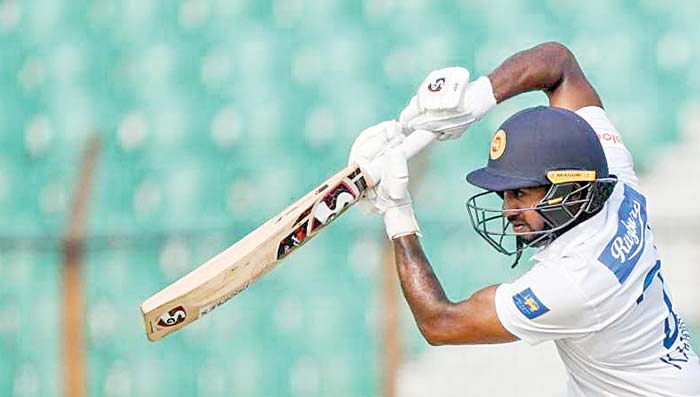
Dinesh Chandimal, Dhananjaya de Silva and Kamindu Mendis joined the trio of half-centurions from day one as Sri Lanka batted out nearly the entirety of the second day in Chattogram to rack up an imposing first-innings total of 531, and put themselves in a commanding position in the second Test.
In the process, they also posted the highest total in a Test innings without a single century, surpassing India’s effort of 524 for 9 declared against New Zealand in 1976. Kamindu Mendis, who was unbeaten on 92, also equalled Javed Miandad for the most runs in the first four innings of the career with 419.
Bangladesh, who had to bat a little over an hour before stumps, negotiated it quite comfortably for the most part with openers Mahmudul Hasan Joy and Zakir Hasan scoring freely. They would have gone wicketless too if not for an absolute peach from Lahiru Kumara that seamed back sharply from outside off to scythe through Joy and clip the bails.
Zakir Hasan and nightwatcher Taijul Islam saw things through without further damage as Bangladesh ended the day on 55 for 1 in 15 overs.
The story of the day though was about the Sri Lanka batters. It took Bangladesh 159 overs to bowl out the visitors, roughly an hour into the final session. Shakib Al Hasan ended with figures of 3 for 110, along with two for debutant Hasan Mahmud and one apiece for Khaled Ahmed and Mehidy Hasan Miraz.
On the whole, though, it was a tough day in the field for the hosts, particularly with their profligacy in the field once more coming to the fore. They dropped two more catches, making it five for the innings, as Prabath Jayasuriya and Kamindu became the latest beneficiaries.
Jayasuriya, who was on 6 at the time, flashed at a wide one from Khaled and got a thick edge. It flew to first slip, who bobbled it up towards second slip, who continued the juggling before third slip also sprung forward and failed to hold on. It was a sequence that summed up Bangladesh’s time in the field.
That it came during Bangladesh’s most menacing period of the day – post lunch – was also further evidence of how such lapses served to snuff out any momentum that might have been building. In this instance, with Khaled having just trapped Dhananjaya de Silva lbw, another wicket could have set them on their way to bundling out Sri Lanka’s tail cheaply.
But as things would pan out, Jayasuriya ended up sticking around for another 66 deliveries, contributing 28 in a 65-run stand with Kamindu. Kamindu himself was dropped later on – on 60 – by a sprinting Mahmud on the square-leg boundary. He scored another 32 after the reprieve.
In total, Kamindu added 120 alongside the last four batters, a majority of which could have been mitigated had Bangladesh held on to their catches.
Earlier in the day, Chandimal and Dhananjaya patiently negotiated the first hour of play, and were content to wait for the loose deliveries. While the Bangladesh seamers did probe good areas, boundary balls were a frequent feature as well, which alleviated any pressure being built.
For most of the day, the Bangladesh bowlers did not stick to set lines and lengths. And even when they did, all it took was one shot of aggression by the Sri Lanka batters to disrupt their plans.
And when a plan did work, such as when Khaled and Mahmud were peppering the batters with a barrage of bouncers, the lack of a third seamer allied with the hot and humid conditions meant it could not be persevered for any significant length of time.
With the pitch still offering uneven bounce and the odd one gripping and turning, Sri Lanka never pressed too hard to up the rate of scoring – even when it might have been prudent to do so – and were happy to bat out time until their bowlers could use the new ball towards the close of play. A plan which seemed to have been justified in the end due to Kumara’s late breakthrough. (cricinfo)
Scores:
Sri Lanka 531 all out in 159 overs (Nishan Madushka 57, Dimuth Karunaratne 86, Kusal Mendis 93, Dinesh Chandimal 59, Dhananjaya de Silva 70, Kamindu Mendis 92n.o.; Hasan Mahmud 2/92, Shakib Al Hasan 2/110)
Bangladesh
55 for 1 in 15 overs







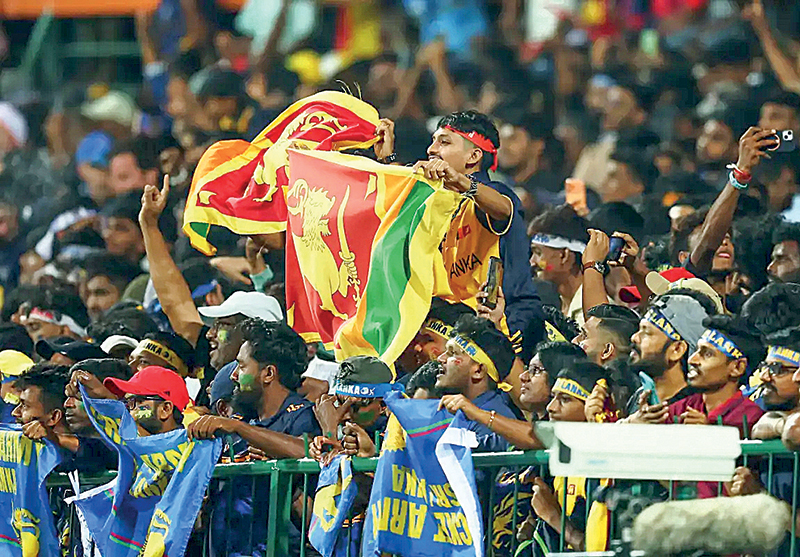
Sri Lanka’s final group game of the T20 World Cup was, on paper, a dead rubber. Zimbabwe had already punched their Super Eight ticket and so had the co-hosts. Yet, 24 hours before the toss, tickets were sold out. By the time the coin went up at Colombo’s R. Premadasa Stadium, the access roads were chock-a-block, horns blaring, vendors shouting, fans draped in blue streaming in like it was a final.
For a so-called inconsequential game, it felt anything but.
When supporters turn up in numbers for a fixture with nothing riding on it, that’s not blind loyalty, that’s belief. Sri Lanka, after years in the wilderness, have given their faithful something to cheer about. They are no longer making up the numbers. They are back in the contest.
The moment that injected oxygen into this campaign was the night they showed Australia the exit door. For Sri Lankan fans, there is no sweeter soundtrack than the silence of an Aussie dressing room packing up early. The younger fan brigade may relish having a go at India, but knocking out Australia still carries its own flavour.
Now the focus shifts to the Super Eight. Three games. Win two and Sri Lanka could be boarding flights to Calcutta or Bombay for a semi-final berth. That would be a seismic moment. The national side has not reached the last four of a global event for 12 long years. In cricketing terms, that’s an eternity.
Sport, like life, moves in cycles. Between 2007 and 2015, Sri Lanka were serial semi-finalists and finalists, a golden era when reaching the knockouts of ICC events was routine business. England, in contrast, were perennial underachievers in white-ball cricket, often bundled out early and licking their wounds. But they went back to the drawing board, addressed their white-ball philosophy, and emerged as a different beast, fearless, methodical and consistent on the global stage.
Sri Lanka appear to be following a similar blueprint.
One of the burning issues identified was strike rate. Last year, Chairman of Selectors Upul Tharanga publicly called for urgency with the bat. Too many Sri Lankan batters were stuck in second gear, striking at 120 or 130, respectable in another era, but pedestrian in modern T20 cricket.
This tournament has told a different story.
Kamindu Mendis has been batting as if the fielders are mere ornaments, striking at a jaw-dropping 225. Dasun Shanaka has rediscovered his finishing boots, going at 200. Pavan Rathnayake has muscled his way to 177, while Pathum Nissanka, long seen as more accumulator than aggressor, has operated at a healthy 155.
Those are not cosmetic improvements. Those are match-defining numbers.
Sri Lanka’s bowling cupboard has rarely been bare. Spin has been their calling card, seamers their workhorses. But too often in recent years, the batting has misfired, leaving bowlers with too little to defend. Now, with Pathum anchoring, Pavan counter-punching and Kamindu playing the role of accelerator, the top order is beginning to hum. Charith Asalanka, meanwhile, is far too gifted to be warming the bench for long.
The Super Eight will provide sterner examinations. England have had the wood over Sri Lanka in recent meetings. Pakistan and New Zealand, however, are sides we have found ways to outfox. More importantly, the middle order, once the soft underbelly, is showing signs of steel.
There are, of course, absentees that could haunt them in the business end. Wanindu Hasaranga, Matheesha Pathirana and Eshan Malinga would have been invaluable when the heat rises. Experience in global tournaments and franchise leagues like the IPL is currency you cannot easily replace. Hasaranga’s recurring hamstring troubles remain a concern and managing his fitness, including conditioning, must be a priority if he is to prolong his career.
Credit, too, must go upstairs. Sri Lanka Cricket have left no stone unturned. The appointment of Vikram Rathour and R. Sridhar, key lieutenants under Ravi Shastri during India’s successful run, has added tactical clarity. The involvement of South Africa’s Paddy Upton, a guru of the mental side of the game, has strengthened the team’s headspace.
The dividends are visible.
For now, the biggest victory may not be on the points table but in the stands. The blue flags are back. The roads are jammed again. The buzz has returned.
In Sri Lanka, that is often the first sign that a team has truly turned the corner.
by Rex Clementine
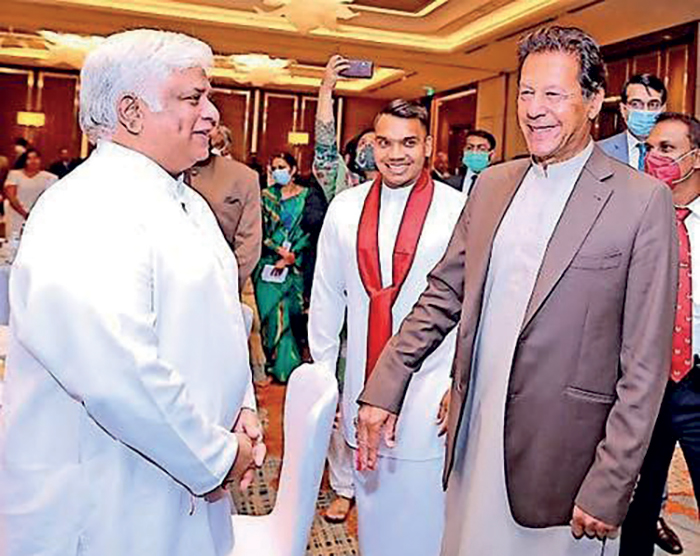
Sri Lanka’s World Cup winning captain Arjuna Ranatunga has called for authorities in Pakistan to ensure proper medical care for former Pakistan skipper Imran Khan, following reports that his health has deteriorated while serving a prison sentence.
Ranatunga, who led Sri Lanka through its own golden chapter in the game, said the cricketing fraternity owed it to one of the sport’s towering figures to ensure he was treated with dignity.
Imran remains one of the game’s most compelling all-rounders, a cricketer who could swing the new ball, marshal his troops with steely resolve and change the complexion of a contest with bat or ball. Under his command, Pakistan were a formidable outfit, never losing a Test series to the mighty West Indies during their halcyon years of the 1970s and 1980s.
His crowning glory came in Melbourne in 1992 when he inspired Pakistan to a World Cup triumph, rallying a cornered side with the now famous “cornered tigers” mantra and leading from the front when the chips were down.
After hanging up his boots, Imran traded the dressing room for the political arena. He entered politics and in 2018 became Prime Minister of Pakistan. His tenure coincided with a tense period in the country’s power corridors, particularly in relations with the military establishment. He was removed from office following a no-confidence vote in 2022 and was arrested the following year.
Ranatunga’s statement read as follows:
Imran Khan was not only an inspiration for millions of Pakistanis, but was also someone whom I, and many other young cricketers, admired and aspired to be. I know of many people who grew up admiring his courage, conviction, and unwavering belief in his country. For us, he transcended beyond cricket and politics. He was a symbol of hope, a patriot who carried his nation’s dreams on his shoulder, and an icon respected beyond Pakistan’s borders.
At this difficult time, I urge the authorities in Pakistan to treat him with humanity and dignity. Whatever the circumstances may be, it is important that compassion prevails. I implore that proper care and fairness be given to a man who has dedicated his life to his country and devoted his life to the people of Pakistan.
It is during these trying times that we must put aside differences and remember that before the politician and before the cricketer, there was Imran Khan, a human being deserving empathy, compassion, and humanity.

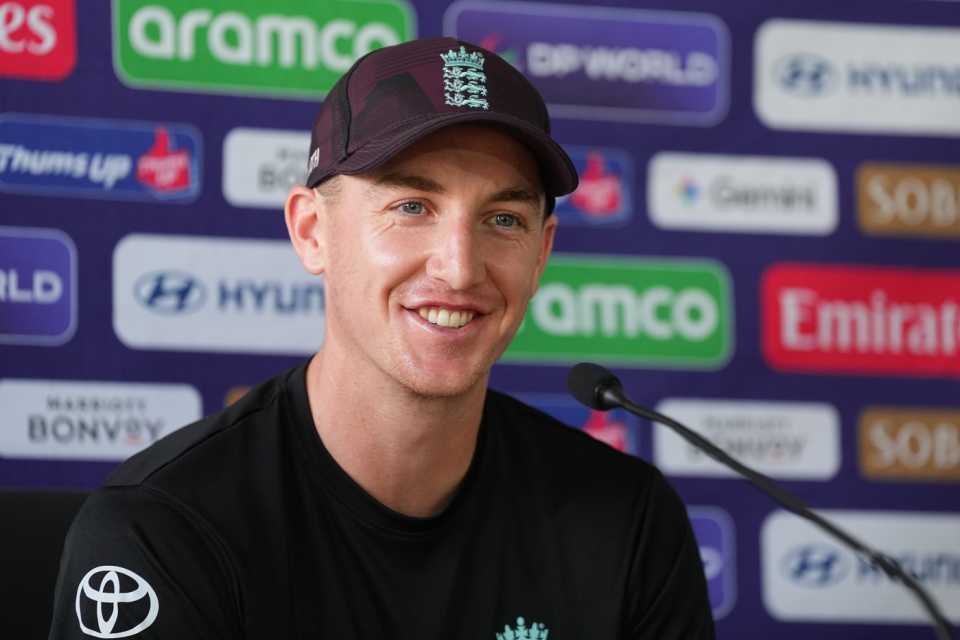
Pallekele was the stage, just under a week ago, for Sri Lanka’s turbo charged victory over a shell-shocked (and soon-to-be-eliminated) Australia. One minute the Aussies were 104 for 0 in the ninth over, and the hosts themselves were the ones contemplating an anxious exit from an unexpectedly competitive Group B. The next thing you knew, their spinners had ripped out Australia’s soul, and Pathum Nissanka had come howling through the breach with his wonderful 52-ball century.
Pallekele’s passionate, opinionatwd, fanbase made their presence felt that night, and as the concurrent scenes in Colombo have indicated, Sri Lanka is somewhat gripped by World Cup fever right now – notwithstanding their team’s shock loss to a surging Zimbabwe in their final group game.
That six-wicket defeat made no odds to the Super Eight, with the pre-seeded pools now awkwardly featuring all the group winners on one side of the draw and all the runners-up on the other. But it was conceivably an untimely bump back to earth, just in time for Sri Lanka’s reunion with a familiar set of foes. England won five matches out of six on their white-ball warm-up tour of the country last month, including three out of three in the T20I leg.
None of these wins were emphatic, but each of them was sealed by subtly different means – Adil Rashid’s spin strangle in game 1, Tom Banton’s middle-order awakening in game 2, Sam Curran’s guts and glory on a tricky turning deck in game 3, in which England’s back-up tweakers, Will Jacks and Jacob Bethell applied the coup de grace.
The net effect was to give the impression of a well-rounded England team, one that was ready to march into the main event with form to fall back on and faith in their myriad methods. And while that might still be the case in an eminently surmountable Group 2 which also features the known unknowns of New Zealand and Pakistan, the sheer terror of those near-misses against Nepal and Italy cannot be easily forgotten. Nor the disturbing passivity of their old-school trouncing in Mumbai by West Indies.
The stage is therefore set for Sri Lanka to pounce on the big occasion, as they have often done in the recent past, most notably with their wins at the 2019 and 2023 ODI World Cups, when their brace of victories went against the grain of their one-sided bilateral records.
Sri Lanka’s batting has broadly fired across the group stages, with Nissanka leading the line and Kusal Mendis contributing a trio of fifties in four matches, but agonisingly they’ll have to take the stage without the raw pace of Matheesha Pathirana, whose slingy action had England’s top order in all sorts of bother throughout their bilateral engagements. He lasted just four balls of the Australia game before succumbing to a calf strain, and has been replaced by Dilshan Madushanka.
Pathum Nissanka joined a curiously niche club when he smoked Australia to the brink of elimination last week. Only Chris Gayle before him had managed a T20 World Cup hundred, in addition to an ODI double-hundred and a century in all three formats – and if he’s got some way to go to match Gayle’s twin Test 300s, then a career-best 187 in his last series against Bangladesh suggests he’s tracking in the right direction. England did not see the best of him in the bilateral series just gone, but they’ll remember it alright. At The Oval in 2024, he blazed a superb fourth-innings 127 not out from 124 balls to swipe the third Test from under his opponents’ noses. At a time when England’s own batting lacks a touch of bravado, Nissanka is perfectly placed to steal a march once again.
Adil Rashid has been an unlikely barometer of England’s struggles. On his day, he remains absolutely integral to his team’s hopes of adding to the silverware that he has been instrumental in collecting over the course of the past decade. In England’s loss to West Indies, he did not concede a single boundary in serving up figures of 2 for 16 in four overs, while a combined haul of 5 for 69 in 12 in Pallekele last month suggests he will be right back on the mark on his return to a happy hunting ground. In between whiles, however, he has been treated with rare disdain by a succession of Associate batters, serving up combined figures of 4 for 121 in 11 overs, including a brutal outing of 3-0-42-0 against Nepal. Part of that might come down to a lack of inhibition from a succession of unfancied opponents who had licence to take him on. But with Brook’s tournament stratergy lean8ng so heavily on spin, England cannot afford many more bad days from their veteran. They aren’t programmed to cope when he goes missing.
England’s nerves haven’t been settled, but their team certainly has. Their depth of batting and bowling options came to the fore on their previous trip to Pallekele, and while there’s no expectation of wholesale changes, Brook did hint that some tweaks might be needed to avoid becoming predictable. Whether those are personnel or positional remain to be seen, although Luke Wood’s skiddier left-arm seam might be restored in place of Jamie Overton’s heavier lengths. The cut to Jacob Bethell’s bowling hand (sustained during the match against West Indies), may prevent him from bowling, because those fingers are still strapped. Brook hoped he’d recover in time, however.
England: (probable) Phil Salt, Jos Buttler (wk), Jacob Bethell, Tom Banton, Harry Brook (capt), Sam Curran, Will Jacks, Liam Dawson, Luke Wood, Jofra Archer, Adil Rashid
Pramod Madushan made his first appearance of the campaign in the Zimbabwe defeat, with Dushmantha Chameera taking a break with qualification already assured. That short-term arrangement is likely to be reversed, with Madushanka keeping his spot.
Sri Lanka: (probable) Pathum Nissanka, Kusal Perera, Kusal Mendis (wk), Pavan Rathnayake, Kamindu Mendis, Dasun Shanaka (capt), Dunith Wellelage, Dushan Hemantha, Maheesh Theekshana, Dilshan Madushanka, Dushmantha Chameera
(Cricinfo)

Showers or thundershowers will occur at most part of the Island after 1.00 p.m.

Only single MP refuses salary as Parliament details pays and allowances

Illegal assets of underworld figures frozen since September, Minister tells parliament

Entire coal procurement rigged, SJB charges minister over substandard fuel

WNPS demands immediate ban on illegal construction

CID probes suspect lawyer’s multi-million-rupee money trail in Sanjeewa murder case

‘Dates have the highest sugar content to fight Coronavirus’

Sunday Island 27 December – Headlines

#SundayIsland 17th December – Headlines

Sunday Island – 28th March

Sunday Island Headlines – 21 March

Sunday Island – 21st February – Headlines
-

 Business6 days ago
Ministry of Brands to launch Sri Lanka’s first off-price retail destination
-
 Latest News1 day ago
New Zealand meet familiar opponents Pakistan at spin-friendly Premadasa
-

 Latest News1 day ago
Tariffs ruling is major blow to Trump’s second-term agenda
-

 Latest News2 days ago
ECB push back at Pakistan ‘shadow-ban’ reports ahead of Hundred auction
-

 Features6 days ago
Giants in our backyard: Why Sri Lanka’s Blue Whales matter to the world
-

 Sports3 days ago
Old and new at the SSC, just like Pakistan
-

 News5 days ago
IMF MD here
-
 Business5 days ago
Green Minds: A new platform to rethink environmental governance in Sri Lanka