
Sports
Kamindu and Chamari take top honours at glittering SLC Awards Night


It was a night to remember and cricketing nostalgia as the annual Sri Lanka Cricket Awards returned with a bang at the opulent City of Dreams resort in Colombo. After a lull that saw the event hit a bit of a dead patch, the gala was revived in grand style, thanks to the partnership of real estate giant Home Lands.
The who’s who of Sri Lankan cricket turned up – past legends, club delegates, selectors, coaches, international and club cricketers and sporting icons from across the board. Over the course of three lively hours, the cricketing fraternity celebrated those who had left their mark on the game, both at home and abroad.
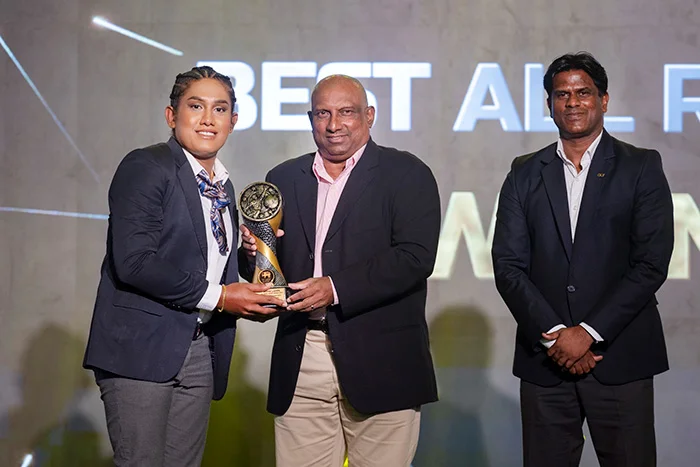
Chamari Atapattu, the bedrock of Sri Lanka’s women’s team, swept six international awards including Cricketer of the Year.
While several young entertainers kept the crowd on their toes, it was the evergreen Rookantha Gunathilaka who hit all the right notes — proving that class, like form, is permanent. His performance, much like a vintage innings under pressure, stole the spotlight and the hearts of the audience.
Chief Guest and Sports Minister Sunil Kumara Gamage struck a patriotic chord, expressing his dream of seeing Sri Lanka lift another World Cup. He reserved special praise for Head Coach Sanath Jayasuriya, whose stewardship has brought about a spirited resurgence in the national setup.
SLC President Shammi Silva commended the award winners and paid tribute to their commitment in restoring Sri Lanka’s reputation as a force to be reckoned with on the world stage.

Chandra Schafter, the oldest living Ceylonese cricketer, was honoured for his lifelong commitment to the sport.
A particularly touching segment of the evening was the felicitation of four stalwarts whose contributions to cricket have stood the test of time. Chandra Schafter, the oldest living Ceylonese cricketer, was honoured for his enduring legacy. Stanley Jayasinghe, a trailblazer who played county cricket for Leicestershire well before Sri Lanka earned Test status, was lauded for his path-breaking role. Ranjith Fernando, a member of the 1975 World Cup squad and a fine wicketkeeper in his day, was also recognized — not just as a player but as a coach and manager who passed on his wisdom to the next generation. Janaka Pathirana, the heartbeat of Kandy cricket, was saluted for his tireless service to the game in the Central Province.
When it came to the star performers of the present, two names stood head and shoulders above the rest. Kamindu Mendis, the ambidextrous marvel who wielded the willow with finesse across continents in 2024, was crowned Men’s Cricketer of the Year. He was in the runs all year round, compiling fifties and hundreds with a cool head and a straight bat.
Meanwhile, Chamari Atapattu, the undisputed queen of Sri Lankan women’s cricket, had the scoreboard ticking like a slot machine. She didn’t just raise the bar — she smashed through the glass ceiling. Chamari pocketed six of the seven women’s international awards on offer, a feat that confirms her status as the linchpin of the national side.

Stanley Jayasinghe, one of Sri Lanka’s earliest county professionals, was recognized for his pioneering achievements
Match officials too got their due, with top-performing umpires and referees applauded — a welcome move that sends a strong message encouraging others to take up the professions.
Veteran scribes Prince Gunasekara and Prasanna Sanjeewa Thennakoon were conferred Lifetime Achievement Awards, a nod to their decades-long innings behind the scenes.
Adding weight to the occasion was the presence of former maestro Aravinda de Silva. He was joined by ex-SLC chief Thilanga Sumathipala.
Indeed, 2024 was a comeback year worth toasting. Having hit rock bottom with a forgettable World Cup campaign in 2023 — finishing eighth and missing out on the Champions Trophy — Sri Lanka bounced back like a ball with extra zip off the pitch. Series wins over Australia and India in the ODIs were statement victories, propelling the team to No. 4 in the ICC rankings. Add to that a hard-earned Test win in England after a decade and suddenly, Sri Lanka were back in the hunt for a World Test Championship final berth as the year drew to a close.
by Rex Clementine



Bengaluru’s M Chinnaswamy Stadium has been cleared to host IPL 2026 after a government-appointed Expert Committee approved the venue for use on Monday.
The immediate implication is that Chinnaswamy – scheduled to host the season opener between Royal Challengers Bengaluru (RCB) and Sunrisers Hyderabad on March 28 – will also stage one playoff game and the final, in keeping with the tradition of the defending champions hosting the title clash.
A committee, appointed by Karnataka’s home minister G Parameshwara, conducted a thorough review of the stadium premises on Friday. The day-long audit involved several checks for structural compliance as well as measures taken to enhance crowd control around the venue.
On Monday, the final nod was given following a meeting between the Karnataka State Cricket Association (KSCA) officials, RCB’s top brass as well as members of the expert committee, chaired by G Maheshwar Rao.
The Chinnaswamy will host five RCB home games, while two others will be played at the Shaheed Veer Narayan Stadium in Raipur, as per a pre-arranged agreement between the franchise and the Chhattisgarh government.
RCB has committed to engaging with KSCA to roll out digital QR coded tickets as one of several measures to tackle overcrowding around the venue. They have also partnered with the Bengaluru Metro Rail Corporation (BMRCL) to ensure hassle-free travel.
The metro services will be extended until 1am on match days, while ticketing formalities are being worked out. It’s likely those with match tickets can travel free of cost. BMRCL is also likely to increase frequency of trains on all routes to prevent overcrowding.
As for structural measures, the KSCA have increased the number of entry points by constructing six new gates around the Chinnaswamy, while widening existing entry gates. The old NCA premises had also been equipped with ramps and tarpaulin sheets to become a holding area for fans, as they make their way towards their respective stands.
The Bengaluru police and the KSCA are working to ensure Cubbon Road – which runs alongside the main entrance of the venue – will be cleared for vehicular movement at specific intervals on match days.
The IPL has announced the schedule only for the first two weeks of the competition in 2026. In the first leg, KSCA will host one more game (apart from the opener)on April 5, involving RCB and Chennai Super Kings.
Chinnaswamy last hosted a competitive fixture during IPL 2025. Since then, the venue has been mired in controversy following the death of 11 fans during RCB’s victory celebrations on June 3.
All of KSCA’s structural changes to comply with short-term measures recommended by the expert committee have happened in two months, following the December elections where Venkatesh Prasad, the former India fast bowler, assumed office after winning a tense election.
The stadium will now officially be handed over to the IPL franchise and their event management partners, DNA Entertainment. RCB are yet to announce sale of tickets officially. That process is expected to begin later this week.
[Cricinfo]

This was an old-fashioned classic disguised as 21st century cricket. Probably the best ODI match of the year so far, tucked away as a gilateral decider in Mirpur. Two batters, Salman Agha and Tanzid Hasan, played stellar knocks while everyone else struggled on a pockmarked pitch. Yes, this was old-fashioned: there was the tragic Pakistan collapse, the comical Pakistan running, and the tragicomic Pakistan finish.
At the end of it all, Bangladesh won their second successive bilateral ODI series against Pakistan, the two series being 11 years apart.
Let’s start with just the last over: one wicket left, Shaheen Shah Afridi on strike, Rishad Hossain with the ball. 14 needed off six. Off the second delivery, Rishad ran back to collect a skier and spilled it at mid-on when he could have closed out the match. With 12 needed off two, a wide was given, then a sneaky review was taken by Bangladesh to reverse it. With 12 needed off the last ball, Afridi ventured down the track and missed the ball all ends up, and could have been off for a stroll by the time Litton Das remembered to whip off the stumps.
However, the match was a long way away from being a heart-stopper, and had mostly been a one-way dogfight with Bangladesh calling the shots. Then, Agha made a belated entry to the middle at 67 for 4. They were chasing 291 on a pitch that turned when you slowed it down, and bounced when you speared it in.
Taskin Ahmed was the early wrecker-in-chief for Bangladesh, taking out Sahibzada Farhan and Mohammad Rizwan in the first and third over. Maaz Sadaqat departed to an edge off Nahid Rana in the one over in between. Yet, debutant Ghazi Ghori and two-ODIs-old Abdul Samad got together to stem the bleeding: they poked and prodded, and sometimes middled one, as they laboured to a 50-run partnership in 67 balls. The highlight of their stand was at least four run-out chances, with many yes-and-no calls as nerves gave way.
Bangladesh were poor in the field themselves, with misfields and balls parried away by the close-in fielders – twice against Ghori and Samad – letting Pakistan stay in the contest for as long as they did. Ghori, in particular, rode his luck, smacking three fours and one eye-catching six into the deep-square boundary.
Ghori (29) and Samad (34) departed in quick succession. Having walked in with 224 needed off 36 overs, Agha built a case for Pakistan’s chase from one end, while Saad Masood, the other debutant of the day, kept the other end chugging along. Still, a rush of young blood was inevitable. They had put together a 79-run partnership for the sixth wicket when Masood rushed down the pitch, and Mustafizur Rahman rattled his stumps. Agha took off his gloves and helmet, and sunk to his haunches at the other end.
The pitch might as well have been laid out with Mustafizur in mind, as he kept angling balls away from the batters to finish with figures of 3 for 54. But Agha countered him – and the other pace bowlers – by mostly sticking to shots down the ground. His knock was peppered with nine fours and four sixes. This was as good a riposte as any with the bat, having been run-out in the previous game in rather unusual circumstances.
Here, he only kept the team’s needs in mind as he dug deeper in the middle with Afridi. Even when he bashed Rana down the ground in the 45th over to bring up his century, they still needed 48 off 35 balls with just three wickets left. He did not indulge in much of a celebration.
Agha and Afridi compiled 52 runs in 49 balls, but Agha was the first to depart: skying a cross-batted shot off Taskin to become his fourth and final victim of the night in the 48th over.
Afridi kept the fight going until the end, drilling two fours and two sixes in a knock of 37 off 38 and was only dismissed on the final ball.
Earlier in the day, Bangladesh had put together an old-fashioned innings of their own after being put in to bat. When Tanzid smacked Agha over the ropes in the 33rd over, he was not wearing a helmet like the batters of yesteryears. He bumped his partner’s first at the other end, performed the sajda, and wiped away his sweat on a humid day in Mirpur. He had brought up his maiden ODI ton in the most old-school way possible.
His century was only one of two Bangladesh knocks that managed to go at or over run-a-ball. But even as he hit six fours and seven sixes, most of his run-making shots were along the ground. He stitched a 105-run opening partnership alongside Saif Hassan, who looked less comfortable in his stay of 36 off 55.
Tanzid kept one end stable through the middle overs, right up till when he cut a long-hop by Abrar Ahmed to Afridi at cover in the 37th over. It was a good reward for Abrar, who was Pakistan’s best spinner, bowling with varied pace and cramping up the batters throughout the middle overs.
Haris Rauf – returning after his expensive opening spell – might have learned his lessons from Abrar too, though he had to fulfil a different job at the death overs. He plucked out Litton Das (41) and Rishad (0) in quick succession, pulling his lengths shorter to throttle Bangladesh.
Rauf finished with 3 for 52, and the only reason Bangladesh managed 290 for 5 was because of a late surge from Towhid Hridoy, who scored 48 off 44.
Still, there were two lasting images from the day: one of Tanzid, smiling in celebration after bringing up his century. The other was of Agha after his dismissal – having struck a scintillating ton of his own, but wearing the glum look of a batter walking back with the job half-done.
Brief scores:
Bangladesh 290 for 5 in 50 overs (Saif Hasan 36, Tanzid Hasan 107, Towhid Hridoy 48*; Haris Rauf 3-52) beat Pakistan 279 in 50 overs (Abdul Samad 34, Salman Ali Agha 106, Saad Masood 38, Shaheen Shah Afridi 37; Taskin Ahmed 4-49, Nahid Rana 2-62, Mustafizur Rahman 3-54 ) by 11 runs
[Cricinfo]

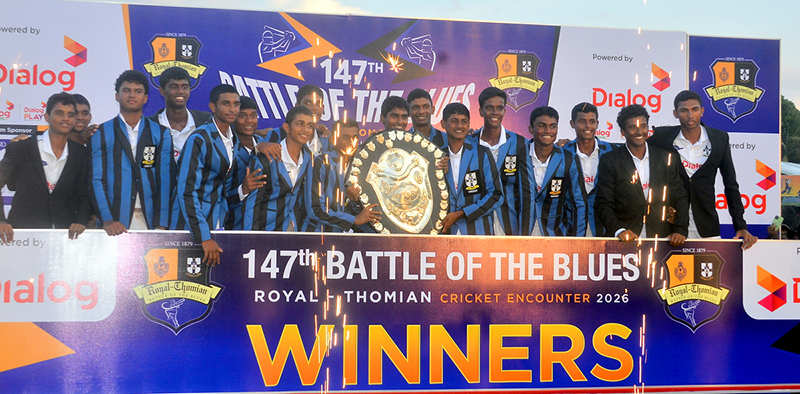
The 147th edition of the historic Battle of the Blues ended in a draw, with Jaden Amaraweera producing the only century of the Big Match to give fans a rare highlight after three days of largely uneventful cricket.
Amaraweera’s unbeaten hundred in the final stages of the match provided an individual milestone for spectators who had otherwise endured a contest dominated by cautious batting and slow scoring.
From the outset it appeared that S. Thomas’ College Mount Lavinia had approached the game with the intention of batting for a draw. Their first innings progressed at a snail’s pace, raising questions among critics about whether the Mount Lavinia side had come prepared to merely occupy the crease rather than push for a result.
The Thomians batted for a massive 124 overs but managed only 302 runs, a modest return for more than 500 minutes of batting. Openers Jaden Amaraweera and Avinash Fernando set the tone with an extremely cautious approach, adding 110 runs for the first wicket in 40 overs. Even their consistent batsman, Reshon Solomon, consumed 147 deliveries for his 66 runs.
In contrast, Royal College Colombo scored at a comparatively brisker rate in their first innings. Skipper Rehan Peiris and Ramiru Perera struck half centuries to guide Royal’s reply. The Reid Avenue school eventually declared their innings in 86 overs with nine wickets down, still trailing by 41 runs.
However, the declaration had little impact on the outcome, as the final day offered limited opportunity for a decisive result.
With the match drifting towards an inevitable draw, the stage was set for individual achievements. Amaraweera seized the moment, crafting the only century of the 2026 encounter. His composed unbeaten 100 came off 162 deliveries and included nine fours and three sixes, ensuring that the match would at least be remembered for a notable batting effort.
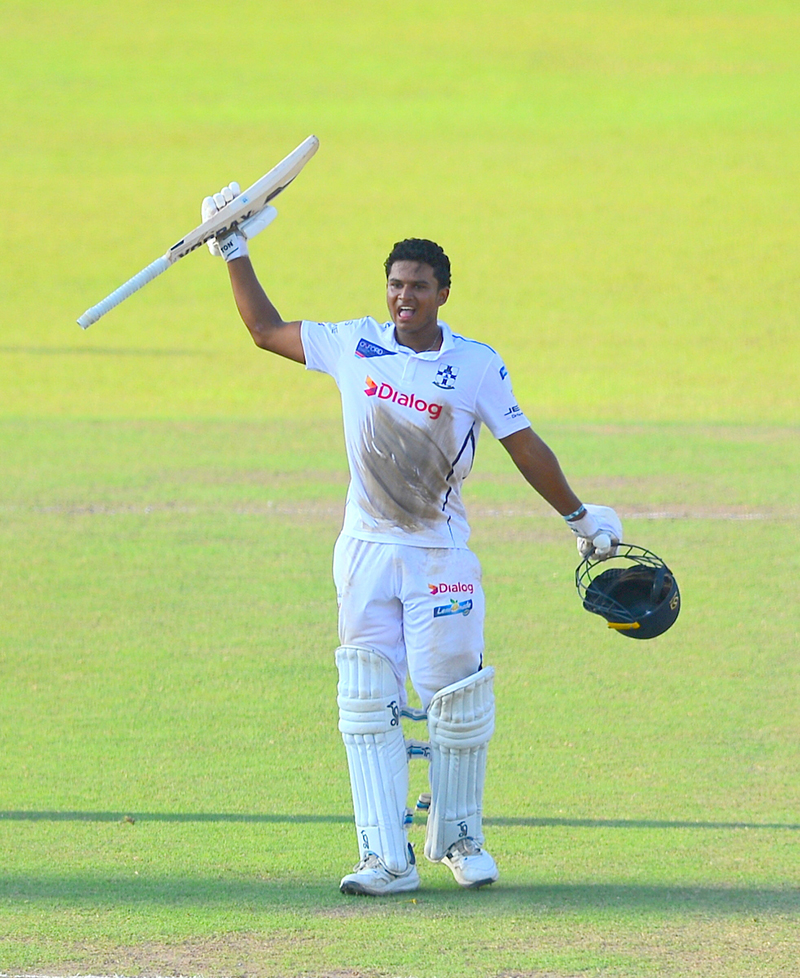
Jaden Amaraweera scored an unbeaten century in the second innings
Royal entered the contest as favourites, yet the Thomians once again managed to deny their arch rivals victory, settling for a draw in another chapter of Sri Lanka’s most celebrated school cricket rivalry

Wednesdays declared a government holiday with effect from 18th March

Iran hits key UAE oil port and Dubai airport

PM declares open Angunukolapelessa Leisure Island

Navy’s successful high-seas bust nets over 133kg haul of heroin

Chinnaswamy stadium receives government clearance to host IPL 2026 final

Tanzid 107, Taskin four-for trump Agha 106 to give Bangladesh series

‘Dates have the highest sugar content to fight Coronavirus’

Sunday Island 27 December – Headlines

#SundayIsland 17th December – Headlines

Sunday Island – 28th March

Sunday Island Headlines – 21 March

Sunday Island – 21st February – Headlines
-

 News7 days ago
Prof. Dunusinghe warns Lanka at serious risk due to ME war
-

 News5 days ago
Historic address by BASL President at the Supreme Court of India
-

 Business6 days ago
BOI launches ‘Invest in Sri Lanka’ forum
-

 Sports6 days ago
Royal start favourites in historic Battle of the Blues
-

 Sports5 days ago
The 147th Royal–Thomian and 175 Years of the School by the Sea
-

 News6 days ago
CEBEU warns of operational disruptions amid uncertainty over CEB restructuring
-

 Features6 days ago
Indian Ocean zone of peace torpedoed!
-
 News5 days ago
Power sector reforms jolted by 40% pay hike demand