
Latest News
Iran rules out new nuclear talks until attacks stop

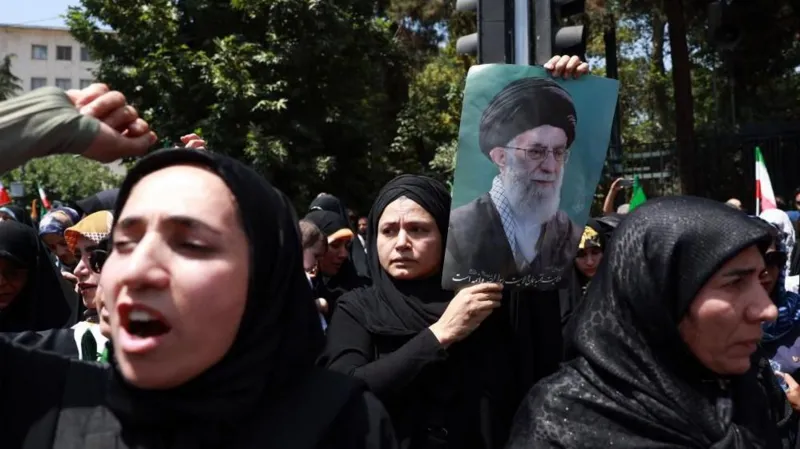
Iran has said it will not resume talks over its nuclear programme while under attack, hours after Israel’s defence minister warned of a “prolonged” conflict with the Islamic Republic.
Fighting raged on Friday as Iran fired a salvo of missiles at northern Israel and Israel targeted dozens of sites in Iran.
Israeli Foreign Minister Eyal Zamir said in a video address that his country should be ready for a “prolonged campaign” and warned of “difficult days ahead”.
His Iranian counterpart, Abbas Araghchi, met European diplomats in Geneva who urged him to revive diplomatic efforts with the US over his country’s nuclear programme.
Araghchi said Iran was ready to consider diplomacy only once Israel’s “aggression is stopped”.
Iran’s nuclear programme was peaceful, he insisted, and Israel’s attacks violated international law. Iran, he added, would continue to “exercise its legitimate right of self-defence”.
“I make it crystal clear that Iran’s defence capabilities are non-negotiable,” he said.
Israel’s ambassador to the UN accused Iran of having a “genocidal agenda” and posing an ongoing threat, adding that Israel would not stop targeting nuclear facilities until they were “dismantled”.
US President Donald Trump said Iran had a “maximum” of two weeks to avoid possible American air strikes, suggesting that he could take a decision before the 14-day deadline he set on Thursday.
“I’m giving them a period of time, and I would say two weeks would be the maximum,” Trump told reporters.
The aim, he said, was to “see whether or not people come to their senses”.
The US president was also dismissive of the talks between Araghchi and foreign ministers from the UK, France, Germany and the EU.
“Iran doesn’t want to speak to Europe,” Trump said. “They want to speak to us. Europe is not going to be able to help in this.”
UK Foreign Secretary David Lammy said that the US had provided a “short window of time” to resolve the crisis in the Middle East which was “perilous and deadly serious”.
French Foreign Minister Jean-Noel Barrot said the ministers had invited the Iranian minister to “consider negotiations with all sides, including the United States, without awaiting the cessation of strikes”.
Barrot added that there could be “no definitive solution through military means to the Iran nuclear problem” and warned that it was “dangerous to want to impose a regime change” in Iran.
Israel was hit by a new round of Iranian strikes on Friday with the Israeli military reporting an attack of 20 missiles targeting Haifa.
One Israeli woman died of a heart attack, bringing the Israeli death toll since the conflict began to 25.
The Israel Defense Forces said they had attacked ballistic missile storage and launch sites in western Iran.
Over the past week, Israeli air strikes have destroyed Iranian military facilities and weapons, and killed senior military commanders and nuclear scientists.
Iran’s health ministry said on Sunday that at least 224 people had been killed, while a human rights group put the unofficial death toll at 639 on Thursday.
Iran has launched hundreds of ballistic missiles at Israel in response to the air strikes.
[BBC]

Latest News
A new curriculum will be introduced for preschools in 2027, while steps will also be taken to train teachers accordingly – PM
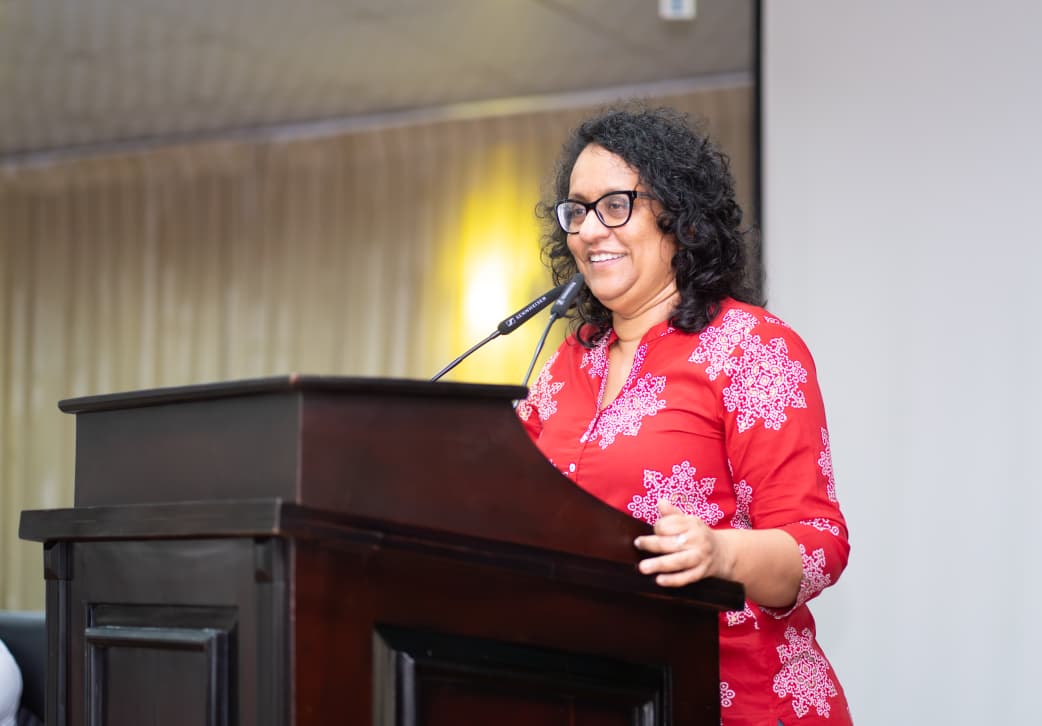
Prime Minister Dr. Harini Amarasuriya stated that a new curriculum will be introduced for preschools in 2027, while steps will also be taken to train teachers accordingly and to regulate preschools through a regulatory authority.
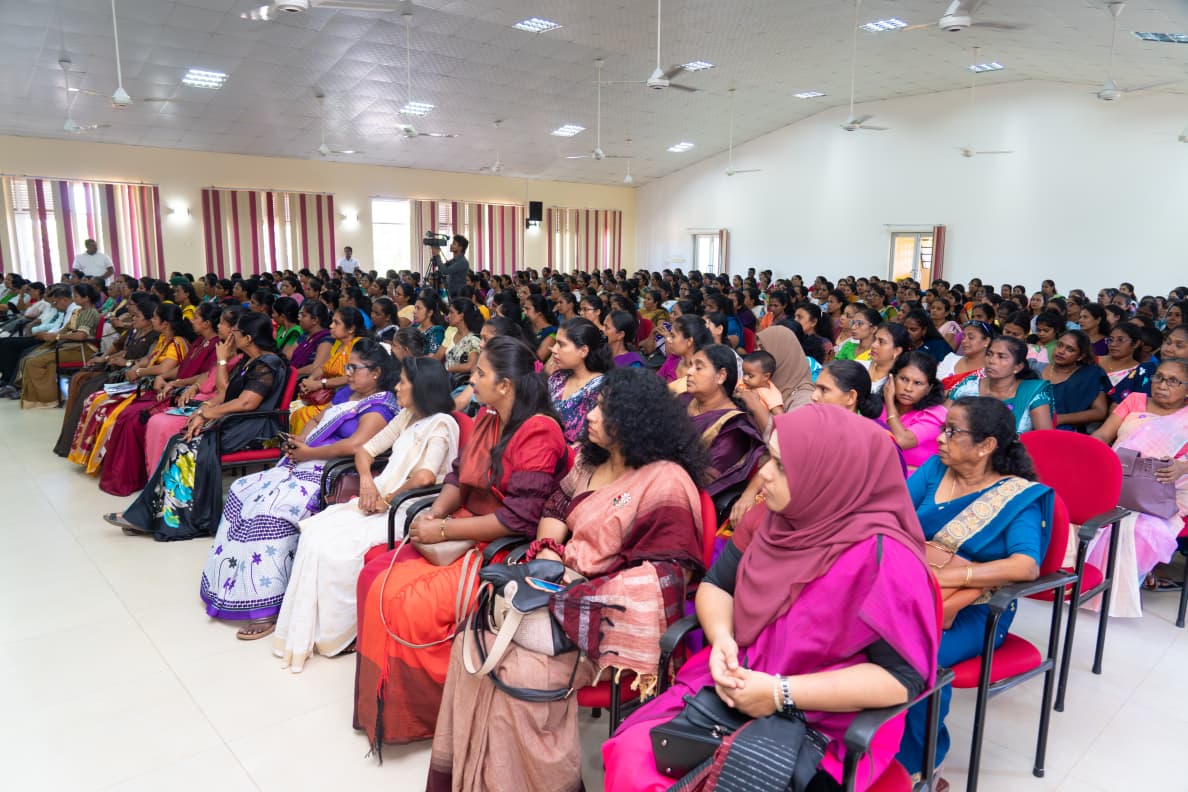
The Prime Minister made these remarks while addressing an awareness programme for preschool teachers in the Hambantota District on education reforms, held on Sunday (15) at the Ambalantota Pradeshiya Sabha Auditorium.
During the programme, preschool teachers briefed the Prime Minister about the challenges they currently face. Responding to their concerns, Dr. Harini Amarasuriya further stated:
“The issues within the preschool system cannot be discussed separately from the broader crisis in society and in the education sector. When we assumed office in 2024, our primary challenge was to free the country from its debt burden and to establish. a sound economic indicators.
Although 2025 was a challenging year, we were able to bring the country’s economy to a certain level of stability and manage the national budget accordingly.
While we were working towards economic recovery, the war in the Middle East began, which has had certain impacts on our country as well.
A significant amount of Sri Lanka’s foreign remittances come from our fellow citizens working in the Middle East. Today, both their livelihoods and employment are under threat. In addition, a large number of tourists travelled to Sri Lanka through Middle Eastern airspace, and the closure of those air routes and airports has reduced tourist arrivals. Another issue concerns fuel transportation. This problem has affected not only Sri Lanka but many countries around the world. If the war continues for a long period, it will have further impacts on us, and therefore we must be prepared. We also need to manage the economy carefully and reduce certain expenditures.
Although we have the ability to borrow, our intention is not to weaken the country’s economy by relying on loans.
You are aware that we have begun implementing education reforms. Within that policy framework, we are also taking steps to reform preschool education. So far, the establishment of preschools and early childhood development has not been carried out in a systematic manner. Therefore, we must regulate and standardize all preschools, which is not an easy task.
First, all preschools must be formally registered. We have already prepared a curriculum for teacher training. In addition, we plan to introduce a new curriculum for preschools in 2027, provide teacher training accordingly, and regulate preschools through a regulatory authority. A recognized curriculum has also been prepared for the preschool diploma. In the future, priority for preschool teachers will be given based on these qualifications. We will also take gradual steps to enhance the professionalism of preschool teachers and establish a proper salary structure”.
The Prime Minister further stated that preschools fall under the authority of Provincial Councils and Pradeshiya Sabhas, while the line ministry can only provide policy recommendations. She also emphasized that issues related to preschools should be addressed in a systematic manner through structural committees and District Development Committees.
Member of Parliament Nihal Galappaththi and other public representatives, along with preschool teachers from the Hambantota District attended the awareness program.
(Prime Minister’s Media Division)
Latest News
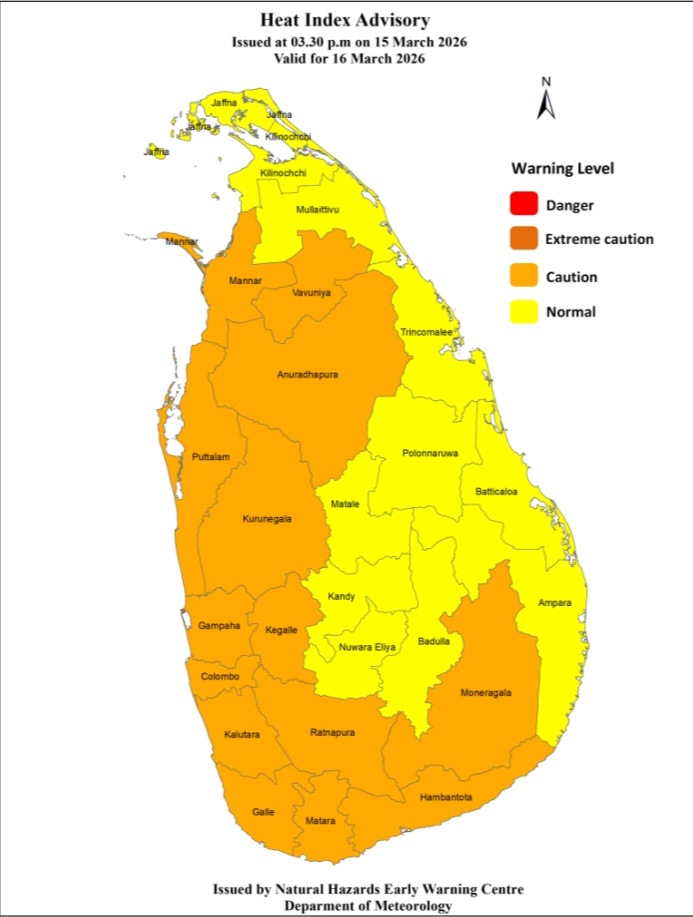
Heat Index at ‘Caution level’ at some places in the Western, Sabaragamuwa, Southern and North-western provinces and in Monaragala, Mannar, Anuradhapura and Vavuniya districts
Warm Weather Advisory
Issued by the Natural Hazards Early Warning Centre of the Department of Meteorology at 3.30 p.m. on 15 March 2026, valid for 16 March 2026.
The public is warned that the Heat index, the temperature felt on human body is likely to increase up to ‘Caution level’ at
some places in the Western, Sabaragamuwa, Southern and North-western provinces and in Monaragala, Mannar, Anuradhapura and Vavuniya districts.
The Heat Index Forecast is calculated by using relative humidity and maximum temperature and this is the condition that is felt on your body. This is not the forecast of maximum temperature. It is generated by the Department of Meteorology for the next day period and prepared by using global numerical weather prediction model data.
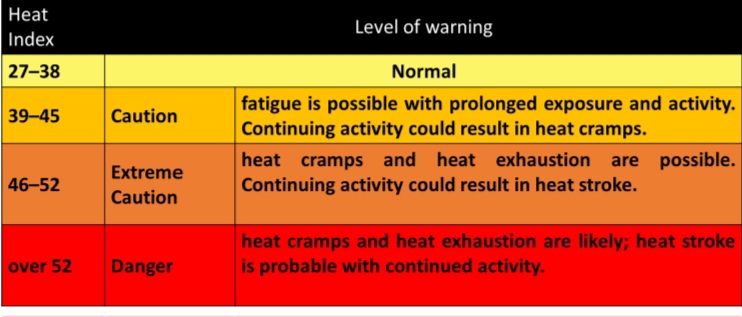
Effect of the heat index on human body is mentioned in the above table and it is prepared on the advice of the Ministry of Health and Indigenous Medical Services.
ACTION REQUIRED
Job sites: Stay hydrated and takes breaks in the shade as often as possible.
Indoors: Check up on the elderly and the sick.
Vehicles: Never leave children unattended.
Outdoors: Limit strenuous outdoor activities, find shade and stay hydrated.
Dress: Wear lightweight and white or light-colored clothing.
Note:
In addition, please refer to advisories issued by the Disaster Preparedness & Response Division, Ministry of Health in this regard as well. For further clarifications please contact 011-7446491
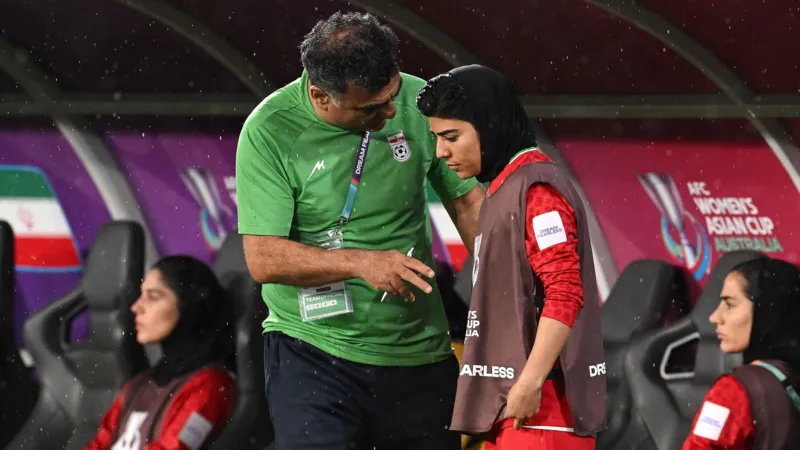
Three more members of the Iranian women’s football delegation – who were given humanitarian visas to stay in Australia – have changed their mind and will return home.
The trio have been named by human rights activists in the Iranian diaspora as Zahra Soltan Meshkehkar, Mona Hamoudi, and Zahra Sarbali.
Concerns grew for the Iranian team after they were silent for the country’s anthem in their opening Asian Cup match against South Korea on 2 March – which led to them being branded “war traitors” in Iran.
Confirming the decisions, Australia’s home affairs minister said his government had done everything it could to ensure the women were given the chance to have a safe future in the country.
“Australians should be proud that it was in our country that these women experienced a nation presenting them with genuine choices and interacted with authorities seeking to help them,” Tony Burke said in a statement.
“While the Australian government can ensure that opportunities are provided and communicated, we cannot remove the context in which the players are making these incredibly difficult decisions.”
Iran’s sports ministry also earlier confirmed the news, first reported by the Islamic Revolutionary Guard Corps-linked Tasnim News Agency, in a statement.
“The national spirit and patriotism of the Iranian women’s national football team defeated the enemy’s plans against this team,” the statement says, also accusing Australia’s government of “playing in Trump’s field”.
Tasnim said the three were on their way to Kuala Lumpur in Malaysia to join the rest of the squad and were “returning to the warm embrace of their families and homeland after withdrawing their asylum application in Australia”.
It said they had resisted “psychological warfare, extensive propaganda and seductive offers”.
It means that, of the seven who initially said they wanted to stay in Australia, only three now remain as defectors. One of the players made the same decision to return to Iran on Wednesday.
Hamoudi and Sarbali were among the original five who refused, after giving minders the slip at the team’s hotel on the Gold Coast, south of Brisbane, last Monday and being taken to a safe house by Australian Federal Police.
Zahra Soltan Meshkehkar, a member of the team’s technical staff, was one of two more women from the group to seek asylum the next day. The other – Mohaddeseh Zolfi – changed her mind hours after being given the right to stay. She is understood to have already rejoined the team.
There was concern in Australia that members of the team and their families might face repercussions in Iran after the players refused to sing the national anthem.
One conservative commentator on Iranian state media accused them of being “wartime traitors” and called for a harsh punishment.
The team did sing the anthem in their last two games before they were eliminated on Sunday, leading critics to believe they had been told to sing by government officials accompanying them during the tournament.
The remaining Iranian players left Australia on Tuesday night local time – two days after they were knocked out of the Asian Cup.
[BBC]

A new curriculum will be introduced for preschools in 2027, while steps will also be taken to train teachers accordingly – PM

Be mindful of the accuracy of information before sharing it on social media – PM

Heat Index at ‘Caution level’ at some places in the Western, Sabaragamuwa, Southern and North-western provinces and in Monaragala, Mannar, Anuradhapura and Vavuniya districts

Showers expected at several places in the Central, Sabaragamuwa, Southern, North-western, Eastern and Uva provinces after 2.00 pm.

Fuel rationing begins: Police deployed as queues return

GMOA warns fuel quota could disrupt health services

‘Dates have the highest sugar content to fight Coronavirus’

Sunday Island 27 December – Headlines

#SundayIsland 17th December – Headlines

Sunday Island – 28th March

Sunday Island Headlines – 21 March

Sunday Island – 21st February – Headlines
-

 News6 days ago
Prof. Dunusinghe warns Lanka at serious risk due to ME war
-

 News4 days ago
Historic address by BASL President at the Supreme Court of India
-

 Sports5 days ago
Royal start favourites in historic Battle of the Blues
-

 Sports4 days ago
The 147th Royal–Thomian and 175 Years of the School by the Sea
-

 Business5 days ago
BOI launches ‘Invest in Sri Lanka’ forum
-

 News5 days ago
CEBEU warns of operational disruptions amid uncertainty over CEB restructuring
-
 News4 days ago
Power sector reforms jolted by 40% pay hike demand
-
 Features5 days ago
Indian Ocean zone of peace torpedoed!