
Foreign News
Indonesia counts human cost as more climate change warnings sounded

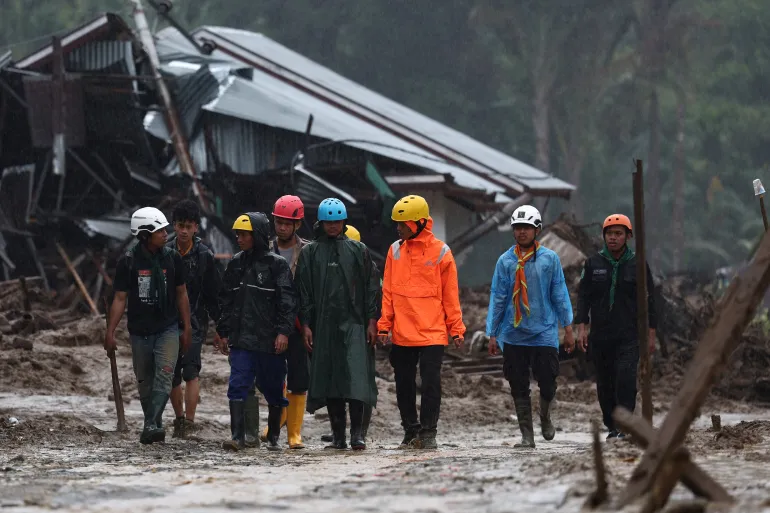
Nearly 1,000 people have been killed, and close to one million displaced, Indonesia has said a week after torrential rains triggered catastrophic floods and landslides.
The National Disaster Management Agency (BNPB) reported late on Sunday that 961 people had been killed, with 234 people missing and about 5,000 injured across the Aceh, North Sumatra and West Sumatra provinces.
The agency also recorded damage to more than 156,000 homes, and 975,075 people had taken refuge in temporary shelters.
Floodwaters have begun to recede in several coastal districts, although large areas in the central highlands are still cut off, BNPB said. However, heavy rain is forecast for parts of the island in the coming days, raising concerns for displaced people.
Indonesia’s rainy season, which usually peaks between November and April, frequently brings severe flooding.
Environmental groups and disaster specialists have warned for years that rapid deforestation, unregulated development and degraded river basins have increased the risks.
Several other countries in Southeast Asia, including Sri Lanka and Thailand, have been hit hard by storms and floods in recent weeks.
Risk to billions
The Asian Water Development Outlook 2025, published by the Asian Development Bank (ADB) on Monday, warned that the impact of climate change on Asia’s water systems poses a risk to billions.
The research said accelerating ecosystem decline and funding shortfalls for investment in critical water infrastructure threaten to plunge many in the sprawling region into water insecurity.
That could jeopardise gains over the past 12 years that have seen more than 60 percent of Asia-Pacific’s population – about 2.7 billion people – escape extreme water insecurity, the report says.
“Asia’s water story is a tale of two realities, with monumental achievements on water security coupled with rising risks that could undermine this progress,” said Norio Saito, the ADB’s senior director for water and urban development.
“Without water security, there is no development,” Saito said, adding that the report showed that urgent action was needed to restore ecosystem health, strengthen resilience, improve water governance, and deploy innovative finance to deliver long-term water security.
Rising disaster threat
The report said extreme weather events such as storm surges, rising sea levels, and saltwater intrusion, along with rising water-related disasters, threaten the region, which already accounts for more than 40 percent of the world’s floods.
That includes the disasters that ravaged Indonesia and other countries in the region in recent weeks.
From 2013 to 2023, the Asia Pacific region experienced 244 major floods, 104 droughts, and 101 severe storms, causing widespread damage to life and property and undermining crucial development gains.
The report said accelerating ecosystem decline was also a serious threat to water security in the region, with rivers, aquifers, wetlands and forests that sustain long-term water security deteriorating rapidly.
It said water ecosystems were deteriorating or stagnating in 30 of the 50 Asian countries it looked at, as they face threats from pollution, unchecked development and the conversion of land to other uses.
Under investment in water infrastructure is another threat to water security.
Asian nations will need to spend $4 trillion for water and sanitation between now and 2040, an outlay of about $250bn a year, the report said.
Currently, governments are collectively spending about 40 percent of that, an annual shortfall of more than $150bn.
[Aljazeera]

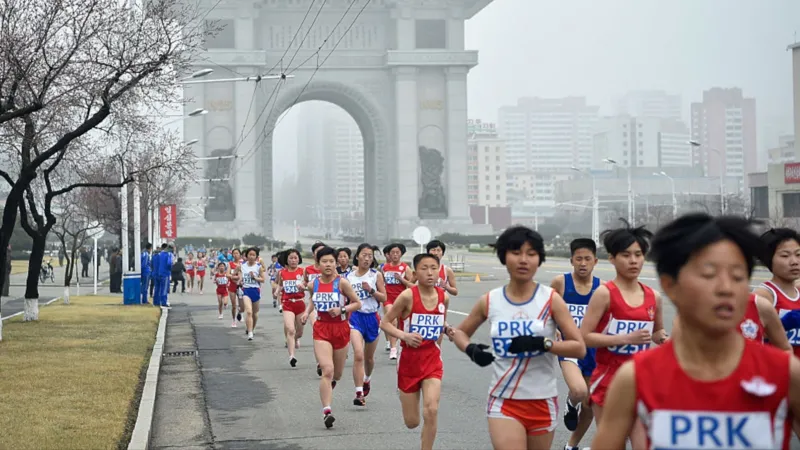
North Korea has cancelled the Pyongyang marathon for unspecified reasons, a tour agency linked to the event has said.
British-owned Koryo Tours, which describes itself as the official partner of the marathon, said on Monday that it had received notice of the cancellation from North Korea’s athletics association.
A message it attributed to the association said the marathon was being cancelled “due to some reasons”.
The annual event was established in 1981 to celebrate the birth of North Korea’s founding leader Kim Il Sung. The 2026 race was set to take place on 5 April.
The message, purportedly from the North Korea athletics association’s general secretary, thanked “all the Elite Marathoners and Amateur Runners of the world who are interested in Pyongyang International Marathon”.
The message gave no further explanation on what the reasons for the cancellation were.
Koryo Tours said it understood the decision was final and had been taken “at a level above the organisers of the event itself”.
It said it would be seeking clarification on the circumstances surrounding the decision.
The tour company added that neither organisers nor event partners were involved in making the decision, and said it recognised “this announcement will be disappointing to many runners who had already registered or were planning to participate”.
Koryo Tours, based in Beijing, China, offers several marathon packages to foreigners, departing from Beijing, Shanghai and Shenyang.
Packages start from €2,190 ($2,529; £1,894) for 2.5 nights in the North Korean capital, Pyongyang, including a marathon place and “highlights” of the capital and tickets were sold out this year, according to the agency’s website.
It said all deposits paid will be returned and runners have the option to retain their deposit for a future event or North Korea tour.
A date for the 2027 marathon has not yet been set.
The event had only returned last year after it was suspended for five consecutive years due to the Covid pandemic.
It is open to both amateur and some professional athletes and offers several race distances – 5km (3.1 miles), 10km (6.2 miles), half marathon (21.1km; 13.1 miles) or full marathon (42.2km; 26.2 miles).
[BBC]
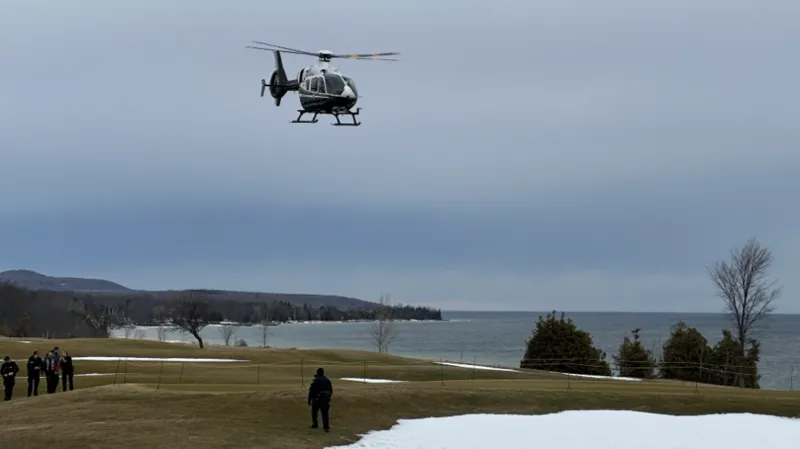
Twenty-three people have been rescued by helicopter crews in Ontario, Canada, after the ice shelf they were standing on broke, sending the group floating into Lake Huron.
Ontario Provincial Police said on social media that the rescue began around noon (16:00 GMT) on Sunday after “winds and current moved the ice shelf away from shore” approximately 2km (1.2 miles).
The rescue involved two helicopters making multiple trips to pluck people off the shelf as it continued to fracture into more pieces in the Owen Sound, about 200km north-west of Toronto.
One member of the group said that he only realised the ice he was fishing on had detached from shore when he noticed that his GPS showed him moving.
Members of the rescued group described harrowing moments, with several of them becoming partially submerged in the cold waters as they sought out the thickest ice on the floe, or sheet.
“I looked at my GPS. We were moving,” fisherman Kevin Fox wrote, identifying himself on Facebook as one of those who were caught up in the incident. “I turned around and saw waves forming behind us.”
He said that he and several others started running towards a route that they hoped still connected to shore.
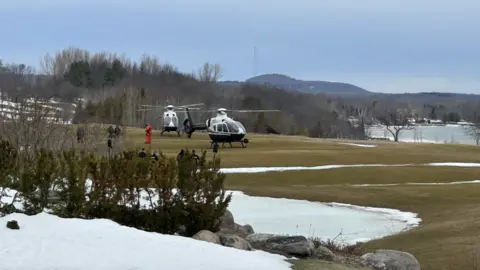
“We decided to run toward one side of the bay, but when we got there the ice had already separated from shore. We turned and ran the other way, but the ice there was breaking apart too,” he wrote.
Some started phoning their families, said Fox, adding: “It’s something I will never forget – seeing grown men crying while saying goodbye to the people they love.”
Fellow fisherman Alfie How told The Owen Sound Sun Times that they eventually “just sat down as a group and said this could be the end”.
Fox told the paper that the rescue occurred during high wind, and the group was concerned that the helicopters would not be able to fly.
“It was being eroded,” Fox said. “It kept getting smaller, and smaller.”
Police say several members of the group suffered hypothermia, but that everyone was expected to make a full recovery.
“Great teamwork and a quick response by all involved,” police added.
Last month in the US state of Vermont, police rescued a group of ice skaters who had also become trapped on floating ice.
Using kayaks and ferry boats, rescuers brought the group back from the icy Lake Champlain.
Officials warn that ice fishing conditions can change rapidly during the relatively warm daylight hours.
[BBC]
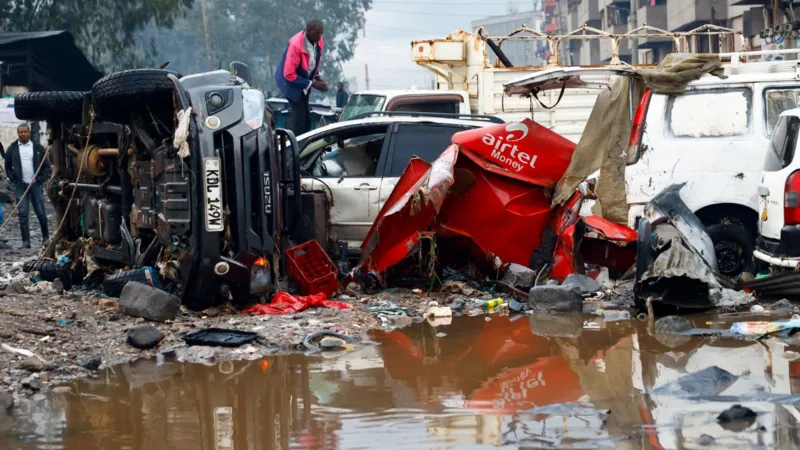
At least 23 people have been killed in Nairobi after heavy rain overnight caused severe flooding in Kenya’s capital city.
Police said about 30 people had been rescued but many others drowned after being swept into rivers – some have been electrocuted.
Kenya’s military has been deployed to help people trapped inside their cars as police described widespread damage to properties as well as road closures.
Several flights bound for Nairobi Airport had to be cancelled or diverted to the coastal city of Mombasa.
“The torrential rains have led to significant flooding, unfortunately resulting in 23 fatalities so far, the destruction of property, road closures, and the displacement of residents,” police said in a statement on Saturday afternoon.
[BBC]

Cabinet approves 14 day Visa extension
Sunil Galagama appointed as District Secretary Badulla

Anupama Mangala Wickramaarachchi appointed District Secretary Ampara
Committee on Economic Surveillance to be established
Cabinet nod to include the National Savings Bank for the Interest-Free Loan Scheme for Students

Nepal election 2026: Counting continues with rapper Balendra Shah’s party close to super-majority

‘Dates have the highest sugar content to fight Coronavirus’

Sunday Island 27 December – Headlines

#SundayIsland 17th December – Headlines

Sunday Island – 28th March

Sunday Island Headlines – 21 March

Sunday Island – 21st February – Headlines
-

 News5 days ago
University of Wolverhampton confirms Ranil was officially invited
-

 News6 days ago
Legal experts decry move to demolish STC dining hall
-

 News5 days ago
Female lawyer given 12 years RI for preparing forged deeds for Borella land
-

 News4 days ago
Peradeniya Uni issues alert over leopards in its premises
-

 Business6 days ago
Cabinet nod for the removal of Cess tax imposed on imported good
-

 News5 days ago
Library crisis hits Pera university
-
 News2 days ago
Repatriation of Iranian naval personnel Sri Lanka’s call: Washington
-

 Business7 days ago
Dialog partners with Ratmalana Audiology Centre for World Hearing Day 2026