
Latest News
ICC shifts Men’s Under 19 World Cup from Sri Lanka to South Africa

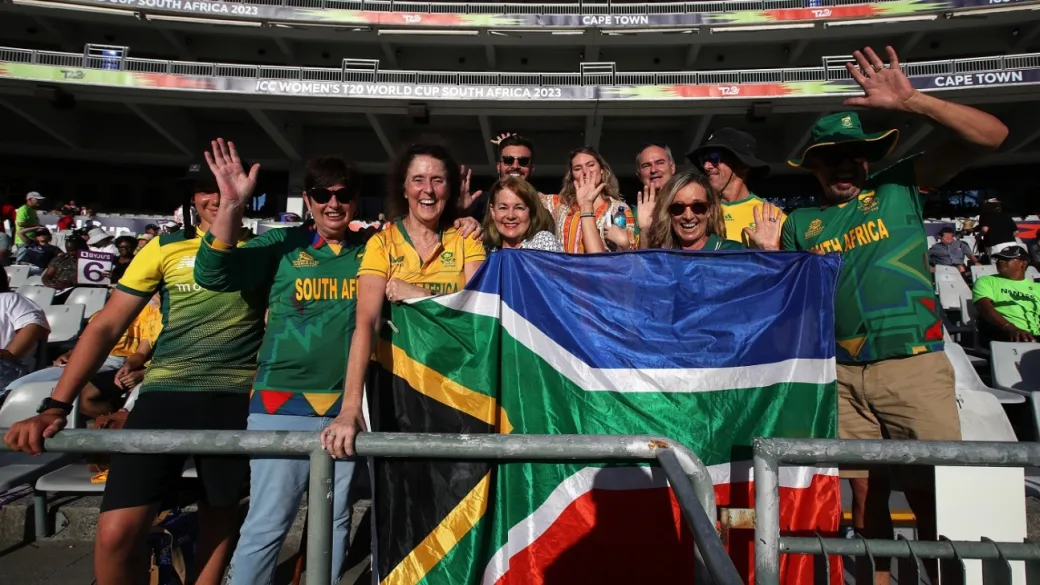
The ICC Board on Tuesday decided to shift the 2024 men’s Under-19 World Cup from Sri Lanka to South Africa. The move, a unanimous decision by the board, was taken as a consequence of the ICC recently provisionally suspending Sri Lanka Cricket (SLC) due to extensive government interference in the board’s administration.
The development will have no immediate implication on the daily running of cricket. ESPNcricinfo has learned that the ICC Board agreed that cricket at all levels, including any bilateral and domestic series and tournaments, will not be disrupted by the suspension. As for the ICC annual funding, that would be controlled until the suspension is lifted.
In a media release, the ICC confirmed moving the tournament to South Africa having heard the SLC. “After hearing representation from SLC, the ICC Board decided that Sri Lanka can continue to compete internationally both in bilateral cricket and ICC events after being suspended recently for breaching its obligations as a Member in particular the requirement to manage its affairs autonomously and without government interference.”
Shammi Silva, SLC president, had recently warned that the biennial tournament, scheduled in January 2024 was in danger of being moved out of the country unless the ICC was satisfied that Sri Lanla government was not meddling in board’s working, which goes against the ICC constitution. The SLC and the country’s sports minister Roshan Ranasinghe have been in conflict over the past year, with Ranasinghe making accusations of corruption and mismanagement in the cricket board, while Silva and SLC accuse him of meddling with cricket.
Silva also notified the ICC in November 2022 of government interference which forced the ICC Board to ask its deputy chairman Imran Khawaja to travel to Sri Lanka to establish the facts.
Four cities shortlisted
The 16-team tournament, originally scheduled for January 13 – February 4 in Sri Lanka, is likely to be played close to the same window. The venues for the 2024 edition are likely to be Benoni, Potchefstroom, Kimberley, and Bloemfontein. It is understood that South Africa and the UAE were among the shortlist of venues the ICC had pencilled in as contingencies in case it had to be moved out of Sri Lanka. The UAE, though, had to be ruled out with the ILT20 clashing with the World Cup.
The top 11 Full Member sides from the 2022 edition have qualified directly, and five teams – Namibia, Nepal, New Zealand, Scotland, and USA – have earned their spots through regional qualification events. The 2024 edition will also be played in a fresh format – with the ‘Super Sixes’ a new segment during the second stage of the event.
India, with five titles, are the most successful team in the competition’s history, followed by Australia with three. Pakistan have won twice and each of England, Bangladesh, South Africa, and West Indies have lifted the crown once. For fans in South Africa, the tournament now clashes with the SA20 franchise competition that runs from January 10 to February 10.
(Cricinfo)









Latest News
Heat Index at Caution Level in the Northern, North-central, North-western, Western, Sabaragamuwa, Eastern and Southern provinces and in Monaragala district.

Warm Weather Advisory
Issued by the Natural Hazards Early Warning Centre
at 3.30 p.m. on 20 April 2026, valid for 21 April 2026
The Heat index, the temperature felt on human body is likely to increase up to ‘Caution level’ at some places in the Northern, North-central, North-western, Western, Sabaragamuwa, Eastern and Southern provinces and in Monaragala district.
The Heat Index Forecast is calculated by using relative humidity and maximum temperature and this is the condition that is felt on your body. This is not the forecast of maximum temperature. It is generated by the Department of Meteorology for the next day period and prepared by using global numerical weather prediction model data.

Effect of the heat index on human body is mentioned in the above table and it is prepared on the advice of the Ministry of Health and Indigenous Medical Services.
ACTION REQUIRED
Job sites: Stay hydrated and takes breaks in the shade as often as possible.
Indoors: Check up on the elderly and the sick.
Vehicles: Never leave children unattended.
Outdoors: Limit strenuous outdoor activities, find shade and stay hydrated.
Dress: Wear lightweight and white or light-colored clothing.
Note:
In addition, please refer to advisories issued by the Disaster Preparedness & Response Division, Ministry of Health in this regard as well. For further clarifications please contact 011-7446491.
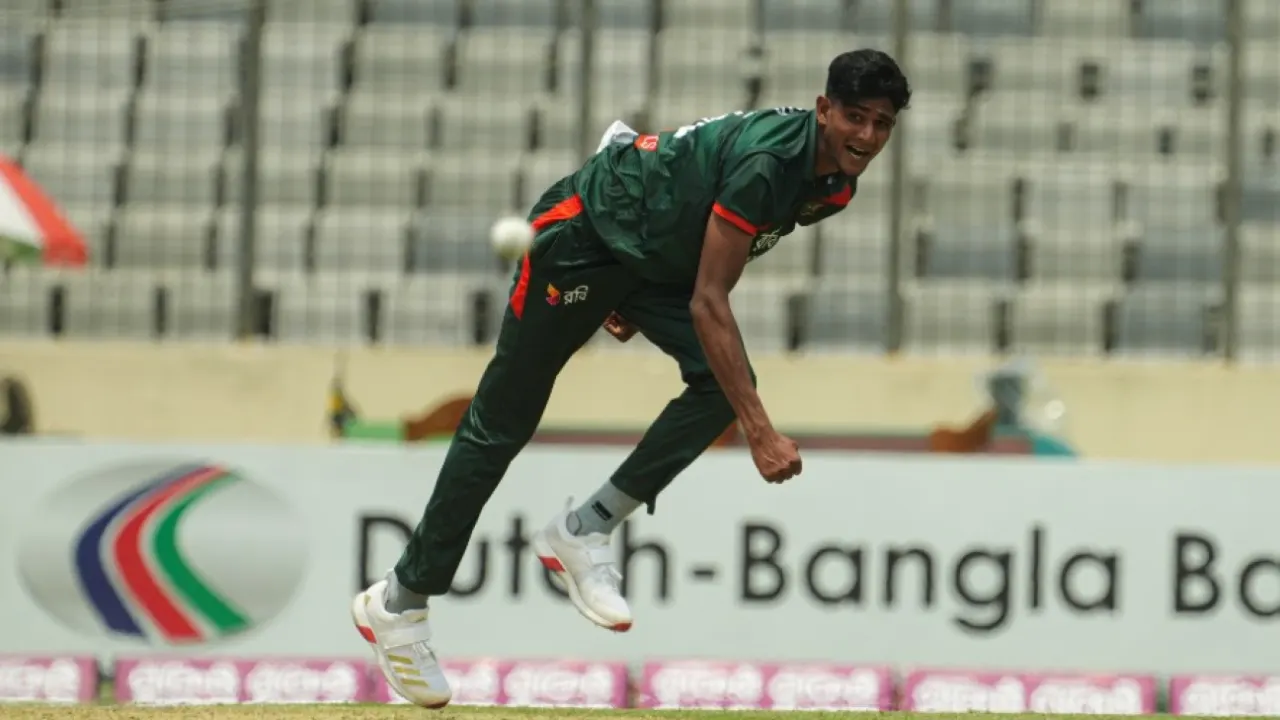
Nahid Rana’s five-wicket haul followed by Tanzid Hasan’s fiery half-century got Bangladesh a six-wicket win against New Zealand. The home side leveled the ODI series, setting up the decider in Chattogram on Thursday.
It was a much-needed contribution from the Bangladesh batters, who were criticised for losing the first game by 26 runs. This time, the bowlers blew a hole through New Zealand’s top and middle orders, with Rana taking 5 for 32, his second five-for in ODIs, before the batters got them home in 35.3 overs.
Bangladesh’s chase, however, began with uncertainty once again. Nathan Smith burst through Saif Hassan with an excellent inswinger in the first over. Soumya Sarkar, drafted into the playing XI to replace Afif Hossain, fell after making eight runs. He struck Will O’Rourke for a six but New Zealand captain Tom Latham kept the three slips as he urged O’Rourke to keep bowling bouncers.
Soumya fell into the trap, when his attempted glide with a vertical bat, only reached Dean Foxcroft at third slip. Tanzid retaliated almost immediately, hitting Smith for two sixes in the fifth over. The first was over long-on, the next over midwicket with a lovely flick.
Tanzid reached his fifty with his third six, slog sweeping Foxcroft over midwicket in the 15th over. He took just 33 balls to reach his sixth half-century in ODIs.
Najimul Hossain Shanto, who made a golden duck in the first game, was more of his dominant self, complementing Tanzid’s efforts in their third-wicket partnership. Shanto struck Foxcroft’s half-tracker for six in the 17th over, before launching Jayden Lennox over long-off for a similar result.
Tanzid was racing towards a big score, hammering Lennox for his fourth six in the 23rd over. But the left-arm spinner had the last laugh the very next ball as Tanzid top-edged a hoick across the line for Henry Nicholls to take a steepling catch tracking back at cover. It ended a 120-run third wicket stand.
Litton Das, playing his 100th ODI, couldn’t add much to the total, when Lennox had him caught off a slog in his next over. Shanto hobbled off the field after completing his fifty due to cramps.
Towhid Hridoy and Mehidy Hasan Miraz added 32 to complete the chase. Hridoy made an unbeaten 30 off 31 balls with five fours, while Mehidy struck the winning run in the 36th over.
Rana had earlier dominated the New Zealand batting line-up whenever captain Mehidy handed him the ball. He took the first two wickets: Henry Nicholls, New Zealand’s top scorer from the first game, trapped lbw, before a 146kph bouncer got Will Young. Rana got the ball to rear into the No 3 batter, who could only guide it to gully where Soumya took an easy catch.
Nick Kelly found Muhammad Abbas as a willing ally, as the pair rebuild the New Zealand innings in the middle overs. Abbas broke the boundary drought of 33 balls, when he edged Soumya to deep third in the 20th over. Kelly struck another bookended the over with another four before driving Mehidy Hasan Miraz through cover in the following over.
Kelly then laid into Taskin Ahmed, driving him down the ground and clipping him over midwicket among his three fours in the 25th over. Kelly soon reached his fifty in the 27th over, before Rana, brought back into the attack, removed Abbas. Wicketkeeper Litton ran quite a distance towards fine-leg, where he dived to complete a brilliant catch. Litton had earlier taken a fine tumbling catch to remove Tom Latham, the New Zealand captain, off Soumya’s bowling
Kelly started to apply himself as a more aggressive batter. He moved a lot around the crease, even getting hit on his visor when he tried to hook Shoriful Islam’s length ball in the 35th over. He fell to the same bowler in his next over, caught at midwicket for 83.
Bangladesh’s fielders contributed to their good showing. Towhid Hridoy took three catches including a superb effort at long-on to end the New Zealand innings.
Rana added two more to his kitty in the death overs, removing Dean Foxcroft for 15, before yorking Jayden Lennox for a duck. Rana’s five wickets apart, Shoriful Islam took two wickets while Rishad Hossain, Taskin Ahmed and Soumya took a wicket each.
Brief scores:
Bangladesh 199 for 4 in 35.3 overs (Tanzid Hasan 76, Najmul Hossain Shanto 50 retd, Towhid Hridoy 30*; Jayden Lennox 2-36) beat New Zealand 198 in 48.4 overs (Nick Kelly 83; Nahid Rana 5-32, Shoriful Islam 2-32) by six wickets
[Cricinfo]

Heat Index at Caution Level in the Northern, North-central, North-western, Western, Sabaragamuwa, Eastern and Southern provinces and in Monaragala district.

Dasun Shanaka handed one-year PSL ban

Nahid, Tanzid help Bangladesh level New Zealand series

Five UAE cricketers given citizenship through naturalisation

Moni, Sharmin help Bangladesh register maiden ODI win against Sri Lanka

Advisory for Severe Lightning issued for all provinces of Sri Lanka

‘Dates have the highest sugar content to fight Coronavirus’

Sunday Island 27 December – Headlines

#SundayIsland 17th December – Headlines

Sunday Island – 28th March

Sunday Island Headlines – 21 March

Sunday Island – 21st February – Headlines
-

 News5 days ago
PNS TAIMUR & ASLAT set sail from Colombo
-

 Business3 days ago
Harnessing nature’s wisdom: Experts highlight “Resist–Align” path to resilience
-

 News3 days ago
Gratiaen Trust announces longlist for the 33rd Annual Gratiaen Prize
-

 Latest News7 days ago
“I extend my heartfelt wishes to all Sri Lankans for a peaceful and joyous Sinhala and Tamil New Year!” – President
-

 News2 days ago
From Nuwara Eliya to Dubai: Isha Holdings markets Agri products abroad
-

 News3 days ago
Heroin haul transported on 50-million-rupee contract
-

 Latest News4 days ago
Singapore Zoo’s first Sri Lankan leopard cubs make their public debut
-

 Latest News7 days ago
US blockade of Iran would worsen global energy crisis, analysts say