
News
House to debate draft Central Bank law on May 11


Parliament is scheduled to take up for debate a bill for a new central bank law on May 11 and a welfare benefit bill on May 12, a statement from the parliament said.The controversial new central bank is expected to legalize output gap targeting (printing money for growth) as a sub objective.
The banks will also get a legal mandate to simultaneously operate money and exchange polices, (so-called dual anchor or impossible trinity regime), in the course of operating flexible inflation targeting regime.
Provisional advances – another form of delivering liquidity shocks – will be done for interest instead of free as of now.
Sri Lanka has had monetary instability from shortly after the central bank was created in 1950 with simultaneous money and exchange policies but the country had managed to avoid external sovereign default until 2022.
Flexible inflation targeting with output gap targeting with aggressive open market operations started around seven years ago after the IMF gave technical assistance to calculate a so-called potential output.



The government, under heavy Opposition fire over inclusion of a sex website in the Grade 6 English module, as well as overall education reforms, has decided to put on hold reforms in respect of Grade 6.
Cabinet Spokesman and Media and Health Minister Dr. Nalinda Jayatissa announced the government decision yesterday (13) at the post-Cabinet media briefing at the Information Department.
According to him, the decision had been taken at the previous day’s Cabinet meeting, chaired by President Anura Kumara Dissanayake. Dr. Jayatissa said that education reforms pertaining to Garde 6 had been put on hold until 2027.
The Minister said that other proposed education reforms would be implemented as planned. The Minister said that action would be taken against those responsible for the inclusion of a link to a sex website following investigations conducted by the Criminal Investigation Department and the National Education Institute.
The SJB and several other political parties, as well as civil society groups, have accused the government of promoting an LGBTQ agenda, through the proposed education reforms.
The Opposition grouping Mahajana Handa, on Monday, made representations to the Mahanayake Thera of the Malwatta Chapter regarding the controversial reforms, while urging their intervention to halt the project.
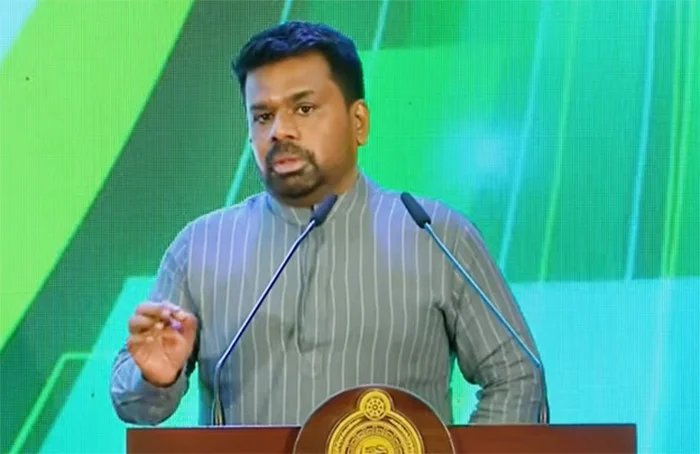
President Anura Kumara Dissanayake yesterday (13) vowed to go ahead with his government’s agenda, regardless of the destruction caused by Cyclone Ditwah.
Emphasising the responsibility on the part of all to contribute to the post-Ditwah recovery efforts, President Dissanayake said that he would have complete faith in the public service.
The President said so at the launch of the re-building Sri Lanka project at the BMICH yesterday.
The JVP and NPP leader said that he wouldn’t take advantage of the death and destruction caused by the cyclone or use the situation as an excuse to reverse their agenda or weaken it.
President Dissanayake said that in spite of many calling for amending the then Budget, in view of the cyclone, the government presented the proposals that were agreed before the disaster struck.

The United States has announced that it will provide the Sri Lanka Air Force with 10 US Navy TH-57 helicopters free of charge.
The announcement was made by outgoing US Ambassador Julie Chung, who stated, on social media, that the helicopters would be transferred under the United States’ Excess Defence Articles programme. The aircraft are Bell 206 Sea Ranger helicopters previously operated by the US Navy.
US sources said that the transfer was intended to strengthen Sri Lanka’s disaster response capabilities, following the devastating cyclone that struck the island at the end of 2025 and killed more than 600 people. US officials have framed the move as a humanitarian measure aimed at improving aerial rescue and relief operations.

Fair weather will prevail except for a few showers in the Uva, Eastern, Western and Central provinces and in Galle, Matara and Rathnapura districts

Trump cancels US-Iran meetings, urges protesters to take over institutions

Govt. bows to pressure, shelves Grade 6 reforms

AKD: Govt. agenda on track despite Ditwah disaster

SL to receive 10 helicopters from US

Foreign couple held over alleged biopiracy at Horton Plains

‘Dates have the highest sugar content to fight Coronavirus’

Sunday Island 27 December – Headlines

#SundayIsland 17th December – Headlines

Sunday Island – 28th March

Sunday Island Headlines – 21 March

Sunday Island – 21st February – Headlines
-

 Business3 days ago
Dialog and UnionPay International Join Forces to Elevate Sri Lanka’s Digital Payment Landscape
-
 News3 days ago
Sajith: Ashoka Chakra replaces Dharmachakra in Buddhism textbook
-

 Features3 days ago
The Paradox of Trump Power: Contested Authoritarian at Home, Uncontested Bully Abroad
-

 Features3 days ago
Subject:Whatever happened to (my) three million dollars?
-

 News3 days ago
Level I landslide early warnings issued to the Districts of Badulla, Kandy, Matale and Nuwara-Eliya extended
-

 News3 days ago
National Communication Programme for Child Health Promotion (SBCC) has been launched. – PM
-

 News3 days ago
65 withdrawn cases re-filed by Govt, PM tells Parliament
-

 Opinion5 days ago
The minstrel monk and Rafiki, the old mandrill in The Lion King – II