
Business
HIP has potential to become Sri Lanka’s ‘Diamond in the Crown’ – Sri Lanka Shippers’ Council


The Sri Lanka Shippers’ Council, led by its Executive Committee, conducted a comprehensive visit to the Hambantota International Port (HIP) last week, emphasizing its critical role in Sri Lanka’s future economic development an HIP press release said.
Chairman of the Council, Sean van Dort who headed the 42-member delegation said it had been a pleasure for Council members to visit the Hambantota Port. “Comparing 2017 to now, we see drastic positive changes that have taken place and we have no hesitation in recommending this beautiful facility that only has the potential to grow and be a diamond in the crown of Sri Lanka,” he added.
The visit centred around inspecting HIP’s current facilities and discussions on future plans, with the port’s management team, who briefed the Council on upcoming developments and corporate social responsibility (CSR) initiatives. During the discussions, the Council delegates inquired about additional shipping lines calling at HIP and the prospect of establishing a feeder service from Hambantota to Colombo. HIP officials indicated that while negotiations are ongoing with shipping lines, current trade volumes did not yet warrant a dedicated feeder service, the release explained.
Chullante Jayasuriya, Honorary member of Sri Lanka Shippers Council said, “This is my second official visit. The first one was in 2016 when we were here for the 50th Anniversary of the Sri Lanka Shippers Council, and what I saw today was the remarkable development and progress that the port has achieved in a mere span of eight years, and it all goes very well for the future of the country and for the future of the economy of the country. We had three very impressive presentations by the port’s senior management, which left nothing to doubt. They also showed us their plans for the future. I have every hope that these plans will come to fruition and that we will have a second international-class port in the south of the country.”
On their 2016 visit to HIP, to mark the new Shippers Council’s 50th anniversary, they had planted 50 king coconut and cashew plants at the port. This time too council members planted king coconut trees to commemorate their visit and support HIP’s green initiatives.
Visiting members of the Shippers Council represented some of the most esteemed institutions in Sri Lanka. A key point they raised at the discussion was the need for improved connectivity, suggesting a rail line between Hambantota and Colombo to ease transportation costs and congestion, particularly when Colombo Port is at full capacity.
Bindu Ranasinghe, Deputy General Manager HIP, while acknowledging the importance of the request, clarified that rail infrastructure was outside HIP’s current scope. However, he informed the council that the port was actively engaged in exploring cost-effective transport alternatives to benefit the country’s shippers and consignees.
The Sri Lanka Shippers’ Council, established over 50 years ago, represents a significant portion of the country’s import/export trade, with its membership spanning Chambers of Commerce, Trade Associations, and several other diverse organisations. The Council remains committed to advocating fair freight rates, preventing surcharge increases, settling trade disputes, and advancing shipping awareness.
The latest visit to HIP by the Sri Lanka Shippers Council further affirms the support extended to the port. It is also an acknowledgment of the pivotal role HIP plays in strengthening Sri Lanka’s position in the global trade network and its evolution into a world-class hub in the southern region of the island.

Business
Prime Minister Holds Bilateral Meetings with ADB Leadership and Participates in education policy dialogue in Manila


Prime Minister Dr. Harini Amarasuriya held a series of bilateral meetings with senior officials of the Asian Development Bank (ADB) on 10 March at the ADB Headquarters in Manila, during her official visit to the Philippines. The discussions focused on strengthening development cooperation between Sri Lanka and the ADB, reviewing ongoing projects, and exploring opportunities for future collaboration.
The Prime Minister first met with ADB President Masato Kanda. During the meeting, both sides reaffirmed the strong partnership between Sri Lanka and the Asian Development Bank. President Kanda welcomed the Prime Minister’s visit and commended Sri Lanka’s efforts to stabilise the economy and advance recovery following the recent economic crisis.
Prime Minister Amarasuriya expressed Sri Lanka’s appreciation for the continued support extended by ADB, including assistance provided in response to the impacts of Cyclone Ditwah and the Bank’s broader development cooperation with the country. She highlighted the importance of ADB-supported initiatives across key sectors that contribute to Sri Lanka’s ongoing recovery and long-term development.
The Prime Minister also held discussions with Yingming Yang, Vice President (South, Central and West Asia) of ADB, where both sides reviewed the progress of ongoing ADB-funded projects in Sri Lanka and explored opportunities to further strengthen collaboration in areas such as health, education, and social development.
In a separate meeting with Christine Engstrom, Director General of Sectors Department 3, discussions focused on sector-specific initiatives supported by ADB, particularly in human and social development, public sector management, and financial sector reforms. The Prime Minister noted that future investments in the education sector should place greater emphasis on human resource development and improving the quality of teaching and learning, alongside infrastructure development.
Following these meetings, the Prime Minister participated in a Policy Dialogue on Education and Skills Development, which brought together representatives from ASEAN institutions, Philippine education authorities, and ADB officials. The dialogue focused on regional education systems, policy collaboration, and initiatives aimed at strengthening education and skills development frameworks.
During the discussion, the Prime Minister highlighted the importance of expanding education cooperation between Sri Lanka and the Philippines, particularly in areas of policy exchange and institutional collaboration. Participants also discussed the development of the Technical and Vocational Education and Training (TVET) sector and explored opportunities to strengthen skills development frameworks to better align with emerging economic demands.
The engagements in Manila reaffirmed the shared commitment between Sri Lanka, the Asian Development Bank, and regional partners to deepen cooperation in advancing sustainable development, strengthening education systems, and promoting inclusive economic growth.

(Prime Minister’s Media Division)
Business
Sri Lanka’s midnight fuel price hike sparks frustrations amidst claims of broken assurances


The government’s decision to raise fuel prices at midnight on March 9 has drawn criticism from observers who say the move contradicts earlier assurances that prices would remain stable for at least a month due to sufficient reserves already imported.
The surprise revision in fuel prices has triggered public concern and renewed debate over the government’s fuel pricing policy, with critics accusing authorities of misleading the public about the stability of supply and prices.
Officials had earlier sought to calm fears of potential shortages or sudden price increases, insisting that the country had adequate fuel stocks secured through prior imports. However, the latest price hike has raised questions about the reliability of those assurances.
Economic analysts say the development reflects the continuing vulnerability of Sri Lanka’s fuel market to global price volatility and geopolitical tensions affecting energy supply chains.
Aminda Methsila Perera, an economics professor at Wayamba University of Sri Lanka, said the latest move raises broader questions about the transparency of the government’s pricing strategy.
“The question arises whether the government is following a grey-market policy in this regard,” Prof. Perera said, suggesting that the manner in which prices are adjusted may not fully reflect a transparent or predictable formula.
Meanwhile, directors of the state-run Ceylon Petroleum Corporation (CPC) defended the decision, saying the increase was a pre-emptive measure aimed at cushioning the country from steeper price shocks in the near future.
A CPC director argued yesterday that implementing a moderate price revision now would allow authorities to manage potential increases more effectively should the international situation deteriorate further.
Meanwhile, an analyst said that the move was intended to preserve the financial stability of the CPC and its bottom line although President AKD had said in parliament that the Treasury had enough funds to mitigate global shocks.
However, they say the abrupt nature of the midnight announcement risks undermining public confidence, particularly after repeated assurances that prices would remain unchanged in the short term.
With global energy markets remaining volatile, analysts warn that further price adjustments cannot be ruled out if international crude prices continue to climb or if regional supply disruptions intensify.
Meanwhile, an economist said that with the unfolding scenario, many Sri Lankans already grappling with the rising cost of living, have been tossed to the fire from the frying pan.
By Sanath Nanayakkare
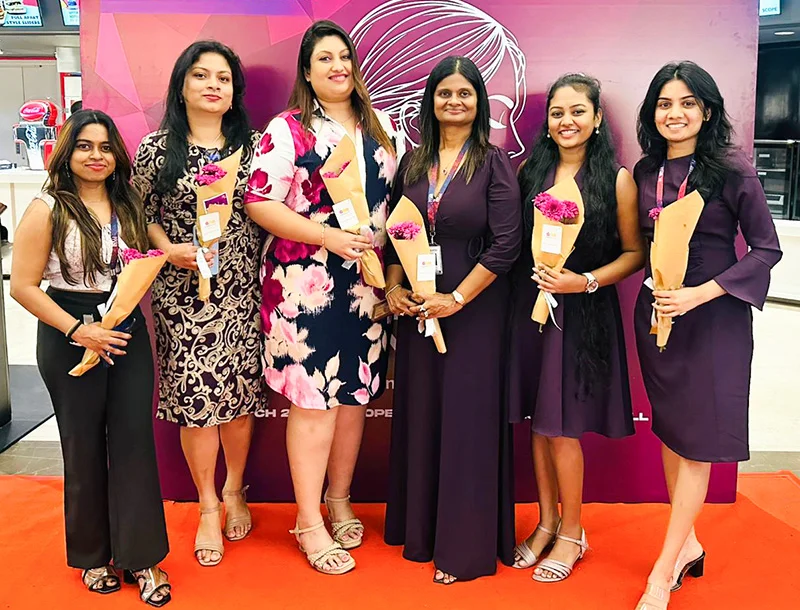
In celebration of International Women’s Day 2026, Havelock City Mall (HCM) hosted what is believed to be one of Sri Lanka’s first women-only cinema screenings, presenting a culturally significant and deeply meaningful tribute to womanhood.
Held at Scope Cinemas, Havelock City Mall, the exclusive event featured a complimentary screening of the iconic Sri Lankan film Gahanu Lamai, and welcomed an audience comprising corporate invitees, celebrities, female staff of Havelock City Mall, and winners of a special social media contest.
The occasion was further distinguished by the presence of Dr. Ranee Jayamaha, Chairperson of Overseas Realty (Ceylon) PLC, who graced the event and added significance to this special celebration.
Guests arrived dressed in purple, the internationally recognised symbol of dignity, solidarity, and justice, reinforcing the spirit and symbolism of the occasion. Through the screening of Gahanu Lamai—the acclaimed work of the late Dr. Sumitra Peiris, Sri Lanka’s first female film director—Havelock City Mall created a platform for reflection on the enduring cultural and contemporary relevance of women’s stories.
Commenting on the initiative, Mrs. Avanthie De Zoysa, Assistant General Manager of Havelock City Mall, stated:
“As a female manager of this organization, I am incredibly proud of this initiative. It is a heartfelt gesture of appreciation for the women who contribute so tirelessly to their families, to our society, and to the country at large. We wanted to provide a space that wasn’t just about celebration, but about acknowledging the profound impact women have in every sphere of life.”

EU-approved sterile pharma facility launched

Prime Minister Holds Bilateral Meetings with ADB Leadership and Participates in education policy dialogue in Manila

Nahid Rana and Tanzid Hasan complete Pakistan’s demolition in opening ODI

Prime Minister highlights the importance of recognising Women’s Unpaid Care Work

Australia grants asylum to 2 more members of Iranian women’s football team

Showers are likely in the Northern, Eastern, Sabaragamuwa, Southern and Uva provinces and in Kandy and Nuwara-Eliya districts

‘Dates have the highest sugar content to fight Coronavirus’

Sunday Island 27 December – Headlines

#SundayIsland 17th December – Headlines

Sunday Island – 28th March

Sunday Island Headlines – 21 March

Sunday Island – 21st February – Headlines
-
 News6 days ago
University of Wolverhampton confirms Ranil was officially invited
-

 News7 days ago
Legal experts decry move to demolish STC dining hall
-

 News5 days ago
Peradeniya Uni issues alert over leopards in its premises
-

 News6 days ago
Female lawyer given 12 years RI for preparing forged deeds for Borella land
-
 News3 days ago
Repatriation of Iranian naval personnel Sri Lanka’s call: Washington
-
 News6 days ago
Library crisis hits Pera university
-

 News5 days ago
Wife raises alarm over Sallay’s detention under PTA
-

 News6 days ago
‘IRIS Dena was Indian Navy guest, hit without warning’, Iran warns US of bitter regret