
News
Health benefits of green tea could be boosted by consuming it with gotu kola

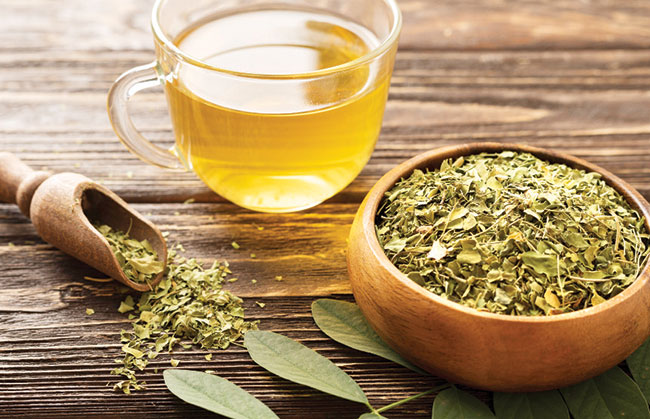
A study conducted by Dr Sameera Samarakoon of the Institute of Biochemistry, Molecular Biology and Biotechnology, University of Colombo, with renowned Food Scientist Dr. D. B. T. Wijeratne, has found that consuming green tea with gotu kola (Centella asiatica) as a mix could produce many health benefits. Gotu kola enhances the antioxidant, antiviral and immune-boosting properties of green tea.
Pegged as the herb of longevity, gotu kola is a staple in traditional Asian medicinal practices and green tea is one of the most popular health beverages around the world. Health benefits of green tea are well known and it is commonly consumed by many people owing to its antioxidant properties, reduction of obesity, prevention of cancer, reduction of blood pressure, etc. Similarly, in ancient medicinal practices in India, Japan, China, Indonesia, South Africa, Sri Lanka, and the South Pacific, the health benefits of gotu kola is well known. Modern laboratory tests have confirmed that the gotu kola has antioxidant properties, beneficial effects to the liver, skin protection and improving cognitive function and memory power. All health benefits of both could be obtained when consuming a mixture of green tea and gotu kola, Dr Samarakoon said.

He said that gotu kola should not exceed more than 20 percent of the mixture due to reduction in acceptability as a beverage.
He said that green tea and gotu kola could be recommended as herbal beverages.
Dr Wjieratne said that previous studies had confirmed that consumption of gotu kola had a positive effect on improving liver health especially with regard to the most common type of primary liver cancer, Hepatocellular carcinoma, fatty liver and liver cirrhosis. Recent research has also pointed out that gotu kola could help reduce blood pressure and cardiovascular diseases including stroke, myocardial infarction and coronary artery disease. Pharmacological studies have reported that the gotu kola extract can regulate the central nervous system activity and enhance cognitive function in the brain.
Dr Wijeratne pointed out that the health benefits of green tea have been well known around the world. Compared to gotu kola there was more scientific research with regard to green tea’s health benefits. Green tea is rich in catechin, polyphenols, particularly Epigallocatechin gallate (EGCG). The EGCG is a powerful antioxidant which kills cancer cells without harming the normal cells. This compound is also effective in lowering LDL cholesterol levels, inhibiting the abnormal formation of blood clots and reduction of platelet aggregation. In addition, it has been found that green tea extract is a promising source of natural antioxidants that has been effectively utilized to enhance the antioxidant properties, Dr Wijeratne said.
He said that obesity had been identified as the major cause of a number of diseases, including coronary heart diseases, hypertension, non-insulin dependent diabetes, pulmonary dysfunction, osteoarthritis and certain types of cancer. Tea catechin, especially EGCG, appears to have an anti-obesity and diabetes effect. Green tea was also seen as a natural herb that can enhance energy expenditure and fat oxidation and thereby induce weight loss, Dr Wijeratne said, adding that consumption of a combination of two herbals could provide plentiful health benefits.


Bus fares have been increased by 12.19% with effect from midnight today [23rd March 2026].
The minimum fare will be increased from Rs 27 to Rs 30 while the maximum fare of Rs2159/- will be increased to 2422/-
Latest News
Public will not be served as Computer system failure at Department of Registration of Persons

The Acting Commissioner General of Registration of Persons has announced that due to an unexpected failure of the computer system of the Department of Registration of Persons, all services, including the one day service will not be held on Tuesday (24th March) at the Head Office and all Provincial offices.

Latest News
Heat Index at Caution Level in the Western, Sabaragamuwa, Southern and North-western provinces and in Anuradhapura, Mannar and Vavuniya districts
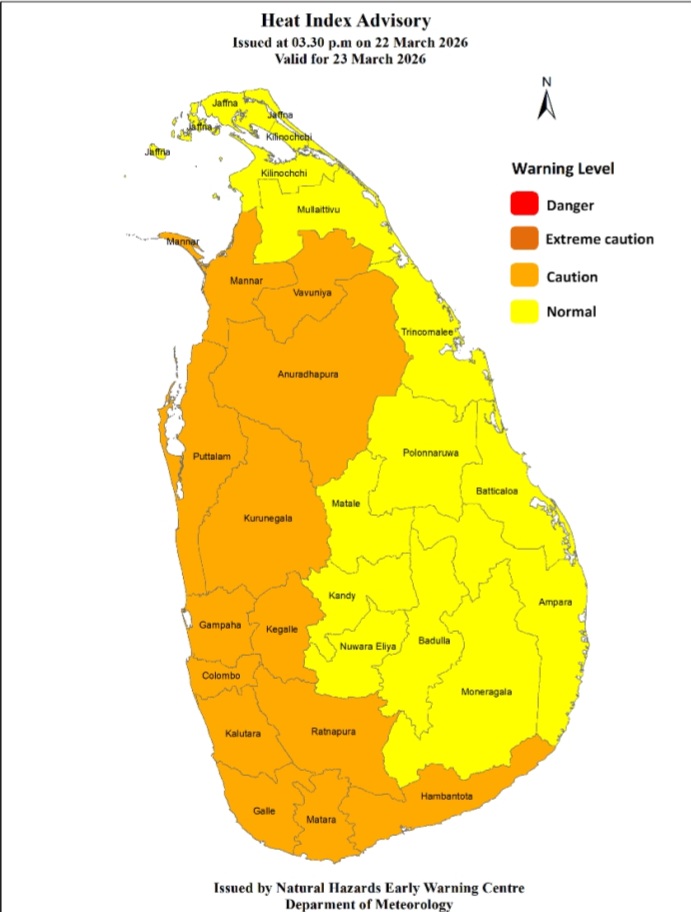
Warm Weather Advisory
Issued by the Natural Hazards Early Warning Centre of the Department of Meteorology
at 3.30 p.m. on 22 March 2026, valid for 23 March 2026.
The Heat index, the temperature felt on human body is likely to increase up to ‘Caution level’ at some places in the Western, Sabaragamuwa, Southern and North-western provinces and in
Anuradhapura, Mannar and Vavuniya districts.
The Heat Index Forecast is calculated by using relative humidity and maximum temperature and this is the condition that is felt on your body. This is not the forecast of maximum temperature. It is generated by the Department of Meteorology for the next day period and prepared by using global numerical weather prediction model data.

Effect of the heat index on human body is mentioned in the above table and it is prepared on the advice of the Ministry of Health and Indigenous Medical Services.
ACTION REQUIRED
Job sites: Stay hydrated and takes breaks in the shade as often as possible.
Indoors: Check up on the elderly and the sick.
Vehicles: Never leave children unattended.
Outdoors: Limit strenuous outdoor activities, find shade and stay hydrated.
Dress: Wear lightweight and white or light-colored clothing.
Note:
In addition, please refer to advisories issued by the Disaster Preparedness & Response Division, Ministry of Health in this regard as well. For further clarifications please contact 011-7446491.

Two killed when Air Canada jet hits fire truck at NYC’s LaGuardia Airport

Bus fares increased by 12.19% from midnight today [23]
Public will not be served as Computer system failure at Department of Registration of Persons

Trump says he is postponing strikes on Iran power plants after ‘productive’ talks on ending war

Asia stocks slide as US and Iran threaten to escalate war

Heat Index at Caution Level in the Western, Sabaragamuwa, Southern and North-western provinces and in Anuradhapura, Mannar and Vavuniya districts

‘Dates have the highest sugar content to fight Coronavirus’

Sunday Island 27 December – Headlines

#SundayIsland 17th December – Headlines

Sunday Island – 28th March

Sunday Island Headlines – 21 March

Sunday Island – 21st February – Headlines
-

 News6 days ago
CIABOC questions Ex-President GR on house for CJ’s maid
-

 News7 days ago
Sri Lankan marine scientist Asha de Vos honoured at UNGA opening
-

 News7 days ago
Australian HC debunks misleading travel risk claims for Sri Lanka
-

 News5 days ago
Bailey Bridge inaugurated at Chilaw
-

 News5 days ago
Pay hike demand: CEB workers climb down from 40 % to 15–20%
-

 News4 days ago
CIABOC tells court Kapila gave Rs 60 mn to MR and Rs. 20 mn to Priyankara
-

 Editorial6 days ago
Couple QR-based quota with odd-even rationing
-

 News3 days ago
Colombo, Oslo steps up efforts to strengthen bilateral cooperation in key environmental priority areas