
Sports
Hathurasingha’s dismissal linked to Nasum incident, reveals BCB report


Former Bangladesh skipper Shakib al Hasan has accused Tamim Iqbal and former BCB cricket operation chairman Jalal Yunus of trying ‘to build a case’ to oust former coach Chandika Hathurusingha from the national team. Shakib alleges that they did so by leaking Hathurusingha’s altercation with Nasum Ahmed to the media.
The Bangladesh Cricket Board formed a three-member committee to assess their 2023 World Cup failure. According to the report of the committee, which was accessed by Cricbuzz, the reason for Hathurasingha’s dismissal was cited to be his altercation with Nasum Ahmed, a claim Hathurasingha recently denied while stating that he fled Bangladesh fearing for his life.
Between December 2023 and January 2024, the special committee conducted private one-on-one meetings with the following persons. It should be noted that all conversations were recorded and documented with the consent of those invited:
Cricketers – Mustafizur Rahman, Litton Kumar Das, Nasum Ahmed, Hasan Mahmud, Tanzim Sakib, Mahmudullah Riyad, Shakib Al Hasan (Bangladesh Captain at World Cup 2023), Tamim Iqbal (not part of the World Cup Squad)
Team Management & Coaching Staff – Rabeed Imam (National Team Operations Manager, World Cup 2023), Nicholas Lee (National Team Strength & Conditioning Coach), Chandika Hathurusingha (National Team Head Coach), Bayjedul Islam Khan (National Team Physio), Khaled Mahmud (National Team Director)
National Selection Panel – Minhazul Abedin (Chairman, National Selection Panel), Kazi Habibul Bashar (Member, National Selection Panel).
BCB Director – Mohammed Jalal Yunus (Chairman, Cricket Operations Committee, BCB).
“Handing over of captaincy at the eleventh hour was not ideal. The captaincy could have been announced before the Asia Cup. The Head Coach was unable to execute his duty properly due to inadequate time to prepare before the World Cup,” Shakib said in his recorded statement.
“The reason for the poor performance at the World Cup is the frequent changing of players. The media had also influenced this. Changes in the batting order had created problems and resulted in bad performance,” he said.
Shakib added that during the World Cup, division between Hathurusingha and other coaches were visible. “The current head coach (Hathurusingha) is good for the Bangladesh team. However, during the World Cup, the tension between the Head Coach and the other Coaches was visible. The formation of the World Cup team was alright. Any information related to a player’s injury must come from the physio, and not from the player,
“Confidential team information had been leaked. Any matter related to the team goes to the media which is harmful. The Team Director does not need to be present in team meetings,
“Caution should be exercised before appointing team assistants/team boys. They may pass confidential team information,
“Chairman cricket operations (Jalal Yunus) and Tamim Iqbal had called Nasum about the ‘slapping’ allegation and had leaked it to the media to build a case against the Head Coach so that he could be sacked”.
Major findings and revelations from discussions with National Team Members (Players, Coaches, Management):
– The strain in the relationship between the Head Coach and support staff was visible to everyone. However, the Head Coach and most players got along well in comparison.
– Most players had heard about an alleged incident involving the Head Coach and Nasum Ahmed during the match with New Zealand in Chennai, with the cricketer being the alleged victim. However, there were no eyewitnesses among the cricketers, and Nasum had not shared his side of the story with any responsible member of the management.
– The general understanding among team members was that it was a relatively minor issue at a tense moment in a match and had no adverse effect on the team. Strength & Conditioning Coach Nicholas Lee was the lone eyewitness and claimed to have seen the Head Coach ‘hit’ Nasum in the neck area.
– Nasum, who was a substitute fielder in the match, stated in his meeting with the committee that the Head Coach got angry at him for a supposed delay in getting something to the batsmen in the middle and pulled him by his shirt’s collar and hit him. He felt shocked and humiliated and only told selector Habibul Bashar about what had happened later. He appeared more concerned with the fact that the matter was leaked to the media when the team returned home, and he was worried about his social image.
– The Head Coach said he had no recollection of any such incident with Nasum. Nasum informed the Team Director that he felt the Head Coach’s attitude towards him was hostile in general.
– Team morale suffered most with the defeat against the Netherlands. From that point onwards, confidence took a nosedive. Players were mentally and physically exhausted due to the duration (46 days) of the event. Homesickness and fatigue were genuine concerns.
– Consistently failing to deliver with the bat in batting-friendly conditions was the main reason for underperformance. There were no complaints in terms of training facilities or the sincerity of the Head Coach, who was always available for guidance. The relationship between players and other members of the coaching staff was good.
– Players did not discuss the frequent changes in batting positions among themselves, and no one had expressed displeasure within the team about the batting order.
– The bonding between the players was good. However, there was a clear division in the coaching group. At one stage, the Head Coach became almost isolated. He and Bowling Coach Allan Donald were openly disagreeing on strategy planning, etc. Mutual respect was not present. The Fielding Coach Shane McDermott, who had heard that his contract may not be renewed post-World Cup, also appeared unhappy with the Head Coach who, for his part, could not resolve the issue and unify the coaches. This raised questions about his management skills. The other coaches and Technical Consultant S Sriram preferred to stay neutral. The rift among the coaches had a negative impression among team members.
– All the coaches, especially Nicholas Lee and Shane McDermott, were hard-working and were ever ready to help players out. However, the internal problems they were having had dampened their spirit.
– Only after reaching India did the squad feels that it was there for the World Cup. The issue with Tamim Iqbal’s sudden announcement of retirement and subsequent developments, including his omission from the World Cup team, the hurried declaration of Shakib Al Hasan as captain, and the constant criticism in the media had severely affected mental focus and preparation in the lead-up to the big event.
– Shakib Al Hasan was reluctant to take up the captaincy as he wanted to focus solely as a player in the event. The captaincy responsibility at such short notice did not allow Shakib to complete his preparations, and some physical issues, including a quad strain and vision complication, bothered him.
(Cricbuzz)



Zimbabwe, the tournament co-hosts, and Scotland, were left sharing a point each after no play was possible at the Takashinga Sports Club in Hararae.
Zimbabwe’s next Group C opponents are England (January 18), while Scotland next face Pakistan (January 19).
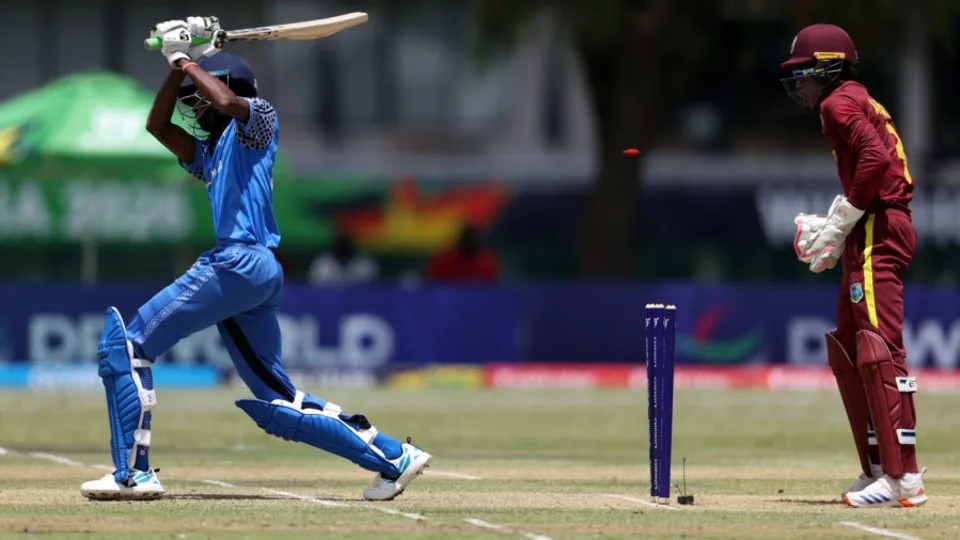
West Indies kickstarted their campaign at the 2026 Men’s U19 World Cup with a drubbing of Tanzania for the first result of the tournament in Windhock.
West Indies won the toss and chose to bowl, but had to wait till the 14th over for the first breakthrough. Tanzania openers Dylan Thakrar (26) and Darpan Jobanputra (19) put on a 53-run opening stand to frustrate West Indies’ new-ball bowlers before medium pacer Jonathan Van Lange broke the stand.
Seamer Shaquqn Belle, who took the catch to break the first-wicket stand, then dismissed Thakrar in the 15th over, ran No. 3 Ayaan Shariff out in the 16th, and got Augustino Mwamele in the 19th. The three wickets in three overs opened up Tanzania’s batting, and a procession of wickets followed. Left-arm wristspinner Vitel Lawes ran through the lower-middle order for a three-wicket haul, and Tanzania folded for 122 in the 34th over.
In the chase, Tanzania’s seamer Mwamele got an early breakthrough to remove West Indies opener Zachary Carter in the fourth over. But an 80-run second-wicket partnership between Tanez Francis (52) and Jewel Andrew (44) eased the chase.
Although West Indies lost four wickets between the 17th and 20th overs for a brief stutter, the low target meant they eventually cruised to their first win in Group D with 29 overs to spare.
Brief scores:
West Indies U-19s 124 for 5 in 21 overs (Tanez Francis 52, Jewel Andrew 44; Augustino Mwamele 2-17, Raymond Francis 2-23) beat Tanzania U-19s 122 in 34 overs (Dylan Thakrar 26; Vitel Lawes 3-23, Micah McKenzie 2-15, Shaquan Belle 2-23) by five wickets
[Cricinfo]

Five-time champions India began their 2026 Men’s Under-19 World Cup campaign with a six wicket win (via DLS) over United States of America, but not without a brief scare.
When right-arm quick Henil Patel’s five-wicket haul skittled USA for 107, it looked like it would be an easy win for India. However, in a rain-affected chase, India lost three wickets – including those of captain Ayush Mhatre and Vaibhav Sooryavanshi – inside the first six overs. But Abhigyan Kundu, who hit a double-century in the Under-19 Asia Cup in the lead up to the World Cup, played an assured knock to seal the deal.
Henil, who draws inspiration from Dale Steyn, struck in his first over in the first innings, with Amrinder Gill the first to fall to his extra bounce as he edged one to second slip. USA opener Sahil Garg and wicketkeeper Arjun Mahesh then put up a resistance, even if runs were hard to come by. They added 28 runs in 45 deliveries before Garg sent Deepesh Devendran’s short ball straight to deep third.
Two overs later, Henil had his second when USA captain Utkarsh Srivastava shouldered arms but couldn’t get his bat out of the way, dragging the ball onto the stumps. This was the first of two double-wicket overs for Henil, as he had the set Mahesh slicing to deep third too.
Spin was introduced in the 16th over and the decision paid off as Amogh Arepally chipped left-arm spinner Khilan Patel to cover. However, Adnit Jhamb and Nitish Sudini looked settled against the spin and put on USA’s highest partnership – 30 in 8.5 overs.
Sudini tried some big shots, but was beaten by the spin, however the pair rotated strike nicely. With the spinners failing to create an opening, Mhatre went back to pace and RS Ambrish got the breakthrough with a length ball that took Jhamb’s outside edge.
A brilliant piece of fielding then sent Adit Kappa back. He hit a ball to cover’s right and took off for the single, but Vihaan Malhotra – a livewire in the field – dived and made a good stop. He then nailed a direct hit at the non-striker’s end.
With just three wickets in hand, Sudini then upped the tempo but Henil ended a 25-run stand by bouncing out Sabrish Prasad. Next ball, Henil cleaned up No. 10 Rishabh Shimpi and found himself on a hat-trick. But he never got another crack as Sudini tried to take on Vaibhav Sooryavanshi’s part-time bowling and picked out long-off, leaving India 108 to chase.
India’s start to the chase was scratchy. First, the players had to walk off for a short rain delay before the first ball of the chase. When they returned, Mhatre cut the first ball straight to point where Gill put down a straight-forward chance. Sooryavanshi then miscued a shot down the ground, but managed to clear mid-off.
It looked like the nerves had calmed when Mhatre hit two gorgeous boundaries off left-armer Shimpi. But Ritvik Appidi, denied in the first over, wasn’t going to be denied again. On the second ball of his second over, Sooryavanshi charged down but was cramped for room and dragged the ball onto his stumps. One over later, the players went off due to lightning nearby and the delay was extended by a spell of rain that left behind a wet outfield.
There was more trouble for India once play resumed after a two-hour delay. Appidi troubled No. 3 Vedant Trivedi throughout the over and on the last ball, Trivedi hit a crisp cut straight to Gill, who held on this time.
With another drizzle around and perhaps feeling the need to up the tempo, Mhatre went on the attack next over. He got a top edge off a pull for four off Shimpi but when he went to hook another short ball, Gill took a good catch running in from deep fine leg. Gill slipped as he ran in, but maintained his composure to complete the catch.
In walked Kundu and immediately stamped his authority with a sublime drive through cover point for four. Malhotra got off the mark first ball with a back-foot punch through covers and in the next over, Kundu hit back-to-back on-drives off Shimpi.
Kundu hit another smooth drive through point before a mix-up almost cost Malhotra’s wicket when he tapped one in front of point and took off for a single. But Malhotra didn’t last long as Srivastava drew the outside edge and Garg grabbed the chance at slip.
Kundu and Kanishk Chouhan ensured there were no more hiccups for India. In the 18th over, Kundu lofted Kappa down the ground for four to bring the target within one hit. He then finished the game with a six over long-on to finish unbeaten on a 41-ball 42.
Brief scores:
India Under 19s 99 for 4 (Abigiyan Kundu 42*; Ritvik Appidi 2-24) beat USA Under 19s 107 (Nitish Sudini 36; Henil Patel 5-16) by six wickets (via DLS)
[Cricinfo]

Diplomatic thaw in Middle East sparks hope for Sri Lankan tea exports

US Ambassador Chung makes farewell call on Sajith

Lanka rises to 93rd in global passport rankings

Speaker holds bilateral talks in India

People’s Bank celebrates Thai Pongal

Over 100 Indian pilgrims to honour St Vaz in Kandy

‘Dates have the highest sugar content to fight Coronavirus’

Sunday Island 27 December – Headlines

#SundayIsland 17th December – Headlines

Sunday Island – 28th March

Sunday Island Headlines – 21 March

Sunday Island – 21st February – Headlines
-

 Business2 days ago
Koaloo.Fi and Stredge forge strategic partnership to offer businesses sustainable supply chain solutions
-

 Business6 days ago
Dialog and UnionPay International Join Forces to Elevate Sri Lanka’s Digital Payment Landscape
-
 News6 days ago
Sajith: Ashoka Chakra replaces Dharmachakra in Buddhism textbook
-

 Editorial1 day ago
The Chakka Clash
-

 Features6 days ago
The Paradox of Trump Power: Contested Authoritarian at Home, Uncontested Bully Abroad
-

 Features6 days ago
Subject:Whatever happened to (my) three million dollars?
-
 Business2 days ago
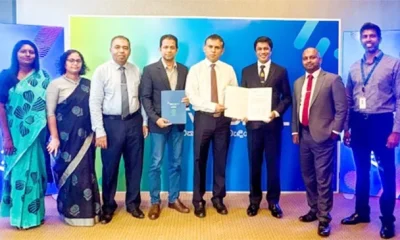
SLT MOBITEL and Fintelex empower farmers with the launch of Yaya Agro App
-

 Features1 day ago
Online work compatibility of education tablets