
Sports
Harry Brook rides his luck for century as fielding lapses cloud New Zealand’s day

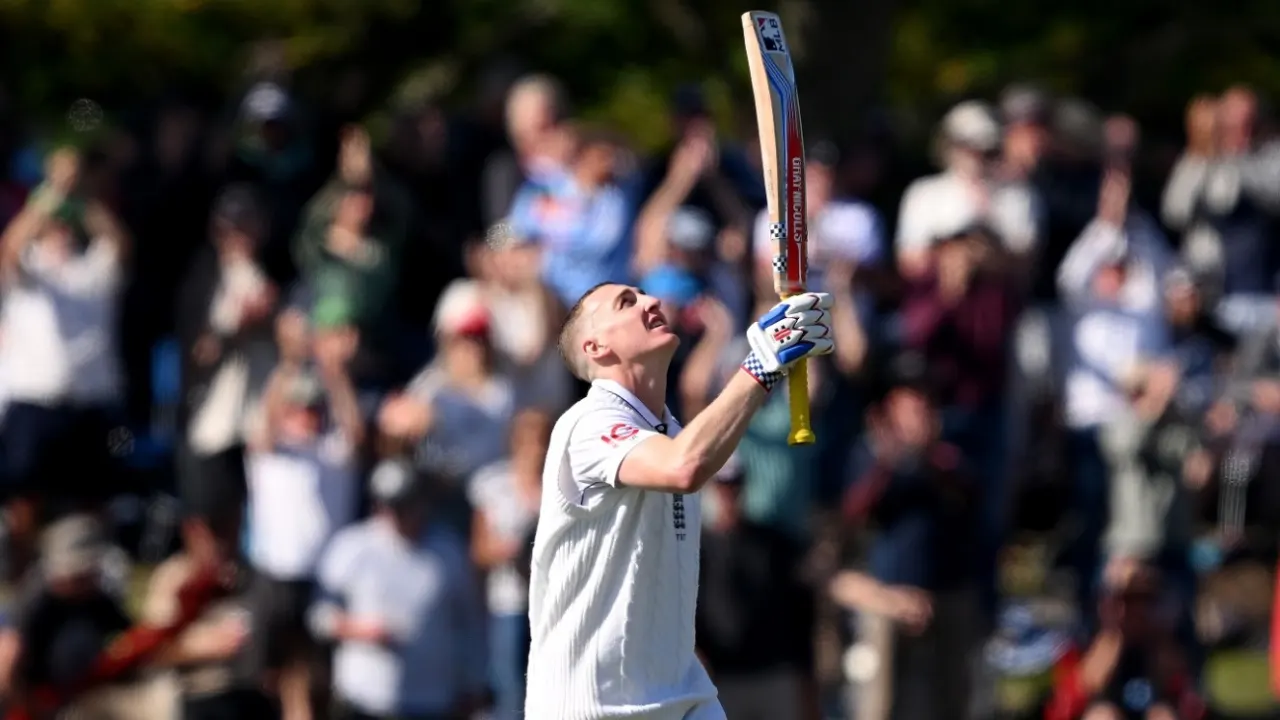
You have to make hay while the sun shines, as Harry Brook proved in two distinct interpretations of that hackneyed old adage. His seventh Test century – and sixth away from home – was a magnificent and crucial contribution to a day of wildly contrasting weather patterns, as England recovered from a torrid working-over under overcast morning skies to storm towards first-innings parity by the close, as the sun broke back through for the day’s final two sessions.
But rarely can New Zealand have clouded their own fortunes with a spate of fielding lapses to match those that they served up on this enthralling second day. Six clear-cut chances went begging in the course of England’s 319 for 5, including four for Brook alone – and at almost rhythmical interviews too: on 18, 41, 70 and 106, as if designed to douse their bowlers’ morale any time they looked ready to turn back the tide.
The upshot is a match situation that now feels like England’s to blow. The sense after they’d prised out eight first-day wickets after choosing to bowl first was that this wicket would get better and better for batting, and so it seemed to prove. Brook himself built key stands of 151 for the fifth wicket with Ollie Pope who responded to his wicketkeeping reshuffle with an excellent 77, and an unbeaten 97 with his captain, Ben Stokes who was ominously placed on 37 from 76 at stumps. Stokes did, however, get a life of his own on 30 in the day’s closing overs, as Tom Latham spilled catch No.6, and his third of the day, this time at short cover.
But England had not bargained for the mayhem that greeted them while the clouds were in situ for the first three hours of play. The hot, windy weather that had greeted the first day’s play was replaced in the morning by cooler, overcast conditions with a gentle breeze that proved perfect for helping the ball talk, with the degree of swing on offer being almost double that which England had managed. The upshot was that New Zealand found themselves bowling in the conditions that England themselves had envisaged exploiting after winning the toss.
And once New Zealand’s first innings had been wrapped up for 348, after the addition of 29 runs in 40 minutes, the ferocity of their bowling onslaught had echoes of their astonishing 46-all-out display against India in Bengaluru last month.
Zak Crawley was the first to go, lbw to Matt Henry for a 12-ball duck that left his average against New Zealand at a grim 10.43, but the most stunning blows were struck by the debutant Nathan Smith in the final over before lunch, as he extracted his fellow newbie Jacob Bethell for 10, then, critically, England’s kingpin, Joe Root, also for a duck.
Bethell’s maiden innings at No. 3 could scarcely have unfolded in tougher conditions. He was made to wait 13 deliveries before nudging his first run through the leg-side, and hadn’t added to his score in 13 more, until the introduction of Smith allowed him to free his arms with a brace of boundaries: one off the pads, the other through backward point.
Smith, however, got the last laugh at the start of his second over – and then some. With just minutes of the session remaining, he served up a perfect seaming delivery, which angled in at the left-hander from round the wicket, then held its line as it bit and climbed into the edge.
Smith had an agonising wait while the third umpire checked for a no-ball, but with the euphoria still surging, he finished the session with an even more critical incision. Root faced down three deliveries, two of which were called as no-balls this time, but his fourth was on a wider line and nipped back off the surface, taking an under-edge into the stumps. It was an astonishing introduction for a bowler with a bustling energy and action redolent of Australia’s Andy Bichel, and as the teams left the field, New Zealand looked good for several more such moments.
Ben Duckettat least resisted in his idiosyncratic fashion, bashing six fours in a 62-ball 46, but he didn’t so much ride his luck, as turn it into a bucking bronco. He survived the day’s first missed chance, to Latham at second slip on 23 off Henry, then got away with two further inside-edges and a spliced pull over deep third before the beanpole seamer Will O’Rourke induced a fatal top-edge to deep backward square.
At 71 for 4, England were reeling, and their predicament could have been insurmountable had Brook fallen to the first of his four lives in the very next over, a bad miss at gully by Glenn Phillips on 18 that looked all the more glaring when, some 30 overs later, he pulled off a one-handed screamer at backward point to end Pope’s doughty stay. Smith had been the luckless bowler, as was the case when Brook was on 41, as Latham spilled his second of the innings, another bad miss at first slip.
By then, however, the sun was beginning to creep through, and England’s unquenchable desire to be proactive was already clawing back some of the lost ground. Pope, at No. 6 for this Test – ostensibly because he is keeping wicket, but also as a consequence of his grim tour of Pakistan – was once again frenetic from the outset, as he took on O’Rourke’s height and bounce with a series of streaky slaps over the cordon, one of which he knew very little about.
But, with Brook following suit with a startling flick for six over fine leg off Henry, England’s run-rate began to creep back towards the habitual 4-an-over pace with which they have subdued so many bowling attacks in the recent past. By tea, both men had marched through to their fifties against a now middle-aged ball – Brook with a second six over fine leg, Pope with a nudge to leg from a brisk 59 balls – and as they kept up that intensity into the evening session, New Zealand’s errors continued to stack up.
Devon Conway spilled chance No.4 at deep midwicket, as Brook wound into a slog-sweep on 70 off Phillips, and by then his century was pre-ordained. He duly moved deep into the 90s with an outrageous lap-scoop over the keeper’s head off Southee, whom he then cracked through deep point to bring up his century from 123 balls. Earlier he had become the eighth fastest player, in terms of innings, to reach 2000 Test runs, and second only to Duckett in terms of balls faced: a brisk 2300. There was time yet for one last let-off; a clanger behind the stumps from Blundell down the leg-side, although seeing as the umpire also missed the edge and singled four byes, maybe there really was no way of dislodging him.
The day’s dramas had been telegraphed during the end of New Zealand’s own innings. Phillips converted his overnight 41 to an unbeaten 58, but it was not an easy stay, as epitomised by his audible cry of “oh you weasel!” as Chris Woakes beat him with an outswinger. He also had a scare on 42 when Carse, generating a good head of steam, smacked him hard in the grille via a top-edge off the splice, and in a sign of things to come, was also dropped in the same over by Root at slip, a tough diving chance to his right.
But Carse had already done for Southee with his first ball of the day, and eventually plucked out O’Rourke’s off stump with an outswinging yorker, to close out the innings with career-best figures of 4 for 64 in his third Test. It was a reminder that England too have the bowlers to compete on this intriguing surface. If they have the catchers too, they will believe this game is back in their grasp.
England 319 for 5 in 74 overs (Harry Brook 132*, Ollie Pope 77, Ben Duckett 46; Nathan Smith 2-86) trail New Zealand 348 in 1 overs (Kane Williamson 93, Glenn Phillips 58*, Tom Latham 47; Brydon Carse 4-64, Shoaib Bashir 4-69) by 29 runs



Sri Lankan champion thrower Rumesh Tharanga created history with yet another world-leading effort when he shattered his own national record at the Champions Track and Field event held at Diyagama Mahinda Rajapaksa Stadium on Saturday.
Tharanga produced a massive throw of 89.37 metres in his final attempt, a distance which, once ratified by World Athletics, is expected to stand as the fourth-longest throw ever recorded in Asia. The outstanding performance further cemented his status as one of the region’s leading javelin throwers.
Despite facing little competition from his rivals at the meet, Tharanga displayed the composure and determination of a true champion. Rising above the field, he delivered the record-breaking throw in dramatic fashion with his final effort of the competition.
Coming into the meet, Tharanga already held the world-leading mark of 83.07 metres for the season. Saturday’s performance elevated him to a new level, strengthening his reputation as a strong medal prospect for Sri Lanka on the global stage this year.
Tharanga first attracted widespread international attention when he set a Sri Lankan national record with a throw of 86.50 metres, a performance that earned him the gold medal at an international meet and secured direct qualification for the World Athletics Championships.
The former athlete of St. Peter’s College Colombo has continued to impress since then, producing consistent world-class performances while competing against some of the best javelin throwers in the world. Among his major achievements is reaching the final of the 2025 World Athletics Championships, becoming the first Sri Lankan male javelin thrower to reach the final stage of the event.
With his latest record-breaking performance, Tharanga has once again demonstrated that he is ready to shine and carry Sri Lanka’s hopes at the highest level of international athletics.
By Reemus Fernando
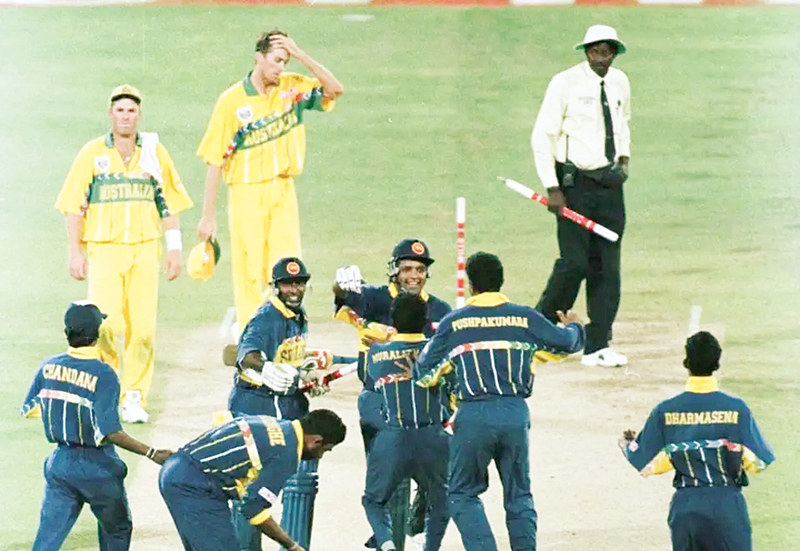
Sri Lanka’s trailblazing 1996 World Cup-winning side will roll back the years when they take on a World XI in Kuala Lumpur, marking three decades since their watershed triumph that changed the game’s field settings for good.
The exhibition match, hosted by the historic Royal Selangor Club, an institution that has been part of Asia’s sporting fabric since 1884, will be preceded by a gala dinner before the old warhorses lace up their boots once more against a Rest of the World XI.
It promises to be more than a nostalgic lap around the park.
“Some of the players took the initiative and I thought it was a splendid idea,” Arjuna Ranatunga, the captain who marshalled his troops like a seasoned general in 1996, told Telecom Asia Sport. “It helps us come together again and more importantly, inspire the next lot coming through.”
Beyond the boundary ropes, the legends will don the coach’s hat, conducting sessions aimed at passing on the baton to aspiring youngsters.
Former Malaysian cricketer Devindran Ramanathan, one of the chief architects behind the event, is keen that this is not just a walk down memory lane but a springboard for the future.
“This isn’t only about celebrating a World Cup win,” Ramanathan said. “It’s about showing young players what’s possible when you dare to dream.”
“When players of that calibre turn up, it shouldn’t end with autographs and photographs. It must open doors and broaden horizons,” he added.
In a heartening initiative, around 20 youngsters from Malaysia’s interior, players who have been making steady strides despite limited facilities, will be brought to the capital on May 15 and 16 to witness the action up close.
For many of them, it will be a once-in-a-lifetime opportunity to rub shoulders with giants of the game, a chance to trade dusty nets for the bright lights and perhaps believe that they, too, can one day play on the big stage.
“The real impact is not the match or the dinner,” Ramanathan noted. “It is whether a young player walks away believing they can go further.”
Malaysia, steadily padding up as a regional cricket hub, has already hosted events like the Under-19 World Cup and continues to expand its footprint in the game. In a sporting landscape dominated by motor racing, racquet sports and football, visits from former world champions in cricket could well help the sport get a firmer grip.
All 14 members of Sri Lanka’s 1996 squad are expected to travel to Malaysia in the second week of May, even as life has taken many of them to different corners of the globe.
Their famous triumph over Australia in Lahore remains one of cricket’s most defining moments, a victory that didn’t just tilt the balance of a final, but shifted the axis of the modern game itself.
(telecomasia.net)

The general secretary of the Confederation of African Football (Caf) has resigned amid a chaotic time for football on the continent
Veron Mosengo-Omba said in a statement he was retiring, but his departure comes during the fallout over decisions to strip Senegal of the 2025 Africa Cup of Nations (Afcon) title and postpone the women’s tournament at the last minute.
These incidents have left Caf, the governing body for African football, battling a crisis of confidence.
Mosengo-Omba alluded to controversies faced during his tenure in his statement on Sunday.
“Now that I have been able to dispel the suspicions that some people have gone to great lengths to cast on me, I can retire with peace of mind and without constraint, leaving the CAF more prosperous than ever,” Mosengo-Omba, deputy to Caf president Patrice Motsepe, wrote.
The 66-year-old has been criticised for staying on as general secretary past the organisation’s mandatory retirement age of 63.
He has also been accused by some employees of creating a toxic atmosphere in the workplace, although an investigation after staff complaints cleared him of any wrongdoing.
Mosengo-Omba, who hails from the Democratic Republic of Congo but also holds Swiss nationality, was appointed general secretary in March 2021.
According to news agency Reuters, Caf’s competitions director, Samson Adamu, will take over as acting general secretary.
The governing body is awaiting a decision by the Court of Arbitration for Sport (Cas) on Senegal’s appeal against being stripped of the Afcon title.
Senegal is challenging Caf’s appeals body for overturning their 1-0 win over hosts Morocco in January’s Afcon final.
During the game, Senegal’s players left the field in protest when, with the score at 0-0, hosts Morocco were awarded a stoppage-time penalty.
When they returned after a delay of about 17 minutes, Morocco subsequently failed to score the spot-kick and Senegal netted an extra-time winner.
Following an appeal by the Moroccan FA (FRMF), Caf later ruled that Senegal had forfeited the match and Morocco were awarded a 3-0 victory.
(BBC)

Inquiry into female employee’s complaint: Retired HC Judge’s recommendations ignored

Motor Traffic CG remanded

Petition launched seeking resignation of Energy Minister Jayakody

SC e-filing portal operational

New arithmetic of conflict: How the drone revolution is inverting economics of war

SLT-MOBITEL turnaround signals new era for SOEs, says deputy minister

‘Dates have the highest sugar content to fight Coronavirus’

Sunday Island 27 December – Headlines

#SundayIsland 17th December – Headlines

Sunday Island – 28th March

Sunday Island Headlines – 21 March

Sunday Island – 21st February – Headlines
-

 News5 days ago
Senior citizens above 70 years to receive March allowances on Thursday (26)
-

 Features2 days ago
A World Order in Crisis: War, Power, and Resistance
-

 News3 days ago
Energy Minister indicted on corruption charges ahead of no-faith motion against him
-

 News4 days ago
US dodges question on AKD’s claim SL denied permission for military aircraft to land
-

 Business4 days ago
Dialog Unveils Dialog Play Mini with Netflix and Apple TV
-

 Sports3 days ago
SLC to hold EGM in April
-

 News5 days ago
CEB Engineers warn public to be prepared for power cuts after New Year
-

 Business6 days ago
Postponement of Sri Lanka Investment Forum 2026