
Foreign News
Hamas returns remains of two more hostages but says more time needed to reach others

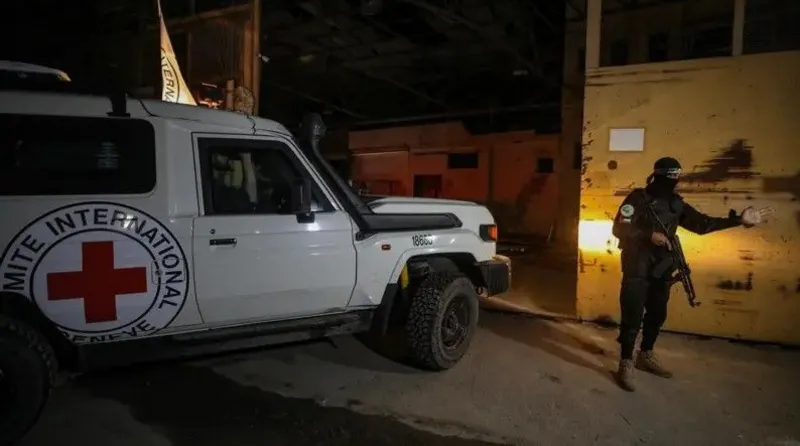
Hamas says it has handed over the bodies of two more Israeli hostages under the terms of the US-brokered ceasefire deal, but says it needs time and specialised equipment to recover the rest of the deceased from the ruins of Gaza.
The group’s armed wing said in a statement it was committed to the deal but had returned all the bodies of hostages it was able to reach.
US President Donald Trump has said Israeli forces could resume fighting in Gaza if Hamas does not uphold the agreement.
In a statement, the Israeli PM’s office said Israel had received – through the Red Cross – coffins containing the bodies of hostages which were now awaiting official identification.
“The IDF urges the public to act with sensitivity and wait for official identification, which will first be communicated to the families of the deceased hostages,” the statement said.
Senior US advisors providing an update on the implementation of the 20-point peace plan said that the US government did not so far believe Hamas had broken the agreement by not retrieving the remains of remaining deceased hostages.
The advisors argued that Hamas had acted in good faith by returning the live hostages and was working with various interlocutors to find and return the remains of hostages.
If the two bodies returned on Wednesday night are confirmed to be hostages, that would mean 19 are still unaccounted for in Gaza. Hamas is required to return all 28 dead hostages as part of the first phase of the Gaza peace plan.
But Hamas’s armed wing said in a statement “the remaining bodies require significant efforts and specialised equipment to search for and retrieve, and we are making a great effort to close this file”.
Earlier, Israel said it would “not compromise” on hostage returns, saying “the mission is not complete”.
Israel’s defence minister said he had instructed the IDF to prepare a “comprehensive plan” to defeat Hamas in Gaza in the event of a renewal of the war.
After meeting senior generals on Wednesday, Israel Katz said the military must be prepared to act if Hamas refuses to implement the peace plan.
The latest repatriations came after Israel said one of four bodies returned by Hamas on Tuesday was not one of the missing hostages.
The other three deceased were identified as Tamir Nimrodi, 20, Eitan Levy, 53, and Uriel Baruch, 35, the Hostages Families Forum said.
Earlier on Wednesday UN humanitarian chief Tom Fletcher urged Israel to immediately open all crossings into Gaza for humanitarian aid, as called for in the ceasefire plan.
In a post on X, Fletcher said Hamas must “make strenuous efforts to return all the bodies of the deceased hostages”.
He added: “As Israel has agreed, they must allow the massive surge of humanitarian aid – thousands of trucks a week – on which so many lives depend, and on which the world has insisted.”
He called for “more crossings open and a genuine, practical, problem-solving approach to removing remaining obstacles” and said “withholding aid from civilians is not a bargaining chip”.
Trump’s ceasefire plan, which both Israel and Hamas accepted, envisaged the handover of all 48 hostages would be completed by noon on Monday. Hamas returned all the 20 living hostages on Monday.
But the US-brokered ceasefire agreement appears to acknowledge that Hamas and other Palestinian factions may not have been able to find all hostage remains before the initial deadline on Monday.
Under the agreement, Israel also agreed to hand over the bodies of 15 Palestinians in return for every deceased Israeli hostage.
Israel has returned the bodies of a further 45 Palestinians, the Hamas-run health ministry confirmed on Wednesday, bringing the total number of bodies released by Israel to 90.
Meanwhile in Gaza, residents report growing concern about the durability of the ceasefire – and food prices have surged as Palestinians stockpile food.
Traders and suppliers in the enclave have been hoarding food items to create shortages and drive up profits, fearing that the war could resume, local residents told the BBC.
“Every time we start to feel safe, new threats appear, and we fear the war will start all over again,” says mother-of-six Neven Al-Mughrabi, a displaced resident from Gaza who lives in Khan Younis.
“I lost my house in Gaza City, I decided to stay here with my family because I don’t trust the ceasefire and we’re sick of displacement.”
She added that a trader in Khan Younis’s main market said demand for flour, oil and sugar had surged within hours. “Despite the sudden rise of prices by about 30%, people are buying as if they don’t trust the calm will last long, everyone is afraid aid will stop,” Neven says.
The US advisors also said the US was working with Israel to create “safe spaces” behind the yellow-line for people to flee if they feel under threat from Hamas.
In the longer-term, the advisors said they did not see a future for Hamas to govern parts of Gaza.
The current focus, according to the advisors, is on “de-confliction” that would allow aid to flow into Gaza and reconstruction to begin, with an international security force still in its early stages.
[BBC]


Hushruzjon Salohidinov, 26, was working as a courier in Saint Petersburg, Russia’s second-largest city and President Vladimir Putin’s hometown.
But last year, the Tajik man and practising Muslim says he was arrested while picking up a parcel which police claimed contained money stolen from elderly women.
Salohidinov says he never interacted with the alleged criminals, but nevertheless spent nine months in the Kresty-2 pre-trial detention centre about 32km (20 miles) from the city, while a judge refused to start his trial because of the “weak evidence” against him.
But instead of releasing him after that, prison wardens threatened to place him in a cell with HIV-infected inmates who, they said, would gang-rape him – unless he “volunteered” to fight in Ukraine.
“They said, ‘Oh, you’ll put on a skirt now, you’ll be raped,’” Salohidinov, who has raven black hair and a messy full beard, told Al Jazeera at a centre for war prisoners in northeastern Ukraine, where he is now being held, having been captured in January this year by Ukrainian forces.
Using a carrot-and-stick tactic, the wardens also promised him a sign-up bonus of 2 million rubles ($26,200), a monthly salary of 200,000 rubles ($2,620) and an amnesty from all convictions.
So, in the autumn of 2025, Salohidinov signed up as he “saw no other way out”.
Officials in Kresty-2, St Petersburg’s prosecutors’ office and Russia’s Ministry of Defence did not respond to any of Al Jazeera’s requests for comment.

Hochu Jit, a Ukrainian group that helps Russian soldiers surrender, has published verified lists of thousands of Central Asian soldiers like Salohidinov.
“They are literally sent to be killed, no one considers them soldiers that need to be saved,” the group wrote in a 2025 post on Telegram. These soldiers’ life expectancy on the front line is about four months. “Losses among them are catastrophic,” the group reported.
With its low birthrate and large oil wealth, Russia has for years been a magnet for millions of labour migrants from ex-Soviet Central Asia, especially Tajikistan, Uzbekistan and Kyrgyzstan.
The campaign by the Kremlin to force Central Asians to fight in Ukraine dates back to 2023 – the year after Russia’s invasion of Ukraine – when police began rounding up anyone who didn’t look Slavic and charging them with real or imagined transgressions such as a lack of registration, expired or “fake” permits or blurred stamps on their documents. Sometimes, migrants are simply bused straight to conscription offices.
In 2025, Al Jazeera interviewed another Tajik man who said he had been detained with an expired work permit and was then tortured into “volunteering” while being subjected to countless xenophobic and Islamophobic slurs from his officers.
Migrants say they are abused, tortured and threatened with jail or having their entire families deported.
“The main way of recruiting as many migrants as possible is pressure on them with threats of deportation,” Alisher Ilkhamov, the Uzbekistan-born head of the London-based Central Asia Due Diligence think tank, told Al Jazeera.
Sometimes, migrants are simply duped.
Salohidinov said one serviceman in his squad was an Uzbek who “didn’t speak a word of Russian” and was fooled into “volunteering” while signing papers at a migration centre.
In their reports about “catching” migrants, officials frequently use derogatory terms about them, and also when they describe men who have obtained Russian passports but skipped registration at conscription offices. Since the Soviet era, such registration has been obligatory for all men and, since 2024, a newly naturalised Russian national can lose his citizenship if he fails to do it.
“We’ve caught 80,000 such Russian citizens, who don’t just want to go to the front line, they don’t even want to go to a conscription office,” chief prosecutor Alexander Bastrykin said in May 2025, referring to the migrants’ alleged patriotic sentiments.
He boasted that 20,000 Central Asians with Russian passports were herded to the front line in 2025.
The year before, he said 10,000 Central Asians had been sent to Ukraine.
Such remarks resonate with the Russian public that lives with “a high level of xenophobia in the stage of fear and helplessness,” Sergey Biziyukin, an exiled opposition activist from the western city of Ryazan, told Al Jazeera.
“For them, such phrases from Bastrykin are a form of sedative.”
What makes Central Asians easy targets is that they hail from police states, which depend on Moscow politically and economically, observers say.
“While the migrants are frightened into signing contracts, their motherland doesn’t really pay any attention,” Galiya Ibragimova, an Uzbekistan-born, Moldova-based regional expert, told Al Jazeera.
Despite hefty signup bonuses and relentless propaganda, the number of Russians who want to fight in Ukraine fell by at least one-fifth this year, and Moscow will strive to recruit more Central Asians, she said.

After signing the contract and leaving his debit card with his sign-up bonus with his parents, Salohidinov was sent to the western city of Voronezh for three weeks of training that did little to prepare him for the war.
“We just kept running back and forth with guns,” he said.
Their drill sergeants, he says, told the conscripts that the standard-issue flak jackets, helmets, boots and flashlights were of subpar quality and urged them to pitch in a million rubles ($13,100) each for “better” gear.
The incident corroborates reports on dozens of similar cases in Russian military units.
Salohidinov was ordered to work in a kitchen – and was verbally abused and beaten for the slightest transgression.
Of 28 men in his unit, 21 were Muslims – but their ethnic Russian officers ignored their pleas not to have pork in meals, repeating a decades-old practice of ignoring religion-related dietary restrictions dating back to the Soviet army.
The commanders demonised Ukrainians, telling them “that if we surrender, we’d be tortured, have our fingers broken, maimed, get [construction] foam up our a**, have our teeth yanked out one by one, have our arms broken”, Salohidinov says.
In early January this year, the conscripts were bused to the Russia-occupied Ukrainian region of Luhansk.
Salohidinov says he was tired, frightened and disoriented – Ukrainian drones were “always” above them and a grenade explosion nearby damaged his left eardrum.

On the fourth day of his service, Salohidinov was ordered to run beyond Ukrainian positions as part of Russia’s new tactic to send two or three servicemen to infiltrate the porous front line.
The mission was suicidal because the terrain was open, dotted with landmines and the bodies of dead Russian soldiers, while Ukrainians were firing machineguns and flew drones above them.
“I ran and ran and saw we were being shot at,” he said. “Me and my commander decided to surrender voluntarily instead of dying for nothing.”
They detached their assault rifles’ magazines, raised their hands and yelled they were surrendering.
What followed was “a calm feeling, beautiful”, he said. “They fed us, let us have a smoke, gave us food and water and even cake.”
Now, Salohidinov hopes to return to Tajikistan and panics at the thought of being made part of a prisoner swap – these have taken place several times each year – and returning to Russia because he would be sent back to the front line.
Tajikistan and other Central Asian nations have never endorsed Russia’s war in Ukraine, but nor have they openly criticised it.
In August 2025, Tajikistan’s Prosecutor General Habibullo Vohidzoda declared that no Tajik national would be charged for fighting in Ukraine.
So, what Salohidinov needs right now is an extradition request.
“I’m even glad that I got captured, because I’m not fighting anyone now, not risking anything,” he said. “I’ll even say thanks to Ukraine for taking me prisoner.”
The Tajik embassy in Kyiv did not respond to Al Jazeera’s request for comment.
[Aljazeera]

Iranian forces have said they struck down two fighter jets belonging to the United States military, one over the southwest part of the country and another around the Strait of Hormuz.
A spokesperson for the Iranian military’s Khatam al-Anbiya Central Headquarters said on Friday that air defences completely destroyed one F-15 jet. Later in the day, the Iranian military said it targeted an A-10 US aircraft that crashed into the Gulf.
The New York Times had cited unidentified officials as saying that the A10’s pilot was safe after the crash.
But the fate of at least one pilot from the downed F-15 crew is unknown. Several US media outlets reported that one crew member of the jet was located and rescued by US forces, but the other remains missing.
US President Donald Trump told NBC News on Friday that the downing of the jet will not affect the prospect of talks with Tehran. “No, not at all. No, it’s war. We’re in war,” he said.
State media outlets in Iran showed photos of the wreckage of the F-15 jet and what appears to be an ejection seat with an attached parachute.
After the jet was downed, Iranian Parliament Speaker Mohammad-Bagher Ghalibaf mocked Trump’s repeated claims of victory in the war.
“After defeating Iran 37 times in a row, this brilliant no-strategy war they started has now been downgraded from ‘regime change’ to ‘Hey! Can anyone find our pilots? Please?’” Ghalibaf wrote in a social media post.
There was no immediate comment on the incident from the Pentagon and US Central Command (CENTCOM), which oversees military operations in the Middle East and much of Asia.
[Aljazeera]

United States President Donald Trump has announced that Pam Bondi is out as US attorney general, in his second major cabinet-level shake-up in less than a month.
Trump confirmed the decision in a post on Truth Social on Thursday, after a slate of media reports suggested he was considering removing Bondi from the top law enforcement role. Several cited his discontent over Bondi’s handling of investigative files related to financier and convicted sex offender Jeffrey Epstein.
Deputy Attorney General Todd Blanche will temporarily replace Bondi in an interim capacity, he said.
“Pam Bondi is a Great American Patriot and a loyal friend, who faithfully served as my Attorney General over the past year,” Trump wrote.
The US president also praised Bondi for leading the Department of Justice during a period when violent crime decreased in the US, part of a wider downward trend in the wake of the COVID-19 pandemic.
Trump did not mention his reasoning for the decision, instead writing, “We love Pam.” He added that she would be “transitioning to a much-needed and important new job in the private sector”.
In a statement, Bondi said she would be transitioning the office to Blanche over the next month, adding she was moving to “an important private sector role I am thrilled about, and where I will continue fighting for President Trump and this Administration”.
“I remain eternally grateful for the trust that President Trump placed in me to Make America Safe Again,” she said.
Bondi’s dismissal comes shortly after Trump abruptly fired Department of Homeland Security Secretary Kristi Noem, who oversaw the agency amid a mass deportation campaign that led to the killing of two US citizens.
[Aljazeera]

No date set for US-Iran talks, as Pakistan pushes to keep diplomacy alive

Arshdeep and Prabhsimran star as Punjab Kings hammer Mumbai Indians

Showers expected in the Western, Sabaragamuwa, Southern and Uva provinces and in Kandy and Nuwara-Eliya districts after 1.00 pm

Israel and Lebanon agree 10-day ceasefire, Trump says

Heat Index at Caution Level in the Northern, North-central, North-western, Western, Sabaragamuwa, Eastern and Southern provinces and in Monaragala district

Ex-COPE head questions Prez Secy’s intervention in coal scam probe

‘Dates have the highest sugar content to fight Coronavirus’

Sunday Island 27 December – Headlines

#SundayIsland 17th December – Headlines

Sunday Island – 28th March

Sunday Island Headlines – 21 March

Sunday Island – 21st February – Headlines
-

 News5 days ago
CEB orders temporary shutdown of large rooftop solar systems
-

 Features5 days ago
From Royal College Platoon to National Cadet Corps: 145 years of discipline, leadership, and modern challenges
-

 Latest News4 days ago
PNS TAIMUR & ASLAT arrive in Colombo
-

 News6 days ago
Anura Solomons passes away
-

 Features5 days ago
CIA’s hidden weapon in Iran
-

 Latest News4 days ago
Prasidh, Buttler set up comfortable win for Gujarat Titans
-

 Business6 days ago
SL’s economic outlook for 2026 being shaped by M-E conflict
-

 Latest News5 days ago
Heat index likely to increase up to ‘Caution level’ at some places in the Northern, North-central, North-western, Western, Sabaragamuwa, Southern and Eastern provinces and Monaragala district