
News
Grit Foundation helps 100 poor families to build their own houses


In the North Central Province
Grit Property Group Australia, a licensed property consultancy company with its Head Office in Melbourne, and its international branches in Sri Lanka and India, has reached out to help 100 families to build their own houses in the North Central Province.
After serving many clients over the years, Grit has now taken the initiative with the establishment of the Grit Foundation to give back to the community by helping families in need in the way that they know best – by providing housing.
Team Grit Sri Lanka embarked on a journey to Welikanda, a small town in North Central Province, situated 300 km from Colombo, for a life-changing purpose.
The families were handed over new two or three-bedroom brick houses built within a span of 45 days to two months at most depending on the prevailing weather conditions.
Each family was required to find their own sand and granite and was given the permit to do so. Everything else, including charges for the builders was provided by Team Grit Sri Lanka.
Welikanda, around 40 minutes’ drive from Polonnaruwa, is one of the most drought-hit areas in the country. Villagers and wildlife are at risk with no means or access to water when the situation worsens.
Team Grit members also journeyed on an 18-km off-road drive through the village to visit a six-member family in need of help at Sooriyawewa. Living close to the riverbank, they depend on farming for their sustenance. However, they live in constant fear of wild animals, especially elephants, who destroy their wattle and daub huts – their only living space.

Latest News
Heat Index at Caution Level in the Northern, North-central, North-western, Western, Sabaragamuwa, Eastern and Southern provinces and in Monaragala district.


Warm Weather Advisory
Issued by the Natural Hazards Early Warning Centre
at 3.30 p.m. on 20 April 2026, valid for 21 April 2026
The Heat index, the temperature felt on human body is likely to increase up to ‘Caution level’ at some places in the Northern, North-central, North-western, Western, Sabaragamuwa, Eastern and Southern provinces and in Monaragala district.
The Heat Index Forecast is calculated by using relative humidity and maximum temperature and this is the condition that is felt on your body. This is not the forecast of maximum temperature. It is generated by the Department of Meteorology for the next day period and prepared by using global numerical weather prediction model data.

Effect of the heat index on human body is mentioned in the above table and it is prepared on the advice of the Ministry of Health and Indigenous Medical Services.
ACTION REQUIRED
Job sites: Stay hydrated and takes breaks in the shade as often as possible.
Indoors: Check up on the elderly and the sick.
Vehicles: Never leave children unattended.
Outdoors: Limit strenuous outdoor activities, find shade and stay hydrated.
Dress: Wear lightweight and white or light-colored clothing.
Note:
In addition, please refer to advisories issued by the Disaster Preparedness & Response Division, Ministry of Health in this regard as well. For further clarifications please contact 011-7446491.
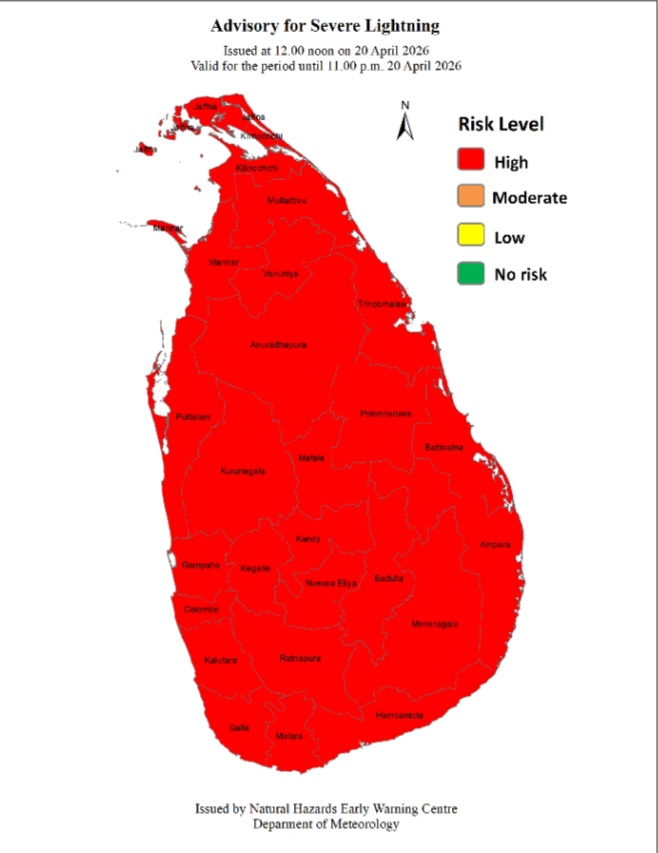
Advisory for Severe Lightning
Issued by the Natural Hazards Early Warning Centre
Issued at 12.00 noon 20 April 2026 valid for the period until 11.00 p.m. 20 April 2026
Thundershowers accompanied with severe lightning are likely to occur most places in the island after 1.00 p.m.
There may be temporary localized strong winds during thundershowers. General public is kindly requested to take adequate precautions to minimize damages caused by lightning activity.
ACTION REQUIRED:
The Department of Meteorology advises that people should:
Seek shelter, preferably indoors and never under trees.
Avoid open areas such as paddy fields, tea plantations and open water bodies during thunderstorms.
Avoid using wired telephones and connected electric appliances during thunderstorms.
Avoid using open vehicles, such as bicycles, tractors and boats etc.
Beware of fallen trees and power lines.
For emergency assistance contact the local disaster management authorities.
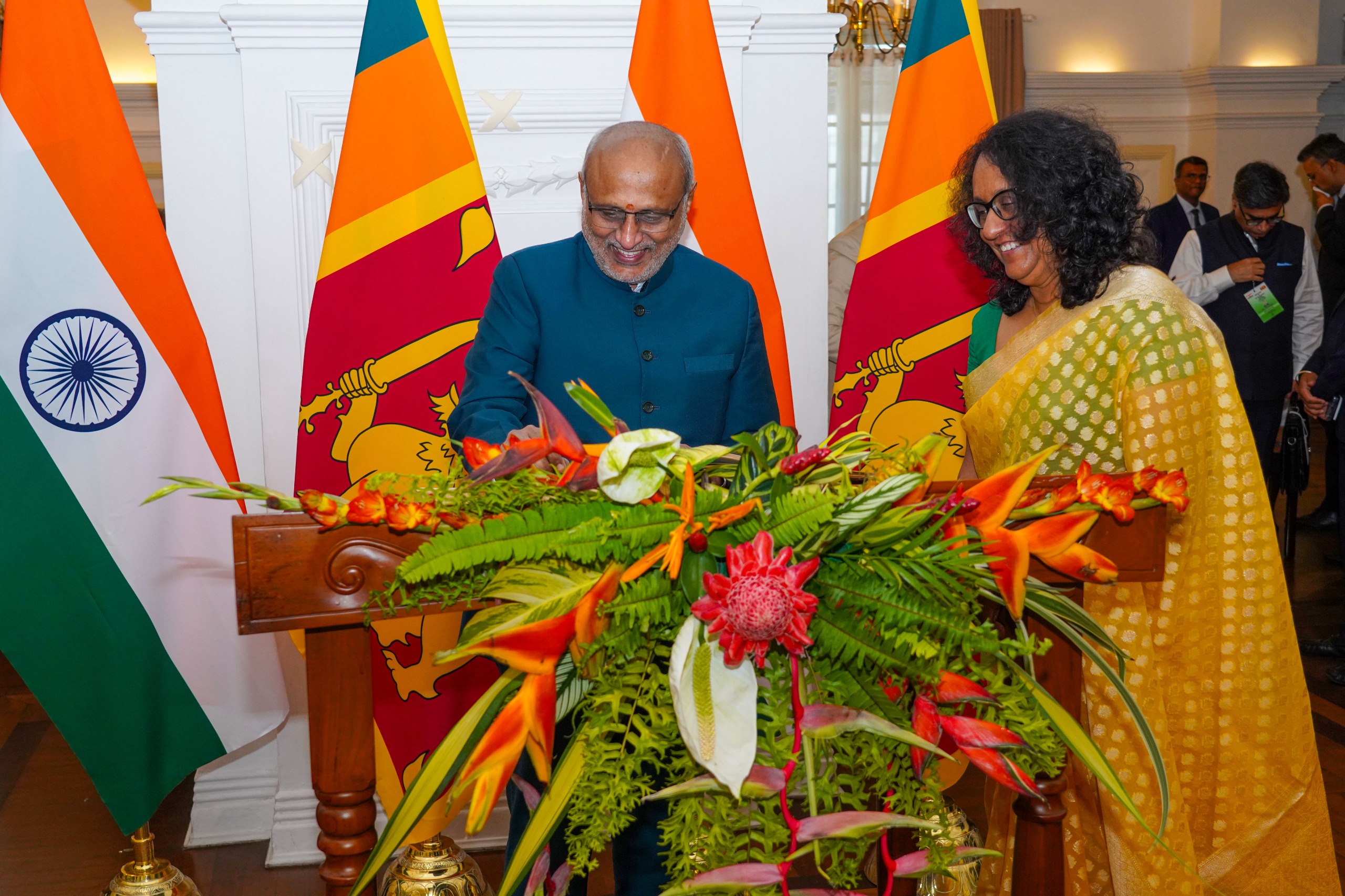
The Vice President of India, C.P. Radhakrishnan, who is currently on a two-day official visit to Sri Lanka, held a bilateral discussion with Prime Minister Dr. Harini Amarasuriya on Sunday (19) morning at Temple Trees.
Upon his arrival at Temple Trees, the Indian Vice President was received by Prime Minister Dr. Harini Amarasuriya. The Prime Minister also extended her congratulations to C.P. Radhakrishnan on his appointment as the Vice President of India.
During the meeting, the Vice President noted that this is his first official visit to Sri Lanka and expressed his appreciation for the warm welcome and hospitality extended to him during his stay.
The occasion was attended by the Minister of State for Fisheries, Animal Husbandry and Dairying, Prof. S.P. Singh Baghel; Members of Parliament Dr. K. Laxman and Dr. Medha Vishram Kulkarni; Foreign Secretary Vikram Misri; and the High Commissioner of India to Sri Lanka, Santosh Jha, and representing the Government of Sri Lanka the Minister of Foreign Affairs, Foreign Employment and Tourism Vijitha Herath; Minister of Sports Sunil Kumara Gamage; Minister of Women and Child Affairs Saroja Savithri Paulraj; Secretary to the Prime Minister Pradeep Saputhanthri; Secretary to the Ministry of Finance Harshana Suriyapperuma; Secretary to the Ministry of Education Nalaka Kaluwewa; and several other officials.
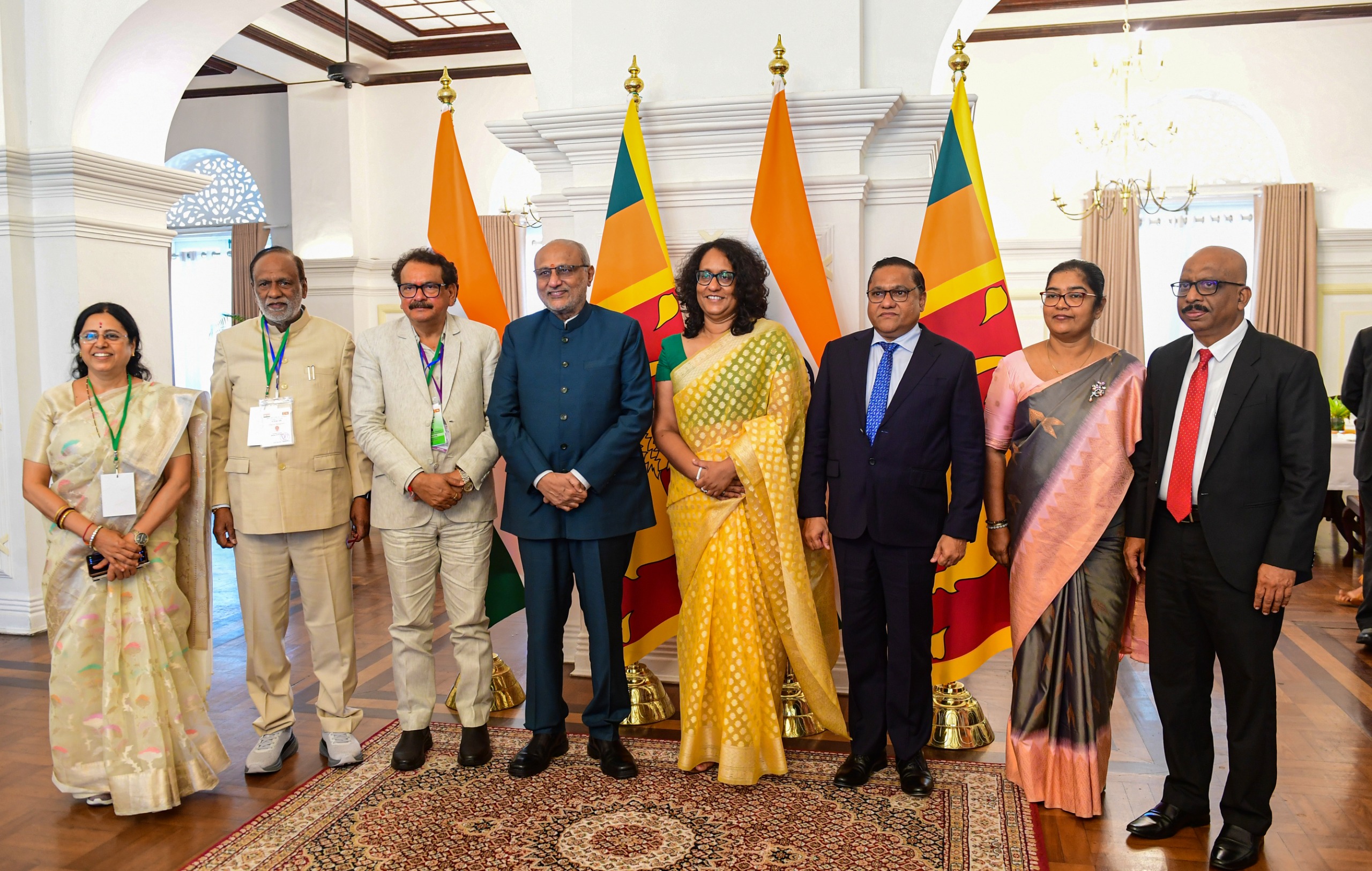
[Prime Minister’s Media Division]

Heat Index at Caution Level in the Northern, North-central, North-western, Western, Sabaragamuwa, Eastern and Southern provinces and in Monaragala district.

Dasun Shanaka handed one-year PSL ban

Nahid, Tanzid help Bangladesh level New Zealand series

Five UAE cricketers given citizenship through naturalisation

Moni, Sharmin help Bangladesh register maiden ODI win against Sri Lanka

Advisory for Severe Lightning issued for all provinces of Sri Lanka

‘Dates have the highest sugar content to fight Coronavirus’

Sunday Island 27 December – Headlines

#SundayIsland 17th December – Headlines

Sunday Island – 28th March

Sunday Island Headlines – 21 March

Sunday Island – 21st February – Headlines
-

 News5 days ago
PNS TAIMUR & ASLAT set sail from Colombo
-

 Business3 days ago
Harnessing nature’s wisdom: Experts highlight “Resist–Align” path to resilience
-

 News3 days ago
Gratiaen Trust announces longlist for the 33rd Annual Gratiaen Prize
-

 Latest News7 days ago
“I extend my heartfelt wishes to all Sri Lankans for a peaceful and joyous Sinhala and Tamil New Year!” – President
-

 News2 days ago
From Nuwara Eliya to Dubai: Isha Holdings markets Agri products abroad
-
 News3 days ago
Heroin haul transported on 50-million-rupee contract
-
 Latest News4 days ago
Singapore Zoo’s first Sri Lankan leopard cubs make their public debut
-
 Latest News7 days ago
US blockade of Iran would worsen global energy crisis, analysts say