
News
Govt. urged to fulfill its pledge to abolish PTA and other repressive laws


The Coalition against the Repressive Laws (CARL) which comprise more than 60 civil society, media, trade unions and professional associations, has, in a letter to President Anura Kumara Dissanayake, called upon the government to abolish the Prevention of Terrorism Act, Online Safety Act, and other repressive laws that undermine fundamental rights of all Sri Lankans.
The CARL members also stressed that they are mindful that the NPP and the JVP have historically opposed such laws and consistently championed their repeal. The PTA remains widely recognized as a draconian law that must be repealed immediately, and its continued use represents a significant deviation from the positions previously upheld by both the NPP and the JVP.
In addition to the PTA, the CARL also strongly appeals for the immediate repeal of the Online Safety Act, another repressive law that severely undermines freedom of expression.
The full text of the letter:
We are a coalition comprising 60 civil organizations, media groups, trade unions, and professionals united in opposition to repressive laws. Over the past two years, and indeed for many years before, our coalition has, collectively and individually, advocated for the repeal of laws that undermine fundamental rights and freedoms.
We are mindful that the National People’s Power (NPP) and the Janatha Vimukthi Peramuna (JVP) have historically opposed such laws and consistently championed their repeal. Your party has maintained this principled stance. And it was expected moves would be made to repeal such laws, especially the most draconian Prevention of Terrorism Act (PTA), after your election as President and the assumption of power by the NPP-led government.
The continued use of provisions under the PTA to detain individuals is therefore deeply troubling. These detentions are often followed by charges filed under alternative legal frameworks. The PTA remains widely recognized as a draconian law that must be repealed immediately, and its continued use represents a significant deviation from the positions previously upheld by both the NPP and the JVP.
We urge you, as President, and your government to take immediate action to repeal the Prevention of Terrorism Act in accordance with your long standing commitments.
In addition to the PTA, we also strongly appeal for the immediate repeal of the Online Safety Act, another repressive law that severely undermines freedom of expression. Although presented under the pretext of safeguarding online space, this Act was hastily passed by the previous government despite strong opposition from various stakeholders. It is evident that the primary objective of this legislation was to stifle dissent—a concern repeatedly emphasized by both you and your party.
The repeal of these repressive laws would not only demonstrate your commitment to fulfilling electoral promises but also reaffirm the government’s dedication to upholding democracy and protecting human rights. Moreover, it would serve as a clear signal of your administration’s resolve to respect transparency and the principles of good governance.
We, therefore, reiterate our demand for the immediate repeal of both the Prevention of Terrorism Act and the Online Safety Act. Moving forward, we strongly urge that all legislative processes be conducted in a democratic, transparent, and consultative manner, setting a standard of accountability and responsible governance.


Sri Lanka is standing on the edge of a coastal catastrophe, with the nation’s lifeline rapidly eroding under the combined assault of climate change, reckless development and weak compliance, Director General of the Department of Coast Conservation and Coastal Resource Management (DCC&CRM) Dr. Terney Pradeep Kumara has warned.
“This is no longer an environmental warning we can afford to ignore. The crisis is already unfolding before our eyes,” Dr. Kumara told The Island, cautioning that the degradation of Sri Lanka’s 1,620-kilometre coastline has reached a point where delayed action could trigger irreversible damage to ecosystems, livelihoods and national security.
He said accelerating coastal erosion, rising sea levels, saltwater intrusion and the collapse of natural barriers, such as coral reefs and mangroves, are placing entire coastal communities at risk. “When mangroves disappear and reefs are destroyed, villages lose their first line of defence. What follows are floods, loss of homes, declining fisheries and forced displacement,” he said.
Dr. Kumara stressed that the coastline is not merely a development frontier but the backbone of Sri Lanka’s economy and cultural identity. “More than half of our tourism assets, fisheries and key infrastructure are concentrated along the coast.
If the coast fails, the economy will feel the shock immediately,” he warned.
Condemning unregulated construction, illegal sand mining and environmentally blind infrastructure projects, he said short-term economic interests are pushing the coastline towards collapse. “We cannot keep fixing one eroding beach while creating three new erosion sites elsewhere. That is not management—it is destruction,” he said, calling for science-driven, ecosystem-based solutions instead of politically convenient quick fixes.
The Director General said the Department is intensifying enforcement and shifting towards integrated coastal zone management, but warned that laws alone will not save the coast. “This is a shared responsibility. Policymakers, developers, local authorities and the public must understand that every illegal structure, every destroyed mangrove, weakens the island’s natural shield,” he added.
With climate change intensifying storms and sea surges, Dr. Kumara warned that Sri Lanka’s vulnerability will only worsen without urgent, coordinated national action. “The sea has shaped this nation’s history and protected it for centuries. If we fail to protect the coast today, we will be remembered as the generation that allowed the island itself to be slowly eaten away,” he went on to say.
By Ifham Nizam
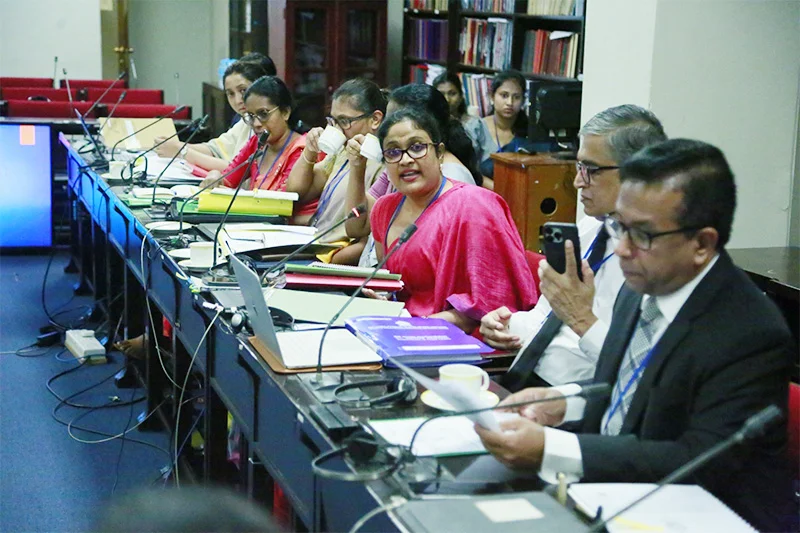
The Sectoral Oversight Committee (SoC)on Economic Development and International Relations recently examined the Microfinance and Credit Regulatory Authority Bill and the proposed amendments thereto.
The SoC met in Parliament under the chairmanship of Member of Parliament Ms. Lakmali Hemachandra, (Attorney at Law). A group of officials representing the Central Bank of Sri Lanka, the Department of Development Finance of the Ministry of Finance, Planning and Economic Development, and the Legal Draftsman’s Department participated in the meeting.
The Microfinance and Credit Regulatory Authority Bill was presented to Parliament for its First Reading on 26.11.2025. Accordingly, the Committee held an extensive discussion on the amendments that have been proposed to the Bill. The Chair of the Committee, Hon. Member of Parliament Ms. Lakmali Hemachandra, (Attorney at Law) stated that it is important to give careful and further consideration to this Bill and that discussions on the proposed amendments will be held again on a future date.
Members of Parliament Lakshman Nipuna Arachchi, Thilina Samarakoon, Nilanthi Kottahachchi, Attorney at Law, Sagarika Athauda, Attorney at Law, Suranga Ratnayaka, and Wijesiri Basnayake also participated in this Committee meeting.

The Trincomalee Power Company (TPC)—a 50:50 joint venture between the Ceylon Electricity Board (CEB) and India’s NTPC—has called for international tenders for a 50-megawatt solar power plant with battery storage at Sampur in Trincomalee, in a move expected to draw strong investor interest amid Sri Lanka’s accelerating shift towards utility-scale renewables.
Tender documents invite bidders to undertake the complete engineering, procurement and construction (EPC) of the ground-mounted solar photovoltaic plant, together with a minimum 20 MW / 20 MWh battery energy storage system, positioning the project as a commercially attractive, grid-stabilising asset in the Eastern Province.
Bids will be accepted until February 18, 2026, and opened on February 19, with the successful contractor required to complete the project within 21 months of award—offering investors clear timelines and execution certainty, officials said.
Energy sector sources noted that the project benefits from sovereign backing through the CEB and the balance-sheet strength and technical credibility of NTPC, India’s largest power utility, significantly lowering counterparty and execution risk for developers and financiers.
The Sampur site carries strategic importance in Sri Lanka’s energy landscape. Initially designated for a 500 MW coal-fired power plant under an earlier Indo-Lanka agreement, the project was abandoned in 2016 following environmental opposition. Its re-development as a solar-plus-storage facility signals a policy pivot towards cleaner generation while unlocking the value of a long-idle, infrastructure-ready site.
Analysts said the inclusion of battery storage enhances the project’s bankability by improving dispatchability and grid reliability—key considerations for investors as Sri Lanka integrates higher shares of intermittent renewable energy.
The Sampur solar project also strengthens India–Sri Lanka energy cooperation at a time when regional power security, supply diversification and climate-aligned investments are gaining prominence among institutional investors.
Sri Lanka’s target of sourcing 70% of electricity from renewables by 2030 has sharpened demand for large, utility-scale projects backed by state entities. Market observers said the Sampur project could emerge as a benchmark transaction for future solar and storage investments, particularly in repurposing former thermal power sites into commercially viable clean-energy assets.
By Ifham Nizam

Shafali 69 not out , spinners lead India’s rout of Sri Lanka

Sri Lanka’s coastline faces unfolding catastrophe: Expert

SOC examines proposed amendments to the Microfinance and Credit Regulatory Authority Bill

CEB–NTPC joint venture seeks investors for 50 MW Sampur solar project

Students lead cleanup effort to restore Maha Oya-Kammalthota Estuary and its surroundings

A wise Christmas

‘Dates have the highest sugar content to fight Coronavirus’

Sunday Island 27 December – Headlines

#SundayIsland 17th December – Headlines

Sunday Island – 28th March

Sunday Island Headlines – 21 March

Sunday Island – 21st February – Headlines
-

 News1 day ago
Members of Lankan Community in Washington D.C. donates to ‘Rebuilding Sri Lanka’ Flood Relief Fund
-

 News6 days ago
Pope fires broadside: ‘The Holy See won’t be a silent bystander to the grave disparities, injustices, and fundamental human rights violations’
-

 News6 days ago
Pakistan hands over 200 tonnes of humanitarian aid to Lanka
-

 Business5 days ago
Unlocking Sri Lanka’s hidden wealth: A $2 billion mineral opportunity awaits
-

 News5 days ago
Army engineers set up new Nayaru emergency bridge
-

 News6 days ago
Officials of NMRA, SPC, and Health Minister under pressure to resign as drug safety concerns mount
-

 News6 days ago
Expert: Lanka destroying its own food security by depending on imported seeds, chemical-intensive agriculture
-

 Editorial6 days ago
Flawed drug regulation endangers lives