
Midweek Review
Govt-civil society imbroglio

By Shamindra Ferdinando
Civil society activists are sharply divided over their strategy to deal with the government. The majority of them have found fault with the Sri Lankan Collective for Consensus (SLCC) for undermining the overall civil society strategy by entering into a high profile dialogue with the government.
The Sri Lanka Civil Society Forum (SLCSF) in particular is disappointed over the way the SLCC handled contentious issues. The outfit is concerned that the government would take advantage of the ongoing dialogue with the SLCC thereby cause irreparable damage to achieving a post-war national reconciliation on their terms.
The issues at hand, in the eyes of SLCSF, are curbs on civil society, enactment of the 20th Amendment, continuing use of the Prevention of Terrorism Act (PTA), threats on social justice activists and media, transitional justice, enforced disappearances, arbitrary use of quarantine regulations, inordinate delay in a political settlement to the national problem, delay in proper investigations into 2019 Easter Sunday attacks and the delay related to introducing reforms to the Muslim Marriage and Divorce Act.
The SLCSF consists of 30 organisations, including Families of the Disappeared, Centre for Policy Alternatives, IMADR- Asia Committee, Right to Life Human Rights Centre, Women and Media Collective, Rights Now for Collective Democracy, Centre for Society and Religion, Women’s Action Network, Mothers and Daughters of Lanka, Centre for Women and Development – Jaffna, Law and Society Trust, AHAM Humanitarian Resource Center (AHRC), Trincomalee, Rural Development Foundation, Institute for Social Development, Janawabodha Kendraya, Web Journalist Association of Sri Lanka, Eastern Social Development Foundation, Human Elevation Organisation, National Fisheries Solidarity Movement, National Fisher Women’s Federation, Mannar Women’s Development Federation, Malarum Mottukal Women’s Collective, Alliance for Minorities, Rule of Law Forum, Food First Information and Action Network – Sri Lanka, International Centre for Ethnic Studies, Mannar Social and Economic Development Organisation, Citizens Committee Human Rights Centre – Gampaha, Sri Vimukthi Fisher Women Organization and Centre for Human Rights and Development.
The live wires in the SLCSF are Dr. Paikiasothy Saravanamuttu, Dr. Gehan Gunatilleke, Dr. Nimalka Fernando, Dr. Mario Gomez, Dr. Sakunthala Kadirgamar, Rev. Rohan de Silva, Britto Fernando, K. S. Ratnavale, Ms. Shreen Saroor, Ms. Ambika Sathkunanathan, Philip Dissanayake, Ms. Kumudhini Samuel, Godfrey Yogarajah, Prabodha Ratnayake, Ameer Faaiz, Thilak Kariyawasam, Ms Saroja Sivachandran, Aruna Shantha Nonis, Ms Bhavani Fonseka, Ruki Fernando, Periyasami Muthulingam, Gowthaman Balachandran, Sudarshana Gunawardana, Freddy Gamage, Abdul Ramees, Ms Sumika Perera, Ms Marreen Srinika Nilasini, Asanka Abeyrathna, Ms Mahaluxmy Kurushanthan, Herman Kumara, Jehan Jegatheesan, Yartan Figurado, Shantha Pathirana, Ms A.D. Rajani, Ms M. Kusum Silva and Vinoth Anthony.
However, some of those who represented the SLCSF, in a statement issued recently, strongly criticised the SLCC. Inquiries revealed that statement hadn’t been issued as the SLCSF but signified a major rift among civil society groups since the last presidential election in Nov 2019. The media received that statement from Ambika Sathkunanathan, former outspoken member of the Human Rights Commission (HRC). She resigned from the HRC in early March 2020. Her resignation fueled speculation that she would campaign for the Tamil National Alliance (TNA) at the general election scheduled for April 2020 but later postponed to August 2020. When one Chanaka Dissanayake tweeted on January 9, 2021 that Sathkunanathan exposed HRC being biased by throwing her weight behind the TNA campaign, she tweeted: “after I resigned from HRCSL, was asked to contest by TNA & refused. Was on National List but never campaigned for TNA. Was never part of or participated in their election or any other campaign. Pls fact check. Care to comment on current Chair-HRCSL being a politician? She was referring to Dr. Jagath Balasuriya, formerly of the SLFP parliamentary group being appointed HRCSL Chairman by President Gotabaya Rajapaksa.
In spite of severe criticism, the SLCC, spearheaded by Dr. Jehan Perera, one-time darling of the Norwegians, has sustained the project and seems to be confident in continuing with the effort. Foreign Minister Prof. G.L. Peiris recently addressed a conference, organised by the National Peace Council (NPC), the leading element in the SLCC. The Foreign Minister and the Sri Lanka Podujana Peremuna (SLPP) Chairman’s participation at the event, organised on the theme of ‘Plural Sri Lanka: Paths to Reconciliation’ underscored the government appreciation of that particular civil society grouping.
It would be pertinent to mention that both Prof. Peiris and UN Human Rights Commissioner Michelle Bachelet referred to President Gotabaya Rajapaksa’s government entering into a dialogue at the March 2021 Geneva sessions. The government seems somewhat comfortable in having a continuous dialogue with at least a section of the civil society as part of overall efforts to appease Western powers.
Unfortunately, the incumbent administration has conveniently forgotten the dire need to contradict an accountability resolution co-sponsored by the yahapalana government in Oct 2015. That contentious resolution based on unsubstantiated allegations resulted in strictures.
Western powers insulted the war-winning Sri Lanka Army by refusing to accept retired military officers as Ambassadors or High Commissioners, denied visas to serving and retired officers, and the US named Army Chief General Shavendra Silva as a war criminal.
The government seems unaware that the NPC has absolutely no interest in genuine reconciliation. Perhaps the government does not care to set the record straight. Beset by a range of simmering political and economic issues, the government appeared to have placed the accountability issue on the back burner. If the NPC is genuine in its efforts, it would have certainly made a bid to reconcile the communities by helping the government to establish the truth.
The writer was not surprised when NPC acknowledged that war-related matters hadn’t been discussed at the nearly two-year-long reconciliation project that brought together students from Eastern, Jaffna, Ruhuna and Sabaragamuwa Universities.
Pointing out those post-war reconciliation efforts had been badly hampered by allegations that the Sri Lankan military killed over 40,000 civilians on the Vanni east front, The Island sought clarification as regards measures taken by the NPC to improve relations among the communities, and the following question was raised:
The Island: During your two-year long project did participants discuss specific war crimes allegations and disclosure made in the House of Lords in Oct 2017 that contradicted unsubstantiated accusations pertaining to 40,000 civilian deaths.
Executive Director NPC Dr. Jehan Perera: “No, we did not discuss these war-related matters. The project was titled “Creative Youth Engagement for Pluralism” and it focused on the nature of Sri Lanka as a plural society and the value framework that should guide it.
It would be a grave mistake on the government’s part to believe the SLCC would assist Sri Lanka counter lies. Dr. Perera was quite close to the yahapalana administration, the late Mangala Samaraweera accommodated him on the Sri Lanka delegation to Geneva sessions in March 2018. There hadn’t been a previous instance of civil society representing the government in Geneva.
Regrettably, the incumbent government for some unexplained reason, continues, to refrain from making a proper response on behalf of the war-winning armed forces in Geneva. Information (Gash papers) provided by Lord Naseby that may help Sri Lanka to challenge lies remain unused. The British Conservative Lord, a true friend of Sri Lanka, made them available to us in late 2017.
Whatever the differences among the civil society members, they would never under any circumstances help Sri Lanka to counter war crimes accusations. Those who receive foreign funding and sponsorships cannot help the Sri Lankan military clear its name. They have to dance to the tune of their Western pay masters. The government will realise its folly at the next Geneva session in March 2022.
Field Marshal Sarath Fonseka alleged in Parliament recently that modern-day Mahawamsa chroniclers had done a grave injustice to those who led the fight, with their poor recording of Eelam War IV. Sri Lanka’s failure to counter Western strategy should be examined taking into consideration the war winning Army Chief’s accusation.
SLCC under fire
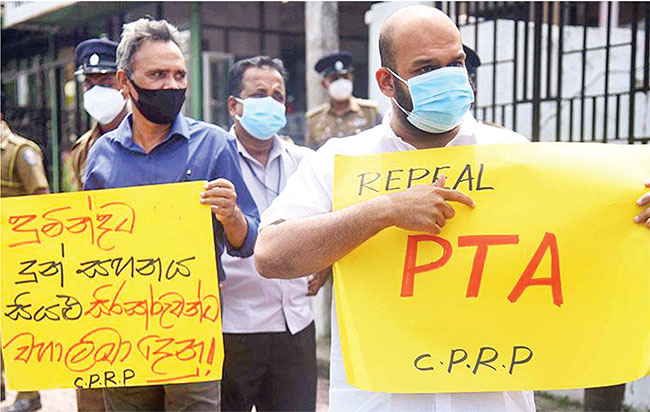
A statement issued by Ambika Sathkunanathan, on behalf of a group of individuals, dealt with a statement, dated Nov 29, put out by the SLCC following consultations with the government. The statement condemned the government-SLCC dialogue on the PTA. Dismissing proposals meant to reform the PTA, the group called for repeal of the PTA and in the interim an immediate moratorium on the use of the law.
The group reiterated that any law that purports to deal with terrorism must adhere to international human rights standards. The following are the signatories to the statement issued by Sathkunanathan: S. Annalaxumy, Bisliya Bhutto, S.C.C. Elankovan, A.M. Faaiz, Brito Fernando, Nimalka Fernando, Ruki Fernando, Aneesa Firthous, Amarasingham Gajenthiran, T.Gangeswary, K. Ginogini, Ranitha Gnanarajah, B. Gowthaman, S. Hayakirivan, V. Inthrani, Noorul Ismiya, Dr. Sakuntala Kadirgamar, S. Kamalakanthan, Mahaluxmy Kurushanthan, Kandumani Lavakusarasa, Jensila Majeed, Buhary Mohamed, Juwairiya Mohideen, Jaabir Raazi Muhammadh, P. Muthulingam, Thangaraja Prashanthiran, Dorin Rajani, Maithreyi Rajasingham, A.R.A. Ramees, V. Ranjana, K.S. Ratnavale, Yamini Ravindran, Kumudini Samuel, Thurainayagam Sanjeevan, Shreen Saroor, Ambika Satkunanathan, Rev. Fr. S.D.P. Selvan, S. Selvaranie, Vanie Simon, P.N. Singham, Usha Sivakumar, N. Sumanthi, Vani Sutha, Ermiza Tegal, S. Thileepan, P. Vasanthagowrey, Rev. Fr. Yogeswaran, Adayalam Centre for Policy Research Alliance for Minorities, Centre for Human Rights and Development Centre for Justice and Change, Eastern Social Development Foundation, Families of the Disappeared, Forum for Plural Democracy, Law and Society Trust, Mannar Women’s Development Federation, Rural Development Foundation, Tamil Civil Society Forum, Viluthu, and Women’s Action Network.
Some sections of the civil society feel the SLCC’s dialogue with the government can be exploited by the latter. They question the incumbent government’s sincerity as tangible measures haven’t been taken to address the grievances of the minorities. The SLCC comprises Ven. Kalupahana Piyaratana Thera – Convenor, Inter Religious Alliance for National Unity, Chairman, Human Development Edification Centre, Bishop Asiri Perera – Retired President Bishop of Methodist Church, Rev. Fr. C.G. Jeyakumar – Parish Priest Ilavalai and Lecturer at the Jaffna Major Seminary, Human Rights Activist, Dr. Joe William – Founder member and Chairman of National Peace Council, Director, Centre for Communication Training and Convenor, Alliance for Justice, Prof. T. Jayasingam – Director NPC, former Vice Chancellor of Eastern University and former member, Public Service Commission of the Eastern Provincial Council, Prof. Kalinga Tudor Silva – Professor Emeritus Dept of Sociology, University of Peradeniya, Dr. Dayani Panagoda – Social Activist, former director of Secretariat for Coordinating the Peace Process and Lecturer, former member of the Official Languages Commission, Ms. Visaka Dharmadasa – Peace Activist, Chair of Association of War Affected Women, Dr. Jehan Perera – Founder member and Executive Director of NPC, Dr. P. Saravanamuttu – Founder Executive Director, Centre for Policy Alternatives, Hilmy Ahamed – Vice President Muslim Council of Sri Lanka, Sanjeewa Wimalagunarathna – Former director of Secretariat for Coordinating Reconciliation Mechanisms, Rohana Hettiarachchi – Executive Director PAFFREL, Javid Yusuf – Former Ambassador to Saudi Arabia, former member of Human Rights Commission, former member, Constitutional Council, former principal, Zahira College and Founder member and Governing Council member, NPC, Varnakulasingham Kamaladas- President STA solidarity foundation, Convenor, Assembly of Hindus for Peace and Harmony, and Ms. Sarah Arumugam – Human Rights Lawyer (This list was made available by Dr. Perera in response to the writer’s request)
Focus on post-Easter Sunday attacks
A second statement issued by Ambika Sathkunanathan on behalf of smaller group of activists namely Radhika Coomaraswamy, Nimalka Fernando, Sakuntala Kadirgamar, Chulani Kodikara, Rehab Mamoor, Yamini Ravindran, Thyagi Ruwanpathirana, Kumudini Samuel, Shreen Saroor, Ambika Satkunanathan and Muqaddasa Wahid following a two-day visit to Batticaloa dealt with the difficulties experienced by those affected by the Easter Sunday carnage. The National Thowheed Jamaat (NTJ) targeted a church in Batticaloa.
The statement focused on the continued challenges faced by the Christian community in exercising their right to practice their faith freely and without fear. The group blamed the situation on both extra-legal state interference, as well as social discrimination by the Hindu community and the Catholic Church. The group stated: “Christian pastors highlighted the phenomenon of Hindu groups that propagate Hindutva-like ideologies and have affiliations to the Shiv Sena in India, targeting the Christian community.
Other forms of discrimination, marginalisation and harassment of the Christian community include denial of permission to establish places of worship, preventing them from using the public cemetery, denying their children admission to national schools, interruption of prayer meetings, including through the use of violence, and perpetration of violence against pastors. We were informed that complaints to the police often have no impact as the police do not take any action. The security agencies reportedly visit churches and request information about congregants, supposedly to ensure that those who are not part of the congregation are not allowed to enter the churches. The pastors however stated this only served to intimidate them and was contrary to the open and inclusive policy they practiced of welcoming persons of all faiths.”
The group appeared to have ignored controversial statement made by TNA heavyweight M.A. Sumanthiran, PC within days after the Easter Sunday carnage. Lawmaker Sumanthiran alleged that the Easter Sunday carnage was a result of Sri Lanka’s failure to ensure certain basic values. Did he justify the Easter Sunday attacks?
The Jaffna District MP warned of dire consequences unless the government addressed the grievances of the minorities. MP Sumanthiran said that no conversation took place without reference to Easter Sunday attacks. The lawmaker said that the public were asking what was going to happen because the country was stunned by what happened on that day. Sumanthiran: “All of us were so complacent we lived in a fool’s paradise imagining that the country was at peace in the absence of violence.”
As there had been no fighting for 10 years people assumed the country had attained peace. All that was shattered that morning on Easter Sunday, the MP said.
Such an attack would have happened some day because the country had not laid the foundation for peaceful co-existence in this country the TNA heavyweight said. “What we saw was a false edifice. And we were quite happy to carry on with that. Three decades of violent conflict that emanated from the North and East kept us on our toes and those days we actually saw the need to address those issues in a very deep and meaningful way”.
Sumanthiran alleged that once the war was brought to a conclusion in May 2009, those responsible assumed there was no requirement to address those issues. They continued to pay lip service, the lawmaker alleged, adding: “Whenever issues were raised, they say they must resolve those issues. But deep down, they didn’t feel those issues had to be addressed”.
The Presidential Commission of Inquiry that probed the Easter Sunday carnage owed an elucidation as to why an explanation was not sought from Sumanthiran. In fact, the writer brought to the PCoI’s notice the TNA MP’s statement when the police unit attached to the outfit recorded his statement as regards the justification of terrorist attacks.
Many years before Sumanthiran entered Parliament as a TNA National List MP in 2010, his party recognised the LTTE as the sole representative of the Tamil speaking people. Did the LTTE achieve TNA’s cooperation at gun point? The LTTE and the TNA worked as a team. It was a deadly combination.
Following the 2004 general election, the European Union Election Observation Mission faulted the TNA for receiving the LTTE’s backing to secure the lion’s share of parliamentary seats in the Northern and Eastern provinces with the latter stuffing the ballot boxes.
Having faithfully served the LTTE throughout the war, the TNA backed General Sarath Fonseka’s candidature at the 2010 presidential election. The civil society didn’t find fault with the TNA for backing the war-winning Army Commander nor blamed the group for depriving the Northern Province Tamils of their right to vote at the 2005 presidential election. The LTTE and the TNA worked on this project together. No less a person than R. Sampanthan, the current TNA leader confirmed the decision with this writer a few days before the election. Dr. Pakiasothy Saravanamuttu was the only civil society activist to take a courageous stand against the LTTE-TNA polls boycott decision.
The government should realise that it should set the record straight in Geneva. The current Geneva project cannot be reversed by engaging the civil society and the Tamil Diaspora. The recent announcement made by US Secretary of State Antony Blinken as regards an SLN intelligence officer and former Staff Sergeant of the Army underscored the fact that the sinister Western agenda was continuing. The recent declaration of the above-mentioned officers as gross violators of human rights should be examined against the backdrop of Army Commander General Shavendra Silva still being blacklisted.


The failure on the part of the Janatha Vimukthi Peramuna (JVP)-led National People’s Power (NPP) government to fulfil a plethora of promises given in the run up to the last presidential election, in September, 2024, and a series of incidents, including cases of corruption, and embarrassing failure to act on a specific weather alert, ahead of Cyclone Ditwah, had undermined the administration beyond measure.
Ditwah dealt a knockout blow to the arrogant and cocky NPP. If the ruling party consented to the Opposition proposal for a Parliamentary Select Committee (PSC) to probe the events leading to the November 27 cyclone, the disclosure would be catastrophic, even for the all-powerful Executive President Anura Kumara Dissanayake, as responsible government bodies, like the Disaster Management Centre that horribly failed in its duty, and the Met Department that alerted about the developing storm, but the government did not heed its timely warnings, directly come under his purview.
The NPP is on the back foot and struggling to cope up with the rapidly developing situation. In spite of having both executive presidency and an overwhelming 2/3 majority in Parliament, the government seems to be weak and in total disarray.
The regular appearance of President Dissanayake in Parliament, who usually respond deftly to criticism, thereby defending his parliamentary group, obviously failed to make an impression. Overall, the top NPP leadership appeared to have caused irreparable damage to the NPP and taken the shine out of two glorious electoral victories at the last presidential and parliamentary polls held in September and November 2024 respectively.
The NPP has deteriorated, both in and out of Parliament. The performance of the 159-member NPP parliamentary group, led by Prime Minister Dr. Harini Amarasuriya, doesn’t reflect the actual situation on the ground or the developing political environment.
Having repeatedly boasted of its commitment to bring about good governance and accountability, the current dispensation proved in style that it is definitely not different from the previous lots or even worse. (The recent arrest of a policeman who claimed of being assaulted by a gang, led by an NPP MP, emphasised that so-called system change is nothing but a farce) In the run-up to the November, 2024, parliamentary polls, President Dissanayake, who is the leader of both the JVP and NPP, declared that the House should be filled with only NPPers as other political parties were corrupt. Dissanayake cited the Parliament defeating the no-confidence motions filed against Ravi Karunanayake (2016/over Treasury Bond scams) and Keheliya Rambukwella (2023/against health sector corruption) to promote his argument. However, recently the ongoing controversy over patient deaths, allegedly blamed on the administration of Ondansetron injections, exposed the government.
Mounting concerns over drug safety and regulatory oversight triggered strong calls from medical professionals, and trade unions, for the resignation of senior officials at the National Medicines Regulatory Authority (NMRA) and the State Pharmaceutical Corporation (SPC).
Medical and civil rights groups declared that the incident exposed deep systemic failures in Sri Lanka’s drug regulatory framework, with critics warning that the collapse of quality assurance mechanisms is placing patients’ lives at grave risk.
The Medical and Civil Rights Professional Association of Doctors (MCRPA), and allied trade unions, accused health authorities of gross negligence and demanded the immediate resignation of senior NMRA and SPC officials.
MCRPA President Dr. Chamal Sanjeewa is on record as having said that the Health Ministry, NMRA and SPC had collectively failed to ensure patient safety, citing, what he described as, a failed drug regulatory system.
The controversy has taken an unexpected turn with some alleging that the NPP government, on behalf of Sri Lanka and India, in April this year, entered into an agreement whereby the former agreed to lower quality/standards of medicine imports.
Trouble begins with Ranwala’s resignation
The NPP suffered a humiliating setback when its National List MP Asoka Ranwala had to resign from the post of Speaker on 13 December, 2024, following intense controversy over his educational qualification. The petroleum sector trade union leader served as the Speaker for a period of three weeks and his resignation shook the party. Ranwala, first time entrant to Parliament was one of the 18 NPP National List appointees out of a total of 29. The Parliament consists of 196 elected and 29 appointed members. Since the introduction of the National List, in 1989, there had never been an occasion where one party secured 18 slots.
The JVP/NPP made an initial bid to defend Ranwala but quickly gave it up and got him to resign amidst media furor. Ranwala dominated the social media as political rivals exploited the controversy over his claimed doctorate from the Waseda University of Japan, which he has failed to prove to this day. But, the JVP/NPP had to suffer a second time as a result of Ranwala’s antics when he caused injuries to three persons, including a child, on 11 December, in the Sapugaskanda police area.
The NPP made a pathetic, UNP and SLFP style effort to save the parliamentarian by blaming the Sapugaskanda police for not promptly subjecting him for a drunk driving test. The declaration made by the Government Analyst Department that the parliamentarian hadn’t been drunk at the time of the accident, several days after the accident, does not make any difference. Having experienced the wrongdoing of successive previous governments, the public, regardless of what various interested parties propagated on social media, realise that the government is making a disgraceful bid to cover-up.
No less a person than President Dissanayake is on record as having said that their members do not consume liquor. Let us wait for the outcome of the internal investigation into the lapses on the part of the Sapugaskanda police with regard to the accident that happened near Denimulla Junction, in Sapugaskanda.
JVP/NPP bigwigs obviously hadn’t learnt from the Weligama W 15 hotel attack in December, 2023, that ruined President Ranil Wickremeinghe’s administration. That incident exposed the direct nexus between the government and the police in carrying out Mafia-style operations. Although the two incidents cannot be compared as the circumstances differ, there is a similarity. Initially, police headquarters represented the interests of the wrongdoers, while President Wickremesinghe bent over backwards to retain the man who dispatched the CCD (Colombo Crime Division) team to Weligama, as the IGP. The UNP leader went to the extent of speaking to Chief Justice Jayantha Jayasuriya, PC, and Speaker Mahinda Yapa Abeywardena to push his agenda. There is no dispute the then Public Security Minister Tiran Alles wanted Deshabandu Tennakoon as IGP, regardless of a spate of accusations against him, in addition to him being faulted by the Supreme Court in a high-profile fundamental rights application.
The JVP/NPP must have realised that though the Opposition remained disorganised and ineffective, thanks to the media, particularly social media, a case of transgression, if not addressed swiftly and properly, can develop into a crisis. Action taken by the government to protect Ranwala is a case in point. Government leaders must have heaved a sigh of relief as Ranwala is no longer the Speaker when he drove a jeep recklessly and collided with a motorcycle and a car.
Major cases, key developments
Instead of addressing public concerns, the government sought to suppress the truth by manipulating and exploiting developments
* The release of 323 containers from the Colombo Port, in January 2025, is a case in point. The issue at hand is whether the powers that be took advantage of the port congestion to clear ‘red-flagged’ containers.
Although the Customs repeatedly declared that they did nothing wrong and such releases were resorted even during Ranil Wickremesinghe’s presidency (July 2022 to September 2024), the public won’t buy that. Container issue remains a mystery. That controversy eroded public confidence in the NPP that vowed 100 percent transparency in all its dealings. But the way the current dispensation handled the Port congestion proved that transparency must be the last thing in the minds of the JVPers/NPPers holding office.
* The JVP/NPP’s much touted all-out anti-corruption stand suffered a debilitating blow over their failure to finalise the appointment of a new Auditor General. In spite of the Opposition, the civil society, and the media, vigorously taking up this issue, the government continued to hold up the appointment by irresponsibly pushing for an appointment acceptable to President Dissanayake. The JVP/NPP is certainly pursuing a strategy contrary to what it preached while in the Opposition and found fault with successive governments for trying to manipulate the AG. It would be pertinent to mention that President Dissanayake should accept the responsibility for the inordinate delay in proposing a suitable person to that position. The government failed to get the approval of the Constitutional Council more than once to install a favourite of theirs in it, thanks to the forthright position taken by its civil society representatives.
The government should be ashamed of its disgraceful effort to bring the Office of the Auditor General under its thumb:
* The JVP/NPP government’s hotly disputed decision to procure 1,775 brand-new double cab pickup trucks, at a staggering cost exceeding Rs. 12,500 mn, under controversial circumstances, exposed the duplicity of that party that painted all other political parties black. Would the government rethink the double cab deal, especially in the wake of economic ruination caused by Cyclone Ditwah? The top leadership seems to be determined to proceed with their original plans, regardless of immeasurable losses caused by Cyclone Ditwah. Post-cyclone efforts still remain at a nascent stage with the government putting on a brave face. The top leadership has turned a blind eye to the overwhelming challenge in getting the country back on track especially against the backdrop of its agreement with the IMF.
Post-Cyclone Ditwah recovery process is going to be slow and extremely painful. Unfortunately, both the government and the Opposition are hell-bent on exploiting the miserable conditions experienced by its hapless victims. The government is yet to acknowledge that it could have faced the crisis much better if it acted on the warning issued by Met Department Chief Athula Karunanayake on 12 November, two weeks before the cyclone struck.
Foreign policy dilemma
Sri Lanka moved further closer to India and the US this year as President Dissanayake entered into several new agreements with them. In spite of criticism, seven Memorandums of Understanding (MoUs), including one on defence, remains confidential. What are they hiding?
Within weeks after signing of the seven MoUs, India bought the controlling interests in the Colombo Dockyard Limited for USD 52 mn.
Although some Opposition members, representing the SJB, raised the issue, their leader Sajith Premadasa, during a subsequent visit to New Delhi, indicated he wouldn’t, under any circumstances, raise such a contentious issue.
Premadasa went a step further. The SJB leader assured his unwavering commitment to the full implementation of the 13th Amendment to the Constitution that was forced on Sri Lanka during President JRJ’s administration, under the highly questionable Indo-Lanka Accord of July, 1987, after the infamous parippu drop by Indian military aircraft over Jaffna, their version of the old gunboat diplomacy practiced by the West.
Both India and the US consolidated their position here further in the post-Aragalaya period. Those who felt that the JVP would be in a collision course with them must have been quite surprised by the turn of events and the way post-Aragalaya Sri Lanka leaned towards the US-India combine with not a hum from our carboard revolutionaries now installed in power. They certainly know which side of the bread is buttered. Sri Lanka’s economic deterioration, and the 2023 agreement with the IMF, had tied up the country with the US-led bloc.
In spite of India still procuring large quantities of Russian crude oil and its refusal to condemn Russia over the conflict in Ukraine, New Delhi has obviously reached consensus with the US on a long-term partnership to meet the formidable Chinese challenge. Both countries feel each other’s support is incalculably vital and indispensable.
Sri Lanka, India, and Japan, in May 2019, signed a Memorandum of Cooperation (MoC) to jointly develop the East Container Terminal (ECT) at the Colombo Port. That was during the tail end of the Yahapalana administration. The Gotabaya Rajapaksa administration wanted to take that project forward. But trade unions, spearheaded by the JVP/NPP combine, thwarted a tripartite agreement on the basis that they opposed privatisation of the Colombo Port at any level.
But, the Colombo West International Terminal (CWIT) project, that was launched in November, 2022, during Ranil Wickremesinghe’s presidency, became fully operational in April this year. The JVP revolutionary tiger has completely changed its stripes regarding foreign investments and privatisation. If the JVP remained committed to its previous strategies, India taking over CDL or CWIT would have been unrealistic.
The failure on the part of the government to reveal its stand on visits by foreign research vessels to ports here underscored the intensity of US and Indian pressure. Hope our readers remember how US and India compelled the then President Wickremesinghe to announce a one-year moratorium on such visits. In line with that decision Sri Lanka declared research vessels wouldn’t be allowed here during 2024. The NPP that succeeded Wickremesinghe’s administration in September, 2024, is yet to take a decision on foreign research vessels. What a pity?
The NPP ends the year on the back foot, struggling to cope up with daunting challenges, both domestic and external. The recent revelation of direct Indian intervention in the 2022 regime change project here along with the US underscored the gravity of the situation and developing challenges. Post-cyclone period will facilitate further Indian and US interventions for obvious reasons.
****

Perhaps one of the most debated events in 2025 was the opening of ‘City of Dreams Sri Lanka’ that included, what the investors called, a world-class casino. In spite of mega Bollywood star Shah Rukh Khan’s unexpected decision to pull out of the grand opening on 02 August, the investors went ahead with the restricted event. The Chief Guest was President Anura Kumara Dissanayake, who is also the Finance Minister, in addition to being the Defence Minister. Among the other notable invitees were Dissanayake’s predecessor Ranil Wickremesinghe, whose administration gave critical support to the high-profile project, worth over USD 1.2 bn. John Keells Holdings PLC (JKH) and Melco Resorts & Entertainment (Melco) invested in the project that also consist of the luxurious Nüwa hotel and a premium shopping mall. Who would have thought President Dissanayake’s participation, even remotely, possible, against the backdrop of his strong past public opposition to gambling of any kind?
Don’t forget ‘City of Dreams’ received a license to operate for a period of 20 years. Definitely an unprecedented situation. Although that license had been issued by the Wickremesinghe administration, the NPP, or any other political party represented in Parliament, didn’t speak publicly about that matter. Interesting, isn’t it, coming from people, still referred by influential sections of the Western media, as avowed Marxists?
By Shamindra Ferdinando

Through the Eyes of the Patua:
 Organised by the Colombo Institute for Human Sciences in collaboration with Millennium Art Contemporary, an interesting and unique exhibition got underway in the latter’s gallery in Millennium City, Oruwala on 21 December 2025. The exhibition is titled, ‘Through the Eyes of the Patua: Ramayana Paintings of an Artisanal Community’ and was organized in parallel with the conference that was held on 20 December 2025 under the theme, ‘Move Your Shadow: Rediscovering Ravana, Forms of Resistance and Alternative Universes in the Tellings of the Ramayana.’ The scrolls on display at the gallery are part of the over 100 scrolls in the collection of Colombo Institute’s ‘Roma Chatterji Patua Scroll Collection.’ Prof Chatterji, who taught Sociology at University of Delhi and at present teaches at Shiv Nadar University donated the scrolls to the Colombo Institute in 2024.
The paintings on display are what might be called narrative scrolls that are often over ten feet long. Each scroll narrates a story, with separate panels pictorially depicting one component of a story. The Patuas or the Chitrakars, as they are also known, are traditionally bards. A bard will sing the story that is depicted by each scroll which is simultaneously unfurled. For Sri Lankan viewers for whom the paintings and their contexts of production and use would be unusual and unfamiliar, the best way to understand them is to consider them as a comic strip. In the case of the ongoing exhibition, since the bards or the live songs are not a part of it, the word and voice elements are missing. However, the curators have endeavoured to address this gap by displaying a series of video presentations of the songs, how they are performed and the history of the Patuas as part of the exhibition itself.
The unfamiliarity of the art on display and their histories, necessitates broader explanation. The Patua hail from Medinipur District of West Bengal in India. Essentially, this community of artisans are traditional painters and singers who compose stories based on sacred texts such as the Ramayana or Mahabharata as well as secular events that can vary from the bombing of the Twin Towers in New York in 2001 to the Indian Ocean Tsunami of 2004. Even though painted storytelling is done by a number of traditional artisan groups in India, the Patua is the only community where performers and artists belong to the same group. Hence, Professor Chatterji, in her curatorial note for the exhibition calls them “the original multi-media performers in Bengal.”
‘The story of the Patuas’ also is an account of what happens to such artisanal communities in contemporary times in South Asia more broadly even though this specific story is from India. There was a time before the 21st century when such communities were living and working across a large part of eastern India – each group with a claim to their recognizably unique style of painting. However, at the present time, this community and their vocation is limited to areas such as Medinipur, Birbhum, Purulia in West Bengal and Dumka in Jharkhand.
A pertinent question is how the scroll painters from Medinipur have survived the vagaries of time when others have not. Professor Chatterji provides an important clue when she notes that these painters, “unlike their counterparts elsewhere, are also extremely responsive to political events.” As such, “apart from a rich repertoire of stories based on myth and folklore, including the Ramayana and other epics, they have, over many years, also composed on themes that range from events of local or national significance such as boat accidents and communal violence to global events such as the tsunami and the attack on the World Trade Centre.”
There is another interesting aspect that becomes evident when one looks into the socio-cultural background of this community. As Professor Chatterji writes, “one significant feature that gives a distinct flavour to their stories is the fact that a majority of Chitrakars consider themselves to be Muslims but perform stories based largely on Hindu myths.” In this sense, their story complicates the tension-ridden dichotomies between ethno-cultural and religious groups typical of relations between groups in India as well as more broadly in South Asia, including in Sri Lanka. Prof Chatterji suggests this positionality allows the Patua to have “a truly secular voice so vital in the world that we live in today.”
As a result, she notes, contemporary Patuas “have propagated the message of communal harmony in their compositions in the context of the recent riots in India and the Gulf War. Their commentaries couched in the language of myth are profoundly symbolic and draw on a rich oral tradition of storytelling.” What is even more important is their “engagement with contemporary issues also inflects their aesthetics” because many of these painters also “experiment with novel painterly values inspired by recent interaction with new media such as comic books and with folk art forms from other parts of the country.”
From this varied repertoire of the Patuas’ painterly tradition, this exhibition focusses on scrolls portraying different aspects of the Ramayana. In North Indian and the more dominant renditions of the Ramayana, the focus is on Rama while in many alternate renditions this shifts to Ravana as typified by versions popular among the Sinhalas and Tamils in Sri Lanka as well as in some areas in several Indian states. Compared to this, the Patua renditions in the exhibition mostly illustrate the abduction of Sita with a pronounced focus on Sita and not on Ravana, the conventional antagonist or on Rama, the conventional protagonist. As a result, these two traditional male colossuses are distant. Moreover, with the focus on Sita, these folk renditions also bring to the fore other figures directly associated with her such as her sons Luv and Kush in the act of capturing Rama’s victory horse as well as Lakshmana.
Interestingly, almost as a counter narrative, which also serves as a comparison to these Ramayana scrolls, the exhibition also presents three scrolls known as ‘bin-Laden Patas’ depicting different renditions on the attack on New York’s Twin Towers.
While the painted scrolls in this collection have been exhibited thrice in India, this is the first time they are being exhibited in Sri Lanka, and it is quite likely such paintings from any community beyond Sri Lanka’s shores were not available for viewing in the country before this. Organised with no diplomatic or political affiliation and purely as a Sri Lankan cultural effort with broader South Asian interest, it is definitely worth a visit. The exhibition will run until 10 January 2026.

Power comes like a demonic spell,
To restless humans constantly in chains,
And unless kept under a tight leash,
It drives them from one ill deed to another,
And among the legacies they thus deride,
Are those timeless truths lucidly proclaimed,
By prophets, sages and scribes down the ages,
Hailing from Bethlehem, Athens, Isipathana,
And other such places of hallowed renown,
Thus plunging themselves into darker despair.
By Lynn Ockersz

Lankan aircrew fly daring UN Medevac in hostile conditions in Africa

Lanka to observe National Safety Day today

Street vendors banned from Kandy City

Police fully armed with breathalyser test kits during season of cheer

Hunt on for cops aiding and abetting heroin trafficking network in Moratuwa, Lunawa, Angulana and Ratmalana

Do-or-die battle for NPP at CMC second budget vote next week

‘Dates have the highest sugar content to fight Coronavirus’

Sunday Island 27 December – Headlines

#SundayIsland 17th December – Headlines

Sunday Island – 28th March

Sunday Island Headlines – 21 March

Sunday Island – 21st February – Headlines
-

 News3 days ago
Members of Lankan Community in Washington D.C. donates to ‘Rebuilding Sri Lanka’ Flood Relief Fund
-

 Latest News6 days ago
Landslide early warnings issued to the districts of Badulla, Kandy, Kurunegala, Matale and Nuwara-Eliya extended till 8AM on Sunday (21)
-

 News4 days ago
Air quality deteriorating in Sri Lanka
-

 Business5 days ago
Browns Investments sells luxury Maldivian resort for USD 57.5 mn.
-

 Editorial6 days ago
Cops as whipping boys?
-
Latest News7 days ago
Landslide early warnings issued to the Districts of Badulla, Kandy, Kurunegala, Matale and Nuwara Eliya extended
-

 News4 days ago
Cardinal urges govt. not to weaken key socio-cultural institutions
-
 News3 days ago
Suspension of Indian drug part of cover-up by NMRA: Academy of Health Professionals