
Business
Governance Matters: SEC engages corporate leaders


The Securities and Exchange Commission of Sri Lanka (SEC) on 04th November conducted a special awareness session on “Directors’ Liabilities” for directors of listed companies, with over 150 listed company directors participating. The session was held as part of the SEC’s ongoing commitment to fostering good governance and transparency in the capital market.
In his opening remarks Senior Prof. Hareendra Dissabandara, Chairman, SEC highlighted the critical role of board leadership in strengthening the capital market.
“The strength of companies lies in the quality of its leadership. The strength of the market lies in the integrity of Boards,” the Chairman stated.
He emphasized that when directors fulfill their responsibilities consciously, investor confidence is enhanced, market participation increases, and capital formation accelerates.
“Directors’ responsibilities are not just about avoiding punitive measures but about promoting long-term value, preserving reputation, and protecting stakeholder interests,” he noted.
Delivering the keynote address, Dr. Harsha Cabral, President’s Counsel, commended the SEC for its proactive approach in promoting awareness among directors.
“It is a very healthy step taken by the SEC to invite directors of listed entities to gain more exposure on new and evolving areas of Corporate Governance,” Dr. Cabral said. “The SEC has taken a lead role in promoting awareness of directors’ duties, responsibilities, and liabilities, and that is a commendable initiative.”
Dr. Cabral elaborated on the evolution of company law in Sri Lanka, noting that with the enactment of the Companies Act No. 7 of 2007, the country moved away from the traditional English company law model and adopted a modern, regulated framework based on Canadian principles.
“This Act introduced, for the first time, clear statutory provisions defining directors’ duties and liabilities,” he explained. “Section 187 very clearly provides that directors must act in good faith and in the best interest of the company, this is the cornerstone of corporate responsibility.”
He emphasized that directors must be well-versed with the internal governance framework of their companies.
“Every director must be familiar with the Articles of Association of their company, it is the constitution of the company. Unfortunately, many directors have not even read it. You cannot discharge your duties if you do not understand your company’s own governing document.”
Highlighting the standard of care expected of directors, Dr. Cabral stated that directors must exercise prudence and diligence in all decisions.
“Directors must not act recklessly or negligently. They must exercise the same care a parent would in safeguarding their family, acting prudently, responsibly, and in good faith.”
He further cautioned directors on conflicts of interest and the importance of transparency in board deliberations:
“Conflicts of interest must be clearly declared and recorded. Failure to do so can expose directors to serious legal consequences. Transparency in Board deliberations is essential for integrity and investor confidence.”
Discussing financial prudence, he described the solvency test under Section 57 as the “golden thread that runs across the entire fabric of corporate law,” reminding directors to remain conscious of their company’s financial health.
He also drew attention to the broad spectrum of legal liabilities faced by directors, stating that there are 37 civil and 131 criminal liabilities under the Companies Act, underscoring the need for integrity and accountability in decision-making.
“Boards must comprise competent, responsible individuals,” he said. “If shareholders appoint the wrong people, they must also be prepared for the consequences. Sound governance begins with strong and ethical leadership.”
Following the opening remarks, a comprehensive panel discussion moderated by Ms. Chandanie Weragala, Consultant Company Secretary at Nexia Consultants, addressed critical aspects of directors’ responsibilities and regulatory compliance.
Speaking on directors’ reliance on management information, Laknath Jayawickrama, Commission Member of the SEC, outlined a practical framework for assessing the appropriateness of such reliance.
“When we take decisions, we have to act in a manner which is not reckless or negligent. The key question is how we ensure this,” Jayawickrama stated. He emphasized that directors’ ability to rely on information depends on several critical factors, including the timing of information provision, whether the subject matter falls within the director’s domain knowledge, and the qualifications of external experts providing advice.
“If we are getting Board papers well in advance, I can make adequate queries. But if we are getting Board papers at the last minute, my ability to ask the right questions is eroded,” he explained, highlighting how late provision of information can compromise effective Board oversight.
Jayawickrama also stressed the importance of clarity in Board papers: “Some Board papers are very precise and clear, with proper conclusions. Some are ambiguous. When we don’t have proper conclusions as a director, we are not sure whether the person forwarding the Board resolution has made up his mind or has come to a proper conclusion.”
Renuke Wijayawardhane, Former Chief Regulatory Officer and Consultant at CSE, emphasized the importance of vigilance in recognizing early indicators of financial difficulties, noting that financial distress does not occur overnight.
“There are triggers, there are early indicators. As directors of listed companies, you should have the capacity of understanding it in a very timely manner. Most of these figures actually relate to the financial statements, the transparency, integrity and timeliness of financial statements,” Wijayawardhane stated.
He cautioned Boards against over-reliance on audit committees: “You should not leave that to the accounting person. Everything is handed over to the audit committee Chairman who is also an accounting professional. Others are just relaxing. No, you can’t do that because these are the early signs which can blow up into a real catastrophe.”
Wijayawardhane identified several critical red flags that Boards must monitor, including delays in preparation of financial statements, reluctance by management in providing information, frequent restatements of accounts, and key personnel departures. “If the audit committee gets the audited accounts and the accounts are qualified, then they start firefighting. It’s too late,” he cautioned.
He also highlighted the serious consequences of delisting under new regulations: “Under the new delisting rules, if it is a mandatory delisting, you lose the fit and propriety. You can’t be on the Board for three years. It’s very important that you understand these things.”
Buwaneka Basnayake, Partner at F J & G de Saram, emphasized that compliance fundamentally begins with understanding a company’s legal capacity and obligations under the law.
“Compliance is all about what you should do and shouldn’t do at a fundamental level,” Basnayake stated, highlighting that Section 2 of the Companies Act articulates the capacity of a company to carry on its business, subject to its articles and written law.
He stressed that effective delegation is crucial to maintaining compliance: “It is impracticable for the Board of directors as a collective or individual director to look into all compliance aspects. Delegation is a key component of compliance. These functions have to be delegated to the relevant experts, those who have relevant expertise in those areas.”
Basnayake outlined practical measures for ensuring ongoing compliance, including developing comprehensive checklists, establishing well-articulated action plans with timelines, and conducting periodic awareness programs. However, he cautioned that systems alone are insufficient: “It’s all well and good to have the mechanisms in place, but if the implementation is lax, you will anyway get into trouble. It will be too late when you find out that the entire compliance culture has broken down.”
(To be Continued)


Sri Lanka private healthcare leaders recently pledged an action plan with timelines to address the practical priorities of Sri Lanka’s healthcare sector while making it more viable for local and foreign investments.
The Association of Private Hospitals and Nursing Homes (APHNH) has committed to converting recommendations from its first Healthcare Leadership Summit into a trackable outcome document with defined actions, responsibilities, and timelines, marking a shift from discussion to implementation in sector reform efforts.
The summit held on March 9 at Waters Edge, Colombo, brought together hospital leaders, policymakers, regulators, insurers, and international experts to address practical priorities for Sri Lanka’s healthcare sector.
A key outcome of the summit was APHNH’s plan to consolidate recommendations into a single, trackable charter that will outline specific actions, assign responsibilities, establish timelines, and provide periodic progress updates.
“Our objective is to bring the right decision-makers into one room and focus on what can be implemented, not only what can be discussed, ” said Raveen Wickremesinghe, President of APHNH. “We are committed to taking the inputs from today and converting them into a clear, trackable set of actions that strengthens quality, transparency and public confidence, while supporting national health priorities. “
The summit featured insights from Dr. Hafeez Rahman Padiyath, Dr. Hamdani Anver, and Chandana L. Aluthgama on scaling quality and operational discipline. A keynote and fireside discussion with Dr. Paiboon Eksangsri, President of the Private Hospital Association of Thailand, explored lessons from Thailand’s private healthcare development and conditions for making Sri Lanka more competitive for healthcare investment.
By Sanath Nanayakkare
Business
Atlas SipSavi Naththal Poronduwa records positive public participation, benefiting 10,000 students


Atlas, Sri Lanka’s No. 1 learning brand, successfully concluded Atlas SipSavi Naththal Poronduwa, a national initiative that saw strong public participation in supporting children at risk of dropping out of school due to financial hardship. At a time when more than 22,000 Sri Lankan children leave school each year due to rising economic challenges, the initiative reinforced Atlas Sipsavi’s long-standing ‘No Child Left Behind’ promise by turning seasonal generosity into meaningful educational support.
The initiative reached 10,000 students, with beneficiary schools carefully selected to ensure support reached those most in need. The collected books were distributed to children at risk of dropping out, including those whose education had been disrupted by recent adverse weather, ensuring students had essential learning resources at the start of the new school term. Through its flagship Atlas SipSavi programme, the brand focused on improving access to education by providing essential learning tools, scholarships, and infrastructure to create better learning environments, bringing its purpose of ‘making learning fun’ to life in a meaningful way. As part of the initiative, the public was invited to donate schoolbooks, with each contribution matched one-for-one by Atlas. Donation boxes were placed at all Keells outlets island-wide and at Sarvodaya District Offices, making it easy for communities to take part.
Business
John Keells Logistics expands strategic engagement with CWIT through inter-terminal transport operations

John Keells Logistics (Pvt) Ltd (JKLL), one of Sri Lanka’s leading third-party logistics solutions providers, has successfully expanded its operational engagement with Colombo West International Terminal (Private) Limited (CWIT), through inter-terminal transport services within the Port of Colombo. This enhanced engagement further strengthens CWIT’s efforts to improve operational efficiency, reliability, and scalability across terminal activities.
Inter-terminal transport plays a critical role in modern port operations, requiring high levels of coordination, precision, and operational discipline. JKLL’s appointment for ITT operations reflects CWIT’s confidence in the company’s demonstrated capabilities in managing complex transport operations within a high-throughput port environment.
The ITT operations are underpinned by JKLL’s technology-enabled logistics framework, incorporating real-time fleet tracking, performance monitoring systems, and data-driven operational planning. These capabilities provide enhanced visibility and control over transport movements, while ensuring compliance with established safety, productivity, and service quality standards.
The awarding of this engagement to JKLL is a testament to the successful implementation of the Inter-Terminal Vehicle (ITV) operations undertaken by John Keells Logistics at CWIT during the previous year. The ITV assignment was executed through structured operating procedures and disciplined service delivery, contributing to improved cargo movement, operational coordination, and service continuity within the terminal. The performance outcomes of the ITV operations provided the basis for the subsequent expansion of the partnership into ITT services.

Agha calls for ‘sportsman spirit’ after controversial dismissal

US embassy in Baghdad hit by strike as Trump says military targets ‘obliterated’ on Iran’s key oil island

Showers or thundershowers will occur at several places in the Western, Sabaragamuwa, Central, North-western and Uva provinces and in Galle, Matara, Mannar and Anuradhapura districts after 2.00 pm.

Bahrain & Saudi Arabia Grands Prix to be cancelled

Pink Floyd guitar sold for record-breaking $14.6m

Promoting Local Industries is a key priority of the Government – PM

‘Dates have the highest sugar content to fight Coronavirus’

Sunday Island 27 December – Headlines

#SundayIsland 17th December – Headlines

Sunday Island – 28th March

Sunday Island Headlines – 21 March

Sunday Island – 21st February – Headlines
-
 News5 days ago
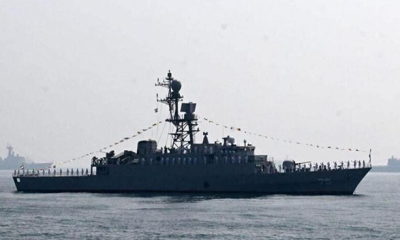
Repatriation of Iranian naval personnel Sri Lanka’s call: Washington
-
 Features5 days ago
Winds of Change:Geopolitics at the crossroads of South and Southeast Asia
-

 News4 days ago
Prof. Dunusinghe warns Lanka at serious risk due to ME war
-

 Sports3 days ago
Royal start favourites in historic Battle of the Blues
-

 Sports2 days ago
The 147th Royal–Thomian and 175 Years of the School by the Sea
-

 News2 days ago
Historic address by BASL President at the Supreme Court of India
-

 News3 days ago
CEBEU warns of operational disruptions amid uncertainty over CEB restructuring
-

 Business6 days ago
Seven decades of sartorial excellence: The legacy of Linton Master Tailors in Kandy