
News
GL recalls how SLA was wrongly blamed for Mannar mass graves

By Shamindra Ferdinando
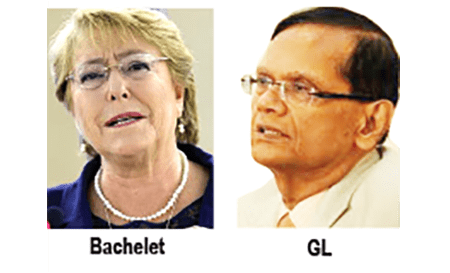
Education Minister Prof. G.L. Peiris, who is also Chairman of the ruling SLPP, has questioned the rationale in UN human rights Chief Michelle Bachelet’s latest report that dealt with Sri Lanka accountability issues during the war and post-conflict period in the run-up to the 46th session of the Geneva-based United Nations Human Rights Council (UNHRC).
Bachelet served as the Chilean President for nine years beginning 2006.
Acknowledging that Sri Lanka was again on the Geneva agenda, Prof. Peiris told a media briefing at the SLPP office at Battaramulla that Foreign Minister Dinesh Gunawardena would state the government’s stand. Prof. Peiris, who served as the External Affairs Minister during President Mahinda Rajapaksa’s second term (2010-2015) emphasized the government would take the following factors into consideration. Prof. Peiris asked how the UNHRC as regards Sri Lanka pursued a controversial agenda not compatible with its mandate. The top academic emphasized therefore forceful intervention in domestic matters was contrary to its mandate.
The UNHRC consists of 47 countries divided into five groups.
Referring to Bachelet’s latest report Prof. Peiris pointed out the absurdity in the UN human rights chief raising the enactment of an Amendment to the Constitution, appointments given to retired armed forces officers and interference in parliamentary matters. The Education Minister said the UN rights chief and the UNHRC had no business to intervene in such domestic matters.
Minister Peiris said that the UNHRC actions should be fair by all member states of the UN. Recollecting his recent three-day visit to Kilinochchi and the Jaffna peninsula, Prof. Peiris alleged that Bachelet conveniently ignored substantial development achieved in the Northern and Eastern Provinces since the eradication of the LTTE.
Sri Lanka brought the war to a successful conclusion in May 2009.
The former Chief Negotiator for the government in talks with the LTTE, Prof. Peiris faulted Bachelet for not giving sufficient attention to two key post-war factors namely rehabilitation of the LTTE cadre and vacation of public and private land and property occupied by the military.
Prof. Peiris said Sri Lanka had rehabilitated as many as 12,000 LTTE cadres after fighting ‘the world’s most ruthless terrorist organisation’, in an efficient manner that received the appreciation of some sections of the international community. The UN human rights chief however had chosen to ignore Sri Lanka’s unique rehabilitation project, the minister said, urging the Geneva body to give up its offensive directed at post-war Sri Lanka.
Prof. Peiris explained the orderly vacation of public and private property in the Northern and Eastern provinces by the security forces would never have been possible without the eradication of the LTTE. Those who always inquire about the continuing military presence in the predominantly Tamil speaking areas were conspicuously silent about significant reduction of in military presence over the years, Prof Peiris said. Would that be possible until the armed forces crushed the LTTE, Prof. Peiris asked.
Prof. Peiris said that the Office of the Missing Persons (OMP), too, was continuing its work. The SLPP Chairman also pointed out Bachelet’s failure to recognize improvement in education, agriculture, fisheries and industrial sectors over the past decade.
Prof. Peiris said that the Geneva body lost its credibility as it dealt with countries differently. “We are a case in point,” Minister Peiris said, underscoring Sri Lanka was definitely not the first country investigated over accountability issues.
The former foreign minister alleged that the UNHRC targeted some countries while some received protection. The minister said that the Geneva body was being used by those with vested interests to suit their agendas. The minister described Sri Lanka as a victim of that despicable strategy.
The former Foreign Minister said that the Geneva body should give due recognition to local mechanisms set up by Sri Lanka to address accountability issues. Unfortunately, Geneva had ignored the LLRC, Paranagama Commission as well as its Second Mandate thereby deprived Sri Lanka of an opportunity to set the record straight.
The Minister said that the international community should recognize the political environment too. Having won two national elections overwhelmingly, in 2019 and 2020, the ruling party commanded the respect of the people, the minister said, urging Geneva to be mindful of the circumstances leading to the rejection of yahapalana administration, twice within 12 months.
Responding to a query by The Island, Prof. Peiris pointed out that the Geneva rights chief had been in such a hurry to pressure Sri Lanka she blamed the Mannar mass graves on the Sri Lanka Army before US lab revealed the bones found therein were several centuries old and belonged to the colonial period. They never bothered to verify facts, the minister said, calling for examination of disclosure made by Lord Naseby in Oct 2017, US defence attaché Lt. Col. Lawrence Smith’s statement in June 2011, Wikileaks cables and dispatches from the UN office during Eelam War IV to establish the truth.


Police have stepped up their crackdown on organised crime, after securing Interpol Red Notices for 95 suspects believed to be hiding overseas.
Police Spokesman SSP F. U. Wootler told a media briefing yesterday that the move marked a major escalation in efforts to track down and extradite high-profile figures linked to organised crime syndicates and online fraud networks.
He said the strategy was already producing results. In 2024, Sri Lanka secured the return of 10 suspects through Interpol channels, while a further 11 were extradited in 2025 to face legal proceedings.
In addition to Red Notices, authorities have relied on formal legal mechanisms to overcome jurisdictional barriers. “During the 2024–2025 period, 21 suspects were extradited under the Extradition Act,” SSP Wootler said.
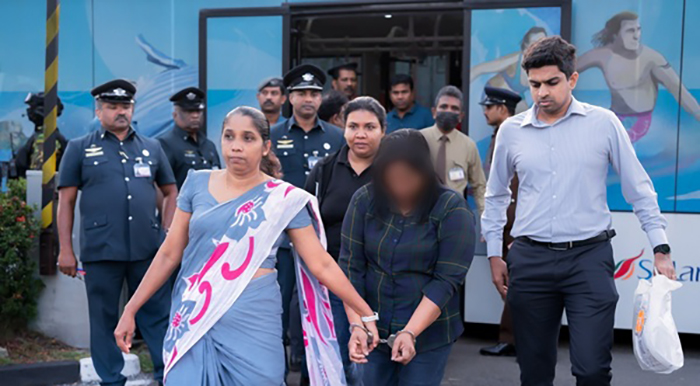
The briefing coincided with three more fugitives being escorted back to Sri Lanka yesterday following the issuance of Interpol Red Notices.
SSP Wootler said many of the fugitives had continued to coordinate criminal activities here from abroad, including sophisticated online scams, underscoring the importance of international cooperation.
Two male suspects, for whom Red Notices had been issued and who were overseas, and a female suspect wanted in connection with defrauding state funds, were flown back.
Following their arrival yesterday morning at Katunayake Airport, they were taken into custody by a team of officers from the CID.
The arrested suspects are residents of Kandana and Uragasmanhandiya, aged 30 and 52, respectively. The female suspect is a 56-year-old resident of Mount Lavinia.
The suspect residing in Kandana is an individual wanted in connection with an attempted murder. It has been revealed that while overseas, he is connected to a range of crimes, including orchestrating a shooting incident that resulted in a homicide in the Kandana area on 2025.07.03. This suspect has been handed over to the Officer-in-Charge of the Kelaniya Division for further investigations.
The one hailing from Uragasmanhandiya is a suspect wanted in connection with carrying out homicides using sharp weapons and being involved in a series of organised crimes in the Uragasmanhandiya area. This suspect has been handed over to the Officer-in-Charge of the Elpitiya Division for further investigations.
The female suspect, residing in Mount Lavinia, who is reported to have worked at an Embassy in 2014, is an accused in a case where the Criminal Investigations Department is investigating the defrauding of state funds. She has been sentenced to imprisonment, fines, and also ordered to compensate victims by the Colombo High Court.
“These operations were carried out with the strong support of the Government of the United Arab Emirates, including Abu Dhabi International Police, Dubai Police, as well as Sri Lankan diplomatic missions,” he said.
Interpol Red Notices function as international alerts requesting law enforcement agencies worldwide to locate and provisionally arrest individuals pending extradition.
Wootler said efforts would continue to identify and pursue suspects operating from foreign jurisdictions, particularly those involved in organised and cyber-related crimes posing threats to national security.
By Norman Palihawadane and Hemantha Randunu

Leader of the Pivithuru Hela Urumaya (PHU), Udaya Gammanpila, yesterday launched a scathing attack on outgoing United States Ambassador to Sri Lanka Julie Chung, accusing her of interfering in Sri Lanka’s internal affairs and exerting undue influence over recent political developments.
Addressing a press conference in Colombo, Gammanpila said Chung’s departure, after a four-year tenure, marked a “day of national relief,” claiming her presence had been harmful to the country.
He said patriots marked the occasion by sharing kiribath (milk rice), which he described as a symbolic celebration.
Gammanpila alleged that Ambassador Chung had remained in Sri Lanka longer than the customary three-year diplomatic term because of, what he described as, her success in bringing the country under American influence. Drawing comparisons with past foreign diplomats, he claimed that Chung was the most influential envoy since Indian High Commissioner J.N. Dixit in the 1980s. He alleged that successive Sri Lankan governments had failed to challenge what he described as interference by the envoy.
The PHU leader accused Chung of playing a behind-the-scenes role in the 2022 protest movement, commonly known as the Aragalaya, claiming it was orchestrated to destabilise the country. He alleged that young protesters were unknowingly “acting out a foreign script” under the guise of patriotism.
Gammanpila also alleged that Chung played a key role in elevating the National People’s Power (NPP), which he referred to as the “Malimawa” movement, into a governing force in 2024. He claimed the movement had been transformed from its earlier ideological roots into, what he described as, a pro-Western political project, asserting that President Anura Kumara Dissanayake had come to power with foreign backing. He cited a photograph shared on Chung’s social media account of her visit to the NPP headquarters as evidence of what he termed political proximity.
According to Gammanpila, Ambassador Chung’s public criticism of governance issues sharply declined following the change of government. He alleged that while she had frequently commented on incidents under previous administrations, she had remained silent on alleged corruption and governance failures over the past 14 months.
Turning to the future, Gammanpila urged caution regarding the incoming US Ambassador, Eric Meyer, stating that any engagement on religious or cultural matters should be viewed carefully. He called on President Dissanayake to pursue an independent foreign policy, free of external influence.
Gammanpila also criticised the government over, what he described as, repeated “policy blunders,” particularly in relation to issues affecting children and social values. He cited several instances, including proposals to promote Sri Lanka as a destination for same-sex couples, educational material controversies, and a recent People’s Bank advertisement that he claimed subtly promoted same-sex symbolism. While stating that he held no animosity towards the LGBTQ community, Gammanpila said he opposed, what he described as, attempts to influence children through state institutions.
In addition, the PHU leader condemned legal action taken by the Coast Conservation Department against nine individuals, including four Buddhist monks, for installing a Buddha statue within a coastal conservation zone in Trincomalee. He described the arrests as discriminatory, alleging that similar structures belonging to other religions and commercial entities had been overlooked.
Calling the current administration “anti-Buddhist,” Gammanpila urged authorities to apply the law equally and not just in words, and “not to turn legal frameworks into instruments against Buddhism.” He also accused members of the government of ingratitude, alleging that many had once sought refuge in temples during periods of political violence.
By Anuradha Hiripitiyage
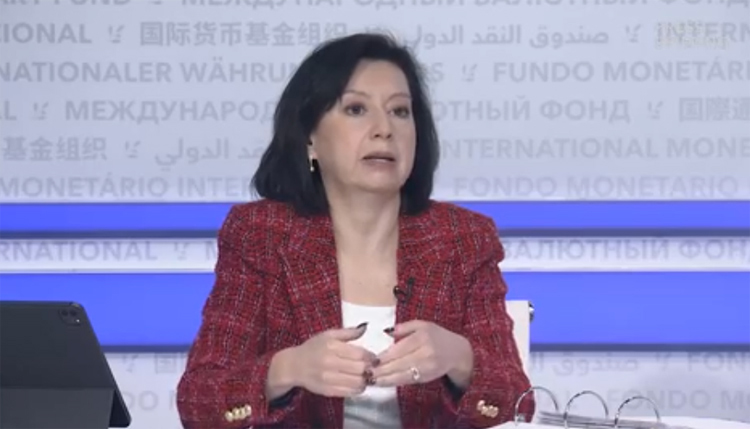
The International Monetary Fund (IMF) has decided to send a fact-finding mission to Sri Lanka, from 22 to 28 January, to assess the damage caused by the recent Cyclone Ditwah.
The Director of the IMF’s Communications Department, Julie Kozack, also stated that the team will discuss related policy implications under the Extended Fund Facility (EFF) programme.
She also underscored that this is a fact-finding mission aimed at enabling the team to gain a clearer understanding of the situation on the ground.

Police step up crackdown on organised crime after securing 95 Interpol Red Notices

Julie’s exit gladdens Udaya’s heart

IMF fact-finding mission to visit Lanka from 22–28 Jan.

Countrywide police operation on Thursday nets 412 drunk drivers out of 554 arrests, including those wanted

Diplomatic thaw in Middle East sparks hope for Sri Lankan tea exports

US Ambassador Chung makes farewell call on Sajith

‘Dates have the highest sugar content to fight Coronavirus’

Sunday Island 27 December – Headlines

#SundayIsland 17th December – Headlines

Sunday Island – 28th March

Sunday Island Headlines – 21 March

Sunday Island – 21st February – Headlines
-

 Business2 days ago
Koaloo.Fi and Stredge forge strategic partnership to offer businesses sustainable supply chain solutions
-

 Business6 days ago
Dialog and UnionPay International Join Forces to Elevate Sri Lanka’s Digital Payment Landscape
-
 News6 days ago
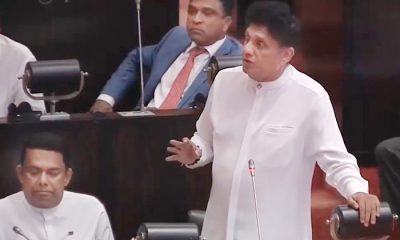
Sajith: Ashoka Chakra replaces Dharmachakra in Buddhism textbook
-

 Editorial1 day ago
The Chakka Clash
-

 Features6 days ago
The Paradox of Trump Power: Contested Authoritarian at Home, Uncontested Bully Abroad
-

 Features6 days ago
Subject:Whatever happened to (my) three million dollars?
-
 Business2 days ago
SLT MOBITEL and Fintelex empower farmers with the launch of Yaya Agro App
-

 Features1 day ago
Online work compatibility of education tablets