
News
Geneva resolution: GTF disappointed over Lanka’s response; appreciates India’s efforts


The UK-headquartered Global Tamil Forum (GTF) said that Sri Lanka’s response to the latest Geneva resolution presented by Foreign Minister Ali Sabry – who insisted on an exclusive domestic mechanism to address wartime atrocities despite the country’s inability to take a single meaningful initiative for 13 years – is thoroughly disappointing.
Rejecting any external involvement in investigating the economic crimes – despite overwhelming evidence that such crimes partly contributed to the economic crisis, the President’s Counsel trivialised the efforts put in by many countries for Resolution 51/L1/Rev1, alleging it catered for their domestic politics and regional differences only.
The following is the text of the GTF statement issued by its spokesperson Suren Surendiran: “For Minister Ali Sabry, there was no sense of irony when invoking an outdated concept of sovereignty as an all-encompassing protective shield while the country is totally dependent on international assistance to overcome its deep economic crisis. Perhaps therein lies a pathway to make a meaningful transformation in Sri Lanka. Knowing Sri Lanka’s track record with past UNHRC resolutions, it makes complete sense to link the progress on implementing the key aspects of Resolution 51/L1/Rev1 to the financial packages provided by the international community.
Implementing key aspects of the UNHRC Resolution 51/L1/Rev1 is crucial for promoting human rights, accountability and economic stability in Sri Lanka
The GTF welcomes the passing of Resolution 51/L1/Rev1 with minimal opposition among the member countries of the UNHRC on 6 October 2022. It is particularly pleasing that several countries who would have traditionally voted against such a resolution recognised the criticality of the Sri Lankan situation and decided to abstain. For the thousands of victims of serious human rights abuses in Sri Lanka, who have been denied justice for more than a decade, UNHRC continues to offer hope, even if the process of seeking justice is painstakingly slow and arduous.
The process towards this important outcome commenced with the comprehensive report of the UN High Commissioner for Human Rights, which was highly critical of Sri Lanka’s failure to address wartime accountability; entrenched impunity for human rights violations; economic crimes; endemic corruption; and the application of draconian security laws to crackdown peaceful protests. The High Commissioner’s recommendations were ably converted into Resolution 51/L1/Rev1 by the core group of countries – in effect, a balancing act of highly concerning developments in Sri Lanka and challenging geopolitical reality.
GTF would like to express its gratitude to all progressive forces that made this outcome possible – the Office of the High Commissioner for Human Rights (OHCHR), the core group of countries led by the UK, countries that voted for or co-sponsored the resolution, the human rights organisations who championed the cause, and more importantly, the victims of human rights abuses in Sri Lanka who despite the long time elapsed and the risks involved, continue to provide inspiration by bravely fighting for accountability.
Resolution 51/L1/Rev1 recognises Sri Lanka’s total failure in addressing wartime accountability. It has extended and reinforced the capacity of the OHCHR to collect, consolidate, analyse and preserve information and evidence, and develop strategies for future accountability processes. Such options could include extraterritorial and universal jurisdiction as well as targeted sanctions against those credibly implicated in serious human rights abuses.
The resolution acknowledges the lack of freedoms and marginalisation endured by the Tamil and Muslim communities and calls for the government to fulfil its commitment to the devolution of political authority, specifically to ensure that all provincial councils, including the northern and eastern provincial councils, are able to operate effectively in accordance with the 13th Amendment to the Constitution.
The resolution also underscores how unaccountable governance, deepening militarisation and impunity for human rights violations eventually led to the unprecedented economic crisis in Sri Lanka and calls on the government to address the crisis, including by investigating and prosecuting corruption committed by present and former public officials, and offers assistance with the investigation into economic crimes.
Furthermore, Resolution 51/L1/Rev1 notes the heavy-handed approach adopted by the government against protesters calling for change, such as declaring multiple state of emergencies and continuing with detentions under the Prevention of Terrorism Act. It calls on the government to protect civil society actors and human rights defenders while emphasizing the positive contribution peaceful protests can make towards the effectiveness of democratic processes.
Notwithstanding India’s abstention, we are pleased with its strong statement in support of the Tamil people for equality, justice, dignity and peace. India noted inadequate progress in implementing the 13th Amendment to the Constitution and called for meaningful devolution and early elections for the Provincial Councils. GTF hopes India’s actions of goodwill – both the unprecedented assistance during the economic crisis and abstention at UNHRC – could be leveraged to protect and promote the legitimate political and economic aspirations of Tamils.
Resolution 51/L1/Rev1 which aims to address many legacies and emerging human rights and economic issues is timely. Its success depends entirely on the insistence and persistence of the international community in ensuring its full implementation. In this context, it is important to highlight the sense of frustration engulfing many victims and their families with no sense of accountability and justice even after 8 UNHRC resolutions and 13 years of waiting.
Unlike previous years when the outcome at the UNHRC was eagerly sought mainly by the Tamil community, the interests and expectations this year were much more widespread. The ruthless treatment meted out to those protesting against the government, and the authoritarian and militarised trajectory the country is increasingly adopting, has brought a new awareness about human rights and their universality among all citizens of the country.
GTF believes this convergence of concerns, fears and apprehensions offer hope for all the people of Sri Lanka to come together as equal citizens and communities. Such progress is possible only when all communities stop living a lie based on denial and come to terms with the truth based on evidence. The UNHRC resolution just passed provides a useful framework to work towards such an outcome in unity.”









Latest News
Heat Index at Caution level’ in the Northern, North-central, North-western, Western and Southern provinces and in Trincomalee district.


Warm Weather Advisory
Issued by the Natural Hazards Early Warning Centre
Issued at 3.30 p.m. on 12 April 2026, valid for 13 April 2026.
Heat index, the temperature felt on human body is likely to increase up to ‘Caution level’ at some places in the Northern, North-central, North-western, Western and Southern provinces and in Trincomalee district.
The Heat Index Forecast is calculated by using relative humidity and maximum temperature and this is the condition that is felt on your body. This is not the forecast of maximum temperature. It is generated by the Department of Meteorology for the next day period and prepared by using global numerical weather prediction model data.

Effect of the heat index on human body is mentioned in the above table and it is prepared on the advice of the Ministry of Health and Indigenous Medical Services.
ACTION REQUIRED
Job sites: Stay hydrated and takes breaks in the shade as often as possible.
Indoors: Check up on the elderly and the sick.
Vehicles: Never leave children unattended.
Outdoors: Limit strenuous outdoor activities, find shade and stay hydrated.
Dress: Wear lightweight and white or light-colored clothing.
Note:
In addition, please refer to advisories issued by the Disaster Preparedness & Response Division, Ministry of Health in this regard as well. For further clarifications please contact 011-7446491.

On the apparent northward relative motion of the sun, it is going to be directly over the latitudes of Sri Lanka from 05th to 15th of April in this year.
The nearest areas of Sri Lanka over which the sun is overhead today (13th) are Pesalai, Mankulam and Nedunkerny about 12:11 noon.
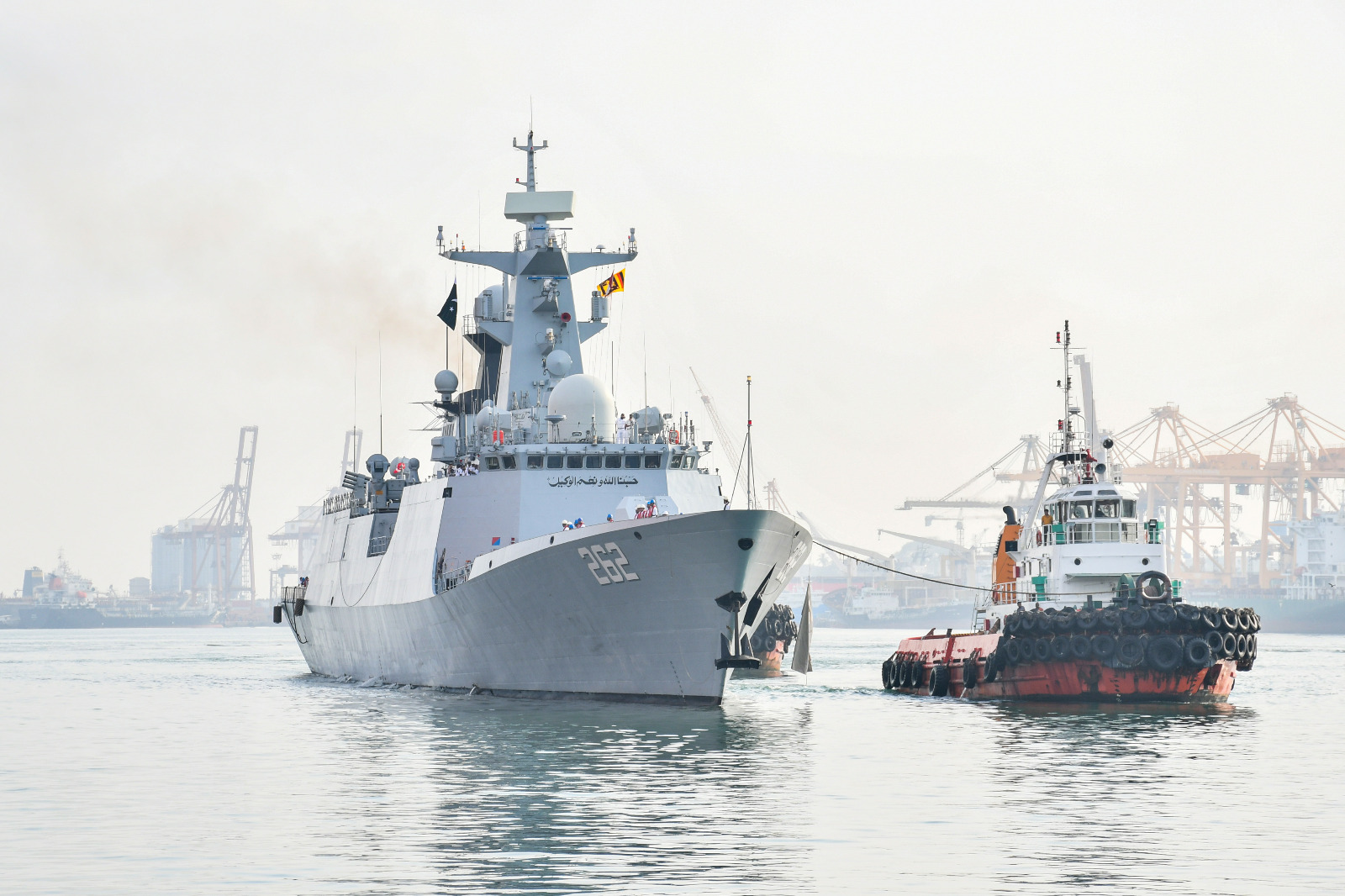
The Pakistan Navy Ship (PNS) TAIMUR and ASLAT arrived at the Port of Colombo on a goodwill visit on 12 Apr 26.
The visiting ships were welcomed by the Sri Lanka Navy in
compliance with naval traditions.
The duo of ships is commanded by Captain NIAMAT SAEED KHAN (PNS TAIMUR) and Captain NADIR MATEEN AFRIDI (PNS ASLAT).
Meanwhile, the ships are expected to conduct a Bilateral Naval Exercise LION STAR V with the Sri Lanka Navy in Colombo seas.

Salt and Patidar power RCB past Mumbai Indians

Prasidh, Buttler set up comfortable win for Gujarat Titans

Heat Index at Caution level’ in the Northern, North-central, North-western, Western and Southern provinces and in Trincomalee district.

Showers above 75 mm are likely at some places in the Western, Sabaragamuwa, Central, Southern and North-western provinces.

Sun directly overhead Pesalai, Mankulam and Nedunkerny about 12:11 noon

PNS TAIMUR & ASLAT arrive in Colombo

‘Dates have the highest sugar content to fight Coronavirus’

Sunday Island 27 December – Headlines

#SundayIsland 17th December – Headlines

Sunday Island – 28th March

Sunday Island Headlines – 21 March

Sunday Island – 21st February – Headlines
-

 News7 days ago
Lankan-origin actress Subashini found dead in India
-

 News2 days ago
CEB orders temporary shutdown of large rooftop solar systems
-

 News5 days ago
AG: Coal procurement full of irregularities
-

 Business4 days ago
Israeli attack on Lebanon triggers local stock market volatility
-

 Business5 days ago
Hayleys Mobility introduces Premium OMODA C9 PHEV
-

 News7 days ago
UN Regional Director launches SL’s first Country Gender Equality Profile during official visit
-

 Business4 days ago
HNB Assurance marks 25 years with strategic transformation to ‘HNB Life’
-

 News7 days ago
Dialog Launches ‘GanuDenu QR’, Making Cashless Transfers Free for All with eZ Cash and Dialog Finance