
News
Gen (retd) Dias asks candidates to disclose their positions on ‘Geneva threat’

By Shamindra Ferdinando
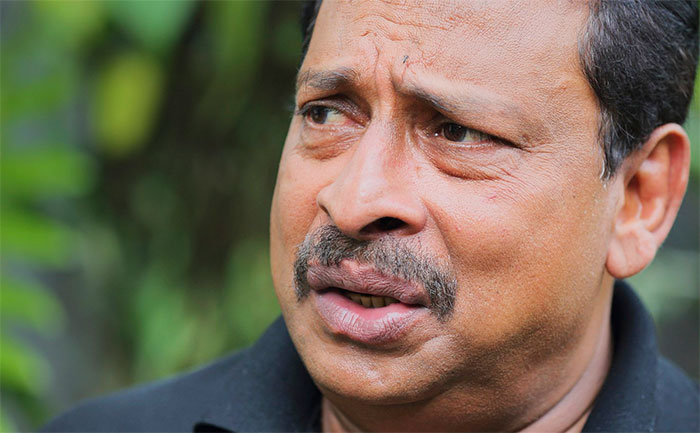
General (retd) Jagath Dias has appealed to presidential contestants to explain how they intended to meet the growing threat posed by the Geneva-based United Nations Human Rights Council pushing Sri Lanka to punish the war winning military personnel on the basis of unsubstantiated war crimes allegations.
Presidential election is scheduled to be held on Sept. 21. Thirty-eight contestants representing 23 political parties and 17 independent candidates are in the fray.
Referring to the latest Geneva report, which spells out ‘transformational changes’ required to achieve accountability and reconciliation, General Dias emphasised the responsibility on the part of the government and presidential candidates to meet the daunting challenge.
Having served the Army for over 35 years, Dias retired in late Dec 2015, two months after Sri Lanka co-sponsored 30/1 accountability resolution that brought the country under the purview of Geneva. Dias commanded the 57 Infantry Division tasked with bringing Kilinochchi under government control. Dias retired as the Chief of Staff of the Army.
The Combined armed forces brought the war to a successful conclusion in May 2009.
Political parties in the fray couldn’t remain silent against the backdrop of the latest Geneva warning that whoever won the presidential election should adhere with the Geneva process, the Gajaba Regiment veteran said.
The retired Gen. was speaking at a seminar organised by the Yuthukama civil society group at the Colombo Public Library recently. Ven. Madagama Dhammananda Nayaka Thera of Asgiriya Chapter, Siyam Maha Nikaya chaired the meeting.
In his brief speech, General Dias pointed out that Geneva, having accused Sri Lanka of failing to prosecute and punish whom it called perpetrators of war crimes, had urged the international community to pursue complementary strategies to support accountability in Sri Lanka, including appropriate use of extraterritorial and universal jurisdiction, targeted sanctions against credibly alleged perpetrators and other available measures, consistent with international law.
Gen. Dias questioned the right of the executive and legislature to submit the serving and retired top brass to foreign judicial mechanisms. Dias said he was one of those who have been unfairly held responsible for war crimes, and all other like-minded retired and serving officers felt disappointed with the way successive governments had addressed the ‘accountability issues’.
Yuthukama leader and parliamentarian Gevindu Cumaratunga, in his opening remarks emphasized the need to educate the electorate in the run-up to the presidential poll as political parties offered to implement the 13th Amendment fully whereas some indicated their readiness to go even beyond.
Declaring that Sri Lanka was at a crossroads, the dissident SLPP lawmaker questioned the role played by parliament responsible for enactment of laws that undermined the country. How could parliament bring in laws that targeted the war winning military responsible for saving the country from terrorism that threatened to divide Sri Lanka on ethnic lines, MP Gumaratunga asked.
Gen Dias underscored the danger of interested parties linking the Geneva process with the agreement reached with the International Monetary Fund (IMF) to pressure the government in power to follow the Western agenda.
Pointing out that retired officers and men had been divided on political party lines, Gen. Dias said that he represented the interests of all those who fought for the motherland. “The sacrifices made by officers and men cannot be forgotten under any circumstances as politicians seek advantage through devious ways,” Gen. Dias said, urging the electorate to be mindful of the utterly irresponsible political party system.Prof. Tudor Weerasinghe and Jaffna-based civil society activist Arun Siddharthan, too, addressed the gathering.





Latest News
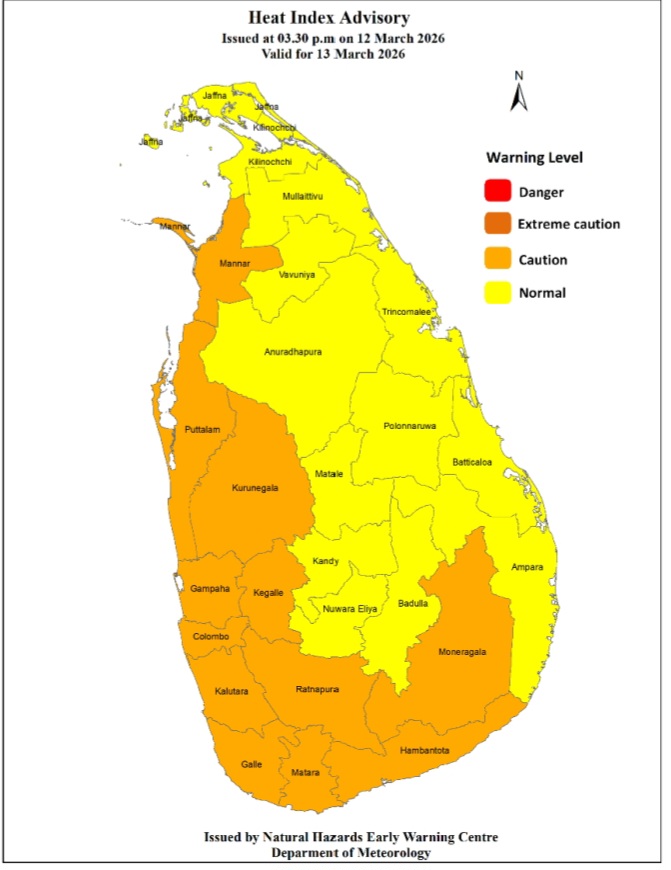
Heat Index likely to increase up to ‘Caution level’ at some places in the Western, Sabaragamuwa, Southern and North-western provinces and in Monaragala and Mannar districts

Warm Weather Advisory
Issued by the Natural Hazards Early Warning Centre of the Department of Meteorology at 3.30 p.m. on 12 March 2026, valid for 13 March 2026.
Heat index, the temperature felt on human body is likely to increase up to ‘Caution level’ at some places in Western, Sabaragamuwa, Southern and North-western provinces and in
Monaragala and Mannar districts.
The Heat Index Forecast is calculated by using relative humidity and maximum temperature and this is the condition that is felt on your body. This is not the forecast of maximum temperature. It is generated by the Department of Meteorology for the next day period and prepared by using global numerical weather prediction model data.
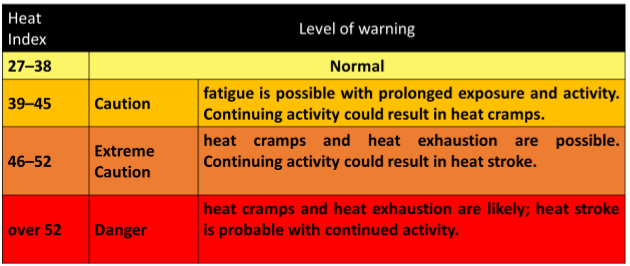
Effect of the heat index on human body is mentioned in the above table and it is prepared on
the advice of the Ministry of Health and Indigenous Medical Services.
ACTION REQUIRED
Job sites: Stay hydrated and takes breaks in the shade as often as possible.
Indoors: Check up on the elderly and the sick.
Vehicles: Never leave children unattended.
Outdoors: Limit strenuous outdoor activities, find shade and stay hydrated.
Dress: Wear lightweight and white or light-colored clothing.
Note:
In addition, please refer to advisories issued by the Disaster Preparedness & Response Division, Ministry of Health in this regard as well. For further clarifications please contact 011-7446491.

The Frontline Socialist Party (FSP) yesterday accused the government of trying to award another tender to the Indian company that supplied low-grade coal to the Norochcholai Power Plant and failed to deliver the stipulated amount of coal according to schedule.
The allegation was made by the Education Secretary of the Progressive Socialist Party, Pubudu Jayagoda, during media briefing at the party office in Nugegoda last afternoon.
Jayagoda said that in September 2025, the government had awarded a tender to the Indian company Trident Chemphar to supply 25 coal shipments for electricity generation in 2026.
In August 2025, it was confirmed that the coal delivered by the company was substandard. The company also failed to supply coal on schedule. Although the first shipment was expected in the second week of December 2025, it arrived at the end of the month. By mid-March, only 12 ships had arrived, and biweekly deliveries have been disrupted, putting Sri Lanka at risk of a severe energy shortage.
On 11 March, the government called a sudden spot tender for five coal shipments. Four companies submitted bids, and they include Trident Chemphar. FSP criticiced awarding the tender to the same discredited company, saying it was unethical and could trigger a major national crisis, as the company had failed to supply quality coal reliably in the past.
Previously, coal quality was strictly measured, with a “Reject Value”. But now to help the errant supplier the term of Reject Value has now been omitted altogether and replaced with a new term ‘Minimum Value’ setting it as the minimum calorific threshold—coal producing less than 5,900 kilocalories per kilogram was rejected, and coal with ash content above 16% was also discarded.
However, the government is now reportedly lowering these standards, accepting substandard coal, and changing tender specifications to accommodate the company.
Jayagoda castigated the latest stunt coming especially at a time when the world faces war and oil shortages. Diesel meant for electricity generation is being diverted to school buses, public transport, and emergency vehicles, leaving households at risk of prolonged blackouts. Even if diesel is imported, electricity tariffs could skyrocket.

The Indian Ministry of External Affairs has said it is considering requests for diesel supplies from neighbouring countries, including Sri Lanka, Bangladesh and the Maldives.
Speaking to the Press Trust of India, Ministry Spokesperson Randhir Jaiswal noted that India was a major exporter of refined petroleum products in the region. He confirmed that Bangladesh had formally requested a diesel supply, which is currently under review.
He said that diesel exports to Bangladesh had largely continued since 2017, but any new allocations would take into account India’s refining capacity, domestic demand, and overall fuel availability.
Jaiswal added that similar requests from Sri Lanka and the Maldives were also being considered, with India’s own energy requirements forming a key part of the decision-making process.

Heat Index likely to increase up to ‘Caution level’ at some places in the Western, Sabaragamuwa, Southern and North-western provinces and in Monaragala and Mannar districts

Showers above 50 mm can be expected at some places in the Western and Sabaragamuwa provinces and in the Galle and Matara districts

Govt. bends rules, lowers coal standards in favour of errant company: FSP

Lanka requests diesel from India

Gas shortage pushes up electricity demand, night peak rises: CEB

Navy seizes narcotics haul, lethal weapons in two vessels, arrests 10 suspects

‘Dates have the highest sugar content to fight Coronavirus’

Sunday Island 27 December – Headlines

#SundayIsland 17th December – Headlines

Sunday Island – 28th March

Sunday Island Headlines – 21 March

Sunday Island – 21st February – Headlines
-

 News6 days ago
Peradeniya Uni issues alert over leopards in its premises
-

 News4 days ago
Repatriation of Iranian naval personnel Sri Lanka’s call: Washington
-

 News6 days ago
Wife raises alarm over Sallay’s detention under PTA
-

 News3 days ago
Prof. Dunusinghe warns Lanka at serious risk due to ME war
-
 Features4 days ago
Winds of Change:Geopolitics at the crossroads of South and Southeast Asia
-

 Latest News6 days ago
Heat Index at ‘Caution Level’ in the Sabaragamuwa province and, Colombo, Gampaha, Kurunegala, Anuradhapura, Vavuniya, Hambanthota and Monaragala districts
-

 Sports2 days ago
Royal start favourites in historic Battle of the Blues
-

 Features6 days ago
The final voyage of the Iranian warship sunk by the US