
News
FSP urges NPP MPs to reject unfair tax policies


The Frontline Socialist Party (FSP) has sent a letter to all MPs of the ruling National People’s Power (NPP) government, urging them to reject what it describes as a severely unfair tax policy outlined in the 2025 Budget. The party has warned that the proposed tax structure will place an unbearable burden on the public, while at the same time granting significant concessions to large corporations and wealthy individuals.
The 2025 Budget, which was presented to Parliament on 17 February, is scheduled for a final decision on 21 March. The FSP stated that tax policies were generally designed to reduce economic inequalities, prioritise economic development, and regulate market consumption patterns. It argued that the 2025 Budget approached taxation solely as a means of generating government revenue, disregarding the economic hardships faced by the majority of the population.
The FSP has raised concerns over the significant increase in Value Added Tax (VAT) on goods and services, which is set to rise by 25.94% in 2025. The government aims to increase tax revenue from Rs. 2,201 billion in 2024 to Rs. 2,772 billion in 2025, resulting in a notable rise in the financial burden on ordinary citizens. According to the FSP’s analysis, this means that in 2024, an average Sri Lankan household paid Rs. 31,623 per month in indirect taxes on goods and services. In 2025, this figure is expected to increase to Rs. 39,817 per month, placing an additional Rs. 4,200 in taxes on each household. The party argued that this increase is unbearable for families already struggling under the weight of the economic crisis.
Citing data from the Department of Census and Statistics, the FSP has highlighted that the average monthly household income in Sri Lanka is Rs. 76,414, while monthly expenses amount to Rs. 63,130. It has warned that nearly two-thirds of a family’s monthly spending would now be consumed by taxes, describing this as a severe economic blow to working-class and lower-income groups. The party accused the government of betraying the expectations of the people who placed their trust in the NPP administration.
While the government has defended its decision by claiming that the higher VAT collection is not the result of introducing new taxes, but rather improving tax enforcement, the FSP dismissed this argument as misleading. It pointed to the Ministry of Finance’s own report, which stated that between 2023 and 2024, businesses collected Rs. 333.1 billion in taxes from consumers but failed to remit them to the state. Despite this massive tax evasion by corporations, the 2025 Budget does not prioritise recovering these unpaid revenues or strengthening direct taxation on high-income earners. Instead, the government has doubled the withholding tax on savings from 5% to 10%, imposed a 15% tax on foreign income earned through online services, and extended import duties on 63 essential goods, including food items, from 1 January 2025.
The FSP also criticised the government’s handling of VAT rates, which have been rising continuously since 2022. The VAT rate, which was 8% in early 2022, was increased to 12% in August 2022, then raised to 15% in January 2023, and further increased to 18% in January 2024. The party warned that the government appears to be following a pattern of gradually increasing VAT, making it even more difficult for ordinary people to afford basic goods and services. Additionally, a Social Security Contribution Tax was introduced in 2023, further exacerbating financial pressures on the public.
Beyond the tax hikes on ordinary citizens, the FSP condemned the favourable treatment given to wealthy individuals and large corporations. It cited a Parliamentary Committee on Public Accounts (COPA) report from March 2024, which revealed that large corporations evaded Rs. 1,068 billion in taxes, while domestic and foreign corporate entities received tax concessions worth Rs. 978 billion. Despite these staggering figures, the government has only planned to increase direct tax revenue by Rs. 141 billion, indicating that it has no real intention of recovering unpaid taxes from the country’s largest businesses.
The FSP also highlighted a controversial clause in the 2025 Budget that offers a six-month amnesty period for overdue tax payments. This clause, buried in the technical section (Clause 1.9) of the budget document—which was only released in English—states that businesses that failed to pay taxes between 2022 and 2023 can settle their dues without facing penalties or interest charges. The party described this as a shameful giveaway to tax-evading corporations, arguing that it directly undermines the government’s claims of enforcing tax compliance.
In its letter to MPs, the FSP urged lawmakers to reject the tax policy and stand against what it called a blatant betrayal of the public interest. The party reminded Parliamentarians that Sri Lanka’s economic crisis, IMF-imposed financial restructuring, and rising inflation have already pushed millions into financial hardship, and that imposing additional tax burdens on struggling families would only deepen the crisis.
The FSP warned that if MPs vote to approve these unfair tax measures, they risk facing public outrage and a loss of trust. It called for an immediate revision of the 2025 Budget’s tax policy, urging the government to shift the tax burden away from ordinary citizens and onto the country’s wealthiest individuals and corporations.








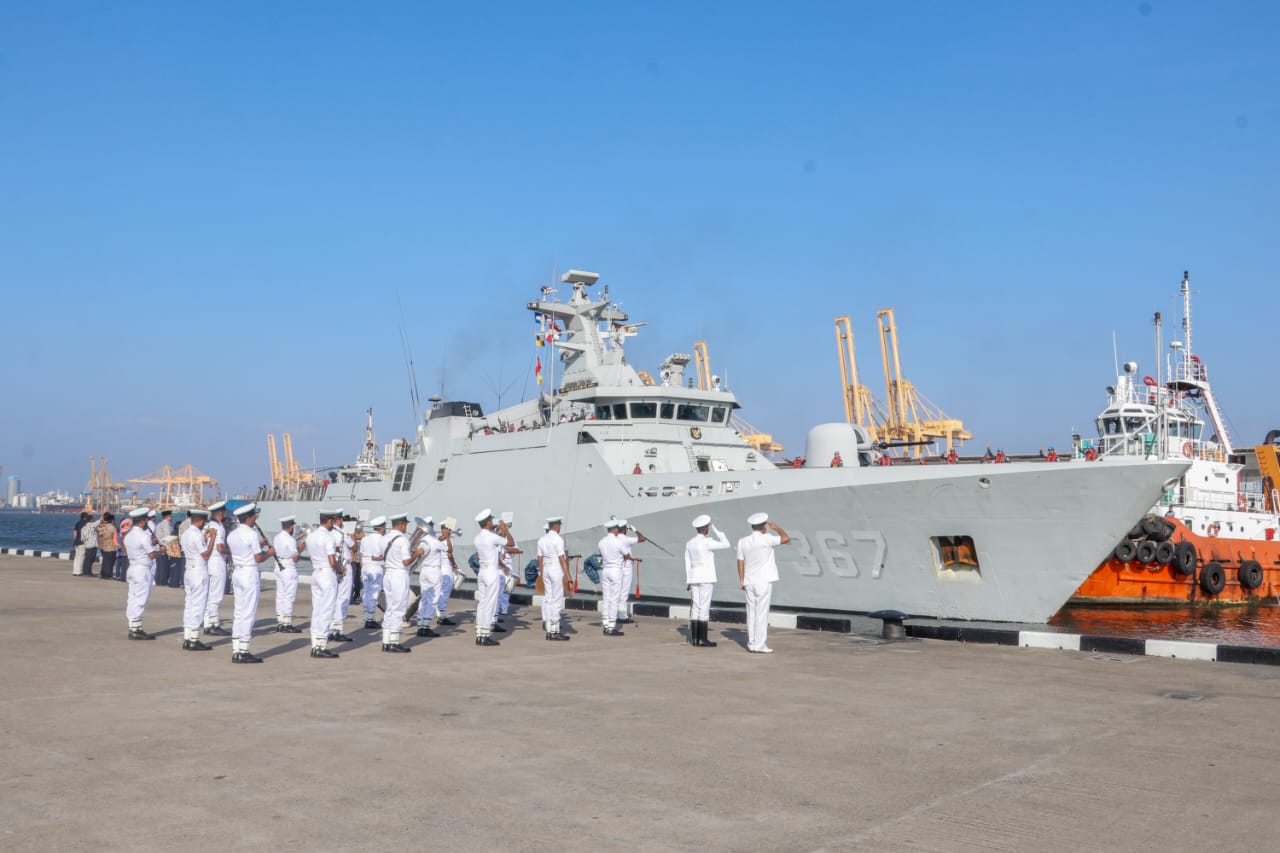
The Royal Navy of Oman Ship ‘AL SEEB’ concluded a logistics replenishment visit to Sri Lanka and departed the Port of Colombo on 24 Jan 26.
In accordance with naval tradition, the Sri Lanka Navy extended a customary farewell to the departing ship.

The price of gold has risen above $5,000 (£3,659) an ounce for the first time, extending a historic rally that saw the precious metal jump by more than 60% in 2025.
It comes as tensions between the US and NATO over Greenland have added to growing concerns about financial and geopolitical uncertainty.
US President Donald Trump’s trade policies have also worried markets. On Saturday he threatened to impose a 100% tariff on Canada if it strikes a trade deal with China.
Gold and other precious metals are seen as a so-called safe-haven assets that investors buy in times of uncertainty.
Demand for gold has also been driven by a range of other factors including higher-than-usual inflation, the weak US dollar, buying by central banks around the world and as the US Federal Reserve is expected to cut interest rates again this year.
Wars in Ukraine and Gaza, as well as Washington seizing Venezuelan President Nicolás Maduro, have also helped push up the price of gold.
On Friday, silver topped $100 an ounce for the first time, building on its almost 150% rise last year.
[BBC]

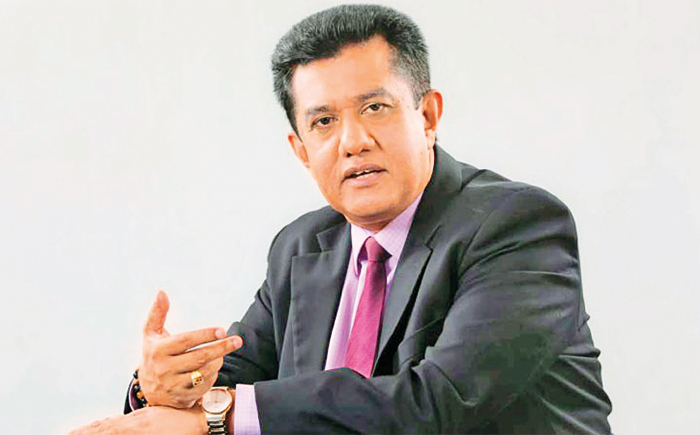
SJB Working Committee member and ex-SLPP lawmaker Charitha Herath says that all eyes are on the newly constituted Constitutional Council (CC) as to how it will handle the dispute between President Anura Kumara Dissanayake, and the previous CC, over the appointment of Auditor General (AG).
The former parliamentarian said so in response to The Island query yesterday (25). In terms of the Constitution, Prime Minister Dr. Harini Amarasuriya and Opposition Leader Sajith Premadasa last week agreed on the appointment of former civil servant Austin Fernando, Professor Wasantha Seneviratne and Ranjith Ariyaratne as non-MP members of the CC.
They replaced former Ministry Secretary Dr. Prathap Ramanujam, former Chairperson of the Sri Lanka Medical Association Dr. Dilkushi Anula Wijesundere and Dr. Dinesha Samararatne of the University of Colombo. Pointing out that they rejected the President’s nominees for the AG’s post on several occasions, Herath emphasised the pivotal importance of the appointment of a person with impeccable credentials.
The other CC members are the Prime Minister, Speaker Dr. Jagath Wickremaratne (Chairman), the Opposition Leader, the President’s nominee Bimal Rathnayake and five persons appointed by the President, upon being nominated as follows: one MP nominated by agreement of the majority of the MPs representing the Government (Aboobucker Athambawa, MP), one MP nominated by agreement of the majority of the Members of Parliament of the political party, or independent group, to which the Leader of the Opposition belongs (Ajith P. Perera, MP), and one MP nominated by agreement of the Members of Parliament other than those representing the Government and those belonging to the political party or independent group to which the Leader of the Opposition belongs, and appointed by the President ( Sivagnanam Shritharan, MP.)
The present CC was established on October 31, 2022 in terms of the 21st Amendment to the Constitution. The Attorney General heads the National Audit Office (NAO). One-time COPE Chief said that it would be the responsibility of the government to ensure the integrity of the NAO.
Chulantha Wickramaratne, who served as AG for a period of six years, retired in April 2025. Following his retirement, President Dissanayake nominated H.T.P. Chandana, an audit officer at the Ceylon Petroleum Corporation as the AG. The CC rejected that nomination. Subsequently, President Dissanayake appointed the next senior-most official at the NAO Dharmapala Gammanpila as Acting Auditor General for a period of six months. Then, the President nominated Senior Deputy Auditor General L.S.I. Jayarathne to serve in an acting capacity, but her nomination, too, was also rejected. Many an eyebrow was raised when the President nominated O.R. Rajasinghe, the Internal Audit Director of the Sri Lanka Army for the top post. That nomination too was rejected. As a result, the vital position remains vacant since 07 December, 2025.
Herath said that the government was in a bind over the Auditor General’s appointment and the disgraceful campaign launched against Attorney General Parinda Ranasinghe, Jr, PC.
The ex-lawmaker said that JVP/NPP loyalists masquerading as journalists and civil activists had launched the protest against the Attorney General. Herath said that the decision to send Deputy Secretary General of Parliament Chaminda Kularatne, on compulsory leave, too, was a matter of serious concern.
Herath said: “This is the same government that campaigned strongly on non-interference, institutional independence, and respect for the rule of law—principles they used to criticise every previous administration. Now, they appear to be doing exactly what they once opposed, only more openly. If this pattern continues, these undemocratic actions will eventually lead to their own downfall.”
BASL in late December, 2025 urged President Dissanayake and others, including the Opposition Leader, to consult civil society and professional bodies, including them, before the appointment of civil society representatives.
Herath said that the newly constituted CC would face its first acid test when it addressed the Auditor General issue.
by Shamindra Ferdinando

Royal Navy of Oman Ship ‘AL SEEB’ leaves island

Gold tops $5,000 for first time ever, adding to historic rally

Showers will occur in the Northern, North-central, Eastern, North-western, Western, Sabaragamuwa and Uva provinces and in Matale, Matara, Galle and Nuwara-Eliya districts

U – 19 World Cup: Andrew, McKenzie deliver West Indies comfortable win

U – 19 World Cup: Bowlers, Hogan help Australia breeze past South Africa

Abhishek blasts 14-ball fifty to hand India unassailable 3-0 lead against New Zealand

‘Dates have the highest sugar content to fight Coronavirus’

Sunday Island 27 December – Headlines

#SundayIsland 17th December – Headlines

Sunday Island – 28th March

Sunday Island Headlines – 21 March

Sunday Island – 21st February – Headlines
-
 Business16 hours ago
ComBank, UnionPay launch SplendorPlus Card for travelers to China
-

 Business2 days ago
ComBank advances ForwardTogether agenda with event on sustainable business transformation
-

 Opinion7 days ago
American rulers’ hatred for Venezuela and its leaders
-

 Opinion5 days ago
Remembering Cedric, who helped neutralise LTTE terrorism
-
 Business5 days ago
CORALL Conservation Trust Fund – a historic first for SL
-

 Opinion4 days ago
A puppet show?
-
 Opinion2 days ago
Conference “Microfinance and Credit Regulatory Authority Bill: Neither Here, Nor There”
-

 Opinion7 days ago
History of St. Sebastian’s National Shrine Kandana