
Business
Forward plans to transform Sri Lanka into a global aviation and logistics hub


Harischandra Gunaratna of The Island Financial Review speaks to Andre Fernando, Managing Director of MAC Holdings (PRIVATE) LTD
Sri Lanka’s strategic location in the Indian Ocean among major air routes connecting Asia, Europe, Africa and the Middle East, offers a unique opportunity to transform the island into a thriving aviation hub. With the right investments and policy changes, Sri Lanka can leverage its geographical advantage to bolster tourism, facilitate international cargo & passenger transportation, and serve as a key transit point for passengers and goods. This vision not only promises to boost the nation’s economy but also has the potential to redefine its position on the global aviation map. Perfect example is the growth of 4 prominent airlines; Emirates, Fly Dubai, Air Arabia and Etihad and their importance to the economy of UAE, which was a desert in the mid-1990s.
Why Sri Lanka is well-suited to be an aviation hub
Strategic Location: Sri Lanka’s proximity to major global markets—India, China, Southeast Asia, Africa the Middle East and Europe—makes it a perfect transit point for airlines and cargo carriers. This natural geographic advantage means shorter flight routes and lower fuel costs for airlines choosing to hub in Sri Lanka. Sri Lanka could also be the best hub to connect passengers and cargo to Africa and minimize the long deviation one has to take by travelling via Middle- East hubs of Dubai, Abu Dhabi, Doha or Bahrain.
Tourism Potential: The country has long been a magnet for tourists due to its rich culture, pristine beaches, wildlife, and heritage sites. A strong aviation sector will help open new tourism markets, providing better connectivity to key destinations.
Cargo Hub Opportunity: Sri Lanka is positioned at the crossroads of key maritime and air trade routes, making it an ideal center for logistics and cargo services. With growing demand for air freight in e-commerce and perishable goods, Sri Lanka could serve as a bridge for goods moving between East and West. PPP investment at BIA must be done to invest in a courier and e-commerce hub terminal which is a dire necessity.
What are the steps to establish Sri Lanka as an aviation and cargo hub?
1. Upgrade Infrastructure
Expand Airport Facilities: The Bandaranaike International Airport (BIA) in Colombo is Sri Lanka’s primary international gateway, but it faces capacity constraints. Expanding BIA’s terminals and runways to accommodate more flights and passengers is essential. Mattala Rajapaksa International Airport, located in the South, can also be developed as a complementary MRO facility and also a secondary airport for leisure charter flights to be moved to tourism hot spots like Passe kudah, Yala and Arugam bay.
Enhance Ground Handling and Technology: To attract airlines and cargo carriers, Sri Lankan airports need world-class ground handling services, including efficient passenger & cargo handling, including that of passenger baggage, faster immigration & customs clearance and seamless technology integration for booking and scheduling. In order to be competitive one could also moot a 2nd ground handling service which can be a PPP and compete with Sri Lankan airlines.
2. Attract More Airlines and Routes
Open Skies Policy: Adopting more liberal air service agreements with key markets could encourage international airlines to increase their services to Sri Lanka. An open skies policy, or at least partial liberalization, could make Sri Lanka more accessible to global carriers and stimulate both passenger and cargo traffic.
Partnerships and Code Shares: Encouraging SriLankan Airlines to forge stronger code-sharing partnerships with major international carriers would facilitate seamless connectivity, making the island a more attractive stopover for passengers.
3. Develop Cargo and Logistics Capabilities
Establish Free Trade Zones (FTZs): Strategically located Free Trade Zones (FTZs) near the airport, with efficient customs and logistical services, would help attract multinational logistics firms to use Sri Lanka as a warehousing and distribution hub.
Cold Storage and Perishables Handling: Investing in cold storage facilities at airports would allow the nation to become a key player in handling perishable goods, such as food and pharmaceuticals, which require specific conditions during transport.
Leverage Port-Aviation Synergy: The close proximity of Colombo’s port to the airport offers unique opportunities for an integrated sea-air logistics system. Creating multimodal logistics corridors between the Port of Colombo and BIA would enable seamless movement of goods, particularly for time-sensitive shipments.
4. Boost Human Capital and Expertise
Training and Development: Investing in training programs for aviation personnel, including pilots, ground crew, air traffic controllers, and cargo handlers, will ensure a skilled workforce capable of meeting global standards. Minimizing the loss arising from our experienced and trained staff migrating to Middle East countries is a must. This will naturally stop if we can make Sri Lanka a key aviation hub as our salaries will improve to match regional markets in the Middle East and Asia.
Aviation Management Schools: Developing educational institutions focused on aviation management, engineering, and logistics will cultivate local talent, reducing dependence on foreign expertise while fostering innovation within the sector.
5. Enhance Tourism Infrastructure
Create More Tourist Attractions: Developing world-class infrastructure, including hotels, theme parks, and luxury resorts around key airports, will make Sri Lanka more appealing as a tourism destination.
Improve Connectivity: Strengthening the domestic aviation network will allow international tourists to easily explore all corners of the island. Investments in regional airports, like those in Jaffna, Hambantota, and Trincomalee, can play a critical role in this.
6. Sustainability and Eco-Friendly Practices
Green Airports: Building eco-friendly airport infrastructure and encouraging the use of renewable energy can enhance Sri Lanka’s image as a sustainable tourism destination.
Carbon Offsetting Programs: Implementing carbon offsetting schemes for airlines operating in Sri Lanka will help mitigate the environmental impact of increased air traffic and appeal to environmentally conscious travelers.
What are the benefits of a Sri Lankan aviation hub?
Economic Growth: A well-functioning aviation hub will drive investment, create jobs, and increase the island’s GDP. From tourism to freight forwarding, the aviation sector can have a multiplier effect across industries.
Boost to Tourism: As Sri Lanka becomes a transit point, it will increase exposure to new tourists who can be enticed to stay and explore the country. Targeting niche tourism, such as medical tourism, eco-tourism and adventure travel, will diversify the industry.
Enhanced Trade and Connectivity: The establishment of a logistics hub will facilitate regional and global trade. Sri Lanka will become the go-to center for re-exports and regional distribution, attracting multinational companies to use its airspace and logistics capabilities.
What are the challenges to overcome?
While the potential for an aviation hub is promising, Sri Lanka must overcome several challenges to achieve this goal:
Political Stability: For long-term investments in aviation infrastructure, political stability and consistent policies are necessary.
Regulatory Framework: A transparent and investor-friendly regulatory environment will be essential to attracting foreign airlines and logistic operators.
Financial Investment: Developing airports, logistics centers, and tourism infrastructure will require significant financial resources and strategic public-private partnerships.
(Andre Fernando is a self- made entrepreneur and the grandson of a billionaire businessman from Wattala,Boniface Fernando hailing from an era when billionaires were far and few in the country. Fernando is the chairman of the Transport and Logistics committee of the National Chamber of Commerce of Sri Lanka)

Business
Successful completion of consent solicitation, exchange and tender offer related to SriLankan Airlines’ bond restructuring


SriLankan Airlines Limited (the “Company”) and the Government of Sri Lanka (the “Government”) announce the expiration of the Consent Solicitation, Exchange and Tender Offer related to the Company’s U.S.$175,000,000 Guaranteed Bonds due June 2024, guaranteed by the Government (the “Existing Bonds”).
On 20 February 2026, the Company launched an official invitation to holders of the Existing Bonds to tender and exchange their holdings for cash and the U.S.$-denominated 4.00% amortizing PDI bonds due 2028 issued by the Government (the “New Republic Bonds”), pursuant to the agreement in principle reached on 20 November 2025 with the members of the Ad Hoc Group of Bondholders – together holding approximately 55% of the aggregate outstanding amount of the Existing Bonds.
Following the expiration of the offer period, the Company and the Government are delighted to report a very high level of participation of over 99% of the total outstanding amount of the Existing Bonds. Bondholders representing more than 97% of the outstanding amount voted in favour, resulting in all Existing Bonds being tendered and exchanged on the settlement date.
Mr. Sarath Ganegoda, the Company’s Chairman, reacted to the results stating: “We are sincerely appreciative of the bondholders’ strong participation. The overall transaction results in a 16% haircut on the outstanding claim, and its successful completion marks a significant step forward that allows us to focus on the future of the Company with renewed optimism. As the flag carrier of our island nation, this important progress toward financial recovery will further strengthen our ability to support Sri Lanka’s economic prosperity.”
Dr. Harshana Suriyapperuma, Secretary to the Treasury at the Ministry of Finance, issued the following statement: “The successful completion of this transaction paves the way for the full normalization of our relations with our external partners. Having now successfully concluded restructuring agreements covering 99% of our public external debt, we extend our sincere appreciation to all stakeholders who supported Sri Lanka throughout this process. This achievement strengthens our position as we pursue our efforts to improve our credit rating.”
The settlement of the exchange and tender offer is intended to take place on 20 March 2026, subject to the relevant settlement conditions being satisfied.
Any questions related to this transaction can be directed to the Information, Tender, Tabulation and Exchange Agent for this transaction, Sodali & Co Limited
Email: srilankanairlines@investor.sodali.com
Transaction Website: https://projects.sodali.com/srilankanairlines

With over 18% already aged 60 and above—and one in four projected to be 60 or older by 2041—the Sri Lankan population is rapidly ageing. IF harnessed effectively, the elderly population and the related Silver Economy have great potential to contribute to Sri Lanka’s economy. This blog analysis shows the challenges and the possibilities for Sri Lanka to reap demographic dividends by unlocking the potential of the ageing population and the related Silver Economy.
Demographic Dividend and Silver Economy
Although population ageing poses challenges such as slower growth and increased fiscal pressures, healthier ageing trends offer a silver lining by boosting labour force participation, extending working lives, and enhancing productivity. Population ageing becomes a demographic dividend when the older population is considered an economic asset, rather than a social burden, and the potential of the change in the age structure is harnessed to accelerate economic growth. This involves creating employment and other economic opportunities, products, and services required by the elderly.
The Silver Economy refers to the economic opportunities associated with the growing public and consumer expenditure related to population ageing and the specific needs of the 50+ population. It is the system of production, distribution, and consumption of goods and services, targeting older adults, who are recognised as active economic agents with spending power, life experience, and growing demographic significance.
Changing Population Dynamics
To trigger a demographic dividend, this older population requires accumulated savings and investments to finance consumption during their retirement. However, the status quo of the elderly in Sri Lanka is mostly gloomy. In recent years, 49% of 55-64 year old cohorts were economically inactive, while the labour force participation rate for males and females were 36% and 11%, respectively. This suggests limited interest, capacity, and/or employment options. For instance, the retirement age of 60 years restricts formal employment opportunities for the elderly. Hence, a majority of older workers are employed in the informal sector, which underutilises their skills and underemploys them. Similarly, the elderly have limited options for part-time and flexible work, and are dissatisfied with participating in work. With the current average life expectancy of 75.5 years, they face about 15 years of post-retirement life with limited income and employment opportunities.
Additionally, only 31% of those above retirement age received a pension in recent years. Over three-quarters of retired persons were net dependants, and 91.7% did not receive any income from savings. Among those with savings such as the Employees’ Provident Fund (EPF), most spent their EPF without saving or investing for later life. Estimates suggest that by 2030, the economic old-age dependency ratio in Sri Lanka will reach 29.2%. Moreover, the 65+ years population had the highest multidimensional poverty headcount ratio (17.9%) in 2019. The age group of 36-64 years, including those who will be 60+ years in 2037, had a multidimensional poverty headcount ratio of 16%. With the worsening of overall poverty in the post-crisis setting, Sri Lanka’s older population is likely to be more vulnerable now.
Looming Care Crisis
Moreover, there is a growing care deficit – a gap in demand and availability of caregivers, for the ageing population. Around 76% of 65+ years population live with children, which is projected to decline over time with the emerging cultural and social shift from home-based care towards institutional care. Three-generation households are projected to decline from 19% in 2012 to 5% by 2060. The decreased availability of family care due to smaller family sizes and growing female employment will increase demand for commercial care. Yet, as discussed, most elderly people will not have the financial capacity to seek commercial care. At the same time, the elder care sector in Sri Lanka is polarised. On the one hand, there is an excess demand for the limited number of state-run elder care institutions—often of relatively low quality, while fee-based facilities remain unaffordable for the average elderly. Hence, the less-affluent middle-class elderly have virtually no options for institutional care. On the other hand, formal and professional home-based care is costly, while lower-cost options are informal and ad hoc. Moreover, free adult day care centres are limited and often target low-income elders, with almost no paid day-care options for other income groups. Across all care options, there is an acute deficit in both formal and informal care workers. Projections indicate a 149,076 deficit of long-term care workers by 2037.
Silver Economic Strategic Plan
Therefore, without timely strategic action, the ageing population would become a burden to the Sri Lankan society and increase government expenditure on health and other care, pensions, and social protection. The potential demographic dividend would instead become a drag on the economy.
The global approach to reap a demographic dividend includes policies supporting healthy ageing, increasing labour force participation among older individuals, and closing gender gaps in the workforce, to boost growth and rebuild fiscal buffers amid demographic headwinds. In the case of Sri Lanka, targeted strategies are needed urgently to facilitate the elderly to accumulate savings and investments to finance their post-retirement consumption. Similarly, it is important that Sri Lanka creates an ecosystem of affordable products and services for healthy, productive, and dignified lives for this demographic group.
To achieve this, Sri Lanka should focus on two strategic areas:
Prioritise the extension of economic opportunities into later life. This includes employment opportunities, such as phased retirement, flexible working arrangements, part-time work, and work-from-home arrangements targeted at older workers, to engage them in productive economic activities for a longer period. Such activities include adopting an age-friendly certification for businesses and employers to ensure businesses are welcoming, accessible, and responsive to older workers and clients. Another is to increase the minimum retirement age in the formal sector beyond 60 years of age. Moreover, increasing awareness on saving and investing for retirement and expanding related options—such as scaling up coverage of private life insurance and state-led contributory pension schemes—are essential.
Expand care options to not only protect the elderly but also create economic opportunities. This includes scaling up both free and fee-based elder care facilities to cater to all income types across both living-in and day-care options. Another is providing incentives, such as tax breaks or land, for the private sector to invest in care facilities and tie these to subsidised services for low-income elders. Additionally, existing infrastructure and systems, such as Development Officers at the Divisional Secretariats and local government community centres, could be harnessed to provide community-based care. Similarly, establishing and protecting the rights of elder care workers, providing formal Recognition of Prior Learning and certifying their skills would help attract and retain care workers.
By Dr Bilesha Weeraratne,
Research Fellow and Head of Migration and Urbanisation Policy Research at the Institute of Policy Studies of Sri Lanka
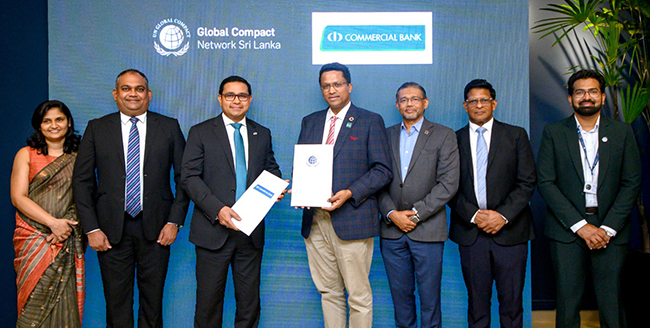
The Commercial Bank of Ceylon has taken a leadership role in advancing key sustainability priorities of the United Nations Global Compact Network Sri Lanka by becoming a Patron of Network Sri Lanka’s ‘Diversity & Inclusion’ and ‘Water & Ocean Stewardship’ Working Groups.
The Bank formalised this landmark commitment through the signing of a two-year Memorandum of Understanding (MoU) between Commercial Bank and UN Global Compact Network Sri Lanka, establishing the Bank’s patronage of the two Working Groups and its role in guiding initiatives that promote sustainable water management and inclusive business practices.
Commercial Bank will provide leadership and advocacy to advance the objectives of the Diversity & Inclusion and Water & Ocean Stewardship Working Groups. The Bank will collaborate with the Network to organise events, facilitate dialogue and partnerships, and encourage greater participation by companies seeking to strengthen their environmental, social and governance (ESG) practices. The engagement will also focus on initiatives that accelerate progress towards the Ten Principles of the UN Global Compact and the UN Sustainable Development Goals (SDGs), particularly in the areas of sustainable water management, ocean stewardship, gender equality and inclusive economic participation.

Advisory for Severe Lightning issued for Galle, Matara, Kaluthara and Rathnapura districts

Sri Lanka says it denied US request to land two aircraft at Mattala airport

Eid celebrations dimmed by war and displacement across Middle East

Showers may occur at several places in the Western, Sabaragamuwa, Northwestern and Uva provinces and in Galle, Matara, Kandy and Nuwara-Eliya districts after 1.00 pm.

Iranian strikes on bases used by US caused $800m in damage, new analysis shows

President maintains Lanka has been even-handed in dealing with Iran and US

‘Dates have the highest sugar content to fight Coronavirus’

Sunday Island 27 December – Headlines

#SundayIsland 17th December – Headlines

Sunday Island – 28th March

Sunday Island Headlines – 21 March

Sunday Island – 21st February – Headlines
-

 Business6 days ago
Browns EV launches fast-charging BAW E7 Pro at Rs. 5.8 million
-

 Life style7 days ago
From culture to empowerment: Indonesia’s vision for Sri Lanka
-

 News4 days ago
CIABOC questions Ex-President GR on house for CJ’s maid
-

 Life style7 days ago
Ranjith Fernando celebrates cricketing journey with Hob Nails to Spikes
-

 News5 days ago
Sri Lankan marine scientist Asha de Vos honoured at UNGA opening
-

 Features6 days ago
Achievements of the Hunduwa!
-

 Latest News7 days ago
QR code system will be implemented for fuel with effect from 06.00 a.m. today (15th)
-

 News5 days ago
Australian HC debunks misleading travel risk claims for Sri Lanka