
News
Former STF Commandant admits to transferring out its intelligence officers from East on his watch


by Rathindra Kuruwita
STF intelligence officers had stopped probing Islamic extremism in the East as a gazette issued in August 2017 entrusted them with dealing with organised crimes and drugs, former Commandant of the STF, M.R. Latheef, on Saturday, told the Presidential Commission of Inquiry (PCoI) probing the Easter Sunday attacks.
“Thereafter, we focussed on our new mandate. However, I expected that the STF too would be involved in dealing with rising Islamic extremism. In the past, the STF commandant and the head of STF intelligence took part in the weekly intelligence coordination committee meetings. When I became the head of the STF, I was informed that there was no need for the STF to attend those meetings.”
The chairman of the Commission then asked the witness whether by 2019, the focus of the STF had been completely shifted from eradicating terrorism to tackling organised crime. Latheef said that to deal with organised crimes, the STF had to assist the Police Narcotic Bureau, the Police Crimes Division and the Women and Children’s Bureau.
“We focused on these from 2018. Our main role was to assist the police. We were also asked by the Presidential Secretariat to look into environmental destruction,” he said.
Latheef was also asked if there had been transfers of STF intelligence officers deployed in the East on his watch. The witness said there had been 31 transfers. Some were sent for advanced training at the State Intelligence Service (SIS) and Directorate of Military Intelligence (DMI). There were 20 such transfers. There had been two transfers over misconduct, four based on appeals, and five had been removed over indiscipline, he said.
The Chairman: “The STF commandant before you, Ranjith Perera, attached these 30 intelligence officers to camps in the east. They were the ones who were transferred, weren’t they?”
“Yes,” Latheef said.
Chairman: “So these officers were removed and placed somewhere else?”
Latheef: “That had been done due to service needs and requests by commanders in various camps. We were also not asked to look at Islamic extremism and Community Police, who consisted of people from the same areas also found nothing.”
Chairman: “Why didn’t the SIS ask for your help?”
Latheef: “That’s a puzzle to me too.”
The Commission also questioned Latheef why he had not earlier submitted to the commission reports by STF intelligence officers warning of rising Islamic extremism in the East. During his first appearance at the PCoI in late September, Latheef said STF intelligence officers had never reported on the National Thowheed Jamaat (NTJ) leader Zahran Hashim. In his second appearance, earlier this month, Commissioners directed Latheef’s attention to a report sent by the STF intelligence officers to the Commanding Officer of the Kalawanchikudi STF camp on 24 March, 2018. This report referred to Zahran and the NTJ and Latheef acknowledged that the report referred to NTJ and Zahran.
Commissioners: “Why didn’t you include STF reports on Zahran and the NTJ in the documents you submitted to the Commission?”
SDIG Latheef: “I don’t know if the documents you have were received by the STF headquarters. Can you please request a report on this from the STF headquarters? These three reports were sent to STF regional camps. It should be checked whether they were referred to the headquarters and it should be ascertained whether any officer at the headquarters had inquired into them.”
On Saturday, this issue was taken up again, when the Attorney General’s Department official leading the evidence asked Latheef why he had not submitted two reports dated March 18, 2017 and March 24, 2017, warning of NTJ and Zahran, to the PCoI.
“I only presented reports after July 2017,” the witness said.
The AG’s Department official said: “None of these reports speak of NTJ or their involvement in a clash at the Aliyar Junction in Kattankudy. It is after this that Zahran and others left the area.”
“There was no specific reason and I wanted to show th 2019 reports,” the witness said.
At this point the Chairman of the PCoI stressed that the PCoI had asked him to submit all STF intelligence reports in his possession on Islamic Extremism since 2015. Letheef affirmed that it indeed was the case.
“The main reason why the STF was established was to combat terrorism, am I right?” the Chairman asked.
“Yes,” the witness said.
“At that time the STF had a strong intelligence wing, didn’t it?” the Chairman asked.
“A small team was trained to gather information,” Latheef said.
“If I say these men were given special training on gathering intelligence, would you accept?” the Chairman asked.
“Yes, in 2006 a team of Indian intelligence officials gave a training,” Latheef said.
“So, the STF had a strong intelligence network in the East. Why weren’t they able to detect what was brewing underneath?” the Chairman asked.
“We received a lot of support from Muslims during the war. But as I said earlier our focus shifted in 2017,” Latheef said.

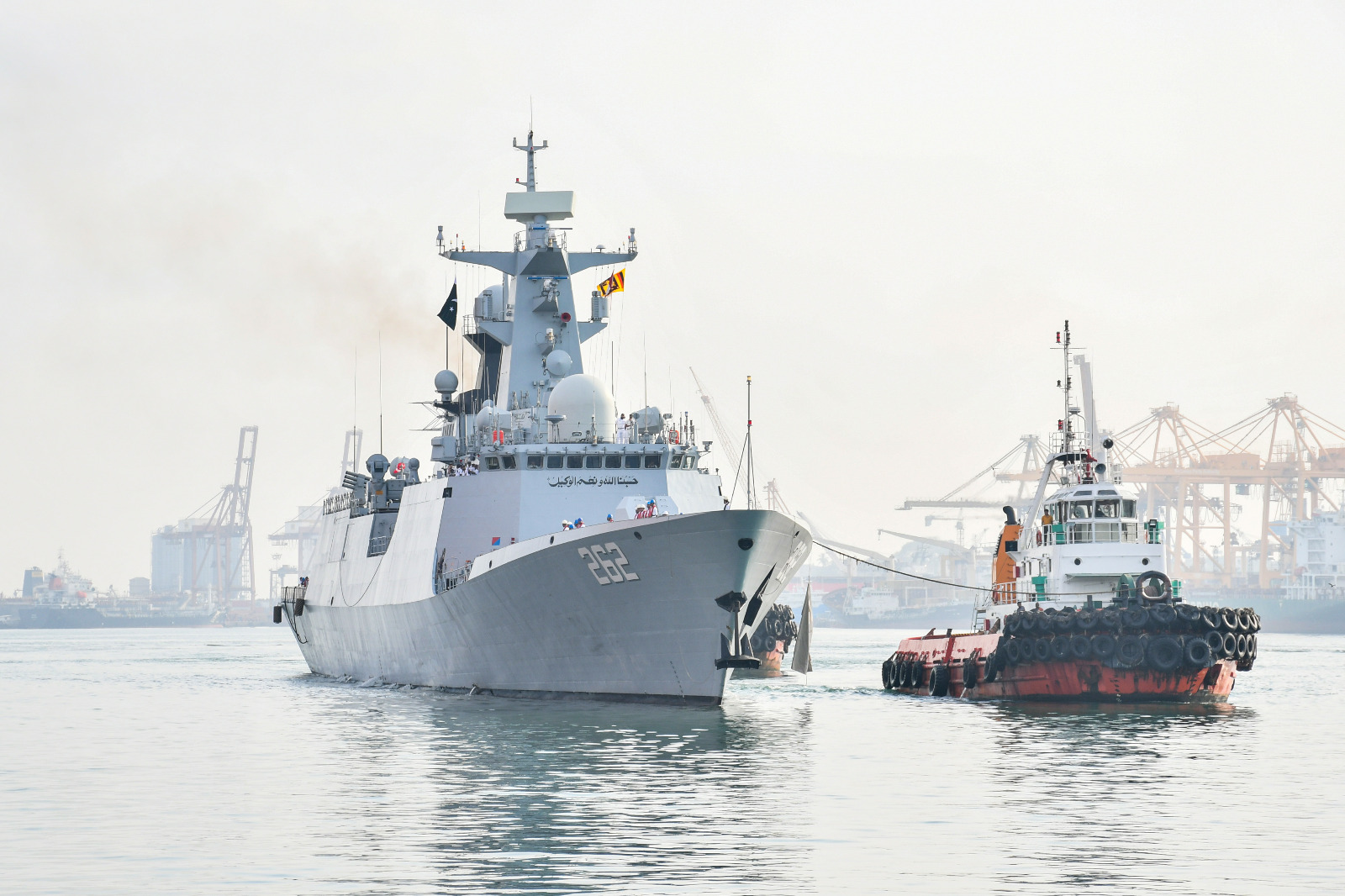
The Pakistan Navy Ship (PNS) TAIMUR and ASLAT arrived at the Port of Colombo on a goodwill visit on 12 Apr 26.
The visiting ships were welcomed by the Sri Lanka Navy in
compliance with naval traditions.
The duo of ships is commanded by Captain NIAMAT SAEED KHAN (PNS TAIMUR) and Captain NADIR MATEEN AFRIDI (PNS ASLAT).
Meanwhile, the ships are expected to conduct a Bilateral Naval Exercise LION STAR V with the Sri Lanka Navy in Colombo seas.
Latest News
Heat index likely to increase up to ‘Caution level’ at some places in the Northern, North-central, North-western, Western, Sabaragamuwa, Southern and Eastern provinces and Monaragala district


Warm Weather Advisory
Issued by the Natural Hazards Early Warning Centre at 3.30 p.m. on 11 April 2026, valid for 12 April 2026
The Heat index, the temperature felt on the human body is likely to increase up to ‘Caution level’ at some places in the Northern, North-central, North-western, Western, Sabaragamuwa, Southern and Eastern provinces and Monaragala district.
The Heat Index Forecast is calculated by using relative humidity and maximum temperature and this is the condition that is felt on your body. This is not the forecast of maximum temperature. It is generated by the Department of Meteorology for the next day period and prepared by using global numerical weather prediction model data.

Effect of the heat index on human body is mentioned in the above table and it is prepared on the advice of the Ministry of Health and Indigenous Medical Services.
ACTION REQUIRED
Job sites: Stay hydrated and takes breaks in the shade as often as possible.
Indoors: Check up on the elderly and the sick.
Vehicles: Never leave children unattended.
Outdoors: Limit strenuous outdoor activities, find shade and stay hydrated.
Dress: Wear lightweight and white or light-colored clothing.
Note: In addition, please refer to advisories issued by the Disaster Preparedness & Response Division, Ministry of Health in this regard as well. For further clarifications please contact 011-7446491.
Latest News
Sun directly overhead Cheddikulam, Kebithigollewa, Gomarankadawala and Nilaveli about 12:11 noon. today [12]

On the apparent northward relative motion of the sun, it is going to be directly over the latitudes of Sri Lanka from 05th to 15th of April in this year.
The nearest areas of Sri Lanka over which the sun is overhead today (12th) are Cheddikulam, Kebithigollewa, Gomarankadawala and Nilaveli about 12:11 noon.

PNS TAIMUR & ASLAT arrive in Colombo

Sanju Samson and Jamie Overton deliver first points for Chennai Super Kings

Arya, Prabhsimran and Shreyas help Punjab Kings ace another 200-plus chase

Beauty of Sri Lanka in focus: Global showcase blends art, diplomacy and conservation

Showers expected in the Western, Sabaragamuwa, Central, Southern, North-western and Uva provinces and in Ampara, Batticaloa and Polonnaruwa districts after 1.00 p.m.

Heat index likely to increase up to ‘Caution level’ at some places in the Northern, North-central, North-western, Western, Sabaragamuwa, Southern and Eastern provinces and Monaragala district

‘Dates have the highest sugar content to fight Coronavirus’

Sunday Island 27 December – Headlines

#SundayIsland 17th December – Headlines

Sunday Island – 28th March

Sunday Island Headlines – 21 March

Sunday Island – 21st February – Headlines
-

 News6 days ago
Lankan-origin actress Subashini found dead in India
-

 News4 days ago
AG: Coal procurement full of irregularities
-

 Business3 days ago
Israeli attack on Lebanon triggers local stock market volatility
-

 News1 day ago
CEB orders temporary shutdown of large rooftop solar systems
-

 Business4 days ago
Hayleys Mobility introduces Premium OMODA C9 PHEV
-

 Business3 days ago
HNB Assurance marks 25 years with strategic transformation to ‘HNB Life’
-

 News6 days ago
UN Regional Director launches SL’s first Country Gender Equality Profile during official visit
-

 Sports4 days ago
DS to face St. Anthony’s in ‘Bridges of Brotherhood’ cricket encounter