
News
Foreign Minister reminds UN of the importance of its founding principles for international stability

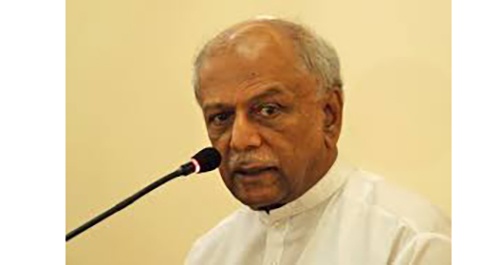
No state could withstand the varied effects of the COVID-19 pandemic nor find solutions alone, Foreign Minister, Dinesh Gunawardena said at a virtual event on Friday to mark the 75th Anniversary of the United Nations and 65th Anniversary of the United Nations in Colombo.
Gunawardena said that the United Nations’ reaching its 75th year, demonstrated the durability of not only the organization, but also the concept of multilateralism, based on the core principles of sovereign equality of all States, respect for their territorial integrity and non-interference in their domestic affairs. The partnerships fostered between Member States and the UN continued were at their best when based on those principles, he said.
“As we are celebrating this milestone, the world is faced with the unprecedented challenge of the COVID-19 pandemic. This virus transcends national boundaries and no Member State can withstand the varied effects of the pandemic nor find solutions alone. The UN plays an important role in fostering multilateral action and mobilizing global solidarity towards addressing this scourge. Sri Lanka appreciates and supports the contributions by the UN and especially the WHO to the global response to address the multiple challenges of the pandemic,” he said.
The Foreign Minister said that Sri Lanka is pleased to have contributed significantly to the work of the United Nations, from its peacekeeping operations to its specialized agencies.
“Historically, Sri Lanka has been closely associated with many of the important discourses in the UN. Sri Lanka served as a non-permanent member of the Security Council in 1960 and as the President of the General Assembly in 1976,” Gunawardena said.
The Foreign Minister said that as one of the founding members of the Non-Aligned Movement (NAM) and as a key member of the Group of 77, Sri Lanka had continued to play a significant role in multilateral deliberations at the UN, particularly representing the interests of the global South.
“Some of the landmark contributions by Sri Lanka in the UN system include: leading the negotiations on the Convention on the Law of the Sea (UNCLOS), which has provided the foundation for a rules-based order for the oceans for over 30 years; initiating the UN General Assembly Resolution which unanimously declared Vesak, the most sacred day in the Buddhist calendar, as a United Nations Observance Day and serving the organisation through high-level professionals, such as the Under-Secretary General for Disarmament Affairs the UN and Secretary General of the UNCTAD,” he said.
“Sri Lanka has been contributing to the UN Peacekeeping efforts since the 1960s, serving in the Central African Republic, Congo, Cote d’Ivoire, Haiti, Lebanon, Liberia, Mali, South Sudan, Timor and Western Sahara, demonstrating our commitment to global peace and security. Having acquired multiple skills after ending nearly three decades of separatist terrorism domestically, Sri Lanka’s forces have brought much pride to the country, also being internationally recognized with UN.” He said that even now Sri Lankan peacekeepers were serving in some of the world’s most high intensity conflict regions.
“The theme of this commemoration ‘Shaping our future together’ is future focused and reiterates the importance of collective action for the future that we wish for. Youth has been recognized as the centre of the UN 75 dialogues as the role of youth and the way they perceive the future is pivotal in this context. I recall that in 2014 Sri Lanka took the leadership to declare 15 July as the World Youth Skills day to celebrate the strategic importance of equipping young people to face the future with skills for employment, decent work and entrepreneurship. This date is annually commemorated at the United Nations Headquarters co-hosted by Sri Lanka and Portugal together with UNESCO, ILO and the Office of the UN Secretary General’s Youth Envoy,” he said.



The Frontline Socialist Party (FSP) yesterday accused the government of trying to award another tender to the Indian company that supplied low-grade coal to the Norochcholai Power Plant and failed to deliver the stipulated amount of coal according to schedule.
The allegation was made by the Education Secretary of the Progressive Socialist Party, Pubudu Jayagoda, during media briefing at the party office in Nugegoda last afternoon.
Jayagoda said that in September 2025, the government had awarded a tender to the Indian company Trident Chemphar to supply 25 coal shipments for electricity generation in 2026.
In August 2025, it was confirmed that the coal delivered by the company was substandard. The company also failed to supply coal on schedule. Although the first shipment was expected in the second week of December 2025, it arrived at the end of the month. By mid-March, only 12 ships had arrived, and biweekly deliveries have been disrupted, putting Sri Lanka at risk of a severe energy shortage.
On 11 March, the government called a sudden spot tender for five coal shipments. Four companies submitted bids, and they include Trident Chemphar. FSP criticiced awarding the tender to the same discredited company, saying it was unethical and could trigger a major national crisis, as the company had failed to supply quality coal reliably in the past.
Previously, coal quality was strictly measured, with a “Reject Value”. But now to help the errant supplier the term of Reject Value has now been omitted altogether and replaced with a new term ‘Minimum Value’ setting it as the minimum calorific threshold—coal producing less than 5,900 kilocalories per kilogram was rejected, and coal with ash content above 16% was also discarded.
However, the government is now reportedly lowering these standards, accepting substandard coal, and changing tender specifications to accommodate the company.
Jayagoda castigated the latest stunt coming especially at a time when the world faces war and oil shortages. Diesel meant for electricity generation is being diverted to school buses, public transport, and emergency vehicles, leaving households at risk of prolonged blackouts. Even if diesel is imported, electricity tariffs could skyrocket.

The Indian Ministry of External Affairs has said it is considering requests for diesel supplies from neighbouring countries, including Sri Lanka, Bangladesh and the Maldives.
Speaking to the Press Trust of India, Ministry Spokesperson Randhir Jaiswal noted that India was a major exporter of refined petroleum products in the region. He confirmed that Bangladesh had formally requested a diesel supply, which is currently under review.
He said that diesel exports to Bangladesh had largely continued since 2017, but any new allocations would take into account India’s refining capacity, domestic demand, and overall fuel availability.
Jaiswal added that similar requests from Sri Lanka and the Maldives were also being considered, with India’s own energy requirements forming a key part of the decision-making process.

A noticeable rise in electricity consumption, particularly during the night peak hours, has been observed in recent weeks, with power sector officials attributing the trend partly to households increasingly turning to electricity for cooking amid shortages of liquefied petroleum gas (LPG).
Data from the Ceylon Electricity Board (CEB) shows that both the total units generated and the evening peak demand have been gradually increasing, signalling a possible shift in household energy use.
Energy sector sources said the rising night peak load suggests that more consumers may be relying on electric appliances such as hot plates, electric cookers and induction stoves as alternatives to LPG.
“The night peak is increasing steadily. One of the likely reasons could be the growing use of electricity for cooking due to the shortage of LPG,” a senior power sector official said.
Electricity demand traditionally rises during the evening hours between 6.30 p.m. and 9.30 p.m., when domestic consumption surges as households switch on lighting and appliances while preparing meals.
Power engineers point out that electric cooking appliances consume comparatively high amounts of electricity, and a widespread shift towards their use can significantly raise the evening peak load.
“If many households begin cooking with electricity at the same time, the night peak can rise sharply even if the total daily consumption increases only moderately,” an engineer familiar with grid operations said.
The increase in demand comes at a time when the power sector is undergoing a major restructuring programme aimed at unbundling the CEB into separate entities responsible for generation, transmission and distribution.
Energy analysts note that higher electricity consumption could boost revenues for the sector if tariffs remain stable.
However, they caution that a sustained rise in peak demand may place additional pressure on generation capacity.
During the night peak period, the system relies heavily on thermal and hydropower plants to meet demand, as solar power is unavailable after sunset.
If the trend towards electric cooking continues, planners may need to adjust generation schedules and grid management strategies to cope with higher evening demand.
Energy experts say the development illustrates the close link between different energy sources.
“When shortages occur in one energy source, consumers quickly shift to alternatives. In this case, LPG shortages appear to be pushing more households towards electricity for cooking,” an analyst said.
Power sector officials say demand patterns are being closely monitored to determine whether the rising night peak represents a temporary fluctuation or a longer-term shift in consumer behaviour.For now, engineers say the power system remains stable, though sustained growth in evening demand could require careful management to ensure uninterrupted electricity supply.
By Ifham Nizam

Govt. bends rules, lowers coal standards in favour of errant company: FSP

Lanka requests diesel from India

Gas shortage pushes up electricity demand, night peak rises: CEB

Navy seizes narcotics haul, lethal weapons in two vessels, arrests 10 suspects

Heed ominous signs – II

ADB pledges over $1 billion annually to Sri Lanka in post-cyclone recovery push

‘Dates have the highest sugar content to fight Coronavirus’

Sunday Island 27 December – Headlines

#SundayIsland 17th December – Headlines

Sunday Island – 28th March

Sunday Island Headlines – 21 March

Sunday Island – 21st February – Headlines
-

 News6 days ago
Peradeniya Uni issues alert over leopards in its premises
-
 News4 days ago
Repatriation of Iranian naval personnel Sri Lanka’s call: Washington
-

 News6 days ago
Wife raises alarm over Sallay’s detention under PTA
-

 News3 days ago
Prof. Dunusinghe warns Lanka at serious risk due to ME war
-
 Features4 days ago
Winds of Change:Geopolitics at the crossroads of South and Southeast Asia
-

 Latest News6 days ago
Heat Index at ‘Caution Level’ in the Sabaragamuwa province and, Colombo, Gampaha, Kurunegala, Anuradhapura, Vavuniya, Hambanthota and Monaragala districts
-

 Features6 days ago
The final voyage of the Iranian warship sunk by the US
-

 Sports2 days ago
Royal start favourites in historic Battle of the Blues