
News
FM questions whether UK pursuing anti-Sri Lanka agenda for political reasons


By Shamindra Ferdinando
Foreign Affairs Minister Prof. G. L. Peiris has questioned the British government action vis-a-vis Sri Lanka on the basis of its latest controversial travel advisory that warned of terrorist attacks.
Prof. Peiris condemned the British warning issued on 07 March 2022. Referring to the Easter Sunday suicide bombings that had been carried out by the National Thowheed Jaamat (NTJ), in April 2019, the UK government warned terrorists were likely to try to carry out attacks in Sri Lanka. Attacks could be indiscriminate and the targets could include places visited by foreigners.
The top academic declared that the government had no issue with foreign governments warning of current shortages in fuel, gas and other essentials but it would be totally unfair to issue warning, as regards impending terrorist attacks.
Prof. Peiris took exception to the British action at the launch of Lord Naseby’s ‘Paradise Lost, Paradise Regained’ at the BMICH on Tuesday (29) where he addressed a distinguished gathering. Among those present at the event were Secretary Defence Gen. Kamal Gunaratne, Commander of the Army Gen. Shavendra Silva, former Commander of the Army Gen. Daya Ratnayake and several former and serving members of Parliament.
Prof. Peiris acknowledged that in spite of the Foreign Ministry taking up the issue at hand with the British High Commission in Colombo, the travel advisory hadn’t been revised.
Both Prof. Peiris and Lord Naseby, in their brief speeches discoursed how successive British governments suppressed official documents that contradicted unsubstantiated war crimes accusations which led to an accountability resolution at the Geneva-based United Nations Human Rights Council (UNHRC) in early Oct 2015.
The yahapalana government co-sponsored the resolution that targeted Sri Lanka’ wartime political leadership and the military.
Prof. Peiris said the UK’s response as well as that of some other members of the ‘international community’ to Sri Lanka’s triumph over terrorism was quiet questionable. Sri Lanka brought the war to a successful conclusion in May 2009 on the banks of the Nanthikadal lagoon against the opinion of so many self-proclaimed experts in the West and their local mouthpieces, who repeatedly chorused the refrain that Sri Lankan security forces were incapable of defeating the LTTE, dubbed by the American FBI as the most ruthless terrorist outfit in the world.
Prof. Peiris, who served as the first post-war External Affairs Minister (2010-2015) explained how the UN squandered money on a costly project targeting Sri Lanka. The FM also flayed those who received mega financial benefits at Sri Lanka’s expense as a result of the UN body pursuing an agenda inimical to the war winning country.
Prof. Peiris said: “There are many problems in this country and tourists are well aware of them. There are power cuts, shortage of diesel and gas. These are all facts of life. A travel advisory can certainly draw attention to these inconveniences which may be suffered by tourists who are planning a visit this country,” he said.
Questioning the rationale in making unsubstantiated claim relating to terrorist attacks, Prof. Peiris expressed surprise at the British response to Sri Lanka’s protest. “The answer we have got is that this is what they have been saying for two years and that the travel advisory has been downgraded from very likely to likely by now.”
“Is that a convincing or acceptable answer? If you were a British family contemplating a holiday with your loved ones, your friends, in Sri Lanka, would you for a moment consider holiday in a country where your government says terrorists’ violence is likely’,” an irate FM asked.
Prof. Peiris said that foreign governments and politicians shouldn’t seek political advantage at Sri Lanka’s expense. The FM emphasized the importance in the public of this country believing that whatever is done is genuinely for the well-being of this country and not to promote the fortunes of politicians in other countries.
Commenting on the controversial Geneva process, Prof. Peiris alleged that the country had been singled out by the application of standards and criteria, which were not being applied to any other country on the planet. “Is that because we are small, we don’t have large armies, we are not an affluent nation?” the Minister asked.



The Indian Naval Ship (INS) Sahyadri which arrived at the Port of Colombo on a formal visit on 04 Apr 25, departed the island today (07 Apr). The Sri Lanka Navy bade customary farewell to the departing ship at the Port of Colombo, following naval traditions.
During the ship’s stay in Colombo, crew members of INS Sahyadri took part in several programmes organized by the Sri Lanka Navy, aimed at enhancing mutual cooperation. In addition, they also explored some tourist attractions in the country. Further, personnel of Sri Lanka Navy had the opportunity to visit INS Sahyadri, gaining insights into her operational capabilities.
Latest News
Advisory for severe lightning issued for Sabaragamuwa, Central and Uva provinces and in Hambanthota district

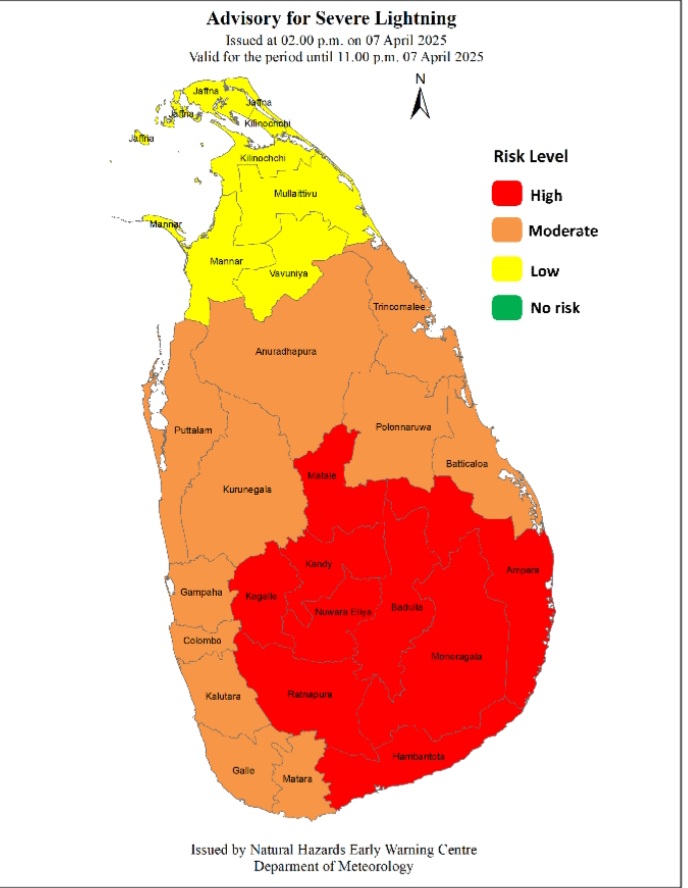
The Natural Hazards Early Warning Centre has issued an Advisory for Severe Lightning for the Sabaragamuwa, Central and Uva provinces and in Hambanthota district.
The advisory issued at 02.00 p.m. today [07 April 2025] is valid for the period until 11.00 p.m. 07 April 2025
The public are warned that thundershowers accompanied by severe lightning are likely to occur at several places in for Sabaragamuwa, Central and Uva provinces and in Hambantota district. There may be temporary localized strong winds during thundershowers. General public is kindly requested to take adequate precautions to minimize damages caused by lightning activity.
ACTION REQUIRED:
The Department of Meteorology advises that people should:
Seek shelter, preferably indoors and never under trees.
• Avoid open areas such as paddy fields, tea plantations and open water bodies during thunderstorms.
• Avoid using wired telephones and connected electric appliances during thunderstorms.
• Avoid using open vehicles, such as bicycles, tractors and boats etc.
• Beware of fallen trees and power lines.
• For emergency assistance contact the local disaster management authorities.
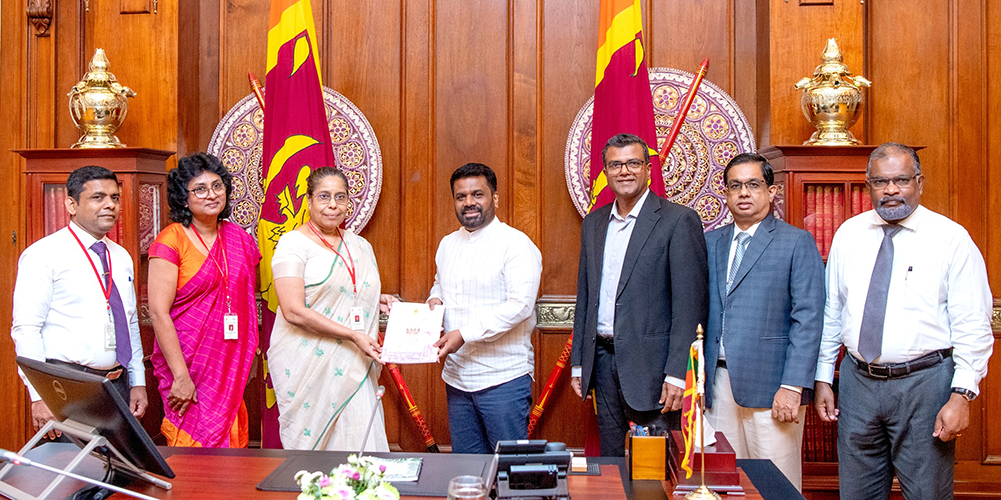
The report of the “Census of Population and Housing 2024,” conducted by the Department of Census and Statistics, was officially handed over to President Anura Kumara Disanayake this morning (07) at the Presidential Secretariat.
This preliminary report has been prepared based on island wide data collected between October and December 2024.
The report provides details on Sri Lanka’s population, its growth and the distribution of the population across districts.
The information gathered through the census is vital not only for the government but also for other institutions in formulating policies and development plans essential for the country’s progress. Significantly, for the first time in the history of census-collecting in Sri Lanka, data collection was carried out using tablet computers and user-friendly mobile devices.
The event was attended by Deputy Minister of Finance & Planning, Harshana Suriyapperuma, Secretary to the President Dr. Nandika Sanath Kumanayake, Secretary to the Ministry of Finance Mahinda Siriwardana, Director General of the Department of Census and Statistics D.D.G.A. Senevirathne and several other officials.


INS Sahyadri sets sail from Colombo

Belgian prince loses bid for benefits on top of £300k royal allowance

Advisory for severe lightning issued for Sabaragamuwa, Central and Uva provinces and in Hambanthota district


-

 Business17 hours ago
Colombo Coffee wins coveted management awards
-

 Features2 days ago
Starlink in the Global South
-

 Business3 days ago
Daraz Sri Lanka ushers in the New Year with 4.4 Avurudu Wasi Pro Max – Sri Lanka’s biggest online Avurudu sale
-

 Business4 days ago
Strengthening SDG integration into provincial planning and development process
-
 Business3 days ago
New SL Sovereign Bonds win foreign investor confidence
-
 Sports5 days ago
To play or not to play is Richmond’s decision
-
 Features2 days ago
Modi’s Sri Lanka Sojourn
-

 Sports4 days ago
New Zealand under 85kg rugby team set for historic tour of Sri Lanka