
News
Expect newer variants with rapid spread of COVID-19 in many parts of South Asia, medical experts say


The uncontrolled spread of COVID-19 in many parts of South Asia implies that newer variants will continue to emerge, a research paper titled ‘Stronger together: a new pandemic agenda for South Asia’ by top South Asian medical experts state.
Among the medical experts is Prof. Neelika Malavige of the Department of Immunology and Molecular Medicine, University of Sri Jayewardenepura.
The paper said that it is estimated that by 1 September 2021, approximately 1.4 million in South Asians will die due to COVID-19 alone. They also said the total number of excess deaths will be much higher—including non-COVID causes, as health systems are on the brink of collapse. With 33.4% of South Asians being extremely poor and the large-scale loss of livelihood being reported, the region faces a potentially catastrophic future for the ongoing decade.
“However, countries in South Asia continue to remain divisive. This differs from other geographic ‘blocs’ that frequently cooperate on mutual interest issues. Tensions in South Asia are shaped by complex domestic, bilateral, intra-regional and international geopolitical factors, despite the region’s obvious geographic, economic and cultural interdependence,” they claim.
A key lesson from the current pandemic is that countries need to share lessons and actively coordinate, complement, and supplement each other’s public health responses, especially between neighbours. The experts then presented a pragmatic ‘Stronger Together’ agenda on critical areas of concern for political, social, medical, and public health leaders in South Asia to consider and build on.
Given below the suggested action plan
“Cross-national surveillance for the
SARS-CoV-2 variants
“The uncontrolled spread of COVID-19 in many parts of South Asia implies that newer variants will continue to emerge. Some variants will inherently display increased transmissibility, infectivity and vaccine/antigenic escape capability, making it difficult for us to track and intelligently act on them. Rapidly scaling up capacity for genomics and rolling out countrywide surveillance systems require increased time and resources. Regional collaborative efforts within existing facilities and building a regional network similar to the Indian SARS-CoV-2 Genome Sequencing Consortia are feasible. The network can also build capacity within each country in the long run making countries self-sufficient to collect data and strengthen regional surveillance. Linking genomic data with clinical and public health data as well as enabling environmental surveillance will provide a more comprehensive picture of circulating SARS-CoV-2 variants. This is an investment, not only for the ongoing pandemic but also for other endemic pathogens and emerging infectious diseases.
“Interconnected and resilient health systems
“Health system capacity and human resources for health remain a major regional challenge. Healthcare worker density in the region is well below the suggested threshold of 44.5 healthcare workers per 10 000 population to achieve universal health coverage. National averages hide the disparities that exist across various geographic, demographic and socioeconomic population groups. The possibility of interconnected and collaborative health systems holds enormous potential, specifically for border areas. Setting up mechanisms for cross-border patient management (relaxed barriers or visa requirements on sharing medical documentation) and regional medical missions is essential from a humanitarian standpoint. Facilitating cross-border teleconsultation by designing more flexible mutually agreed upon regulations will also further boost capacity. At the minimum, peer support groups and tele-mentoring should be put into place. For this, mutual recognition of medical licenses and healthcare qualifications is essential. While close collaborations will be needed for the pandemic response, forming functional mechanisms of public health networking between countries under a long-term regional strategy will be required for developing a shared resilience and preparedness plan.
“Addressing COVID-19 supplies shortage
“There is a dependency on aid from the diaspora and from bilateral, multinational and humanitarian aid agencies to secure COVID-19 supplies during the current surge. This is neither sustainable, nor secure, nor without consequences. South Asian countries need to jointly invest in the augmentation of dedicated production capacities of essential medicines and other supplies. Much has been said about India’s tremendous capacity as the ‘pharmacy of the world’, not recognising manufacturing capacity in Bangladesh, Sri Lanka, Pakistan, Nepal and other countries in the region. Nationalistic policies and hoarding of active pharmaceutical ingredients by high-income countries (HICs) impede access and scale-up. However, such power imbalances can be mitigated to an extent if South Asia acts as a ‘bloc’. Production augmentation alone would not be sufficient—there is a need to agree on shared technology ownership/transfer and an equity-based regional distribution model based on priority groups defined based on assessment of risks and vulnerability.
“COVID-19 vaccines specifically remain a crucial challenge for South Asia. In the short term, South Asian countries must act as a bloc to request excess vaccines from HICs, using a collective needs assessment and a diplomatic approach. In the long term, there is a need to re-invent global health mechanisms such as COVID-19 Vaccines Global Access (COVAX). Equity—the defining purpose of COVAX—has been subverted by HICs who had brought vaccines directly from manufacturers and built stockpiles. The South Asian bloc, together with others, needs to shift COVAX from a neo-colonial purchase-donate model to a model with regional manufacturing hubs. Access to vaccines or essential medicines, a vital component of the right to health, should not be dependent on charitable inclinations, economic or political interests of HICs, or private corporations—a regional effort is required to change the status quo.
“Cooperation between scientific, professional organisations and associations
“Clinical providers (e.g., doctors, nurses), scientists and public health professionals in South Asia must recognise that there is much context-specific knowledge to be learnt from one another and that collaboration is valuable. Shared challenges include low value, irrational clinical care, unregulated home-grown medical solutions and medical misinformation. Many South Asian countries do not develop their own clinical practice guidelines or the ones that are developed are not of high-quality. There is an urgent need for medical associations to collaboratively develop contextually relevant clinical practice guidelines at par with global standards. Advocacy for more significant investments in health and health workers is needed. The social conscience needs to realise that pathogens do not understand nationalism, populism or respect borders. There is also an urgent need to fight against irrationality and anti-science in the region. Drawing on the diverse experiences of countries regarding public health responses, vaccine roll-out, diagnosis and treatment capacity would be highly advantageous in designing effective pandemic responses both immediately and for the long term.
“The way forward
“Focusing on a ‘Stronger Together’ future is a necessary step for tackling health security challenges beyond COVID-19, such as the climate crisis. The longer COVID-19 stays uncontrolled, even in a single country in South Asia, all other countries will be in immediate danger from novel variants and other social, economic and political consequences. Beyond the immediate benefits of addressing the pandemic, a collective regional approach, with global knowledge-exchange collaborations, will be vital for re-imagining the global health structure with equity at its centre.”


Bus fares have been increased by 12.19% with effect from midnight today [23rd March 2026].
The minimum fare will be increased from Rs 27 to Rs 30 while the maximum fare of Rs2159/- will be increased to 2422/-
Latest News
Public will not be served as Computer system failure at Department of Registration of Persons

The Acting Commissioner General of Registration of Persons has announced that due to an unexpected failure of the computer system of the Department of Registration of Persons, all services, including the one day service will not be held on Tuesday (24th March) at the Head Office and all Provincial offices.

Latest News
Heat Index at Caution Level in the Western, Sabaragamuwa, Southern and North-western provinces and in Anuradhapura, Mannar and Vavuniya districts
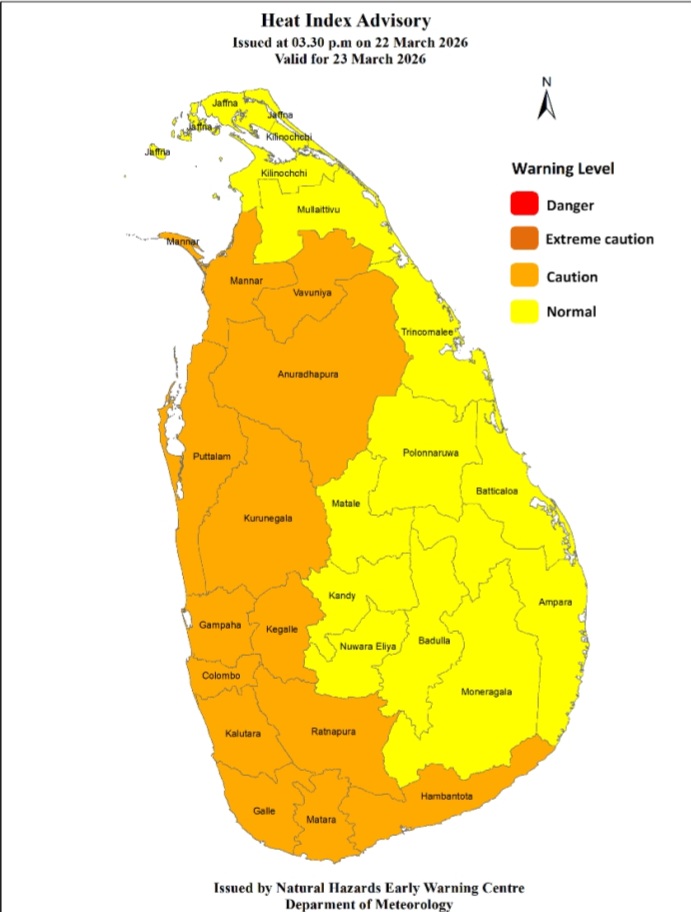
Warm Weather Advisory
Issued by the Natural Hazards Early Warning Centre of the Department of Meteorology
at 3.30 p.m. on 22 March 2026, valid for 23 March 2026.
The Heat index, the temperature felt on human body is likely to increase up to ‘Caution level’ at some places in the Western, Sabaragamuwa, Southern and North-western provinces and in
Anuradhapura, Mannar and Vavuniya districts.
The Heat Index Forecast is calculated by using relative humidity and maximum temperature and this is the condition that is felt on your body. This is not the forecast of maximum temperature. It is generated by the Department of Meteorology for the next day period and prepared by using global numerical weather prediction model data.

Effect of the heat index on human body is mentioned in the above table and it is prepared on the advice of the Ministry of Health and Indigenous Medical Services.
ACTION REQUIRED
Job sites: Stay hydrated and takes breaks in the shade as often as possible.
Indoors: Check up on the elderly and the sick.
Vehicles: Never leave children unattended.
Outdoors: Limit strenuous outdoor activities, find shade and stay hydrated.
Dress: Wear lightweight and white or light-colored clothing.
Note:
In addition, please refer to advisories issued by the Disaster Preparedness & Response Division, Ministry of Health in this regard as well. For further clarifications please contact 011-7446491.

Two killed when Air Canada jet hits fire truck at NYC’s LaGuardia Airport

Bus fares increased by 12.19% from midnight today [23]
Public will not be served as Computer system failure at Department of Registration of Persons

Trump says he is postponing strikes on Iran power plants after ‘productive’ talks on ending war

Asia stocks slide as US and Iran threaten to escalate war

Heat Index at Caution Level in the Western, Sabaragamuwa, Southern and North-western provinces and in Anuradhapura, Mannar and Vavuniya districts

‘Dates have the highest sugar content to fight Coronavirus’

Sunday Island 27 December – Headlines

#SundayIsland 17th December – Headlines

Sunday Island – 28th March

Sunday Island Headlines – 21 March

Sunday Island – 21st February – Headlines
-

 News6 days ago
CIABOC questions Ex-President GR on house for CJ’s maid
-

 News7 days ago
Sri Lankan marine scientist Asha de Vos honoured at UNGA opening
-

 News7 days ago
Australian HC debunks misleading travel risk claims for Sri Lanka
-

 News5 days ago
Bailey Bridge inaugurated at Chilaw
-

 News5 days ago
Pay hike demand: CEB workers climb down from 40 % to 15–20%
-

 News4 days ago
CIABOC tells court Kapila gave Rs 60 mn to MR and Rs. 20 mn to Priyankara
-

 Editorial6 days ago
Couple QR-based quota with odd-even rationing
-

 News3 days ago
Colombo, Oslo steps up efforts to strengthen bilateral cooperation in key environmental priority areas