
News
Ex-top cop urges police to be prepared for any eventuality as protests also have political undertones


By Shamindra Ferdinando
Retired Senior DIG Merril Gunaratne says the police should quickly adopt a contingency plan to meet large scale, often violent and simultaneous protests as the current turmoil is unlikely to end soon.
“Law enforcement authorities are facing quite a challenge. Those at the helm of public security operations must take into consideration there is a political background to the rapidly developing situation, the author of ‘Cop in Crossfire’ and ‘Perils of a Profession’ told The Island yesterday (20).
The outspoken retired policeman, who headed the country’s premier intelligence arm for a long time among other positions was commenting on clashes between the police and those blocking the main railway line close to the Rambukkana railway station on Tuesday (19).
Noting that the police had opened fire over 15 hours after the protesters blocked both the railway line and major roads via Rambukkana, Gunaratne said the police should be firm with protesters but issuing orders to open fire should definitely be the last resort.
Gunaratne said that the National Police Commission (NPC) should inquire into the incident. Responding to another query, Gunaratne said that the police shouldn’t ignore the possibility of interested parties stepping up protests in support of the ongoing ‘Go Gota Home’ campaign opposite the Presidential Secretariat.
“Law enforcement authorities should be also mindful of other unexpected developments,” Gunaratne said, referring to the recent dispute between a group of Army riders and the police deployed at an entry point to the Parliament where protesters interfered with vehicles leaving the House. The police earned the respect of the public for the way the senior officers at the scene thwarted possible incident involving the Army and protesters, Gunaratne said.
The former Senior DIG said that the police appeared to have been unprepared to face large scale protests. Close on the heels of violent protest at President Gotabaya Rajapaksa’s private residence at Pengiriwatte, Mirihana, the public staged a countrywide protest on April 03 in spite of the curfew, Gunaratne pointed out.
“They seemed to be determined to pursue carefully planned action at selected places as part of their overall strategy,” Gunaratne said, urging the police to be prepared to face any eventuality.
Police spokesperson SSP Nihal Thalduwa told The Island that in addition to the police, the Special Task Force (STF) and the Army, too, had been deployed to enforce the curfew imposed by the IGP in the Rambukkana police area on Tuesday night. Attorney-at-Law Thalduwa reiterated accusations that some of those engaged in the protest tried to set ablaze one of the two fuel bowsers that had been held there. The police spokesman alleged that some even tried to set fire to the service station.
SSP Thalduwa said that contrary to initial reports, only 14 protesters had been wounded and one of them succumbed to his injuries. Of them perhaps five or six had received gunshot injuries whereas 20 police officers, including an SSP and SP received wounds as a result of them being hit by rocks. Of them, 14 had been admitted to the Kandy hospital, SSP Thalduwa said, adding that the dead was a 45-year-old person granted bail in a murder case. Among those who had been wounded was another person accused in the same case, the police spokesperson said.
Former DIG Gunaratne said that the police need political leadership at this juncture. The presence of capable Public Security Minister to deal with the issues at hand is of pivotal importance, the ex-policeman said.
President Gotabaya Rajapaksa has appointed Prasanna Ranatunga as the new Public Security Minister after the entire Cabinet resigned in the first week of April following the eruption of public protests over the deepening economic crisis. Ranatunga is also the Chief Government Whip.
The former DIG pointed out that though protests erupted on March 31 and quickly spread to the provinces, the police hadn’t opened fire till April 19th.



The landslide early warnings issued to the Districts of Kandy and Nuwara Eliya by the Landslide Early Warning Center of the National Building Research Organisation [NBRO] have been extended until 0600 hrs on the 14th of February 2026.
Accordingly,
The Level II [AMBER] landslide early warnings issued to the Divisional Secretaries Divisions and surrounding areas of Walapane and Nildandahinna in the Nuwara Eliya district and
the Level I [YELLOW] landslide early warnings issued to the Divisional Secretaries Division and surrounding areas of Pathahewaheta in the Kandy district have been extended till 0600AM on Saturday [14]
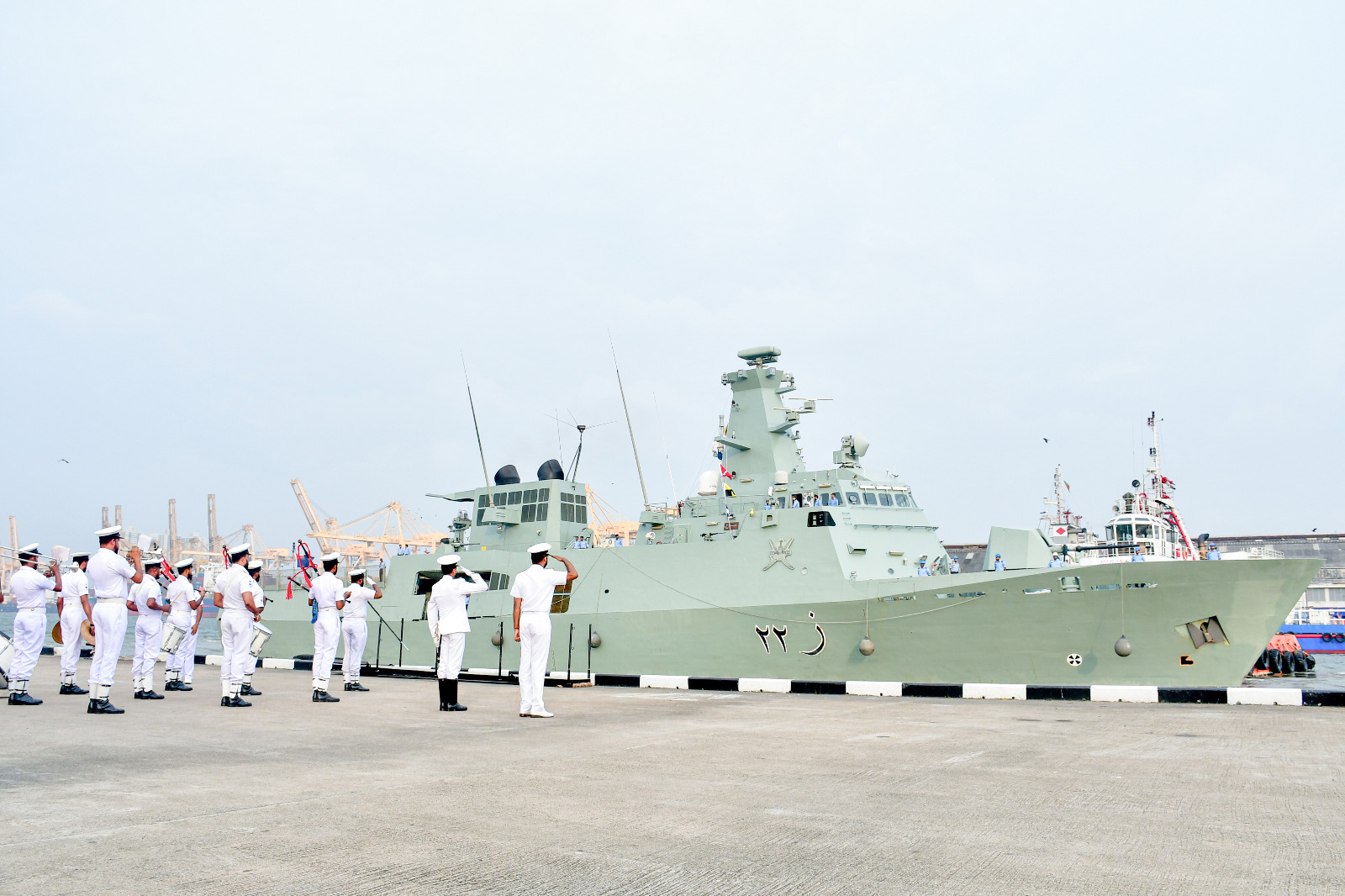
The Royal Navy of Oman Vessel “SADH” which arrived in Sri Lanka for replenishment purpose, departed the island on 12 Feb 26.
In accordance with naval tradition, the Sri Lanka Navy extended a customary farewell to the departing ship.

The Minister of Education, Higher Education and Vocational Education Prime Minister Dr. Harini Amarasuriya stated that aligning with the development activities carried out under the new education reforms, decisions at the rural level will not be taken from Colombo and plans should be sent based on the requirements of the rural level through the District Coordination Committees by structural committees. She further noted that all officials, from the Ministry of Education down to the school level, must commit to working efficiently and with a human-centered approach.
The Prime Minister made these remarks while addressing a discussion held with education authorities of the Hambantota District on Thursday [February 12] at the auditorium of the Hambantota District Secretariat regarding the new education reforms and prevailing issues in the education sector.
During the meeting, the Prime Minister provided an opportunity for education authorities including chief prelates of pirivenas, zonal education directors, teacher advisors, and principals to present the challenges they face and officials raised concerns including salary disparities among principals, developing school infrastructure, issues arising from the division between national and provincial schools, and uplifting pirivena education.
Further elaborating, Prime Minister stated:
“The new education reforms were initiated from 2025 through dialogue, consultations, and the collection of necessary data. As officials, you have extended your support to us during this process. We have embarked on a difficult and long journey, and we look forward to your continued cooperation.
We initiated these reforms in response to a strong social demand. Many have attempted such reforms at different times. Within our political vision, we understood clearly that if this country is to be rebuilt, an educational transformation is essential. The human resource is the most valuable resource of this country and it should be nurtured properly.
Solutions to many of the crises our country faces lie within the education system. Addressing the issues in economic challenges, social issues, drug abuse, violence, the breakdown of political culture, corruption, waste, and even the deterioration of human relationships all lie within the education.
In order to achieve the transformation we envision as a government, that an education transformation is necessary.
This education system should focus on reducing the pressures within the system, minimize school dropouts, increase employability, and instill confidence in children about their future.
There are disparities within the school system, between rural and urban schools, national and provincial schools, and difficult schools. This should not happen. All children must have equal opportunities.
Decisions regarding the establishment of schools or expansion of classes should not be political decisions. They must be decisions taken through Structural Committees. Those representatives understand their divisions, village economies, and population dynamics. Based on your decisions and assessments of needs, prepare the plans, discuss them with the District Coordination Committees, and submit them to us. We will then take steps to provide the necessary allocations and other support. We will not make decisions for the rural level while sitting in Colombo.
We are taking steps to minimize salary disparities. A Cabinet paper regarding the salary anomalies of principals has already been prepared for submission. Steps are also being taken to introduce new reforms in pirivena education through the Pirivena Committee of the Ministry of Education. We require the support of the chief prelates in this regard.
A significant number of teachers turn to human rights due to delays caused by inefficiency. Therefore, all officials from the Ministry of Education down to the schools must commit to working efficiently and in a humane manner”
The discussion was attended by Chief prelates of pirivenas, deputy ministers, Members of Parliament, zonal directors, principals, and other education sector officials.


[Prime Minister’s Media Division]

Landslide Early Warnings issued to the Districts of Kandy and Nuwara Eliya extended

Aryansh Sharma, Sohaib Khan power UAE to thrilling win over Canada

Royal Navy of Oman Vessel “SADH” departs island

Muzarabani, Bennett orchestrate famous Zimbabwe win

“We will not make decisions for rural level schools while sitting in Colombo” – PM

USA need to overturn history to beat Netherlands and stay alive

‘Dates have the highest sugar content to fight Coronavirus’

Sunday Island 27 December – Headlines

#SundayIsland 17th December – Headlines

Sunday Island – 28th March

Sunday Island Headlines – 21 March

Sunday Island – 21st February – Headlines
-
 Features6 days ago
My experience in turning around the Merchant Bank of Sri Lanka (MBSL) – Episode 3
-

 Business7 days ago
Zone24x7 enters 2026 with strong momentum, reinforcing its role as an enterprise AI and automation partner
-
 Business6 days ago
Remotely conducted Business Forum in Paris attracts reputed French companies
-
 Business6 days ago
Four runs, a thousand dreams: How a small-town school bowled its way into the record books
-

 Business6 days ago
ComBank and Hayleys Mobility redefine sustainable mobility with flexible leasing solutions
-
 Business3 days ago
Autodoc 360 relocates to reinforce commitment to premium auto care
-
 Midweek Review3 days ago
A question of national pride
-

 Business7 days ago
HNB recognized among Top 10 Best Employers of 2025 at the EFC National Best Employer Awards