
Foreign News
Ex-Malaysia PM Najib Razak given 15-year jail term over state funds scandal


Former Malaysian Prime Minister Najib Razak has been jailed for 15 years for abuse of power and money laundering, in his second major trial for a multi-billion-dollar state funds scandal.
Najib, 72, was accused of misappropriating nearly 2.3 billion Malaysian ringgit ($569m; £422m) from the nation’s sovereign wealth fund 1Malaysia Development Berhad (1MDB).
On Friday afternoon a judge found him guilty in four charges of abuse of power and 21 charges of money laundering.
The former PM is already in jail after he was convicted years ago in another case related to 1MDB.
Friday’s verdict comes after seven years of legal proceedings, which saw 76 witnesses called to the stand.
The verdict, delivered in Malaysia’s administrative capital Putrajaya, is the second blow in the same week to the embattled former leader, who has been imprisoned since 2022.
He was handed four 15-year sentences on abuse of power charges, as well as five years each on 21 money laundering charges. The jail terms run concurrently under Malaysian law.
On Monday, the court rejected his application to serve the remainder of his sentence under house arrest.
But the former prime minister retains a loyal base of supporters, who claim that he’s a victim of unfair rulings and who have showed up at his trials calling for his release.
On Friday, dozens of people gathered outside the court in Putrajaya in support of Najib.
The 1MDB scandal made headlines across the world when it came to light a decade ago, embroiling prominent figures from Malaysia to Goldman Sachs and Hollywood.
Investigators estimated that $4.5bn was siphoned from the state-owned wealth fund into private pockets, including Najib’s.
Najib’s lawyers claim that he had been misled by his advisers – in particular the financier Jho Low, who has maintained his innocence but remains at large.
But the argument has not convinced Malaysia’s courts, which previously found Najib guilty of embezzlement in 2020.
That year, Najib was convicted of abuse of power, money laundering and breach of trust over 42 million ringgit ($10m; £7.7m) transferred from SRC International – a former unit of 1MDB – into his private accounts.
He was sentenced to 12 years in prison, but saw his jail term halved last year.
The latest case concerns a larger sum of money, also tied to 1MDB, received by his personal bank account in 2013. Najib said he had believed the money was a donation from the late Saudi King Abdullah – a claim rejected by the judge on Friday.
Separately Najib’s wife, Rosmah Mansor, was sentenced to ten years in jail in 2022 for bribery. She is free on bail pending an appeal against her conviction.
The scandal has had profound repercussions on Malaysian politics. In 2018 it led to a historic election loss for Najib’s Barisan Nasional coalition, which had governed the country since its independence in 1957.
Now, the recent verdicts has highlighted fissures in Malaysia’s ruling coalition, which includes Najib’s party United Malays National Organisation (UMNO).
Najib’s failed house arrest bid on Monday was met with disappointment from his allies but celebrated by his critics within the same coalition.
Malaysia’s Prime Minister Anwar Ibrahim called for politicians on all sides to respect the court’s decisions.
Former Malaysian lawmaker Tony Pua told the BBC’s Newsday programme that the verdict would “send a message” to the country’s leaders, that “you can get caught for corruption even if you’re number one in the country like the prime minister”.
But Cynthia Gabriel, founding director of Malaysia’s Center to Combat Corruption and Cronyism, argued that the country has made little headway in anti-corruption efforts despite the years of reckoning after the 1MDB scandal.
Public institutions have not been strengthened enough to reassure Malaysians that “the politicians they put into power would actually serve their interests” instead of “their own pockets”, she told Newsday.
“Grand corruption continues in different forms”, she added. “We don’t know at all if another 1MDB could occur, or may have already occurred.”
(BBC)


Iranian forces have said they struck down two fighter jets belonging to the United States military, one over the southwest part of the country and another around the Strait of Hormuz.
A spokesperson for the Iranian military’s Khatam al-Anbiya Central Headquarters said on Friday that air defences completely destroyed one F-15 jet. Later in the day, the Iranian military said it targeted an A-10 US aircraft that crashed into the Gulf.
The New York Times had cited unidentified officials as saying that the A10’s pilot was safe after the crash.
But the fate of at least one pilot from the downed F-15 crew is unknown. Several US media outlets reported that one crew member of the jet was located and rescued by US forces, but the other remains missing.
US President Donald Trump told NBC News on Friday that the downing of the jet will not affect the prospect of talks with Tehran. “No, not at all. No, it’s war. We’re in war,” he said.
State media outlets in Iran showed photos of the wreckage of the F-15 jet and what appears to be an ejection seat with an attached parachute.
After the jet was downed, Iranian Parliament Speaker Mohammad-Bagher Ghalibaf mocked Trump’s repeated claims of victory in the war.
“After defeating Iran 37 times in a row, this brilliant no-strategy war they started has now been downgraded from ‘regime change’ to ‘Hey! Can anyone find our pilots? Please?’” Ghalibaf wrote in a social media post.
There was no immediate comment on the incident from the Pentagon and US Central Command (CENTCOM), which oversees military operations in the Middle East and much of Asia.
[Aljazeera]

United States President Donald Trump has announced that Pam Bondi is out as US attorney general, in his second major cabinet-level shake-up in less than a month.
Trump confirmed the decision in a post on Truth Social on Thursday, after a slate of media reports suggested he was considering removing Bondi from the top law enforcement role. Several cited his discontent over Bondi’s handling of investigative files related to financier and convicted sex offender Jeffrey Epstein.
Deputy Attorney General Todd Blanche will temporarily replace Bondi in an interim capacity, he said.
“Pam Bondi is a Great American Patriot and a loyal friend, who faithfully served as my Attorney General over the past year,” Trump wrote.
The US president also praised Bondi for leading the Department of Justice during a period when violent crime decreased in the US, part of a wider downward trend in the wake of the COVID-19 pandemic.
Trump did not mention his reasoning for the decision, instead writing, “We love Pam.” He added that she would be “transitioning to a much-needed and important new job in the private sector”.
In a statement, Bondi said she would be transitioning the office to Blanche over the next month, adding she was moving to “an important private sector role I am thrilled about, and where I will continue fighting for President Trump and this Administration”.
“I remain eternally grateful for the trust that President Trump placed in me to Make America Safe Again,” she said.
Bondi’s dismissal comes shortly after Trump abruptly fired Department of Homeland Security Secretary Kristi Noem, who oversaw the agency amid a mass deportation campaign that led to the killing of two US citizens.
[Aljazeera]
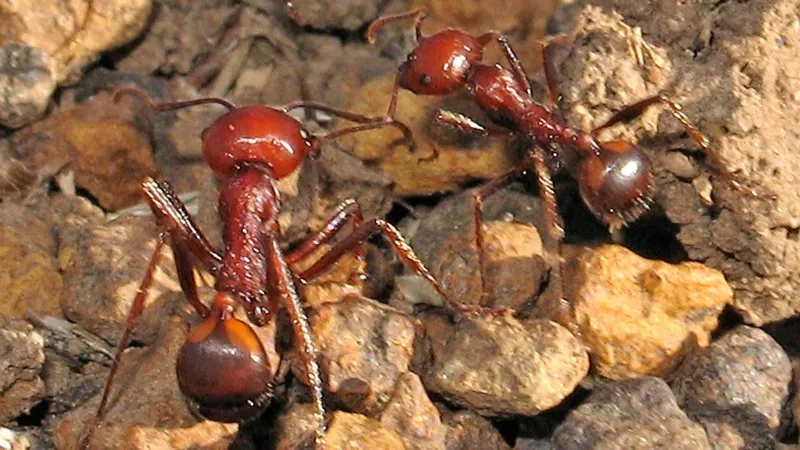
The ants are flying in Kenya at the moment
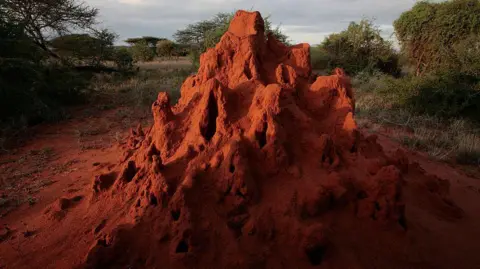
During this rainy season, swarms can be seen leaving the thousands of anthills in and around Gilgil, a quiet agricultural town in Kenya’s Rift Valley that has emerged as the centre of a booming illegal trade.
The mating ritual sees winged males leave the nest to impregnate queens, who also take flight at this time. This makes it the perfect time to chase down queen ants to sell on to smugglers who are at the heart of a growing global black market, that taps into the pet craze for keeping ants in transparent enclosures designed to observe the insects as they busily build a colony.
It is the giant African harvester ant queens, which are large and coloured red, that are most prized by international ant collectors – one can fetch up to £170 ($220) on the black market, which tends to operate online.
A single fertilised queen is able to create a whole colony and can live for decades – and can be easily posted as scanners do not tend to detect organic material.
“At first, I did not even know it was illegal,” a man, who asked not to be named, told the BBC about how he had once acted as a broker, linking foreign buyers with local collection networks.
Also known as Messor cephalotes, these ants are native to East Africa and known for their distinctive seed-gathering behaviour making them popular with ant collectors.
“A friend told me a foreigner was paying good money for queen ants – the big red ones which are easily seen around here,” the former broker said.
“You look for the mounds near open fields, usually early morning before the heat. The foreigners never came to the fields themselves – they would wait in town, in a guest house or a car, and we would bring the ants to them packed in small tubes or syringes they supplied us with.”
The scale of the illicit trade in Kenya became apparent last year when 5,000 giant harvester ant queens – mainly collected around Gilgil – were found alive at a guest house in Naivasha, a nearby lakeside town popular with tourists.
The suspects – from Belgium, Vietnam and Kenya – had packed the test tubes and syringes with moist cotton wool, which would enable each ant to survive for two months, according to the Kenya Wildlife Service (KWS).
The plan was to take them to Europe and Asia and put them up for sale.
This trade in ants has caught scientists and the authorities by surprise.
The East African nation is more accustomed to high-profile wildlife crimes involving elephant tusks and rhino horns.
UK based retailer Ants RbUs described the giant African harvester ant as “many peoples dream species” – though the queens are currently out of stock, with the site explaining that it is very hard for retailers to source them.
“Even I, as an entomologist, have been surprised at the extent of the apparent trade,” Dino Martins, a biologist based in Kenya, where there are around 600 kinds of ants, told the BBC.
However, he can understand the fascination with East Africa’s harvester, with colonies created by a “foundress queen”, who can grow up to 25mm (0.98 inches) and who produces eggs throughout her life.
“They are one of the most enigmatic species of ants – they form large colonies, engage in interesting behaviours and are easy to keep. They are not aggressive.”
During the swarming he says the queens mate with several males.
“Then that is it for the males – their job is done… most are eaten by predators or die,” the entomologist says, going on to explain how the queen then scurries away to dig a small burrow and begin laying eggs to start her empire.
Her workers and soldier ants, those that protect the nest, are all female and will eventually number in the hundreds of thousands.
“Nests can live for over 50 years, perhaps even up to 70 years. I personally know of nests near Nairobi that are at least 40 years old as I’ve been visiting them for that long,” said Martins.
This means the queens live that long too – because as soon as she dies, the colony collapses and any surviving workers will look for another nest.
Kenyans who have had to deal with ants raiding their crops or invading their houses know this well – and to get rid of a colony someone is sent in to locate the queen, often hidden deep in one of the tunnels or chambers of an ant mound.
The former broker said ants could also be harvested by gently disturbing the mound and collecting them as they tried to escape.
“It was only when I saw the arrests on the news that I realised what I had been part of – and I immediately quit,” he said.
Those arrested were convicted on charges of biopiracy and ordered to pay fines or serve 12 months in jail – they opted to pay the $7,700 fee and the foreign nationals left the country.
Two weeks ago, a Chinese national – the alleged mastermind behind last year’s ring and who is said to have escaped using a different passport, was arrested at Nairobi’s Jomo Kenyata International Airport with another 2,000 queen ants packed in test tubes and tissue rolls.
For Zhengyang Wang, who was part of a team of researchers who published a report on the ant trade in 2023 focusing on China, this is a worry and could “wreak havoc” with local ecosystems.
“Initially, we were very excited when we learnt that many people have taken up keeping ants,” Wang, assistant professor at Sichuan University, told the BBC.
“A colony of pet ants are often kept in a formicarium, which is basically a transparent plastic box so that keepers can observe colonies at work, digging tunnels, collecting food, and guarding their queen. I’d say it’s quite charming and… can be a good way of educating people about insects and their behaviour.
“But then we realised, wait, isn’t keeping invasive species incredibly dangerous?”
Monitoring online sales – of more than 58,000 colonies – in China over six months, the researchers found that more than a quarter of the traded species were not native to China – despite it being illegal to import them.
“If the trade volume of invasive ants continues to grow, it’s only a matter of time before a few escape from their formicaria and become established in the wild,” said Wang.
The study he worked on, published in the journal Biological Conservation, explained what could happen in the case of giant African harvester, one of the most traded species in China: “For example, Messor cephalotes, an East African native, is among the largest seed harvesters in the world and could potentially disrupt predominantly grain-based agriculture in south-eastern China.”
The environmental consequences are also a concern in Kenya.
“Harvester ants are both keystone species and ecosystem engineers. They harvest seeds of grasses, and other plants and in so doing also help to disperse the seeds,” said Martins, adding that the insects “create a more healthy and dynamic grassland”.
Mukonyi Watai, a senior scientist at Kenya’s Wildlife Research and Training Institute, shares these fears.
“Unsustainable harvesting – particularly the removal of queen ants – can lead to colony collapse, disrupting ecosystems and threatening biodiversity,” he told the BBC.
It is possible to collect ants legally in Kenya – in line with various international treaties – with a special permit, which would require the buyer to sign a benefit-sharing agreement with the local community involved to split any profits.
But, according to the KWS, so far none have been applied for – with the paperwork also requiring details of how many ants are being collected and their destination.
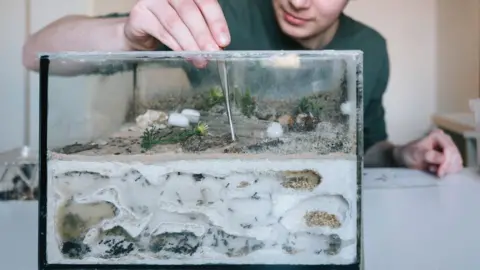 formicarium allows collectors to see the workings of an ant colony (BBC)
Some conservationists are now calling for greater trade protections for all ant species under the Convention on International Trade in Endangered Species (Cites), the global wildlife trade treaty.
“The reality is that no ant species is currently listed under Cites,” Sérgio Henriques, a researcher into the global ant trade, told the BBC.
“Without international treaties monitoring these movements, the scale of the trade remains largely invisible to policy makers and the global community,” he said.
But for the KWS the real problem is more immediate – how to monitor and clamp down on “under-reported” insect trafficking, with the agency suggesting better surveillance equipment at airports and others border points would be a good start.
Martins agrees: “It is likely only a fraction of the actual ants being traded that are being detected, so one can only guess at the scale for now.”
Journalist Charles Onyango-Obbo argues that Kenya is overlooking a significant global revenue opportunity.
“The ants are not finite items like gold or diamonds. They are biological assets that can be bred and farmed, and their production can be scaled up to thousand a day. Yet we treat them like stolen artefacts,” he recently wrote in Kenya’s Daily Nation newspaper.
In fact, Kenya’s cabinet did approve policy guidelines last year aimed at commercialising the wildlife economy, including the ant trade.
“The guidelines seek to promote sustainable use trade of wild species such as ants to generate jobs, wealth and community livelihoods across all the counties,” said Watai.
With careful monitoring in place, it could be that future farmers around Gilgil will have special formicaria on their land expanding the yields from their fields and orchards – full of vegetables and fruits – to include lucrative queen ants.
But the debate over the dangers of exporting ants to hobby collectors in different parts of the world is yet to be settled.

Sanju Samson and Jamie Overton deliver first points for Chennai Super Kings

Arya, Prabhsimran and Shreyas help Punjab Kings ace another 200-plus chase

Beauty of Sri Lanka in focus: Global showcase blends art, diplomacy and conservation

Showers expected in the Western, Sabaragamuwa, Central, Southern, North-western and Uva provinces and in Ampara, Batticaloa and Polonnaruwa districts after 1.00 p.m.

Heat index likely to increase up to ‘Caution level’ at some places in the Northern, North-central, North-western, Western, Sabaragamuwa, Southern and Eastern provinces and Monaragala district

Sun directly overhead Cheddikulam, Kebithigollewa, Gomarankadawala and Nilaveli about 12:11 noon. today [12]

‘Dates have the highest sugar content to fight Coronavirus’

Sunday Island 27 December – Headlines

#SundayIsland 17th December – Headlines

Sunday Island – 28th March

Sunday Island Headlines – 21 March

Sunday Island – 21st February – Headlines
-

 News6 days ago
Lankan-origin actress Subashini found dead in India
-

 News4 days ago
AG: Coal procurement full of irregularities
-

 Business3 days ago
Israeli attack on Lebanon triggers local stock market volatility
-

 Business4 days ago
Hayleys Mobility introduces Premium OMODA C9 PHEV
-

 Business3 days ago
HNB Assurance marks 25 years with strategic transformation to ‘HNB Life’
-

 Sports4 days ago
DS to face St. Anthony’s in ‘Bridges of Brotherhood’ cricket encounter
-

 News15 hours ago
CEB orders temporary shutdown of large rooftop solar systems
-

 News6 days ago
UN Regional Director launches SL’s first Country Gender Equality Profile during official visit