
News
Ex-banker Eran reveals nakedness of the budget

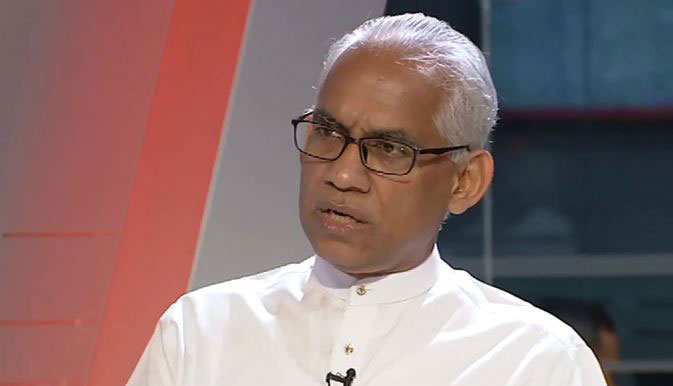
SJB MP Eran Wickramaratne told Parliament that although the 2023 Budget presented to Parliament by President Ranil Wickremeisnghe is full of nice words, lofty ideals and concepts there is no single practical plan outlined in those proposals on how to realize them.
Participating in the second reading debate on the 2023 budget, MP Wickramaratne said that when listening to the budget speech people may have wonderful dreams as if they are flying over the stars but at the end of that speech only they realize that the country has further been pushed into an abyss.
Wickramaratne said that the country was bankrupt. This is a country with no debt sustainability. The economy is contracting at a large negative rate. Budget deficit is more than 10 per cent. Inflation is more than 60 per cent. Food inflation is 100 per cent and the rupee has depreciated by more than 80 per cent.
Inflation is promised to be brought under a single digit. It is promised to increase the government revenue to 15 per cent of the GDP from its present position of 8 per cent. How it would be done is anybody’s guess. It is also envisaged to bring the primary balance from a negative value to a positive value. In the past 74 years, the primary balance of this country has had a positive value only five times. That we witnessed in 2017 and 2018. When the income increased more than the expenditure, it’s called positive in primary balance and through the primary balance, we can pay the loan interest with our revenue money. If not, we have to take out a loan even to pay the loan interest. The most hilarious aspect of these proposals is the promise to achieve all these goals by 2025. A budget presents plans usually for the work to be done in the next year. But this government is giving the target of 2025. This is nothing but a dream budget, Wickramaratne said.







Latest News
Heat Index at Caution Level in the Northern, North-central, North-western, Western, Sabaragamuwa, Eastern and Southern provinces and in Monaragala district

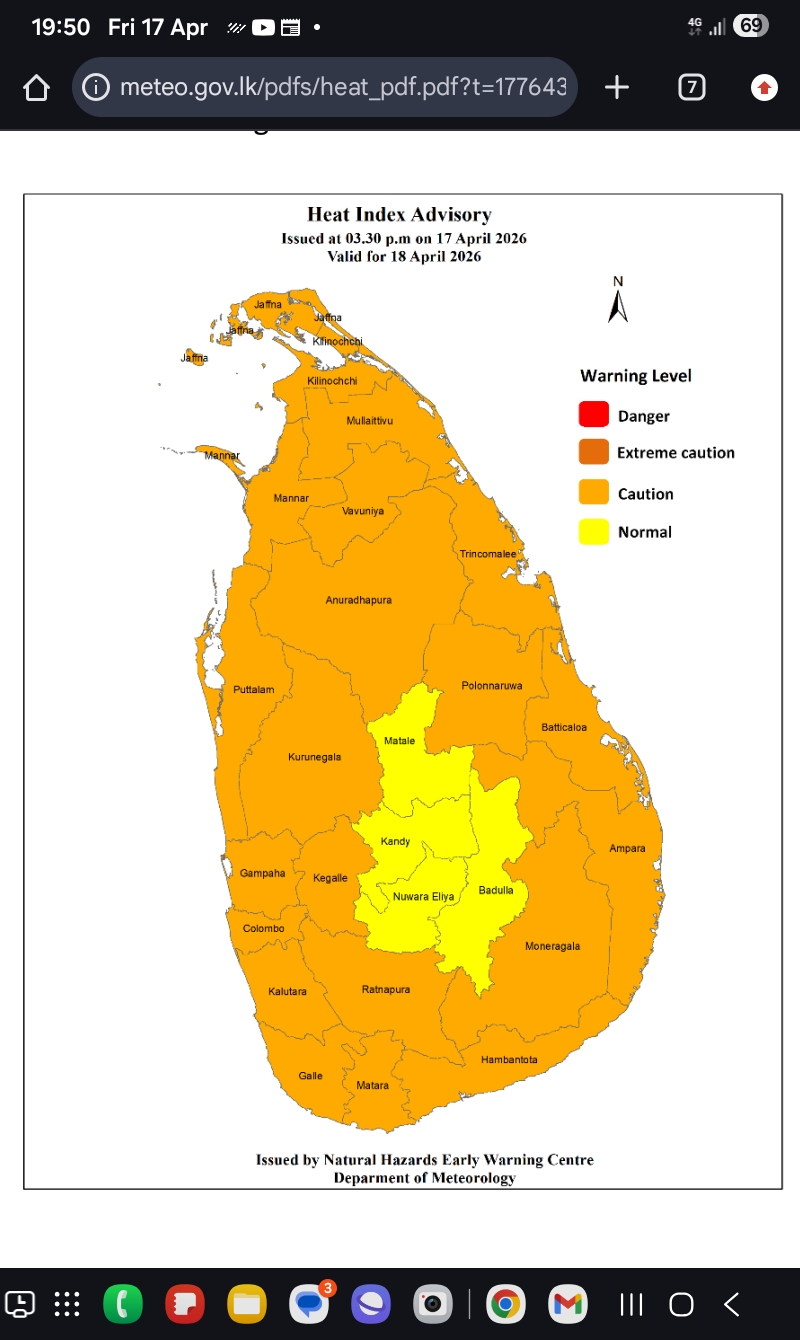
Warm Weather Advisory
Issued by the Natural Hazards Early Warning Centre
Issued at 3.30 p.m. on 17 April 2026, valid for 18 April 2026.
The Heat index, the temperature felt on human body is likely to increase up to ‘Caution level’ at some places in the Northern, North-central, North-western, Western, Sabaragamuwa, Eastern
and Southern provinces and in Monaragala district.
The Heat Index Forecast is calculated by using relative humidity and maximum temperature and this is the condition that is felt on your body. This is not the forecast of maximum temperature. It is generated by the Department of Meteorology for the next day period and prepared by using global numerical weather prediction model data.

Effect of the heat index on human body is mentioned in the above table and it is prepared on the advice of the Ministry of Health and Indigenous Medical Services.
ACTION REQUIRED
Job sites: Stay hydrated and takes breaks in the shade as often as possible.
Indoors: Check up on the elderly and the sick.
Vehicles: Never leave children unattended.
Outdoors: Limit strenuous outdoor activities, find shade and stay hydrated.
Dress: Wear lightweight and white or light-colored clothing.
Note:
In addition, please refer to advisories issued by the Disaster Preparedness & Response Division, Ministry of Health in this regard as well. For further clarifications please contact 011-7446491.
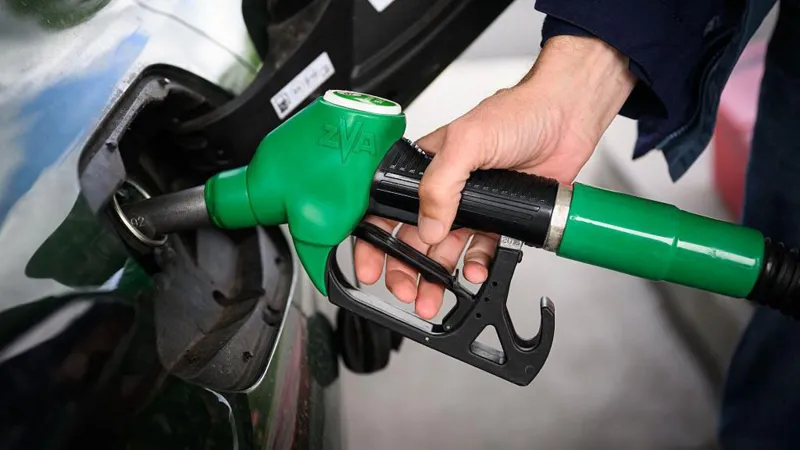
Oil prices have plummeted after Iran said the Strait of Hormuz would be “completely open” to commercial ships for the remainder of the ceasefire.
The cost of a barrel of Brent crude fell to $88 dollars a barrel, having been above $98 earlier on Friday.
The Strait of Hormuz is a narrow strip of water linking the Gulf to the Arabian sea, through which a fifth of the world’s oil and liquified natural gas is typically transported.
“The passage for all commercial vessels through Strait of Hormuz is declared completely open for the remaining period of ceasefire,” Iranian Foreign Minister Abbas Araghchi said.
Global markets also rallied on the announcement, with the major US stock indices rising in early trading. The S&P 500 rose by 0.8%, while the Nasdaq and Dow Jones Industrial Average (DJIA) were both up by more than 1%.
European shares also rose in reaction to the news. The Cac index in Paris and Dax in Frankfurt both climbed by more than 2%, while London’s FTSE 100 rose by around 0.5%.
The Strait of Hormuz has been effectively shut by Iran since the US and Israel launched military strikes in the country in late February.
Tankers have been unable to pass through, drastically reducing the amount of oil and gas available on global markets and causing prices to spike.
Before the conflict, Brent crude was trading at under $70 per barrel. It rose above $100 before reaching a peak of more than $119 per barrel in March.
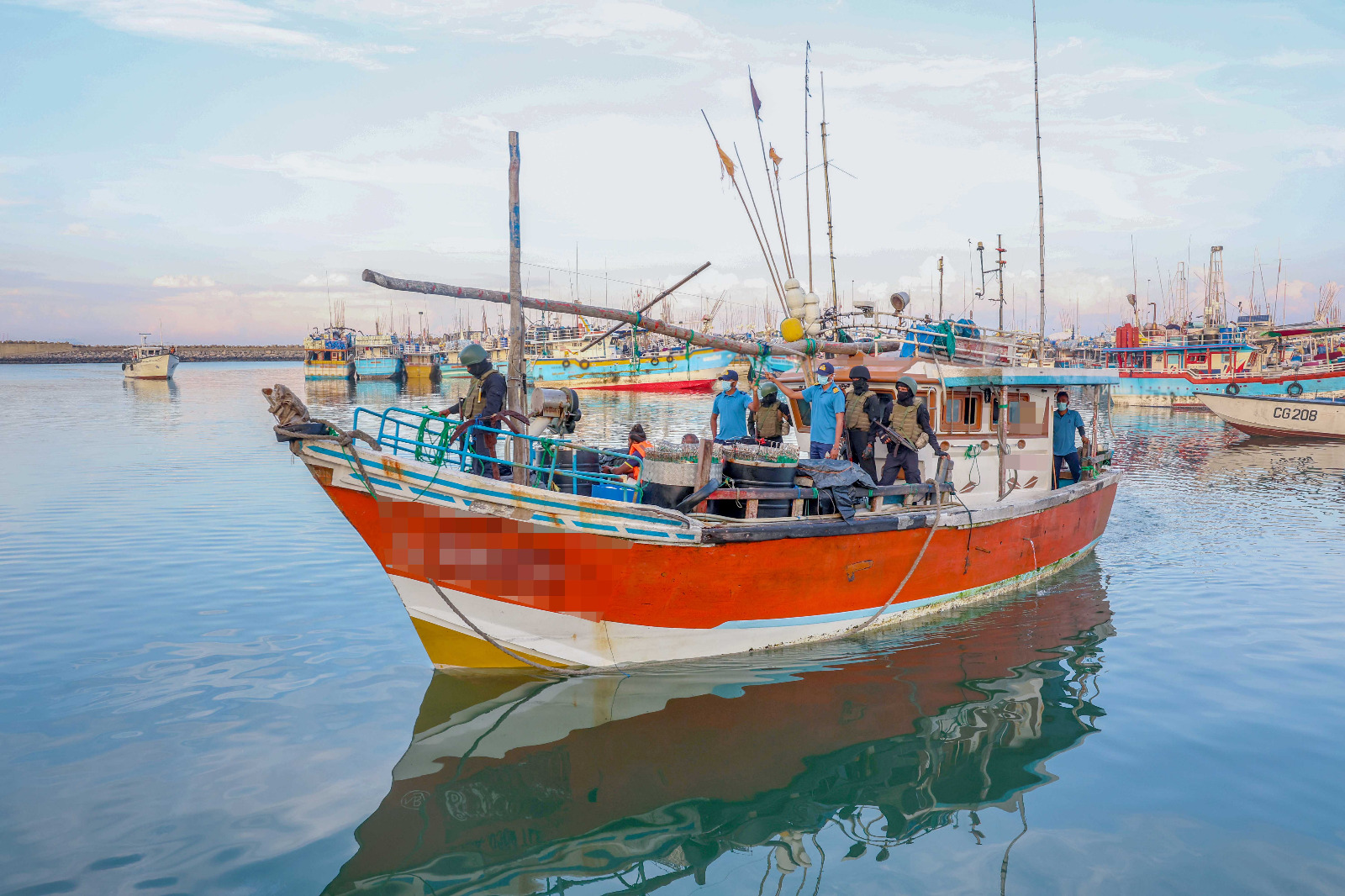
Being a key frontline stakeholder in the national mission, ‘A Nation United,’ the Navy continues to maintain a vigilant maritime shield to eradicate the drug menace from society.
During yet another successful operation on the high seas south of Sri Lanka, the Navy intercepted a local multi-day fishing trawler and apprehended four suspects in connection with the
smuggling of a stock of suspected narcotics.
The intercepted trawler, along with the suspects, was escorted to the Dikowita Fisheries Harbour today, (17 April 2026).
During a special inspection at the fisheries harbour, the Police Narcotic Bureau (PNB) confirmed the presence of over 161kg of heroin.
The Deputy Minister of Defence, Major General Aruna Jayasekera (Retd), and the Commander of the Navy, Vice Admiral Kanchana Banagoda, to inspect seized narcotics.
Addressing the media, the Deputy Minister emphasized that drug trafficking has long persisted as an organized and sophisticated criminal enterprise. He highlighted that under the current government’s national mission, ‘A Nation United,’ a robust state mechanism is now in motion, integrating the Tri-Forces, Police, Special Task Force, PNB, and international agencies to dismantle these networks.
Underscoring the Navy’s operational success, the Deputy Minister revealed that in 2025 alone, the Navy seized narcotics valued at over Rs. 75,000 million. In the first four months of 2026, the momentum has continued with nearly Rs. 50,000 million worth of drugs intercepted and produced for legal action.
During this short period, 14 local multi-day trawlers and 127 suspects have been apprehended. He issued a stern assurance that seized drugs would never find their way back into society, as they are systematically destroyed under strict protocols.
“Human capital is our nation’s most vital asset,” the Deputy Minister noted, adding that a healthy population leads to a quality workforce and a resilient economy. He further remarked that the vision of a “A Thriving Nation – A Beautiful Life”, extends beyond financial stability to include the dignity, discipline, and mindset of the citizenry.
“On the instructions of the President, new legislation is being drafted for Parliamentary approval to further empower this national mission and ensure a law-abiding, civilized society for future generations”, he stated.
Concluding the briefing, the Deputy Minister lauded the media for their role in drug prevention and urged continued responsible journalism to educate the public on the dangers of narcotics.
Meanwhile, the apprehended suspects, the multi-day trawler, and the 161kg heroin shipment were handed over to the Police Narcotic Bureau for onward investigation and legal proceedings.

Heat Index at Caution Level in the Northern, North-central, North-western, Western, Sabaragamuwa, Eastern and Southern provinces and in Monaragala district

Naples bank robbers hold 25 people hostage then vanish through tunnel

Oil prices plunge as Iran says Strait of Hormuz ‘open’ during ceasefire

Iran says $270bn war loss must be compensated, as fresh talks with US loom

Navy seize 161kg heroin shipment in high-seas operation

Minister of Power and Energy and Ministry Secretary resign from posts

‘Dates have the highest sugar content to fight Coronavirus’

Sunday Island 27 December – Headlines

#SundayIsland 17th December – Headlines

Sunday Island – 28th March

Sunday Island Headlines – 21 March

Sunday Island – 21st February – Headlines
-

 News6 days ago
CEB orders temporary shutdown of large rooftop solar systems
-
 Features6 days ago
From Royal College Platoon to National Cadet Corps: 145 years of discipline, leadership, and modern challenges
-
 Latest News5 days ago
PNS TAIMUR & ASLAT arrive in Colombo
-

 News7 days ago
Anura Solomons passes away
-

 Features6 days ago
CIA’s hidden weapon in Iran
-

 Latest News5 days ago
Prasidh, Buttler set up comfortable win for Gujarat Titans
-

 News2 days ago
PNS TAIMUR & ASLAT set sail from Colombo
-

 Business7 days ago
SL’s economic outlook for 2026 being shaped by M-E conflict