
Latest News
England 15-16 South Africa: Springboks fightback settles World Cup semi-final

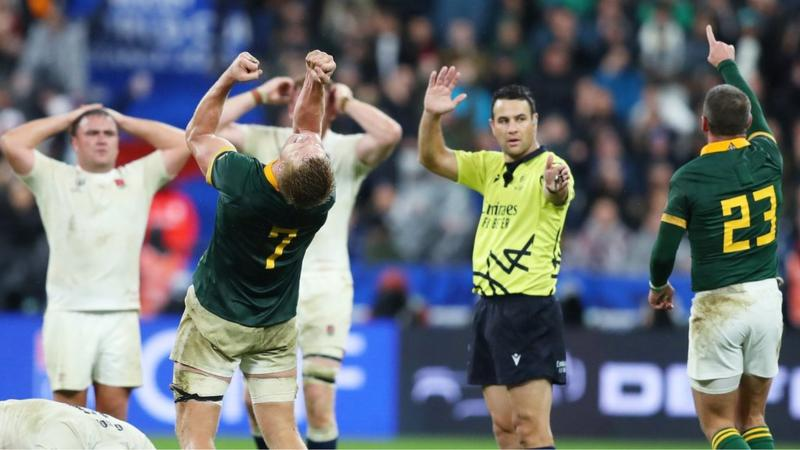
England fell agonisingly short of a supreme upset and a fifth Rugby World Cup final as South Africa came on strong to snatch victory in Paris.
England were canny and committed in the first half, raining down kicks into the South Africa backfield, forcing a steady supply of penalties. Owen Farrell converted four to send his side into the break with a 12-6 lead.
The Springboks chopped and changed their line-up after the break, but a Farrell drop-goal edged England further clear and to the brink of a seismic shock. However, an RG Snyman try 10 minutes from time cut the underdogs’ lead to 15-13 before the Boks’ scrum power earned Handre Pollard the match-winning penalty in the 77th minute.
It was a brutal ending for an England team who had led from the third minute until three minutes from time.
White shirts slumped to the sodden Stade de France turf, while elsewhere the tension and physicality of the contest spilled over with groups of players confronting each other.
It was characteristic of an England side who never took a step back and took the fight to their fancied opposition. The performance was also vindication for coach Steve Borthwick, who turned Leicester from relegation candidates to Premiership champions in 18 months and has produced another spectacular salvage job to guide England within a whisker of a final.
After beating hosts France by a similarly small margin on the same stage last weekend, South Africa will return to take on New Zealand in the showpiece match with both sides chasing a record fourth title.
Line-ups
England: Steward; May, Marchant, Tuilagi, Daly; Farrell (capt), Mitchell; Marler, George, Cole, Itoje, Martin, Lawes, Curry, Earl.
Replacements: Dan, Genge, Sinckler, Chessum, Vunipola, Care, Ford, Lawrence.
South Africa: Willemse; Arendse, Kriel, De Allende, Kolbe; Libbok, Reinach; Kitshoff, Mbonambi, Malherbe, Etzebeth, Mostert, Kolisi (capt), Du Toit, Vermeulen.
Replacements: Fourie, Nche, Koch, Snyman, Smith, De Klerk, Pollard, Le Roux.
Referee: Ben O’Keeffe (New Zealand)
Assistants: Mathieu Raynal (France) and Paul Williams (New Zealand)
TMO: Brendon Pickerill (New Zealand)
(BBC)











Oil prices have surged to their highest level in nearly two weeks amid escalation on multiple fronts of the US-Israel war on Iran.
Brent crude, the global benchmark, rose more than 3 percent on Monday morning to top $116 a barrel.
The latest climb took the global benchmark to its highest point since March 19, when it briefly touched $119 a barrel.
The surge came after Iran said it was prepared for a US ground invasion, with the speaker of the country’s parliament warning that Tehran was waiting for the arrival of US troops to “set them on fire” and “punish” their regional allies.
Tehran’s warning came as the conflict deepened over the weekend, with the Iranian-backed Houthis launching missiles at Israel for the first time in the war, and Israel expanding its invasion of southern Lebanon.
Asia’s main stock indexes fell sharply in morning trading, with Japan’s Nikkei 225 and South Korea’s KOSPI both down more than 4 percent as of 1:30 GMT.
Iran’s effective closure of the Strait of Hormuz in retaliation for the US-Israel war has disrupted about one-fifth of global oil and liquified natural gas (LNG) supplies, plunging the world into its biggest energy crisis in decades.
Oil prices have risen nearly 60 percent since the start of the war, driving up fuel prices worldwide and forcing numerous countries to adopt emergency measures to conserve energy.
Analysts have warned that oil prices are likely to keep rising unless maritime traffic returns to normal levels in the strait.
US President Donald Trump has threatened to “obliterate” Iran’s energy infrastructure if Tehran does not relinquish its stranglehold on the waterway by a deadline of April 6.
Trump, who on Thursday extended his deadline by 10 days, has proposed a 15-point plan for ending the war with Iran and insisted that the two sides are making progress towards a deal in indirect talks being mediated by Pakistan.
Tehran has flatly rejected Trump’s plan and proposed its own terms for a ceasefire, including war reparations and recognition of Iran’s right to control the strait.
Greg Newman, CEO of Onyx Capital Group, which began as an oil derivatives trading house, said energy consumers were only beginning to feel the true fallout of the turmoil.
“Physical oil moves around the world in loading cycles, and Europe has taken around three weeks to really start feeling the effects of the oil shortage,” Newman told Al Jazeera.
“Brent is starting to reflect the reality, and we think it’s a steady rise from here towards $120 and beyond.”
Newman said the scale of the disruption had yet to be fully appreciated.
“No one in the market has ever seen the outages we are now suffering from – physical premiums are the highest ever. There is still a sense that the macro world is not taking this seriously enough, but it is worse than anything that has come before it,” he said.
“The reality will come out in the economic numbers over the coming months.”
While Iran has been allowing a growing number of transits by ships that are not aligned with the US or Israel, traffic remains a fraction of pre-war levels.
On Saturday, Pakistani Minister of Foreign Affairs Ishaq Dar announced that Tehran had agreed to allow 20 Pakistani-flagged vessels to pass the strait in what he described as a “meaningful step toward peace”.
Malaysian Prime Minister Anwar Ibrahim said last week that Iran had granted an unspecified number of Malaysian vessels permission to clear the strait.
Seven non-Iranian vessels passed the strait on Thursday, up from five on Wednesday and four on Tuesday, according to maritime intelligence firm Windward.
Before the start of the war on February 28, the strait saw an average of 120 daily transits, according to Windward.
[Aljazeera]

An Iranian attack on a power and water desalination plant in Kuwait has killed one Indian worker and damaged a building at the site, according to Kuwaiti authorities, as regional tensions heighten amid the United States – Israeli war on Iran.
“A service building at a power and water desalination plant was attacked as part of the Iranian aggression against the State of Kuwait, resulting in the death of an Indian worker and significant material damage to the building,” Kuwait’s Ministry of Electricity said in a statement on Monday.
Technical and emergency response teams were immediately sent to the site to deal with the aftermath of the attack and ensure the normal continuation of operations, it added.
There was no official comment from Iran, where state media quoted the Kuwaiti ministry as saying that there was extensive damage at the plant as a result of the attack.
Reporting from Kuwait City, Al Jazeera’s Malik Traina said Kuwait has been subjected to repeated attacks since the start of the US-Israeli war on Iran more than a month ago.
“Just yesterday evening, the Defence Ministry said that 14 missiles and 12 drones were detected in Kuwaiti airspace, and several of those drones were targeting a military camp, where 10 servicemen were injured,” he said. “They have since been taken to the hospital and have received medical treatment.”
Regional escalations have continued to spike since the start of the US and Israeli attacks on Iran, which have killed more than 2,000 people – including former Supreme Leader Ayatollah Ali Khamenei, several other top officials and at least 216 children, according to Iranian authorities – and destroyed critical infrastructure.
Iranian forces have hit back with drone and missile strikes targeting Israel and regional countries hosting US military assets, causing casualties and damage to infrastructure.
Iran has also effectively blocked the Strait of Hormuz, through which some 20 percent of global oil and liquefied natural gas passes, in a move that has driven up energy prices and rattled financial markets.
Last week, US President Donald Trump said he would pause threatened attacks on Iranian energy plants for 10 days until April 6. Iran said it would respond with its own attacks on energy sites across the Gulf region if its facilities came under attack.
The war has exposed the vulnerability of critical water infrastructure in a region that is among the most water scarce in the world.


The general secretary of the Confederation of African Football (Caf) has resigned amid a chaotic time for football on the continent
Veron Mosengo-Omba said in a statement he was retiring, but his departure comes during the fallout over decisions to strip Senegal of the 2025 Africa Cup of Nations (Afcon) title and postpone the women’s tournament at the last minute.
These incidents have left Caf, the governing body for African football, battling a crisis of confidence.
Mosengo-Omba alluded to controversies faced during his tenure in his statement on Sunday.
“Now that I have been able to dispel the suspicions that some people have gone to great lengths to cast on me, I can retire with peace of mind and without constraint, leaving the CAF more prosperous than ever,” Mosengo-Omba, deputy to Caf president Patrice Motsepe, wrote.
The 66-year-old has been criticised for staying on as general secretary past the organisation’s mandatory retirement age of 63.
He has also been accused by some employees of creating a toxic atmosphere in the workplace, although an investigation after staff complaints cleared him of any wrongdoing.
Mosengo-Omba, who hails from the Democratic Republic of Congo but also holds Swiss nationality, was appointed general secretary in March 2021.
According to news agency Reuters, Caf’s competitions director, Samson Adamu, will take over as acting general secretary.
The governing body is awaiting a decision by the Court of Arbitration for Sport (Cas) on Senegal’s appeal against being stripped of the Afcon title.
Senegal is challenging Caf’s appeals body for overturning their 1-0 win over hosts Morocco in January’s Afcon final.
During the game, Senegal’s players left the field in protest when, with the score at 0-0, hosts Morocco were awarded a stoppage-time penalty.
When they returned after a delay of about 17 minutes, Morocco subsequently failed to score the spot-kick and Senegal netted an extra-time winner.
Following an appeal by the Moroccan FA (FRMF), Caf later ruled that Senegal had forfeited the match and Morocco were awarded a 3-0 victory.
(BBC)

Oil tops $116 a barrel as Iran accuses US of preparing invasion

Iranian attack damages Kuwait power and desalination plant, kills worker

Warm weather conditions prevailing over the island are expected to continue

Inquiry into female employee’s complaint: Retired HC Judge’s recommendations ignored

Motor Traffic CG remanded

Petition launched seeking resignation of Energy Minister Jayakody

‘Dates have the highest sugar content to fight Coronavirus’

Sunday Island 27 December – Headlines

#SundayIsland 17th December – Headlines

Sunday Island – 28th March

Sunday Island Headlines – 21 March

Sunday Island – 21st February – Headlines
-

 News5 days ago
Senior citizens above 70 years to receive March allowances on Thursday (26)
-

 Features2 days ago
A World Order in Crisis: War, Power, and Resistance
-

 News3 days ago
Energy Minister indicted on corruption charges ahead of no-faith motion against him
-

 News4 days ago
US dodges question on AKD’s claim SL denied permission for military aircraft to land
-

 Business4 days ago
Dialog Unveils Dialog Play Mini with Netflix and Apple TV
-

 Sports3 days ago
SLC to hold EGM in April
-

 News5 days ago
CEB Engineers warn public to be prepared for power cuts after New Year
-

 Business6 days ago
Postponement of Sri Lanka Investment Forum 2026