
Features
Dudley Senanayake: some personal anecdotes

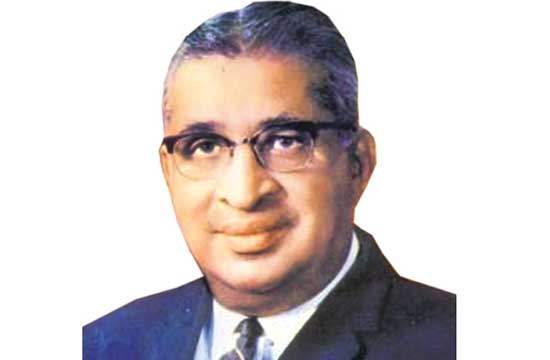
Excerpted from the Memoirs of Snr. DIG (Rtd.) Edward Gunawardena
Dudley Senanayake was a truly charismatic leader. By his exemplary behavior he enjoyed the respect of both sides of the House. He always entered the chamber from the main doorway and walked majestically down the aisle to his seat. Almost all Members rose from their seats to show their respect.
He was an excellent debater. If he had to make a speech it was a studied contribution. He never spent his time in Parliament without making use of every minute. If he was not in the chamber he would be in discussion with his colleagues and members of the opposition as well; or he would be in the library or even learning different aspects of Parliamentary procedure from the Clerk of the House.
A remarkable characteristic of Dudley was his ability to concentrate and focus his mind on what had to be done. If he had to attend a function where he had to make a speech, he would prepare his speech in the car with his eyes closed, seemingly but not asleep. When parliamentary sessions were due he would closet himself in his room either at Woodlands or the annexe at Temple Trees for hours, sometimes smoking the pipe as well as cigarettes, concentrating on the agenda for the morrow.
This desire for solitude even led to unpredictable situations. One day during the time of the 1965 budget debate, when I visited Woodlands at about 8 pm. the PM was not in. Carolis, his man Friday, and the sergeant on duty told me that he had walked across to his brother Robert’s for dinner. When I went there I was told by William, the driver, that ‘Hamu’ had driven away alone in a friend’s car that had been parked there. Asked for the description of the car I was told that it was a black Riley, a fairly large vehicle.
Nobody knew where he had gone. It was a tricky situation. But I did not panic because I knew he was a good driver. I put up Robert who was resting. He had seen Dudley driving off. “Dudley likes to walk up and down by the beach. That’s the way he prepares his speeches, Eddie,” were Robert’s words. He also added that Dudley was sure to be in the Kinross area.
I immediately called the Colombo Traffic Branch on my walkie-talkie, got down a patrol car and traveled to St. Peter’s Place. There were no vehicles to be seen down the lane. However turning to Kinross Avenue, a black vehicle was spotted at the end of the road. To my utter relief it was the Riley. Having instructed the patrol leader to call for an unmarked car to be close to the Riley and position the marked car at the top of the lane on the Galle Road, I walked across the railway line to the beach.
In the hazy moonlight I saw the Prime Minister’s figure in the distance. I got close and kept a reasonable distance behind him. He was bare-footed and the bottoms of his trousers were rolled up.
I kept on following him. It was amazing indeed, no one appeared to have recognized him. Approaching Kinross Avenue he stopped by the railway line until a train passed. When he was opening the door of the Riley, I surprised him by saying “Good evening Sir”.
“Ha, How did you know that I was here?”
“That’s my job Sir,” was my reply. With a guffaw he invited me into the car. The drive to Woodlands was smooth. We were talking of many things all the way. When he asked me why I followed him I explained to him that ensuring his safety was my responsibility. I also told him that if he had a flat and had to change a wheel as the Prime Minister, it would be headline news. “There is something in what you say”, was his response.
It was also on this drive to Woodlands from the Kinross beach that Dudley asked me a question the answer to which probably had serious consequences in the UNP. “Gunawardena, what do you think of this man Menikdiwela?” he asked me. Before I could ask him the reason, he said that he thought Joe Karunaratne (his private secretary) needed some assistance.
I knew Menikdiwela as a DRO in the Warakapola area when I was the ASP Kegalle. He was a very down to earth, rustic, betel chewing public servant recruited as a ‘Kandyan’ under the quota system that once prevailed. Backward and taciturn he kept a distance from even the GA and other Kachcheri officers such as the DLO, AFC and even officials of his own rank, the RDO and SSO. But he was a man of the times, with excellent rapport with the ordinary rural folk. Dudley probably wanted my opinion because I was the ASP Kegalle.
I knew Joe Karunaratne also very well. As such I was able to give a full and comprehensive answer to the Prime Minister’s question. I told him that I knew Joe well. Honourable and accepted in the highest circles, his Colombo 7 upbringing was an impediment to empathizing with people that mattered politically, particularly ordinary village folks and the Buddhist clergy. I still vividly remember the words that I used in my reply to the Prime Minister’s question. “Good to have a man like that, Sir. I know Joe well He is not comfortable meeting Buddhist priests and villagers. Menikdiwela is a ‘bulath hapaya’ sort who can handle them. Good fellow to meet the people coming from the electorate”.
The Prime Minister got the reply that he probably liked to have. Menikdiwela was able to thus became close to the top echelons of the UNP. The rest is history.
As a parliamentarian, Dudley not only enriched the quality of debate and deliberation, he epitomized dignity and decorum. His voice was that of a leader. When he spoke there was rapt attention. Seldom was he heckled. He never got angry. He sometimes pretended to be angry in the course of arguments, aggressively walking across the floor of the House was not in anger but for effect. That was his style.
Devastating wit was one of his strong assets. During the debate on the Dudley- Chelvanayakam pact I was seated in the speaker’s gallery following the proceedings. When he was speaking he was interrupted by none other than a respected parliamentarian Maithripala Senanayake. Pretending to be annoyed he stopped speaking, prompting Sir Albert Pieris the Speaker to say “Carry on Prime Minister”.
Dudley laughed and turning to the Speaker said, “Mr. Speaker, the Hon. Member for Medawachiya (Maithripala Senanayake) is Sinhala Only by day and believes in the reasonable use of Tamil by night!” There entire House roared with loud laughter. Maithripala Senanayake was then courting his wife-to- be, Lake House journalist Ranji Handy from Jaffna!
His habits, likes, dislikes and simple ways
Simplicity was the hallmark of Dudley’s life. He was a typical bachelor least concerned about the neatness of the place where he lived. At Woodlands there were only a few basic pieces of furniture. These were generally in disarray. In the drawing room was a dust laden glass cupboard with memorabilia consisting mainly of garlands of artificial flowers and empty gift boxes. The items of value had apparently been spirited away.
After his days work, in the evenings, either at Woodlands or at Temple Trees he liked to be in the bedroom dressed in sarong and bare bodied or in a banian. on numerous occasions he had got me to sit beside him on his bed and go through petitions particularly against the police, a file prepared by Joe Karunaratne. In fact once there was an anonymous petition which said that Edward Gunawardena was a Trotskyite in the University. When I read this out, he laughed and commented, “Who is the undergrad who is not a leftist?”
Dresswise, to office, Parliament and all other formal functions he wore English tussore or drill suits. To have his laundered suit ready was one of Carolis’ main tasks. He was very particular to see that his slightly graying hair was well groomed. As already mentioned Yardley Brilliantine was his hair cream. It was Robert who saw to all these needs. Once a month he took a haircut at the saloon that had been patronized even by his father, Gabriel’s Hair Dressing Saloon, Colpetty. I am not certain whether this saloon exists today. Perhaps the Bally’s Casino building has swallowed up this modest place!
He had a fair collection of Tootal ties. However, he used only one or two of these regularly. These had more of green or brown. Carolis had neatly arranged all his clothes in two wardrobes. His formal wear including socks, underwear and handkerchiefs were in one large nedun almirah. In another large almirah of teak were his bed linen, towels and sarongs. Stacked neatly in one shelf were about 10 — 15 casual shirts he was fond of wearing in the evenings, when he went out for a drive or for golf. He wore only tan leather shoes custom made by the Majestic Boot Works. Carolis was the man who polished these shoes.
As a rule he was up by 6 a.m. Sipping from a large mug of tea prepared by Carolis he would skim the newspapers before going to the washroom. He would take only about 10 minutes for his ablutions, shave and a shower, which he liked cold. Robert once told me that Dudley had been taking cold showers even when he was at Cambridge; and this was probably the reason for his bouts of catarrh.
As a rule he took his lunch and dinner at Robert’s or ate meals sent to Woodlands from his btother’s home. His favourite dishes were curried or baked seer fish and roast chicken, particularly for dinner. He did not take any alcoholic drinks, but was a heavy smoker, mainly a pipe, but smoked cigarettes too. His collection of pipes consisted mainly of Dunhill’s and Peterson’s and although he received from his friends tobacco brands such as Dunhill, Three Nuns and Balkan Sobrani, his preferred brand was the locally made Island Pride. Ardath and Markovich Black and White were his favourite brands of cigarettes.
He was generally healthy and fit but for a chronic stomach problem and occasional bouts of bleeding catarrh. Both Dudley and Robert believed in a body massage about twice a month. Don Thomas the well known masseur whose nick name was ‘pocket Apollo’ regularly visited Woodlands. Don Thomas had been the masseur attached to the Ceylon team that took part in the 1948 London Olympics at which Duncan White won a silver. The physician who attended on the Prime Minister was Dr. Lucian Gunasekera the son of Sir Frank Gunasekera who was physician to D.S. Senanayake.
Dudley was very fond of photography. On all his field trips to see him with a camera slung on his shoulder was a familiar sight. He had several expensive Canons and Nikons. The exposed reels were sent to Lake House for processing. He merely looked at the prints and put them aside. He did not care to preserve the photographs that he took in albums. Nobody really knows what has happened to the thousands of photographs that he took.
He spent quite some time dusting and cleaning the lenses of his cameras which were in almirahs and drawers here and there. Likewise, he spent much time cleaning his smoking pipes too. Sometimes he would get so engrossed in these that he lost sight of even official engagements. One day when he was operating from the annexe of Temple Trees, there were several people seated, apparently to see him. The time was 9 a.m. When I walked in Shantun Abeygoonwardena was on duty as security officer. He told me that the Prime Minister was in his room upstairs doing some work. But I was surprised when I saw that one of the persons waiting to see the Prime Minister was Hector Kobbekaduwa, the Chairman of the Public Service Commission.
I knew Hector well. He was the brother in law of Sydney Ellawala. The latter was a first cousin of Robert Gunasekera, my father-in-law to be. When I was stationed at Ratnapura I used to drop in regularly at Sydney’s on my visits to Balangoda. Hector too was a regular visitor there and it was here that I befriended him, even enjoying bathing together in the cold waters of the Belihuloya. He told me that he had come to hand over his resignation from the Chair of the PSC to the Prime Minster. The time given to him had been 9 a.m.
As it was already past 9 a.m. I hurried upstairs to the Prime Minister’s room. He was standing outside on the corridor looking skywards holding a camera lens to one eye. He had been cleaning his cameras. He was surprised when I told him that the Chairman of the PSC was seated in the lobby waiting to hand over his resignation He did not care to dress up. He asked me to bring him up immediately.
Hector was greeted very cordially and they had a long chat seated close to each other. Apparently he knew Hector well, with Sydney Ellawala being a friend and a staunch UNP supporter.


A recent discussion by former Environment Minister, Eng. Patali Champika Ranawaka on the Derana 360 programme has reignited an important national conversation on how Sri Lanka plans, builds and rebuilds in the face of recurring disasters.
His observations, delivered with characteristic clarity and logic, went beyond the immediate causes of recent calamities and focused sharply on long-term solutions—particularly the urgent need for smarter land use and vertical housing development.
Ranawaka’s proposal to introduce multistoried housing schemes in the Gannoruwa area, as a way of reducing pressure on environmentally sensitive and disaster-prone zones, resonated strongly with urban planners and environmentalists alike.
It also echoed ideas that have been quietly discussed within academic and conservation circles for years but rarely translated into policy.
One such voice is that of Professor Siril Wijesundara, Research Professor at the National Institute of Fundamental Studies (NIFS) and former Director General of the Royal Botanic Gardens, Peradeniya, who believes that disasters are often “less acts of nature and more outcomes of poor planning.”

Professor Siril Wijesundara
“What we repeatedly see in Sri Lanka is not merely natural disasters, but planning failures,” Professor Wijesundara told The Island.
“Floods, landslides and environmental degradation are intensified because we continue to build horizontally, encroaching on wetlands, forest margins and river reservations, instead of thinking vertically and strategically.”
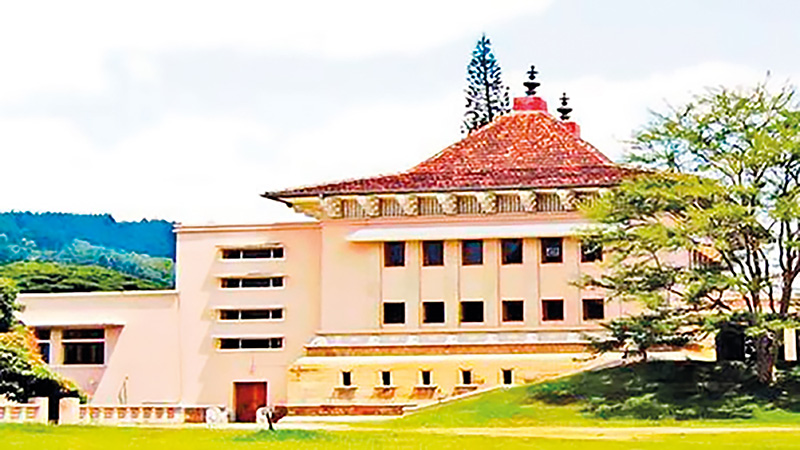
The former Director General notes that the University of Peradeniya itself offers a compelling case study of both the problem and the solution. The main campus, already densely built and ecologically sensitive, continues to absorb new faculties, hostels and administrative buildings, placing immense pressure on green spaces and drainage systems.
“The Peradeniya campus was designed with landscape harmony in mind,” he said. “But over time, ad-hoc construction has compromised that vision. If development continues in the same manner, the campus will lose not only its aesthetic value but also its ecological resilience.”
Professor Wijesundara supports the idea of reorganising the Rajawatte area—located away from the congested core of the university—as a future development zone. Rather than expanding inward and fragmenting remaining open spaces, he argues that Rajawatte can be planned as a well-designed extension, integrating academic, residential and service infrastructure in a controlled manner.
Crucially, he stresses that such reorganisation must go hand in hand with social responsibility, particularly towards minor staff currently living in the Rajawatte area.
“These workers are the backbone of the university. Any development plan must ensure their dignity and wellbeing,” he said. “Providing them with modern, safe and affordable multistoried housing—especially near the railway line close to the old USO premises—would be both humane and practical.”
According to Professor Wijesundara, housing complexes built near existing transport corridors would reduce daily commuting stress, minimise traffic within the campus, and free up valuable land for planned academic use.
More importantly, vertical housing would significantly reduce the university’s physical footprint.
Drawing parallels with Ranawaka’s Gannoruwa proposal, he emphasised that vertical development is no longer optional for Sri Lanka.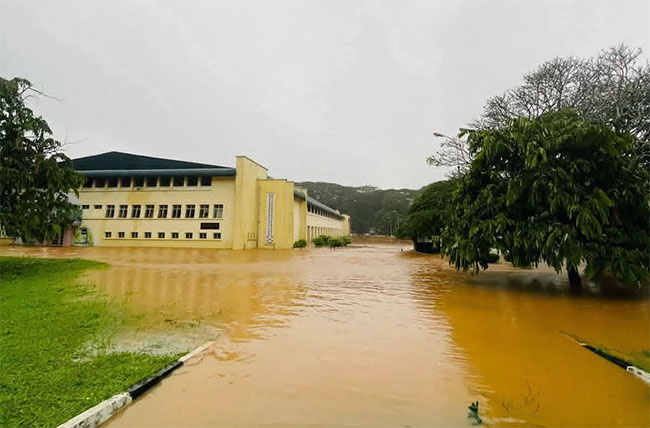
“We are a small island with a growing population and shrinking safe land,” he warned.
“If we continue to spread out instead of building up, disasters will become more frequent and more deadly. Vertical housing, when done properly, is environmentally sound, economically efficient and socially just.”

Peradeniya University flooded
The veteran botanist also highlighted the often-ignored link between disaster vulnerability and the destruction of green buffers.
“Every time we clear a lowland, a wetland or a forest patch for construction, we remove nature’s shock absorbers,” he said.
“The Royal Botanic Gardens has survived floods for over a century precisely because surrounding landscapes once absorbed excess water. Urban planning must learn from such ecological wisdom.”
Professor Wijesundara believes that universities, as centres of knowledge, should lead by example.
“If an institution like Peradeniya cannot demonstrate sustainable planning, how can we expect cities to do so?” he asked. “This is an opportunity to show that development and conservation are not enemies, but partners.”
As climate-induced disasters intensify across the country, voices like his—and proposals such as those articulated by Patali Champika Ranawaka—underscore a simple but urgent truth: Sri Lanka’s future safety depends not only on disaster response, but on how and where we build today.
The challenge now lies with policymakers and planners to move beyond television studio discussions and academic warnings, and translate these ideas into concrete, people-centred action.
By Ifham Nizam ✍️

At the initial stage of my six-year involvement in uplifting society through skill-based initiatives, particularly by promoting handicraft work and teaching students to think creatively and independently, my efforts were partially jeopardized by deep-rooted superstition and resistance to rational learning.
Superstitions exerted a deeply adverse impact by encouraging unquestioned belief, fear, and blind conformity instead of reasoning and evidence-based understanding. In society, superstition often sustains harmful practices, social discrimination, exploitation by self-styled godmen, and resistance to scientific or social reforms, thereby weakening rational decision-making and slowing progress. When such beliefs penetrate the educational environment, students gradually lose the habit of asking “why” and “how,” accepting explanations based on fate, omens, or divine intervention rather than observation and logic.
Initially, learners became hesitant to challenge me despite my wrong interpretation of any law, less capable of evaluating information critically, and more vulnerable to misinformation and pseudoscience. As a result, genuine efforts towards social upliftment were obstructed, and the transformative power of education, which could empower individuals economically and intellectually, was weakened by fear-driven beliefs that stood in direct opposition to progress and rational thought. In many communities, illnesses are still attributed to evil spirits or curses rather than treated as medical conditions. I have witnessed educated people postponing important decisions, marriages, journeys, even hospital admissions, because an astrologer predicted an “inauspicious” time, showing how fear governs rational minds.
While teaching students science and mathematics, I have clearly observed how superstition acts as a hidden barrier to learning, critical thinking, and intellectual confidence. Many students come to the classroom already conditioned to believe that success or failure depends on luck, planetary positions, or divine favour rather than effort, practice, and understanding, which directly contradicts the scientific spirit. I have seen students hesitate to perform experiments or solve numerical problems on certain “inauspicious” days.
In mathematics, some students label themselves as “weak by birth”, which creates fear and anxiety even before attempting a problem, turning a subject of logic into a source of emotional stress. In science classes, explanations based on natural laws sometimes clash with supernatural beliefs, and students struggle to accept evidence because it challenges what they were taught at home or in society. This conflict confuses young minds and prevents them from fully trusting experimentation, data, and proof.
Worse still, superstition nurtures dependency; students wait for miracles instead of practising problem-solving, revision, and conceptual clarity. Over time, this mindset damages curiosity, reduces confidence, and limits innovation, making science and mathematics appear difficult, frightening, or irrelevant. Many science teachers themselves do not sufficiently emphasise the need to question or ignore such irrational beliefs and often remain limited to textbook facts and exam-oriented learning, leaving little space to challenge superstition directly. When teachers avoid discussing superstition, they unintentionally reinforce the idea that scientific reasoning and superstitious beliefs can coexist.
To overcome superstition and effectively impose critical thinking among students, I have inculcated the process to create a classroom culture where questioning was encouraged and fear of being “wrong” was removed. Students were taught how to think, not what to think, by consistently using the scientific method—observation, hypothesis, experimentation, evidence, and conclusion—in both science and mathematics lessons. I have deliberately challenged superstitious beliefs through simple demonstrations and hands-on experiments that allow students to see cause-and-effect relationships for themselves, helping them replace belief with proof.
Many so-called “tantrik shows” that appear supernatural can be clearly explained and exposed through basic scientific principles, making them powerful tools to fight superstition among students. For example, acts where a tantrik places a hand or tongue briefly in fire without injury rely on short contact time, moisture on the skin, or low heat transfer from alcohol-based flames rather than divine power.
“Miracles” like ash or oil repeatedly appearing from hands or idols involve concealment or simple physical and chemical tricks. When these tricks are demonstrated openly in classrooms or science programmes and followed by clear scientific explanations, students quickly realise how easily perception can be deceived and why evidence, experimentation, and critical questioning are far more reliable than blind belief.
Linking concepts to daily life, such as explaining probability to counter ideas of luck, or biology to explain illness instead of supernatural causes, makes rational explanations relatable and convincing.
Another unique example that I faced in my life is presented here. About 10 years ago, when I entered my new house but did not organise traditional rituals that many consider essential for peace and prosperity as my relatives believed that without them prosperity would be blocked. Later on, I could not utilise the entire space of my newly purchased house for earning money, largely because I chose not to perform certain rituals.
While this decision may have limited my financial gains to some extent, I do not consider it a failure in the true sense. I feel deeply satisfied that my son and daughter have received proper education and are now well settled in their employment, which, to me, is a far greater achievement than any ritual-driven expectation of wealth. My belief has always been that a house should not merely be a source of income or superstition-bound anxiety, but a space with social purpose.
Instead of rituals, I strongly feel that the unused portion of my house should be devoted to running tutorials for poor and underprivileged students, where knowledge, critical thinking, and self-reliance can be nurtured. This conviction gives me inner peace and reinforces my faith that education and service to society are more meaningful measures of success than material profit alone.
Though I have succeeded to some extent, this success has not been complete due to the persistent influence of superstition.
by Dr Debapriya Mukherjee
Former Senior Scientist
Central Pollution Control Board, India ✍️

 Australian Prime Minister Anthony Albanese has done very well to speak-up against and outlaw race hate in the immediate aftermath of the recent cold-blooded gunning down of several civilians on Australia’s Bondi Beach. The perpetrators of the violence are believed to be ardent practitioners of religious and race hate and it is commendable that the Australian authorities have lost no time in clearly and unambiguously stating their opposition to the dastardly crimes in question.
The Australian Prime Minister is on record as stating in this connection: ‘ New laws will target those who spread hate, division and radicalization. The Home Affairs Minister will also be given new powers to cancel or refuse visas for those who spread hate and a new taskforce will be set up to ensure the education system prevents, tackles and properly responds to antisemitism.’
It is this promptness and single-mindedness to defeat race hate and other forms of identity-based animosities that are expected of democratic governments in particular world wide. For example, is Sri Lanka’s NPP government willing to follow the Australian example? To put the record straight, no past governments of Sri Lanka initiated concrete measures to stamp out the evil of race hate as well but the present Sri Lankan government which has pledged to end ethnic animosities needs to think and act vastly differently. Democratic and progressive opinion in Sri Lanka is waiting expectantly for the NPP government’ s positive response; ideally based on the Australian precedent to end race hate.
Meanwhile, it is apt to remember that inasmuch as those forces of terrorism that target white communities world wide need to be put down their counterpart forces among extremist whites need to be defeated as well. There could be no double standards on this divisive question of quashing race and religious hate, among democratic governments.
The question is invariably bound up with the matter of expeditiously and swiftly advancing democratic development in divided societies. To the extent to which a body politic is genuinely democratized, to the same degree would identity based animosities be effectively managed and even resolved once and for all. To the extent to which a society is deprived of democratic governance, correctly understood, to the same extent would it experience unmanageable identity-bred violence.
This has been Sri Lanka’s situation and generally it could be stated that it is to the degree to which Sri Lankan citizens are genuinely constitutionally empowered that the issue of race hate in their midst would prove manageable. Accordingly, democratic development is the pressing need.
While the dramatic blood-letting on Bondi Beach ought to have driven home to observers and commentators of world politics that the international community is yet to make any concrete progress in the direction of laying the basis for an end to identity-based extremism, the event should also impress on all concerned quarters that continued failure to address the matters at hand could prove fatal. The fact of the matter is that identity-based extremism is very much alive and well and that it could strike devastatingly at a time and place of its choosing.
It is yet premature for the commentator to agree with US political scientist Samuel P. Huntingdon that a ‘Clash of Civilizations’ is upon the world but events such as the Bondi Beach terror and the continuing abduction of scores of school girls by IS-related outfits, for instance, in Northern Africa are concrete evidence of the continuing pervasive presence of identity-based extremism in the global South.
As a matter of great interest it needs mentioning that the crumbling of the Cold War in the West in the early nineties of the last century and the explosive emergence of identity-based violence world wide around that time essentially impelled Huntingdon to propound the hypothesis that the world was seeing the emergence of a ‘Clash of Civilizations’. Basically, the latter phrase implied that the Cold War was replaced by a West versus militant religious fundamentalism division or polarity world wide. Instead of the USSR and its satellites, the West, led by the US, had to now do battle with religion and race-based militant extremism, particularly ‘Islamic fundamentalist violence’ .
Things, of course, came to a head in this regard when the 9/11 calamity centred in New York occurred. The event seemed to be startling proof that the world was indeed faced with a ‘Clash of Civilizations’ that was not easily resolvable. It was a case of ‘Islamic militant fundamentalism’ facing the great bulwark, so to speak, of ‘ Western Civilization’ epitomized by the US and leaving it almost helpless.
However, it was too early to write off the US’ capability to respond, although it did not do so by the best means. Instead, it replied with military interventions, for example, in Iraq and Afghanistan, which moves have only earned for the religious fundamentalists more and more recruits.
Yet, it is too early to speak in terms of a ‘Clash of Civilizations’. Such a phenomenon could be spoken of if only the entirety of the Islamic world took up arms against the West. Clearly, this is not so because the majority of the adherents of Islam are peaceably inclined and want to coexist harmoniously with the rest of the world.
However, it is not too late for the US to stop religious fundamentalism in its tracks. It, for instance, could implement concrete measures to end the blood-letting in the Middle East. Of the first importance is to end the suffering of the Palestinians by keeping a tight leash on the Israeli Right and by making good its boast of rebuilding the Gaza swiftly.
Besides, the US needs to make it a priority aim to foster democratic development worldwide in collaboration with the rest of the West. Military expenditure and the arms race should be considered of secondary importance and the process of distributing development assistance in the South brought to the forefront of its global development agenda, if there is one.
If the fire-breathing religious demagogue’s influence is to be blunted worldwide, then, it is development, understood to mean equitable growth, that needs to be fostered and consolidated by the democratic world. In other words, the priority ought to be the empowerment of individuals and communities. Nothing short of the latter measures would help in ushering a more peaceful world.

A few showers may occur in the Northern, Eastern and Uva provinces and in Polonnaruwa, Matale and Nuwara-Eliya districts

Sajith warns country is being dragged into authoritarian rule

Wholesale mafia blamed for unusually high vegetable prices

Cyclone-damaged Hakgala Botanical Garden reopened with safety measures

Holiday travellers generate record revenue for expressways

Another casualty from underworld warfare succumbs to his injuries

‘Dates have the highest sugar content to fight Coronavirus’

Sunday Island 27 December – Headlines

#SundayIsland 17th December – Headlines

Sunday Island – 28th March

Sunday Island Headlines – 21 March

Sunday Island – 21st February – Headlines
-

 News4 days ago
Members of Lankan Community in Washington D.C. donates to ‘Rebuilding Sri Lanka’ Flood Relief Fund
-

 News2 days ago
British MP calls on Foreign Secretary to expand sanction package against ‘Sri Lankan war criminals’
-

 Business6 days ago
Browns Investments sells luxury Maldivian resort for USD 57.5 mn.
-

 News5 days ago
Air quality deteriorating in Sri Lanka
-

 News5 days ago
Cardinal urges govt. not to weaken key socio-cultural institutions
-
 Features6 days ago
Hatton Plantations and WNPS PLANT Launch 24 km Riparian Forest Corridor
-
 Features6 days ago
Another Christmas, Another Disaster, Another Recovery Mountain to Climb
-

 Features4 days ago
General education reforms: What about language and ethnicity?