
News
Delhi, Colombo should build on Trincomalee deal with broader strategy’: Lankan envoy


Lankan High Commissioner in India Milinda Moragoda said the two countries should move on from the transactional phase and look at the bigger picture, including integrating Sri Lanka into India’s overall energy security policy India and Sri Lanka should forge a larger strategic framework that builds on the Indian presence in key projects such as the Trincomalee oil tank farm and Colombo port and benefits both countries, Sri Lankan high commissioner Milinda Moragoda has said, according to a report in The Hindustan Times.
Moragoda sought to play down Chinese foreign minister Wang Yi’s recent remarks that no “third party” should interfere in China-Sri Lanka ties by citing the comments of Prime Minister Mahinda Rajapaksa, who said that China is a very close friend of Sri Lanka while India “is our brother and sister”.
Sri Lanka inked a deal with a subsidiary of Indian Oil Corporation (IOC) last week for the long-gestating project to refurbish and develop the British-era Trincomalee oil farm, an 850-acre storage facility with a capacity of almost one million tonnes.
The Hindustan Times report said: State-owned Sri Lanka Ports Authority and Adani Group finalised a deal last year to develop the west container terminal at Colombo port. Dredging work at the terminal is expected to start later this month.
In an “integrated country strategy” document that Moragoda prepared before assuming office in India last year, he suggested that the two sides should evolve from a transactional stage to a strategic, and then a special relationship. He said in an interview on Thursday the time has come for both sides to move on from the transactional phase and look at the bigger picture, including integrating Sri Lanka into India’s overall energy security policy.
“The west terminal [at Colombo port] and the tank farm are two very important transactions, As I see it, the two sides should move seamlessly into the strategic area,” he said, adding he perceived the Trincomalee deal as “integrating Sri Lanka with India in the petroleum, oil and gas sector”.
The two sides should jointly develop a business plan for the Trincomalee tank farm that accounts for projections that India’s energy needs will grow by 50% by 2030 and the need for refining capacity will go up 30%. The two sides can look into joint oil and gas exploration in the Cauvery basin and developing a refining facility at Trincomalee, Moragoda said.
“For us, Trincomalee could potentially be a petroleum hub for India, both for storage and refining. Trincomalee can only service India, it is too far away from sea lanes…We need to think strategically and that’s going to be the next step. Looking at this narrowly as a tank farm transaction would be wrong,” he said.
Oil storage and refining facilities at Trincomalee will also boost Sri Lanka’s energy security. “As India is the world’s third-largest energy consumer, it can get much better deals for petroleum than Sri Lanka. We can work with India on our requirements and it will give us energy security,” he said.
Asked about Chinese foreign minister Wang’s remarks, during a recent visit to Colombo, that no “third party” should interfere in China-Sri Lanka relations, Moragoda said: ” Prime Minister Mahinda Rajapaksa always has a very pithy way of putting things and when he was asked about this, he always said China is a very close friend, but India is our brother and sister.”
He added, “So it’s a different relationship. For us to interpret that comment doesn’t make sense, given the relationship with India.”
Wang’s remarks were widely perceived in New Delhi as a reference to India, especially against the backdrop of India’s opposition to projects under the Belt and Road Initiative in the neighbourhood.
Cooperation on the Trincomalee tank farm, held up since 1987, has been followed by Indian assistance for Sri Lanka to overcome a severe economic crisis, including depleting foreign currency reserves that experts believe can lead to a default on external debt. Following a meeting with Indian envoy Gopal Baglay in Colombo on Thursday, Sri Lanka’s Central Bank governor Ajith Nivard Cabraal tweeted India will provide a SAARC currency swap and other forms of cooperation.
The SAARC currency swap will be for $400 million and India has deferred $500 million due to the Asian Clearing Union for two months. Moragoda said more developments are expected in this regard in the coming weeks.
Sri Lanka expects to get a revolving credit line of $500 million from India’s Exim Bank for buying petrol and diesel and another package for emergency purchases of food and medicines. Steps are being taken to operationalise a line of credit offered by India for counter-terrorism efforts and a grant for a naval floating dock, Moragoda said.
“Sri Lanka is the largest recipient of Indian defence scholarships, and at any time 600 to 700 of our personnel are training in India. We want to increase this and expand it to the police,” he said.
“We’re planning to use the Aadhar card as a template for Sri Lanka’s ID card. Our president is very, very enthusiastic about it. He’s also the minister in-charge of the science and technology sector. Those discussions are ongoing,” he added.

News
It is the government’s objective to create an education system that provides every child with access to modern technological opportunities — Prime Minister


Prime Minister, Dr. Harini Amarasuriya, stated that it is the government’s objective to establish an education system that ensures every child has access to modern technological opportunities.
The Prime Minister made these remarks while attending the opening ceremony of the National Competition of the World Robot Olympiad (WRO), that aims to elevate the technological skills of Sri Lanka’s younger generation to international standards, held on Saturday (28) at Burhani Serendib College in Colombo.
A total of 66 teams from schools across the island participated in this year’s competition, marking a threefold increase compared to last year. The event was held under the theme “Robots Meet Culture,” and over 500 students, presented creations blending local culture with modern engineering concepts.
Expressing her views, the Prime Minister stated:
“In today’s rapidly evolving world, giving priority to the fields of Science, Technology, Engineering, and Mathematics (STEM) should be a national priority.
Platforms such as the World Robot Olympiad provide opportunities for our younger generation to develop essential skills such as logical thinking, innovation, and teamwork”,
Sri Lanka participated in the International Robot Olympiad held in Singapore in 2025, with two teams representing the country, which marked a highly significant and enriching experience for our children.
The Prime Minister further emphasized that the government remains committed to building an education system that enables every child to benefit from such technological opportunities.
The event was attended by the Secretary to the Prime Minister, Pradeep Saputhanthri, officials from the Indian High Commission, government officials, and school students.

(Prime Minister’s Media Division)
Latest News
Heat Index likely to increase up to ‘Caution level’ at some places in the Western, Sabaragamuwa, Southern, Eastern, North-western, Northern and North-central provinces and in Monaragala district

Warm Weather Advisory
Issued by the Natural Hazards Early Warning Centre
Issued at 3.30 p.m. on 29 March 2026, valid for 30 March 2026.
The Heat index, the temperature felt on human body is likely to increase up to ‘Caution level’ at some places in the Western, Sabaragamuwa, Southern, Eastern, North-western, Northern and North-central provinces and in Monaragala district.
The Heat Index Forecast is calculated by using relative humidity and maximum temperature and this is the condition that is felt on your body. This is not the forecast of maximum temperature. It is generated by the Department of Meteorology for the next day period and prepared by using global numerical weather prediction model data.

Effect of the heat index on human body is mentioned in the above table and it is prepared on the advice of the Ministry of Health and Indigenous Medical Services.
ACTION REQUIRED
Job sites: Stay hydrated and takes breaks in the shade as often as possible.
Indoors: Check up on the elderly and the sick.
Vehicles: Never leave children unattended.
Outdoors: Limit strenuous outdoor activities, find shade and stay hydrated.
Dress: Wear lightweight and white or light-colored clothing.
Note:
In addition, please refer to advisories issued by the Disaster Preparedness & Response Division, Ministry of Health in this regard as well. For further clarifications please contact 011-7446491.
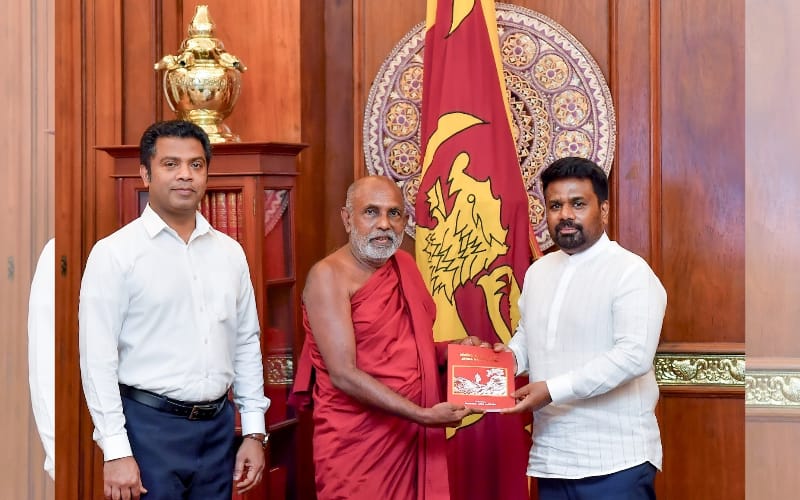
The declaration of the National Namal Uyana as a “National Heritage of Sri Lanka” with the aim of identifying, conserving and bequeathing the country’s national heritage to future generations under the Ministry of Buddhasasana, Religious and Cultural Affairs and the commemoration of the 35th anniversary of its establishment was held under the patronage of President Anura Kumara Dissanayake at the Presidential Secretariat, on Thursday (26).
The National Namal Uyana, spanning 602 hectares within the Palagala Divisional Secretariat Division of the Anuradhapura District, is a unique site of significant national, religious, environmental and geographical value. At the request of its founder, Venerable Wanawasi Rahula Thero and with the intervention of the Ministry of Buddhasasana, Religious and Cultural Affairs, the site was formally declared a National Heritage of Sri Lanka. To mark this occasion, the commemorative plaque was unveiled by the President via virtual technology.
Speaking on the occasion, President Anura Kumara Dissanayake stated that the responsibility of safeguarding this unique environmental heritage and bequeathing it to future generations rests with all.
The President also expressed his sincere appreciation for the dedication shown by Venerable Wanawasi Rahula Thero over the years in protecting and developing the National Namal Uyana.
On the occasion of the 35th anniversary of the National Namal Uyana, the first-day cover issued by the Postal Department of Sri Lanka, along with the ‘National Namal Uyana Shashthreeya Sangrahaya’, was presented to the President by Venerable Wanawasi Rahula Thero.
Delivering a special address on the occasion, Venerable Wanawasi Rahula Thero, founder of the National Namal Uyana, stated that this event would go down in history as one of the most outstanding environmental services undertaken by the present Government.
The thero also expressed his deep appreciation for the President’s decision to hold the programme at the Presidential Secretariat, rather than at the National Namal Uyana premises as originally planned for tomorrow (27), in view of the prevailing situation in the country.
He further highlighted that the people of the country has been widely embraced President Anura Kumara Dissanayake’s vision and commitment for national development and emphasised the need for unity among all citizens in addressing the challenges currently facing the country and for collectively seeking effective solutions.
On this occasion, Venerable Wanawasi Rahula Thero, founder of the National Namal Uyana, also shared further remarks.
On 28 March 1991, I began my work at the National Namal Uyana, a beautiful forested area, dedicating myself with great commitment despite facing a very difficult life. During this time, local monks and members of the public levelled various accusations against me and subjected me to public criticism. Numerous articles were written against me in the press. Yet, I did not waver in my efforts.
However, during the tenure of President Chandrika Kumaratunga, I was fortunate to receive the assistance of Berty Premalal Dissanayake, through whose efforts electricity was made available. Subsequently, I have also received support from all Presidents who have held office after President Kumaratunga. I have not made any personal requests, yet opportunities have consistently been accessible to me, owing to my unwavering commitment to act with integrity.
During your tenure, the roads in the area surrounding the National Namal Uyana have been well developed and I extend my appreciation to all involved in this achievement. I also express my sincere gratitude to Minister Dr. Nalinda Jayathissa and Deputy Minister Gamagedara Dissanayake, who worked with dedication to ensure that the National Namal Uyana was formally declared a National Heritage of Sri Lanka. Similarly, I acknowledge the efforts of officials, including Roshan Gamage, who managed these activities efficiently. I also deeply appreciate the extensive support provided by both electronic and print media in promoting this initiative.
The National Namal Uyana is not my personal property; I have only acted as its guardian. For this reason, I planned for it to be entrusted to the Central Cultural Fund after my tenure and I am confident that this process is being managed effectively. I also envisaged connecting this site with Gangarama and having officials at the level of the Secretary to the President, the Secretary to the Ministry of Wildlife Conservation and the Secretary to the Ministry of Buddhasasana oversee its continued development. Without such measures, the site could have been at risk of deterioration during my absence.
I have done my part for this country. I owe nothing to the nation. My foremost responsibility is to ensure the protection and preservation of this site. As someone born in the nearby village of Anuradhapura District, I am deeply honoured and delighted that, today, this has been officially declared a National Heritage under your auspices.
Additionally, there are two schools and two hospitals in the Palagala Divisional Secretariat Division. On behalf of the local communities, I respectfully request that one of these schools and one of these hospitals be upgraded into fully equipped facilities to better serve the people.
This occasion was attended by a distinguished group of officials, including Minister of Health and Mass Media, Dr Nalinda Jayathissa, Deputy Minister of Buddhasasana, Religious and Cultural Affairs, Gamagedara Dissanayake, Secretary to the President Dr. Nandika Sanath Kumanayake, Secretary to the Ministry of Buddhasasana, Religious and Cultural Affairs, Prince Senadheera, Secretary to the Ministry of Environment, K.R. Uduwawala, Senior Additional Secretary to the President, Roshan Gamage, Director General of Archaeology, E.A. Senerath Wikramasinghe, Director General of the Central Cultural Fund, Dr. Nilan Cooray and Postmaster General S.R.W.M.R.P. Sathkumara among others

It is the government’s objective to create an education system that provides every child with access to modern technological opportunities — Prime Minister

Caf general secretary resigns amid Afcon final fallout

Heat Index likely to increase up to ‘Caution level’ at some places in the Western, Sabaragamuwa, Southern, Eastern, North-western, Northern and North-central provinces and in Monaragala district

National Namal Uyana Declared a ‘National Heritage of Sri Lanka’

Philippine transport strikers say Marcos Jr failing to control oil prices

One ant for $220: the new frontier of wildlife trafficking

‘Dates have the highest sugar content to fight Coronavirus’

Sunday Island 27 December – Headlines

#SundayIsland 17th December – Headlines

Sunday Island – 28th March

Sunday Island Headlines – 21 March

Sunday Island – 21st February – Headlines
-

 News5 days ago
Senior citizens above 70 years to receive March allowances on Thursday (26)
-

 Features2 days ago
A World Order in Crisis: War, Power, and Resistance
-

 Features7 days ago
Trincomalee oil tank farm: An engineering marvel
-

 News3 days ago
Energy Minister indicted on corruption charges ahead of no-faith motion against him
-

 News4 days ago
US dodges question on AKD’s claim SL denied permission for military aircraft to land
-

 Features7 days ago
The scientist who was finally heard
-

 Business4 days ago
Dialog Unveils Dialog Play Mini with Netflix and Apple TV
-

 Sports3 days ago
SLC to hold EGM in April