
Business
Current IMF negotiation process not tailored to address countries in crisis. President

Urges global leaders to make debt restructuring less complex and more effective
Advocates increase in concessional financing through multilateral development banks
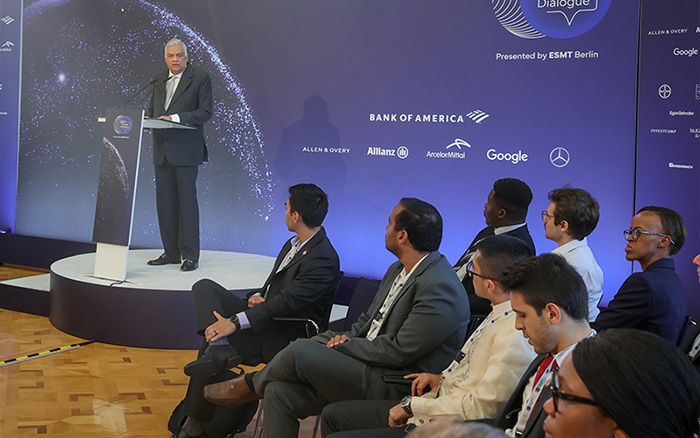
Delivering the opening speech at the Head of State Dialogue at the Berlin Global Conference on September 28, President Ranil Wickremesinghe expressed the need for a comprehensive dialogue between Western nations and China, the United States of America and China and the European Union and China, as a critical component of a robust international plan capable of addressing the global challenges anticipated in 2024.
The President also highlighted that initiatives such as the ‘Belt and Road’ have led to increased scrutiny of countries like Sri Lanka, potentially impacting the economic prospects of nations in the Global South. Nevertheless, he emphasized that Sri Lanka has a history of engaging with countries like the United States, India, and China, making such interactions a familiar and essential part of international relations.
He also expressed gratitude for the support received from India and Bangladesh in addressing Sri Lanka’s recent economic challenges. He underlined the contrast between advanced economies, which possess buffers and reserves to weather these shocks, and developing nations that lack such resources. He emphasized that this disparity was the starting point for the sovereign debt crisis.
The President cautioned that without immediate corrective measures, the world could be on the brink of another crisis. He acknowledged that many developing countries are burdened with substantial debt, highlighting the inadequacy of existing mechanisms like the IMF to address this new situation. He shared Sri Lanka’s experience when declaring bankruptcy, which led to a halt in foreign funding and triggered a political crisis.
President Wickremesinghe praised Germany for its significant contribution to the Green Climate Fund, which has been instrumental in addressing climate change mitigation and debt restructuring challenges. However, he stressed that the current funding available is insufficient to meet the immense challenges.
The President called for utilizing the $100 billion with the IMF as a starting point, emphasizing that it is better than having no funds at all. He noted that the financing needs for climate prosperity and clean energy technology to achieve net-zero emissions are substantial, even for countries facing economic hardships.
He stressed the urgency of global coordination and leadership to resolve these challenges, which have not been sufficient to address their magnitude. He highlighted the need for a new international financial architecture to replace the existing one, designed nearly 80 years ago. The President urged ambitious action to reform the international financial architecture, making debt restructuring less complex and more effective.
He advocated for a significant increase in concessional financing through multilateral development banks, emphasizing the importance of broader accessibility, even for middle-income nations facing economic vulnerabilities. The president pointed out that the current IMF negotiation process is not tailored to address countries in crisis.
He urged for a comprehensive dialogue between Western countries, China, and other key global players. He emphasized that 2024 is the year to act, given the reduced leadership capacity of the United States due to its impending elections.



The Securities and Exchange Commission (SEC) of Sri Lanka is planning to introduce a Code of Ethics or a set of guidelines for the activities of capital market influencers to protect the public from ongoing scams involving the swindling money from potential investors in the share market.
“The market regulator has already identified Blue Ocean Securities Limited and Gladius South Asia as involved in such scams, which are being investigated by the relevant authorities, said Deputy Director General of the SEC Tushara Jayaratne.
The Deputy Director General also said that Gladius was using their their logo in a fraudulent manner to promote their business as well.
He said Blue Ocean has been involved in asking investors to start trading through an app named BOMate Nd. ‘Through this app, you can’t trade shares. But the money transaction goes through this app and the SEC system does not see these transactions, Jayaratne explained.
“The money is going somewhere else, Jayaratne told journalists at a media briefing yesterday held at the SEC auditorium, WTC building, Colombo.
Jayaratne said the SEC has already made complaints to both the Criminal Investigation Department (CID) of the police and the Financial Intelligence Unit (FIU) of the Central Bank.
The Deputy Director General said the second company, Gladius South Asia, has been involved in asking investors not to invest their money in the local stock market, but to do so in the markets in foreign countries.
He also said that the SEC has adopted 12 key capital market development projects to increase the number of capital market investors.
“The Introduction of a Code of Ethics and guidelines for registered investment advisers will help to develop the market in an efficient and effective way, he said.
Jayaratne, however, said that the Sri Lankan share market is not full of scams and that people can have confidence in the market.
“Our market is somewhat free and fair. From the perspective of investors, you also have a responsibility to be careful when investing in the market, he added.
By Hiran H Senewiratne

Norway is providing more than USD 2.4 million to assist those affected by severe flooding in Sri Lanka.
“Norway is contributing emergency assistance to people who have lost both their homes and livelihoods in Sri Lanka. A rapid response is crucial to ensure that those affected have shelter, food, healthcare and support to rebuild their communities,” said Norway’s Minister of International Development, Åsmund Aukrust.
The United Nations estimates that nearly 11 million people have been impacted by catastrophic floods and landslides across large parts of South and Southeast Asia. Sri Lanka, Indonesia, Thailand, Vietnam and Malaysia have experienced record rainfall since 17 November. In total, approximately 1,600 people have lost their lives, and 1.2 million have been forced to leave their homes. Critical infrastructure such as houses and roads has been destroyed, and health risks are increasing due to waterborne diseases and poor sanitation.
“Norway is now contributing NOK 20 million (approx. USD 2 million) to the Red Cross Movement and the UN system in Sri Lanka. These organisations have presence in the country and the capacity to respond quickly based on local needs,” Aukrust said.
Sri Lanka is among the hardest-hit countries. On 28 November, Cyclone Ditwah struck the country, bringing heavy rain and strong winds. The cyclone triggered landslides and caused the most severe floodsing in recent history. The Sri Lankan authorities have led the search and rescue operations and allocated significant resources for immediate relief. “When disasters of this magnitude occur, it is vital that the international community and countries like Norway step up and support local actors in managing the crisis,” Aukrust said.
In addition, the UN Central Emergency Response Fund (CERF) has allocated USD 4.5 million for flood response in Sri Lanka. Around one in ten dollars in the fund comes from Norway.
Norway is also assisting flood-affected communities in Sri Lanka through an immediate response mechanism in the World Food Programme (WFP). The International Labour Organization (ILO) has re-allocated around USD 100,000 in a Norway-funded job generation project, to assist flood-affected participants. Furthermore, Norway has funded a UN expert to help coordinate ongoing relief efforts in the affected areas.

Janashakthi Finance PLC, formerly known as Orient Finance PLC and a subsidiary of JXG (Janashakthi Group), announces the appointment of Sithambaram Sri Ganendran as the Chief Executive Officer.
Sri Ganendran, who has held the position of Chief Operating Officer since September 2024, stepped in as Acting Chief Executive Officer during the past four months.
He brings with him almost 27 years of extensive experience in banking. Throughout his extensive career, he has held senior management roles in multiple local and international banks, where he acquired in-depth knowledge in operations, branch banking (across retail and SME sectors), operational risk, business continuity management, business integration, process reengineering, operational excellence, sales governance and credit card operations. He holds a plethora of qualifications including an MBA from American City University. He is a Fellow of the Chartered Institute of Management Accountants (CIMA) in the United Kingdom, and an Associate Member of the Chartered Institute of Securities and Investments (CISI), and a member of the Association of Professional Bankers of Sri Lanka.
Rajendra Theagarajah, Chairman of Janashakthi Finance PLC, said, “We are delighted to welcome Sithambaram Sri Ganendran to this important leadership role at a pivotal moment in our journey. His wealth of experience, proven track record, and people-focused leadership style make him well suited to strengthen and guide Janashakthi Finance, ensuring efficient continuity in all ongoing operations.”
The appointment of Sri Ganendran as Chief Executive Officer, reinforces Janashakthi Finance’s deep commitment to seamless operations and growth. It also underscores its dedication to vision of delivering trusted financial solutions, while continuously exploring opportunities for innovation and expansion to serve its customers and communities more efficiently.

Flood warning issued to the Mahaweli River Basin

200 km of the 340 km of damaged electric fences in the Polonnaruwa Wildlife Zone Reactivated

Zelensky appeals to EU leaders facing crunch decision on Russia’s frozen cash

Australian PM announces crackdown on hate speech after Bondi shooting

Conway 178* and Latham 137 grind West Indies to dust in Mount Maunganui

Australia have the urn in their sights as England self-destruct again

‘Dates have the highest sugar content to fight Coronavirus’

Sunday Island 27 December – Headlines

#SundayIsland 17th December – Headlines

Sunday Island – 28th March

Sunday Island Headlines – 21 March

Sunday Island – 21st February – Headlines
-

 Features5 days ago
Why Sri Lanka Still Has No Doppler Radar – and Who Should Be Held Accountable
-

 Features7 days ago
Ditwah: A Country Tested, A People United
-

 News15 hours ago
Pakistan hands over 200 tonnes of humanitarian aid to Lanka
-

 News7 days ago
Rs 1. 3 bn yahapalana building deal under investigation
-

 News15 hours ago
Pope fires broadside: ‘The Holy See won’t be a silent bystander to the grave disparities, injustices, and fundamental human rights violations’
-

 Business7 days ago
Fluctuating fortunes for bourse in the wake of selling pressure
-

 Opinion7 days ago
Comfort for some, death for others: The reality of climate change
-

 News7 days ago
Former SAARC SG Esala Weerakoon calls for ‘South Asian Climate Compact’