
News
COVID-19: Financial system stable ‘for now,’ but vulnerabilities rising – IMF

Policymakers’ unprecedented response to the global health crisis has contained risks to the financial system, but a prolonged recession or policy missteps could ignite growing vulnerabilities worldwide, the International Monetary Fund warned on Tuesday.
Agency reports said that the world’s largest multilateral lender said that some banking systems could experience capital shortfalls should the economic downturn in those regions continue, and growing debt burdens in both the private and public sectors could pose future challenges to financial markets.
Given ongoing uncertainty over how quickly the COVID-19 pandemic can be brought under control, the IMF warned that policymakers need to be prepared to continue to provide broad support, and gradually withdraw it only once the pandemic is fully under control.
“As economies reopen, accommodative policies will be essential to ensure that the recovery takes hold and becomes sustainable,” the group wrote in its Global Financial Stability Report ahead of its virtual summit with the World Bank in place of its usual fall in-person gathering.
“Many countries have entered the crisis with elevated preexisting vulnerabilities in some sectors – asset management, nonfinancial firms, and sovereigns – and vulnerabilities are rising,” it added.
Speaking during a press briefing on Tuesday, the report’s authors Tobias Adrian and Fabio Natalucci, director and deputy director respectively of the IMF’s Monetary and Capital Markets Department, warned that the crisis was not yet over, but that the global financial system still has sufficient capital to withstand further adverse shocks.
They said, however, that there is a “weak tail” of banks, particularly in emerging markets, that could struggle. Globally systemically important banks are “generally more stable than the non systemic banks” around the world, while European banks are “somewhat more vulnerable” than North American banks, Adrian added.
The growing role of nonbanks in the financial system poses another risk, as these companies do not face the same strict capital and liquidity requirements as banks, the IMF said.
For example, the IMF warned that asset managers could be forced into “fire sales” if they were to face significant losses in another market downturn. The IMF also flagged growing links between nonbanks and traditional banks, suggesting problems at nonbanks could at some point spread to traditional lenders.
On the corporate front, the IMF said that companies, already burdened with very high levels of debt, could begin to face solvency issues if the recession drags on.
Larger companies able to access capital markets are better positioned to weather a longer downturn, but small and medium-sized companies, particularly in industries directly affected by lockdowns, are more vulnerable.
Once the pandemic is under control, the IMF said global policymakers should focus on rebuilding bank buffers, as well as stricter rules for nonbanks.
Regulators will also need to watch out for the “unintended consequences” of emergency policy measures, Natalucci and Adrian warned during the press briefing, such as financial institutions taking on excessive risk if interest rates remain low or even negative for a long time.



Approval of the Cabinet of Ministers has been granted at their meeting held on 19.05.2025 in order to introduce amendments to the Inland Revenue Act No. 24 of 2017 including the proposed tax revisions to enhance the tax structure paving way for state financial integrity based on revenue.
Accordingly, the revised draft bill has been prepared by the legal draftsman and clearance of the Attorney General has been received.
Therefore, the Cabinet of Ministers has granted approval for
the resolution furnished by the President in his capacity as the Minister of Finance, Policy Planning and Economic Development to publish the aforementioned draft bill in the government gazette notification and subsequently, forward the same to the Parliament for its concurrence.

The National Mineral Policy was prepared for the first time in the year 1999, and the aforementioned policy has been amended in 2023 to cover matters such as preparing an updated data system related to mineral resources, adding value to the export of minerals, encouraging mineral-related industrialists, extracting mineral resources and managing the environment sustainably, and resolving the issues related to the ownership of the land arising in extracting mineral resources.
The revised National Mineral Policy has been reupdated in line with the manifesto “A Sustainable Resource Utilization – Generation of the Highest Benefit” under the policy statement of the current government” A Thriving Nation – A Beautiful Life.”
Accordingly, the Cabinet of Ministers has approved the resolution presented by the Minister of Industries and
Entrepreneurship to implement the so-formulated “National Mineral Policy—2026.”

The Gampaha High Court has sentenced Twelve (12) individuals to death over the 2022 murder of former Polonnaruwa District Member of Parliament Amarakeerthi Athukorala and his security officer.

Heartbreak for Gurbaz and Afghanistan as South Africa win after double Super Over

Amendment of the Inland Revenue Act No. 24 of 2017

Cabinet nod for “National Mineral Policy” – 2026

Twelve sentenced to death by Gampaha High Court
Ten new buses with facilities for people with special needs

Ghosts of 2016 writ large as England, West Indies meet again

‘Dates have the highest sugar content to fight Coronavirus’

Sunday Island 27 December – Headlines

#SundayIsland 17th December – Headlines

Sunday Island – 28th March

Sunday Island Headlines – 21 March

Sunday Island – 21st February – Headlines
-

 Features4 days ago
My experience in turning around the Merchant Bank of Sri Lanka (MBSL) – Episode 3
-

 Business5 days ago
Zone24x7 enters 2026 with strong momentum, reinforcing its role as an enterprise AI and automation partner
-

 Business4 days ago
Remotely conducted Business Forum in Paris attracts reputed French companies
-

 Business4 days ago
Four runs, a thousand dreams: How a small-town school bowled its way into the record books
-

 Business4 days ago
ComBank and Hayleys Mobility redefine sustainable mobility with flexible leasing solutions
-
 Business5 days ago
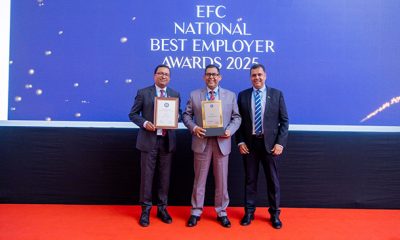
HNB recognized among Top 10 Best Employers of 2025 at the EFC National Best Employer Awards
-

 Editorial7 days ago
All’s not well that ends well?
-

 Business5 days ago
GREAT 2025–2030: Sri Lanka’s Green ambition meets a grid reality check