
News
Country reels under worst weather in living memory


56 confirmed deaths, at least 21 others missing
The country reeled under relentless, countrywide rainfall on Friday as helicopters, Navy boats and thousands of troops fanned out across the country to rescue those marooned by floods, the Disaster Management Centre (DMC) said. Torrential rains drenched the entire 65,000-square-kilometre island, with some regions recording a staggering 360 millimetres in just 24 hours.
Authorities warned that the Kelani River was on the verge of bursting its banks by yesterday evening. Residents living along its path were urged to flee to higher ground as waters continued to surge.
V. S. A. Ratnayake, 56, who had abandoned his flooded home in Kaduwela, as water levels rose rapidly, told the media: “I think this could be the worst flood in our area for three decades. I remember a flood in the 1990s when my house was under seven feet of water.”
The scale of the military response underscored the gravity of the crisis. The Army deployed more than 20,000 troops, while the Navy dispatched boats to evacuate marooned villagers and clear fallen debris choking waterways. Air Force helicopters were also pressed into service, including a dramatic mission in Anuradhapura where a Bell 212 airlifted a man clinging to a coconut tree to escape rising waters. Military footage showed similar rescues taking place across multiple districts.
Of the 56 confirmed deaths, 26 were buried alive in mudslides in the tea-growing Badulla district.
Another 21 people are missing, while 14 remain hospitalised, according to the DMC. Nearly 3,000 homes were damaged and almost 15,000 people have been moved into temporary shelters as floodwaters engulfed communities from the central hills to the northern plains.
In Ruwanwella, a woman, identified only as Akma, issued a desperate plea for help, via the Sirasa TV. Speaking from the second floor of her home, she said the entire ground floor was underwater. “We are six people, including a one-and-a-half-year-old child. If the water rises another five steps up the staircase, we will have nowhere to go,” she said.
Transport Minister Bimal Rathnayake confirmed that 60 stranded Indian tourists were rescued from the central province and brought to Colombo.
The DMC warned that more rain is expected over the weekend, with Cyclone Ditwah forecast to drift northwards toward India’s Tamil Nadu coast by Sunday. Officials fear flooding could surpass levels seen in 2016, when 71 people were killed, nationwide.
Residents along the Kelani River were already witnessing the speed and severity of the deluge. “I sent my children and wife to her sister’s house last night because we expected this,” said M.A. Madushantha, 38, whose home was inundated within hours.
The government moved quickly to limit public exposure, suspending nationwide school examinations for two days and granting civil servants a day off.






A Van Allen Probe spacecraft weighing more than 1,300lb (600kg) is expected to re-enter Earth’s atmosphere almost 14 years after its launch, Nasa says.
The spacecraft is projected to re-enter around 19:45 EDT (23:45 GMT) on Tuesday the US Space Force predicted, according to Nasa, though there is a 24-hour margin of “uncertainty” in the timing.
The Van Allen Probe A, which launched in 2012, is expected mostly to burn up as it travels through the atmosphere, though some components may survive.
The space agency said there is a one in 4,200 chance of being harmed by a piece of the probe, which it characterised as “low” risk.
The spacecraft and its twin, Van Allen Probe B, were on a mission to gather unprecedented data on Earth’s two permanent radiation belts.
It was not immediately clear where in Earth’s atmosphere the satellite is projected to re-enter. The BBC has contacted Nasa for further detail.
Nasa and the US Space Force have said they will monitor the re-entry and update any predictions.
The mission, which was originally designed to last two years, went on for almost seven. It ended after the spacecrafts ran out of fuel and were no longer able to orient themselves toward the Sun.
The probes flew through rings of charged particles trapped by Earth’s magnetic field from 2012 to 2019, in order to study how particles were gained and lost, per Nasa.
Those rings, called the Van Allen belts, shield Earth from cosmic radiation, solar storms and streaming solar wind, which are harmful to humans and can damage technology.
The mission made significant discoveries, including the first data that show the existence of a transient third radiation belt, which can form during times of intense solar activity, Nasa said.
Van Allen Probe B is not expected to re-enter the Earth’s atmosphere before 2030.
[BBC]

Prime Minister Dr. Harini Amarasuriya visited the International Rice Research Institute (IRRI) headquarters in Los Baños, Laguna, Philippines, on 11 March 2026, and held bilateral discussions with Yvonne Pinto, Director General of IRRI, focusing on strengthening cooperation in the field of rice research and sustainable agricultural development.
During the meeting, discussions centered on rice cultivation in Sri Lanka, including the key challenges faced by Sri Lankan paddy farmers. The Prime Minister highlighted issues affecting the sector such as productivity constraints, climate-related impacts, and the need to support farmers through improved agricultural practices and technological innovations.
Both sides also discussed the importance of introducing modern techniques and research-driven approaches to rice cultivation in order to enhance productivity and ensure long-term food security. In this regard, IRRI shared insights on ongoing global research initiatives aimed at improving rice varieties, strengthening climate resilience, and promoting sustainable farming practices.
The discussion further focused on the potential for expanded collaboration between Sri Lanka and IRRI, particularly in areas such as research partnerships, knowledge sharing, and capacity building for Sri Lankan agricultural institutions and farmers. The Prime Minister emphasized Sri Lanka’s interest in strengthening cooperation with IRRI to support the development of the country’s rice sector and to improve the livelihoods of paddy farmers.
The visit reaffirmed the importance of science-based agricultural innovation and international collaboration in addressing food security challenges and enhancing sustainable rice production in Sri Lanka.

(Prime Minister’s Media Division)
Latest News
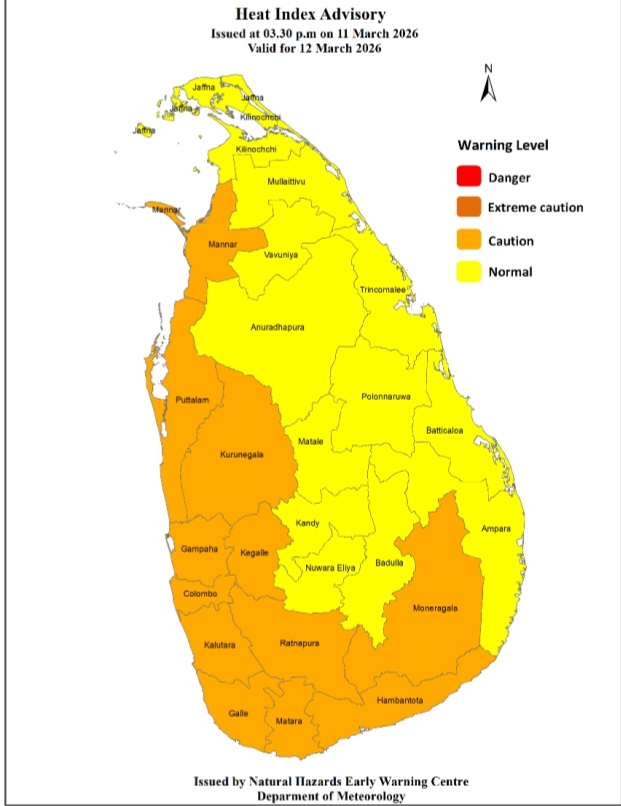
Heat Index at ‘Caution level’ at some places in the Western, Sabaragamuwa, Southern and North-western provinces and in Monaragala and Mannar districts

Warm Weather Advisory
Issued by the Natural Hazards Early Warning Centre of the Department of Meteorology at 3.30 p.m. on 11 March 2026, valid for 12 March 2026.
The public are warned that the Heat index, the temperature felt on human body is likely to increase up to ‘Caution level’ at
some places in the Western, Sabaragamuwa, Southern and North-western provinces and in Monaragala and Mannar districts.
The Heat Index Forecast is calculated by using relative humidity and maximum temperature and this is the condition that is felt on your body. This is not the forecast of maximum temperature. It is generated by the Department of Meteorology for the next day period and prepared by using global numerical weather prediction model data.

Effect of the heat index on human body is mentioned in the above table and it is prepared on the advice of the Ministry of Health and Indigenous Medical Services.
ACTION REQUIRED
Job sites: Stay hydrated and takes breaks in the shade as often as possible.
Indoors: Check up on the elderly and the sick.
Vehicles: Never leave children unattended.
Outdoors: Limit strenuous outdoor activities, find shade and stay hydrated.
Dress: Wear lightweight and white or light-colored clothing.
Note:
In addition, please refer to advisories issued by the Disaster Preparedness & Response Division, Ministry of Health in this regard as well.
For further clarifications please contact 011-744649

Jemimah Rodrigues, Harmanpreet Kaur, Mitchell Starc and Kuldeep Yadav among ESPNcricinfo award winners for 2025

China approves ‘ethnic unity’ law requiring minorities to learn Mandarin

Nasa spacecraft weighing 1,300lb due to re-enter Earth’s atmosphere

Chinese national arrested over attempt to smuggle 2,000 queen ants from Kenya

Attacks reported on three more cargo ships in Gulf, with oil price back near $100

PM Visits the International Rice Research Institute (IRRI)

‘Dates have the highest sugar content to fight Coronavirus’

Sunday Island 27 December – Headlines

#SundayIsland 17th December – Headlines

Sunday Island – 28th March

Sunday Island Headlines – 21 March

Sunday Island – 21st February – Headlines
-

 News7 days ago
University of Wolverhampton confirms Ranil was officially invited
-

 News6 days ago
Peradeniya Uni issues alert over leopards in its premises
-

 News7 days ago
Female lawyer given 12 years RI for preparing forged deeds for Borella land
-

 News4 days ago
Repatriation of Iranian naval personnel Sri Lanka’s call: Washington
-

 News7 days ago
Library crisis hits Pera university
-

 News6 days ago
Wife raises alarm over Sallay’s detention under PTA
-

 News7 days ago
‘IRIS Dena was Indian Navy guest, hit without warning’, Iran warns US of bitter regret
-
 Latest News7 days ago
Sri Lanka evacuates crew of second Iranian vessel after US sunk IRIS Dena