
Opinion
Confusion on NGOs and NSOs in Sri Lanka


If you listen to politicians and journalists here, you will hear of that curious creature rajya novana sanvidane, a Non-State Organization (NSO). Where do you get them? In the uninstructed and dead minds of those who use those terms. In the real world, where politicians and journalists have developed minds, there are Non-Governmental Organizations (NGO). The United Nations is an organization set up by state parties, not by governments. It is true that agents of states, governments, make the United Nations work or fail. Governments may change but not the states, except rarely. When Eritrea broke away from Ethiopia, a new state was formed and was so recognised by the United Nations. However, the LTTE that tried to set up another state was crushed by the established state that it tried to break away from, and the UN had nothing to do with them.
This entirely unnecessary confusion, created out of ignorance, is so destructive that organizations completely loyal to the existing state, are made to be traitorous outfits, for they are ‘non-state organizations’ within the state. There are citizens of each state, but no citizens of any government. Government is but an instrument of the state. In most states there are organizations, neither of the state nor of government: religious organizations including churches. But none of them is beyond the pale of the state.
Those that speak of rajya novana sanvidane give that name partly because they have no idea of the origin of non-governmental organizations. NGOs came into the limelight, as donor agencies, noticed that some governments, in East Africa, in particular, did not have the capacity and the integrity to use the resources that they provided. They construed, about 1970, that NGOs would be a solution to the problem. Little did they realize that some NGOs themselves would become dens of thieves and brigands. I have not seen any evaluation of the performance of NGOs in any country. There was an incomplete essay written by Dr. Susantha Gunatilleka. NGOs are alternatives to the government, not to the state.
Our Constitution emphatically draws a distinction between the government and state, and lays down that the President is both Head of Government and Head of State (Read Article 2 and Article 30 of the Constitution.) It is as head of state that, he/she is the Commander of the Armed Forces, appoints and receives ambassadors and addresses Parliament annually, when a prorogued Parliament, reconvenes. He/she presides over the Cabinet as head of government. The distinction is most clear, in practice, in Britain where Queen Elizabeth is the head of state and Boris Johnson is the Prime Minister and head of government. However, in principle, Johnson is the Queen’s First Minister appointed by the sovereign, and resigns by advising her of his decision to do so.
In the US and in India the term ‘state’ has special significance. In India there is a ‘rajya sabha’ (the Council of States) whose members represent constituent States and Union Territories. Pretty much the same is true of the United States. In the US, executive power is vested in the President and heads the administration, government in our parlance. The Head of State does not come into the Constitution but those functions that one associates with a head of state are in the US performed by the President of the Republic. The US President does not speak of my state (mage rajaya) but of my administration, (mage anduva). Annually, he addresses Congress on the State of the Union. Our present President must be entirely familiar with all this, having lived there as a citizen of the US for over a decade. It is baffling when someone speaks of a past state as a traitor to that same state. It is probable that a government was a traitor to the state. ‘Treason against the United States, shall consist only in levying war against them, or in adhering to their (States’) enemies, giving them aid and comfort’. That a state was a traitor to the same state is gobbledygook.
Apart from probable confusion that we spoke of in the previous paragraph, it is probable that a president and other members of a government, including members of the governing party here, find it grandiloquent to speak of his/her/their state (mage/ape rajaya), rather than my government (mage anduva) or Sirisena anduva’ and not Sirisena state; it was common to talk of ‘ape anduva’ in 1956; politicians in 1956 were far more literate then than they are now.
When translating from another language, make sure that you understand a bit of the history of the concept that you translate. A public school in the US is not the same as a public school in the UK.
MAHADENAMUTTA


I. Background to the Government Proposal
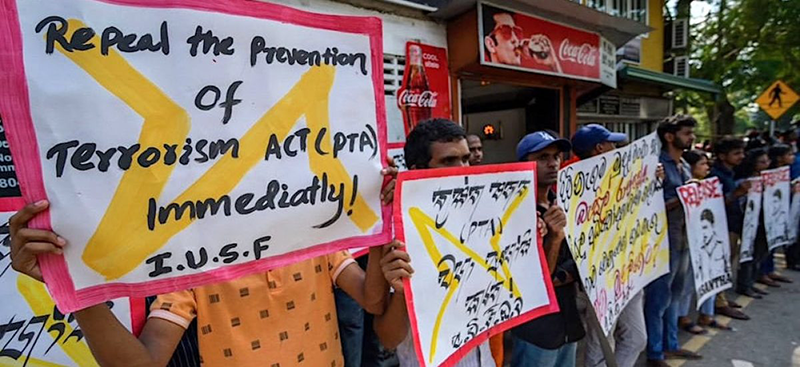
The Prevention of Terrorism (Temporary Provisions) Act, No. 48 of 1979, (PTA), has been vigorously assailed for 45 years as the anchor of a legislative regime which is destructive of basic political and civil rights. It has gained ignominy as an instrument for denial of justice in diverse contexts and also placed in jeopardy, internationally, the prestige of our country as a vibrant democracy. There have been legislative interventions from time to time by Act No. 10 of 1982 and Act No. 22 of 1988.
By 2022, it was clear that the momentum of reform had to be accelerated. As Minister of Foreign Affairs at the time, on 22 March 2022, I introduced in Parliament, and secured the passage of, a series of amendments to the PTA. This was in the form of Act No. 12 of 2022. These amendments had as their principal objective, shortening the maximum period of permissible detention without trial, enhancing judicial oversight of detention, access to legal representation and communication, expediting of trials, liberalizing the law relating to bail, and invocation of the jurisdiction of the Supreme Court in fundamental rights applications.
I made it clear in Parliament that this was only a preliminary step confined to the introduction of urgent amendments to address immediate concerns. The ultimate aim, I informed Parliament, was not ad-hoc modification of the existing law, but the enactment of all-encompassing, fresh legislation. Towards this end, a comprehensive review was underway with participation by the Ministries of Defence, Justice, and Foreign Affairs, and the Attorney General’s Department.
At the 50th session of the Human Rights Council on 13 June 2022, as Foreign Minister of Sri Lanka, I gave a firm assurance in Geneva that, pending this overhaul of the applicable legislation, there would be a de facto moratorium on use of the PTA. Although the Inspector General of Police had issued instructions accordingly at the time, unfortunately, after successive changes of government, this undertaking was not adhered to.
Three attempts have been made by different governments to enact complete legislation on terrorism. These were the Counter-Terrorism Act gazetted in September 2018, and two versions of an Anti-Terrorism Act in March and September 2023. On account of strong public resistance, none of these found their way into the statute book.
The current draft, Protection of the State from Terrorism Act, (PSTA), which has been in the making for almost a year, was published in December 2025. Notwithstanding the high level of expectation which it had generated, regrettably, the draft Bill fails, in fundamental respects, to advance the law towards justice and freedom.
II. Issues of Definition and Scope
One of the main weaknesses of the draft legislation is that it is entirely unsuccessful in addressing the pivotal issue of the legitimate boundaries of an extraordinary system of criminal liability which displaces seminal rights inherent in the Rule of Law. In all democratic cultures, it is recognized that imperatives of security in extreme circumstances call for measures incompatible with guarantees of freedom upheld by the regular law. The lines of demarcation, however, are of overriding importance. From this standpoint, the proposed legislation is a singular disappointment.
Structurally, in its very foundation, it contravenes criteria imposed by international human rights law. This is starkly evident in the approach of the draft Bill to definition of the mental ingredient in terrorism-related offences, one of the critical factors in containing liability within appropriate limits.
International law requires, in this context, a hybrid mental requirement consisting of a dual-layered intention to cause death, serious bodily harm, or taking of hostages but necessarily combined with the calculated intention of bringing about a reign of terror and intimidating the public. Both elements are compulsory requisites of liability for a terrorism-related offence. This fundamental postulate is breached by the proposed legislation which adopts the approach of requiring direct intention or knowledge in respect of the first element [section 3(1)], but regards the second as an oblique inference from a “consequence” such as the death of a person, hurt or hostage taking [section 3(2)]. Dramatic lowering of the threshold of responsibility by this mode of definition strikes at the root of the value system entrenched in international law.
The draft legislation creates no fewer than 13 categories of acts carrying the taint of terrorism. The compelling objection to this extensive catalogue is that it blurs the distinction between ordinary criminal acts and the stringently limited category of acts involving terrorism. The first, and indispensable, requirement of legislation in the latter field is that of clear and unambiguous definition with no scope for elasticity of interpretation. By vivid contrast, the draft law contains a multitude of offences which find their proper place in the Penal Code and other regular legislation, but are by no means necessarily susceptible to the label of terrorism. Egregious examples are serious damage to any place of public use or any public property; the offence of robbery, extortion, or theft; and serious obstruction or damage to, or interference with, any electronic, automated, or computerized system [section 3(2)].
The inclusion of these offences in a counter-terrorism law, given the empirical experience of the past, is no less than an invitation to abuse of the system for collateral purposes, with the distinct prospect of danger to cherished democratic freedoms in such vital areas as communication and assembly. This is especially so, because the types of intention envisaged subsume so vague a purpose as “compelling the government of Sri Lanka or any other government or an international organization to do or to abstain from doing any act” [section 3(1) (c)]. The peril is obvious to entirely legitimate forms of protest and agitation. It must be remembered that the penalty applicable is rigorous imprisonment extending up to 20 years and a fine not exceeding 20 million rupees [section 4(b)].
This clearly threatening feature is aggravated by other characteristics of the draft Bill. Several are worthy of note.
(i) Ancillary offences are framed in such broad terms as to inject a deterrent effect in respect of exercise of individual and group rights enshrined by the Constitution. Section 8(1), according to its marginal note, purports to deal with acts “associated with terrorism”, a vague and catch-all phrase. The text of this provision imposes liability on a person who is “concerned in” the commission of a terrorist offence. “Encouragement of Terrorism”, the title of section 9, is manifestly overbroad. Its ambit, encompassing all forms of “indirect encouragement”, would sweep within its purview, for instance, a large swath of the activity associated with the Aragalaya in 2022, which brought about a change of government.
There is unmistakable exposure for all forms of social activism. Section 10, entitled “Dissemination of Terrorist Publications”, goes so far as to bring within the net of liability for terrorism any person who “provides a service to others that enables them to obtain, read, listen to, or look at a terrorist publication or to acquire it”. The whole range of mainstream and social media is indisputably in jeopardy.
(ii) There are other obnoxious aspects, as well. The draft law makes generous use of the idea of “recklessness”, as in the context of publication of statements and uttering of words (section 9), and in the dissemination of publications (section 10). This is a state of mind alternative to intention; but the concept of “recklessness” is operative within very narrow confines in criminal jurisprudence. This is yet another lever for expansion of liability beyond the class of terrorist offences, properly so designated.
(iii) A feature of the proposed law, open to even more cogent objection, is the extension of this draconian form of liability, carrying condign punishment, to mere omissions. This is the effect of section 15, which makes failure to provide information a terrorist offence. The trend in the modern criminal law is markedly hostile to widening the boundaries of liability to situations in which the accused has only refrained from commission of an act. One of my own mentors, Professor Glanville Williams of Cambridge University, described by Professor Sir Rupert Cross, at the time Vinerian Professor in the University of Oxford, as the greatest criminal lawyer in the United Kingdom since Sir Fitzjames Stephen, has consistently opposed, in principle, the attribution of criminal liability, let alone liability for terrorist offences, to mere omissions. In conjunction with all the other instruments embedded in the draft, this expedient places in the hands of a politically motivated Executive a ready means for indiscriminate application of terrorist sanctions, to the detriment of enjoyment of rights taken for granted in a democratic society.
(iv) Section 3(4), which purports to confer a measure of protection on such activity as protests, advocacy of dissent, or engagement in strikes, by a provision that such activity, by itself, is not to be regarded as a sufficient basis for inference of terrorist intent, has an illusory character. While engendering a sense of comfort, its applicability is negated by parallel provisions which enable imposition of liability, for example, on the ground of alleged intent to bring compulsive pressure to bear on the State [section 3(1)(c)]. Uncertainty created by the conflict between these provisions places at unacceptable risk the ethos of democratic safeguards.
III. Overreach of the Executive Arm for Arrest and Detention
Broadening of categories of terrorist offences beyond legitimate limits presages an imminent danger. This takes the form of authority conferred on the Executive, represented by such officials as the armed forces, the police, and coast guard personnel, to resort to action which erodes the rudiments of liability. The wider the ambit of terrorist offences, the ampler is the power available to these officials to invade the substance of freedom by action to enter the homes of citizens, interrogate persons, seize documents, carry out stop and search operations on public highways, and engage in other forms of harassment. The current draft has no hesitation in conferring these powers in the fullest measure.
(i) Detention Orders
This is one of the features of the PTA of 1979, which attracted trenchant criticism for more than four decades. In terms of section 9(1) of that Act, the Minister of Defence was invested with power to issue detention orders for a maximum period of three months in the first instance, capable of extension for periods not exceeding three months at a time, subject to an aggregate period of detention not exceeding 18 months. Significantly, corresponding provision is contained in the current draft which empowers the Secretary to the Ministry of Defence to issue detention orders [section 29(2)] at the behest of the Inspector General of Police or a Deputy Inspector General of Police authorized by the IGP [section 29(1)].
The only difference is with regard to the period of detention. According to the new draft, the detention order cannot be extended for a period in excess of two months at a time, and the aggregate period is a maximum of one year. Subject to this marginal variation, the perils of the instrument of a detention order continue, unabated.
What is especially disquieting are the grounds specified in the draft for issuance of a detention order. There are four grounds spelt out. Among these is “to facilitate the conduct of the investigation in respect of the suspect” [section 3(a)]. This is wide enough to permit the most flagrant abuse. A provision, so flexibly phrased, allows detention without judicial review. Due process, required by the regular criminal justice system, is supplanted by a regime antithetical at its core to the fundamentals of the Rule of Law.
Our country has had a distressing record of torture and extrajudicial executions in custodial settings. The recurring feature is that these atrocities have typically taken place in non-judicial custody. In the face of this reality and in cynical disregard of sustained protests against this obvious avenue of abuse, the present draft complacently leaves wide open this convenient window. This is done by section 30(1) which accords official sanction to “approved places of detention”. The accumulated harrowing experience of the past has totally escaped attention.
Despite largely cosmetic concessions, the victims of detention orders within the framework of the proposed legislation, no less than under previous statutory regimes, remain substantially at the mercy of the Executive.
The exhortation in section 36 that “Every investigation shall be completed without unnecessary delay” amounts to no more than a pious aspiration, in the absence of a mandatory maximum period stipulated for investigations. Moreover, even when the investigation, potentially open-ended, has been completed and a report submitted to the Magistrate, the Magistrate’s power to discharge the suspect is rigidly curtailed. This is because a judicial order for discharge is possible in terms of section 36(3) only when an allegation against the suspect is not disclosed on the face of the report. There is telling irony in this situation.
The loophole is one through which the Executive is able to drive a coach and six with the greatest ease. Practical experience demonstrates conclusively that, in situations indicative of the most grotesque abuse in the past, the courts were confronted not with the total absence of an allegation, but rather with a clumsy, trumped-up allegation defying credibility. In this, the typical case, the proposed legislation chooses to leave the Magistrate with no jurisdiction to grant urgently needed relief.
The most hazardous provision of all is one which enables a suspect, already in judicial custody, to be transferred to police custody in pursuance of a detention order issued by the Defence Secretary. It is this power, fraught with dire consequences, that the new draft, in section 39(1), seeks to confer. This power can be invoked on the disingenuous pretext that the suspect, prior to being arrested, had committed an offence of which the officer in charge of the relevant police station was unaware. While the desirable direction of movement is obviously from police to judicial custody, movement in the opposite direction is the strange result of this provision. Although interposition of a High Court Judge’s authority is envisaged, the exigencies of a security situation, urged with emphasis by the Executive, may well be difficult to resist in practice.
IV. Other Oppressive Interventions
(a) Restriction Orders
It is quite remarkable that other instruments of oppression which have attracted strenuous condemnation during the entire operation of the PTA, continue substantially intact.
Restriction orders offer an illustrative example. Any police officer of the rank of Deputy Inspector General of Police or above is given authority to make application to a Magistrate’s Court for a restriction order (section 64). The only contrast with the PTA is that, in terms of that regime, the Minister was empowered to make the order directly. In subsequent attempts at reform, this was clearly acknowledged as unacceptable, and in the amending legislation proposed but not enacted in September 2023, the initiative was that of the President and it was the High Court that had jurisdiction to issue the order.In comparison with this, the current proposal is regressive, in that the application is to be made by a police officer, (clearly at the behest of the Executive), and jurisdiction to issue the order is vested in a lower court.
In yet another respect, the present proposal is less satisfactory than the innovation proposed in 2023, in that desirable safeguards embedded in the latter, such as that the order sought should be “necessary” or “proportionate” [section 80(4)], are omitted from the present proposal. In this sense, the current draft is not merely stagnant but regressive, by abjuring salutary approaches to reform.
Restriction orders, without doubt, infringe basic rights corrosively. Their awesome scope contravenes core rights as to communication, association, employment, and travel [section 64(3)]. These erosions remain untouched as to intensity and range, except in respect of duration.While the PTA provided that a restriction order was to be in force for a period not exceeding 3 months, subject to further extensions of 3 months at a time, the maximum aggregate of such extensions being 18 months, the sole concession made by the present proposal is that the validity of a restriction order is limited to 1 month, and the aggregate period cannot exceed 6 months [section 64(9)].
(b) Proscription Orders
In this regard as well, the present proposal takes a step in the wrong direction. Proscription orders are a means by which the President exercises overarching power, simply by notification in the Gazette, to declare organizations illegal, with the consequence of preventing recruitment, meetings, and other activities, transactions in bank accounts, lobbying and canvassing, and publication of material (section 63). The period of application of a proscription order has an arbitrary and capricious quality: it is entirely at the discretion of the President and remains valid until rescinded [section 63(6)].
It is especially noteworthy that the legislative regime at present in force, the PTA, contains no provision whatever for the issuance of proscription orders. This purpose could be accomplished only by having recourse to regulations made under section 27(1) of the Act. Incorporation of this power in the substance of the principal Act itself was proposed in the draft legislation of 2023, which could not be enacted because of vehement resistance. The current proposal, curiously enough, sanctifies as part of the substantive Act, a dangerously fraught procedure which can, as of now, be resorted to only through subordinate legislation. The present draft, then, operates as a travesty rather than a palliative by pushing the law backwards. This hardly amounts to delivery on a promise that underpinned the year-long process which culminated in publication of the current proposal.
(c) Declarations Designating Prohibited Places
The bizarre reality, here again, is that the present proposal, far from expunging excrescences from the current law, actually adds further objectionable provisions which do not exist in the body of terrorist legislation today.
The much-maligned PTA does not include a provision empowering the Executive to declare places as “prohibited places”. This had to be done, if at all, under the aegis of legislation dealing with entirely different subject matter, for example, section 2 of the Official Secrets Act, No. 32 of 1955. Contrary to the professed objective, the new proposal, for the first time, introduces into terrorist legislation the conferment of power on the Defence Secretary to designate “prohibited places”.
The consequences are far-reaching, indeed: entry into a designated place, the taking of photographs and video recordings, and the making of drawings or sketches are all criminalized by the infliction of imprisonment for up to 3 years or a fine not exceeding 3 million rupees [section 66(8)]. This has a particularly chilling effect on journalists and media personnel; and it is the bequest of legislation professedly aspiring to enhance the contours of freedom.
V. Deprivation of Liberty by Insidious Pressure
One of the few positive elements of the new proposal is the deletion of provisions in the PTA dealing with the admissibility of confessions made to a police officer above the rank of an Assistant Superintendent [section 16(1) of the PTA]. Unfortunately, however, this benefit is largely detracted from by other provisions which constitute an onslaught on values intrinsic to the Rule of Law. Pre-eminent among these is the presumption of innocence and the postulate precluding denial of freedom except in full compliance with due process, both substantively and procedurally.
These sacrosanct values receive short shrift in the proposed law, which gives the Attorney-General overwhelming coercive powers in respect of deferment of criminal proceedings on the basis of an iniquitous quid pro quo. The Attorney-General is invested with authority to defer the institution of criminal proceedings for as long a period as 20 years on the footing of a “prior consensual agreement” between the Attorney-General and the suspect, subject to sanction by the High Court [section 56(1)].
It is entirely unrealistic to impute to this “agreement” any element of spontaneity or independent volition. The suspect finds himself under virtually irresistible pressure to acquiesce in any condition proposed, in order to obtain release from the stress and turmoil of a criminal trial potentially entailing the gravest penalties. The situation becomes wholly untenable when the condition takes the form of submission to “a specified programme of rehabilitation”. This is a euphemism for de facto incarceration under thinly-veiled duress without the interposition of a fair trial before a court of law.
VI. Conclusion
Far from making any contribution of value to restoration of balance between security and freedom, the proposed draft has the effect of reversing some of the recent gains of law reform in this field without offering anything significant by way of redeeming features. This is a statutory misadventure which can reflect no credit on the laws of our country.
By Professor G. L. Peiris ✍️
D. Phil. (Oxford), Ph. D. (Sri Lanka);
Former Minister of Justice, Constitutional Affairs and National Integration;
Quondam Visiting Fellow of the Universities of Oxford, Cambridge and London;
Former Vice-Chancellor and Emeritus Professor of Law of the University of Colombo.

I thought of compiling this after reading a leading editorial: “We live in a world of lies, damned lies, and AI hallucinations. A US publication calculated that Donald Trump told 30,573 lies in his first term as President. A lie, they say, travels halfway around the world before the truth gets its boots on. Today, truth might as well stay in bed” (BMJ Editorial, 20th December 2025). Lies—in the form of fake news, videos, messages, and even telephone calls—try to lure us into traps that can cost us our assets, belongings, or even cash, often leaving the perpetrators untraceable. Faiths and religions face similar threats.
Faiths and religions contribute to social harmony by providing shared values and moral frameworks—such as compassion, forgiveness, and justice—and by fostering community through worship, rituals, and charitable work. These practices encourage belonging, trust, and cooperation. Religious leaders often mediate conflicts, promoting dialogue and stability, while diverse traditions enrich culture and cultivate tolerance.
However, these same frameworks are increasingly misused to distort doctrine, promote hatred, incite violence, and even justify killings, sometimes leading to wars of utter destruction. Our moral obligation is to safeguard our faiths—including respecting those who do not follow any faith, as that itself reflects a belief system—by understanding the threats we face, recognising them, and keeping a safe distance, while primarily focusing on deepening our own faith or religion through personal experience.
What Is Faith?
Faith is more than belief—it is trust, confidence, and commitment. Often associated with religion, faith can mean belief in God or in spiritual teachings without proof. It also applies to trust in a person, dedication to an idea, or loyalty to a cause.
=In Islam, faith (Iman) includes belief in God, angels, holy books, messengers, the Last Day, and divine decree.
=In Christianity, faith is confidence in what is hoped for and assurance in what is unseen.
=Outside religion, faith can mean unwavering trust in someone or something, or a commitment to principles, as seen in expressions such as “keep faith” or “break faith.”
Understanding Religion
Religion is a system of beliefs, practices, and ethics that connects people to the spiritual or supernatural. It offers meaning, answers life’s big questions, and guides conduct. Common elements include moral codes, rituals, sacred texts, holy places, and community traditions.
Religions may focus on gods, spiritual concepts, or ethical teachings. Practices such as prayer, meditation, or moral observance help followers navigate life, build community, and explore the mysteries of existence. Major world religions include Christianity, Islam, Hinduism, Buddhism, and Judaism, while countless indigenous and alternative spiritual practices thrive worldwide.
When Faith Is Exploited
Sadly, faith and religion can be misused. Individuals seeking personal gain may manipulate trust and devotion. These include:
=Charlatans: claim false spiritual knowledge.
=Con artistes: promise spiritual rewards in exchange for money.
=Opportunists: exploit religious beliefs for financial, social, or political gain.
=False prophets and spiritual abusers: manipulate followers under the guise of authority.
In everyday terms, they are hypocrites, scammers, or manipulators. Protecting oneself requires discernment and relying on personal experience rather than blind trust.
Safeguarding Our Faith
Maintaining genuine faith can feel like navigating an obstacle course. The wisest approach is to keep faith personal, practise it sincerely, and follow a spiritual path informed by your own experiences. True faith thrives in authenticity, reflection, and mindful practice. In a world of easy exploitation, faith is strongest when quietly lived and genuinely felt.
by Chula Goonasekera ✍️

It is with profound sadness that we received the shocking news of the untimely passing of our dear leader, Mr. Lakshman Balasuriya.
I first met Mr. Balasuriya in 1988 while working at John Keells, which had been awarded an IT contract to computerize Senkadagala Finance. Thereafter, in 1992, I joined the E. W. Balasuriya Group of Companies and Senkadagala Finance when the organization decided to bring its computerization in-house.
Mr. Balasuriya obtained his BSc from the University of London and his MSc from the University of Lancaster. He was not only intellectually brilliant, but also a highly practical and pragmatic individual, often sitting beside me to share instructions and ideas, which I would then translate directly into the software through code.
My first major assignment was to computerize the printing press. At the time, the systems in place were outdated, and modernization was a challenging task. However, with the guidance, strong support, and decisive leadership of Mr. Lakshman Balasuriya, we were able to successfully transform the printing press into a modern, state-of-the-art operation.
Mr. Balasuriya was a farsighted visionary who understood the value and impact of information technology well ahead of his time. He possessed a deep knowledge of the subject, which was rare during those early years. For instance, in the 1990s, he engaged a Canadian consultant to conduct a cybersecurity audit—an extraordinary initiative at a time when cybersecurity was scarcely spoken of and far from mainstream.
During that period, Senkadagala Finance’s head office was based in Kandy, with no branch network. When the decision was made to open the first branch in Colombo, our IT team faced the challenge of adapting the software to support branch operations. It was Mr. Balasuriya who proposed the innovative idea of creating logical branches—a concept well ahead of its time in IT thinking. This simple yet powerful idea enabled the company to expand rapidly, allowing branches to be added seamlessly to the system. Today, after many upgrades and continuous modernization, Senkadagala Finance operates over 400 locations across the country with real-time online connectivity—a testament to his original vision.
In September 2013, we faced a critical challenge with a key system that required the development of an entirely new solution. A proof of concept was prepared and reviewed by Mr. Balasuriya, who gave the green light to proceed. During the development phase, he remained deeply involved, offering ideas, insights, and constructive feedback. Within just four months, the system was successfully developed and went live—another example of his hands-on leadership and unwavering support for innovation.
These are only a few examples among many of the IT initiatives that were encouraged, supported, and championed by Mr. Balasuriya. Information technology has played a pivotal role in the growth and success of the E. W. Balasuriya Group of Companies, including Senkadagala Finance PLC, and much of that credit belongs to his foresight, trust, and leadership.
On a deeply personal note, I was not only a witness to, but also a recipient of, the kindness, humility, and humanity of Mr. Lakshman Balasuriya. There were occasions when I lost my temper and made unreasonable demands, yet he always responded with firmness tempered by gentleness. He never lost his own composure, nor did he ever hold grudges. He had the rare ability to recognize people’s shortcomings and genuinely tried to guide them toward self-improvement.
He was not merely our boss. To many of us, he was like a father and a brother.
I will miss him immensely. His passing has left a void that can never be filled. Of all the people I have known in my life, Mr. Lakshman Balasuriya stands apart as one of the finest human beings.
He leaves his beloved wife, Madam Janine, his children Amanthi and Keshav, and his four grandchildren.
May he rest in eternal peace.
Timothy De Silva
(The writer is the Information Systems Officer at Senkadagala Finance.)

PM lays foundation stone for seven-storey Sadaham Mandiraya

Showers will occur at times in the Eastern and Uva provinces and in Nuwara-Eliya, Matale, Polonnaruwa, and Mullaittivu districts

Curran, bowlers lead Desert Vipers to maiden ILT20 title

PUCSL and Treasury under IMF spotlight as CEB seeks 11.5% power tariff hike

Bellana says Rs 900 mn fraud at NHSL cannot be suppressed by moving CID against him

First harvest of rice offered to Dalada Maligawa

‘Dates have the highest sugar content to fight Coronavirus’

Sunday Island 27 December – Headlines

#SundayIsland 17th December – Headlines

Sunday Island – 28th March

Sunday Island Headlines – 21 March

Sunday Island – 21st February – Headlines
-

 News3 days ago
Health Minister sends letter of demand for one billion rupees in damages
-
 News15 hours ago
Private airline crew member nabbed with contraband gold
-

 Features7 days ago
It’s all over for Maxi Rozairo
-
 News6 days ago
Leading the Nation’s Connectivity Recovery Amid Unprecedented Challenges
-

 Opinion5 days ago
Remembering Douglas Devananda on New Year’s Day 2026
-
 News7 days ago
Dr. Bellana: “I was removed as NHSL Deputy Director for exposing Rs. 900 mn fraud”
-
 News6 days ago
Dons on warpath over alleged undue interference in university governance
-

 Features7 days ago
Rebuilding Sri Lanka Through Inclusive Governance