
Sports
Composed Wanninayake shows promise with century


Rex Clementine in Chelmsford
Chelmsford, the home of English county cricket team Essex, is where outstanding England opening batsmen like Graham Gooch and Sir Alastair Cook came from. An half-hour drive from capital London, the county ground gave us a glimpse of another opening batsman who could go onto make an impact in the game. The difference is this opener doesn’t come from Chelmsford or its nearby cities – Colchester, Southend-on-Sea or Brentwood. He hails from the far off Kurunegala. Asitha Wanninayake is his name.
Opening batting in England is no fun unless you are a Sidath Wettimuny or a Marvan Atapattu, sound technique and solid temperament. The lesser mortals struggle here as the conditions are overcast and the Duke ball swings an awful lot. So Asitha Wanninayake’s effort is no mean one.
Making his debut for Sri Lanka Under-19, Wanninayake came up with a fine effort batting for over seven hours for a superb 132 in which he faced 315 deliveries. The conditions were so overcast that floodlights had to be put on soon after lunch on day two, but that didn’t bother the rookie. He left and defended well and more importantly was patient.
Kaushal Silva is another Sri Lankan opener who had played a pivotal role when the team won a Test series in England. But he wasn’t an overwhelming favourite as his shots were limited. The left-handed Wanninayake however while batting deep cashed in when loose balls were on offer. His 19 boundaries are poof for that.
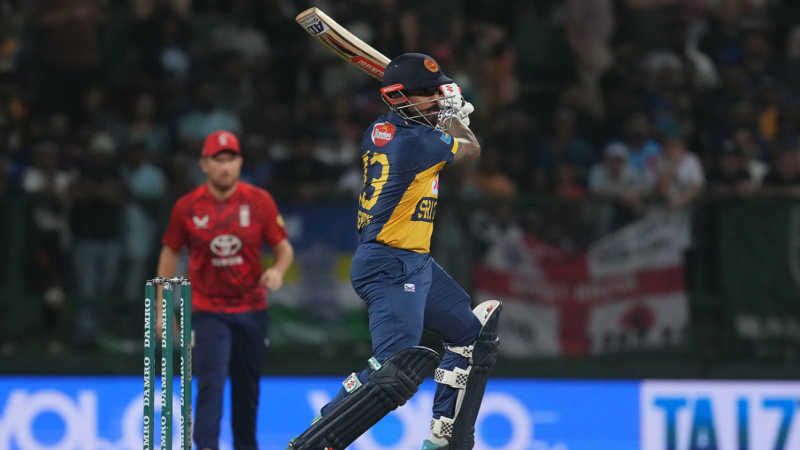
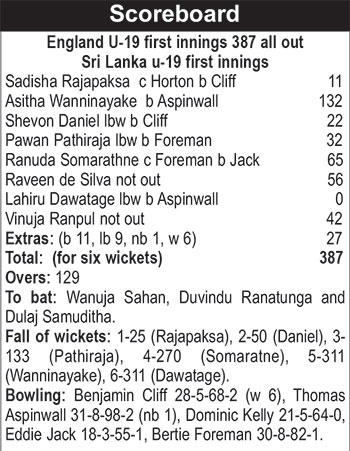 The 143 run stand between Wanninayake and Ranuda Somaratne, an elegant batsman from Trinity College, Kandy, steadied the Sri Lankan innings.
Wanninayake of course is from the rival St. Anthony’s and on a cold English afternoon the Kandy boys were making merry.
Wanninayake was determined to carry on on day three but was dismissed for his overnight score of 132. Lancastrian Thomas Aspinwall cleaned him up with a beauty and stumps were all over the place. In fact, he got two in two balls when wicketkeeper Lahiru Dewatage was trapped leg before wicket for a golden duck.
Sri Lanka lost just those two wickets in the session as captain Raveen de Silva added 78 runs for the fifth wicket with Vinuja Ranpul. The two Nalanda boys, who were part of the history making side that won the Battle of the Maroons after 69 years, ensured the scorers were leveled at lunch.


Englang to bowl first in 2nd T29I at Pallekelke.
Sri Lanka: Pathum Nissanka, Kamil Mishara, Kusal Mendis (wk), Pavan Rathnayake, Charith Asalanka, Janith Liyanage, Dasun Shanaka (capt), Dunith Wellalage, Wanindu Hasaranga, Eshan Malinga, Matheesha Pathirana

Ireland have become the third team to make the cut for the 2026 women’s T20 World Cup from the qualifier in Nepal, joining Bangladesh and Netherlands in the marquee event to be played in England and Wales in June-July. One of Scotland and USA, who are playing the last game of the qualifying competition, will join them at the World Cup to complete the line-up of 12 teams.
Playing Thailand on the last day of the qualifiers, Ireland batted first and scored 121 for 8. Not a massive total, but Thailand had topped the mark only twice before in the tournament. Sunday wasn’t going to be the third time. In fact, Thailand had their worst day out with the bat in the tournament, collapsing for just 59 in 16.1 overs, giving Ireland a 62-run win.
After Gaby Lewis won the toss and batted, the Ireland top three of Amy Hunter (24 in 15 balls), Lewis (25 in 30), and Orla Prendergast (24 in 22) all got starts and Ireland were at a solid 71 by the end of the tenth over. But by the 12th over, all three experienced batters were gone, and Ireland had only two other batters getting into double-digits – Louise Little, who scored 14 in 18 balls from No. 7, and Jane Maguire, who got 15 not out in 12 balls from No. 9.
Legspinner Suleepon Laomi took 4 for 24 for Thailand.
The 121 proved well beyond Thailand on the day. It was a series of single-digit scores for them, broken up only by the wicketkeeper-batter Nannapat Koncharoenkai and captain Naruemol Chaiwai, who scored 15 and 22 respectively and added 26 for the third wicket. There was next to nothing before and after them.
Arlene Kwlly’s medium pace earned her 4 for 7 from four overs, while offspinner Lara McBride took 3 for 6, finishing the game in her fourth over.
(Cricinfo)
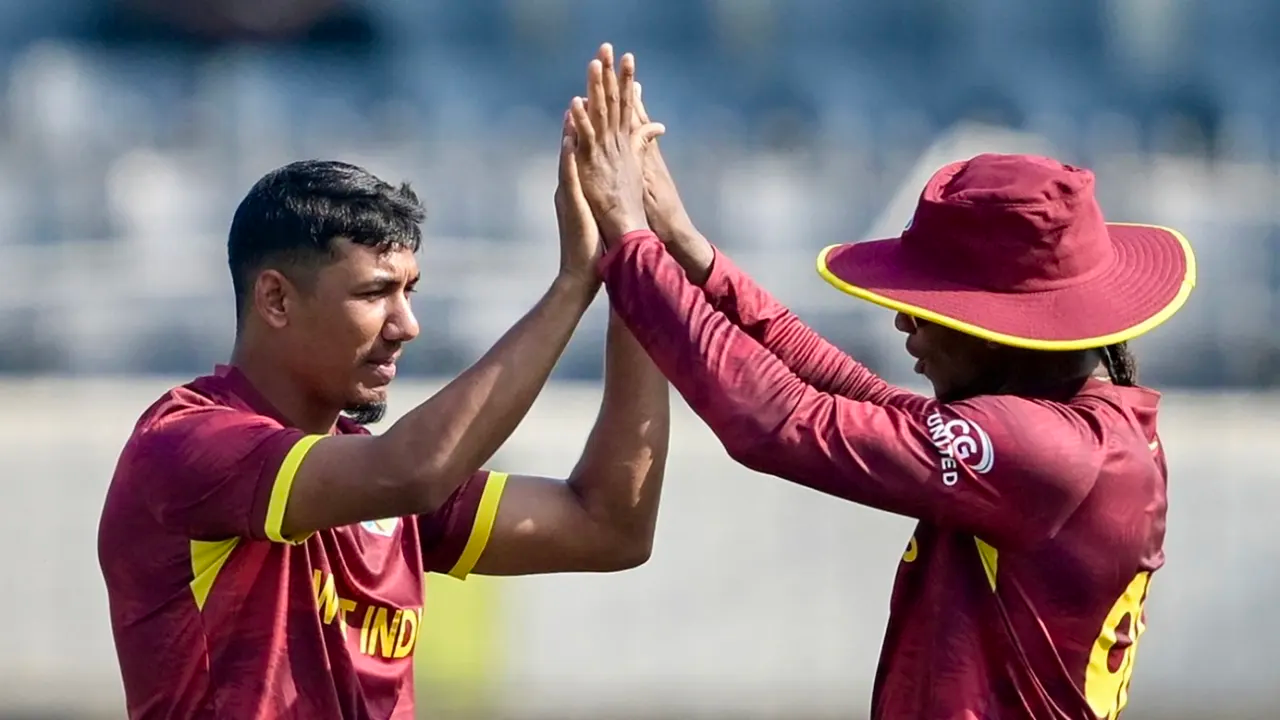
West Indies claimed a consolation win in a match reduced to 10 overs a side at the Wanderers, to hand South Africa defeat in their first T20I in pink. With no ODIs scheduled in South Africa this summer, the annual fixture to raise awareness and funds for breast cancer treatment took place in the shortest format, and was made even shorter after prolonged delays for lightning.
Still, the sell-out crowd got their money’s worth in an entertaining encounter as both teams left everything on the field in their final competitive fixture before next month’s T20 World Cup.
With the series already won, South Africa may not be too unhappy with the outcome, especially as their middle order, untested in game one and two, had a hit out while West Indies’ ability to hold their nerve under pressure will stand them in good stead ahead of a major tournament. They secured a narrow win after two heavy defeats to leave South Africa with something to smile about.
West Indies’ innings started 75 minutes later than the scheduled 6pm start time after lightning strikes were spotted by the pilot in the flyover just before play. The match was reduced to 16 overs a side at that stage and West Indies came out swinging.Shai Hope carved the first ball through the covers for four and Johnson Charles also tried to take it on but Aiden Markram put a short over in place and Charles hit Ngidi straight to him for a three-ball duck.
Hope kept driving but it was Shimron Hetmyer, who arrived at the crease with neither a helmet nor a cap, who turned it on. He sent Ngidi into the stands and onto a spectator’s forehead for six (sidenote: the fan received a medical check-up) and then cleared deep backward square for six more. Hope hit Keshav Maharaj’s opening over for 18 but Markram kept faith in spin and brought himself on in the firth over. Hetmyer cut his first ball for four, then sent him over deep square leg for six and then Hope, off the last ball of the over, pulled Markram into the stands.
Linde delivered a tight second over but West Indies were in a strong position on 66 for 1 after six before the players were forced off again, as more lightning was spotted. Another hour’s delay reduced the match to 10 overs a side, which meant West Indies had just four overs left to bat when play resumed.
Corbin Bosch’s death-bowling was on display early with an over of good length deliveries before Hetmyer and Hope took on Maharaj again. His second over cost 20 but had some success when Hope hit him to Bosch at long-off. Rovman Powell sent Kwena Maphaka’s first and fifth ball for six and then gave Brevis a catch at deep cover before Hetmyer finished off. He ended the innings with his sixth six to finish on 48* off 22 balls. West Indies scored 114 for 3 in 10 overs and South Africa’s target was adjusted up to 125.
Quinton de Kock, fresh off of century at SuperSport Park, got South Africa to a perfect start with 19 runs off the opening over but Markram couldn’t get going in the same way. He top-edged Akeal Hosein straight up and Hosein did well to take the catch as Hetmyer ran in from extra cover and the pair were fortunate to avoid a collision. South Africa sent in Dewald Brevis ahead of Ryan Rickelton at No.3, and it was almost an early mistake. Brevis was dropped on 2 by Romario Shepherd at midwicket – making it West Indies’ third big-name drop in as many games (Markram in match one, Rickelton in match two) – and they would have wondered how costly it would be.
At first, they got rewarded at the other end. De Kock could not clear long-off and was caught on the rope by Powell to give Gudakesh Motie his first wicket of the series. Then, Rickelton and Brevis then combined for a 28-run stand off 11 balls, with two sixes each, but neither could sustain the momentum. Rickelton picked out Holder at long-on to become Motie’s second and Brevis, on 17, got a taste of his own medicine when he fell to a relay catch between Powell and Holder in the same over. South Africa were 63 for 4 after six overs, and needed 62 runs to win off the next four.
Jason Smith, picked as a finisher for the T20 World Cup, made his case with 20 off the first seven balls but did not get any strike in the penultimate over. South Africa needed 27 off 12 balls and Tristan Stubbs reduced that to 15 off the last five balls before he gave Smith strike to try and finish off. Shamar Joseph, in his first appearance in this series, was tasked with the final over. He went yorker length and took out Smith’s middle stump with his third ball, to leave South Africa needing nine runs off two balls. Bosch was dropped off the second last ball of the match when he skied Joseph to Powell at long-on and broke his bat in the process. He also didn’t ground the bat as he ran so South Africa were one-short, had to score eight off one and lost by six runs.
Brief scores:
West Indies 114 for 3 in 10 overs (Shimron Hetmyer 48*, Shai Hope 48, Rovman Powell 13; Lungi Ngindi 1-19, Keshav Maharaj 1-38, Kwena Maphaka 1-12) beat South Africa 118 for 6 in 10 overs (Quinton de Kock 28,Dewald Brevis 17, Ryan Rickelton 15, George Linde 17, Jason Smith 26, Tristan Stubbs 10*; Jason Holder 1-30, Akeal Hosein 1-25, Gudakesh Motie 3-17, Shamar Joseph 1-23) by 6 runs – DLS
[Cricinfo]

England to bowl first in Pallekelle

No child should be deprived of vocational or higher education due to poverty – PM

Ireland thump Thailand to qualify for 2026 women’s T20 World Cup

National Assessment and Policy Review: The impact of social media on children

Public officials must clearly understand public expectations against corruption and fraud – Secretary to the President

West Indies seal consolation win in ten-over shootout

‘Dates have the highest sugar content to fight Coronavirus’

Sunday Island 27 December – Headlines

#SundayIsland 17th December – Headlines

Sunday Island – 28th March

Sunday Island Headlines – 21 March

Sunday Island – 21st February – Headlines
-

 Business7 days ago
ComBank, UnionPay launch SplendorPlus Card for travelers to China
-
 Business4 days ago
Climate risks, poverty, and recovery financing in focus at CEPA policy panel
-
 Opinion3 days ago
Sri Lanka, the Stars,and statesmen
-

 Business2 days ago
Hayleys Mobility ushering in a new era of premium sustainable mobility
-

 Opinion7 days ago
Luck knocks at your door every day
-

 Business2 days ago
Advice Lab unveils new 13,000+ sqft office, marking major expansion in financial services BPO to Australia
-

 Business2 days ago
Arpico NextGen Mattress gains recognition for innovation
-

 Editorial2 days ago
Govt. provoking TUs