
Business
ComBank wins double at ACCA Sustainability Reporting Awards

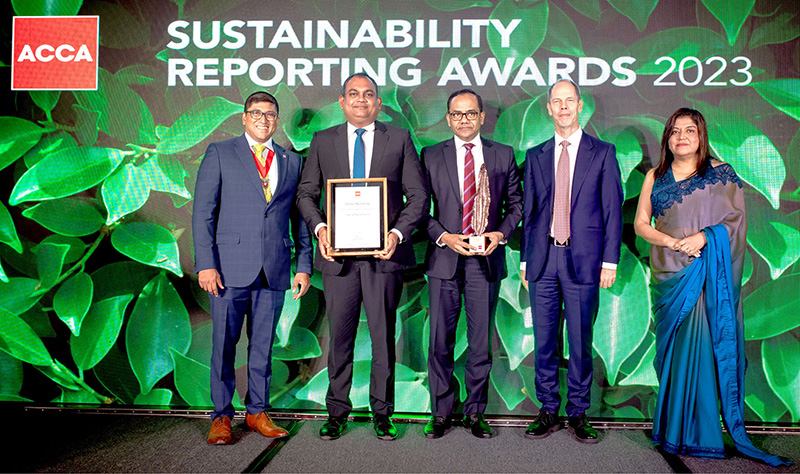
Adjudged overall runner-up and joint winner in Banking sector for 2022 Annual Report
The 2022 Annual Report of the Commercial Bank of Ceylon was adjudged the overall runner-up and joint winner in the Banking category at the Sustainability Reporting Awards presented recently by the Association of Chartered Certified Accountants (ACCA).
Awarding the overall runner-up award to Commercial Bank, the ACCA judges noted that “The bank has submitted an excellent report which covers all material aspects of its business, showing concern for the community at risk in these difficult economic times.”
In their comments on the Bank’s victory in the Banking category, the judges said: “The guiding principles for sustainability are well expressed. 50% of the SME portfolio is devoted to women in the SME sector. There is an excellent sustainability framework which includes UNGC and SDGs. The business model integrates ESG considerations. The contribution to the national health services and to environmental institutions such as in relation to coast conservation are a valuable contribution to national wellbeing. Employees are subject to training in sustainability needs.”
The ACCA Sustainability Reporting Awards recognise Annual Reports that clearly acknowledge and explain the economic, environmental and social impacts of the business to internal and external stakeholders, demonstrating the organisation’s policies, targets and long-term objectives towards the goal of sustainable development.
Commercial Bank’s 2022 Annual Report also won three Golds and a Bronze at CA Sri Lanka’s ‘TAGS’ Awards 2023, excelling in key aspects recognised by the awards programme which is dedicated to Transparency, Accountability, Governance, and Sustainability – TAGS.
The Bank was adjudged the best overall for ‘Corporate Governance Disclosure’ and for Digitally Transformative Reporting’ taking two Golds in the main category awards, and won the Gold for the best annual report in the Banking sector, in addition to taking the Bronze for ‘Overall Excellence in Corporate Reporting.”










Oil prices have surged to their highest level in nearly two weeks amid escalation on multiple fronts of the US-Israel war on Iran.
Brent crude, the global benchmark, rose more than 3 percent on Monday morning to top $116 a barrel.
The latest climb took the global benchmark to its highest point since March 19, when it briefly touched $119 a barrel.
The surge came after Iran said it was prepared for a US ground invasion, with the speaker of the country’s parliament warning that Tehran was waiting for the arrival of US troops to “set them on fire” and “punish” their regional allies.
Tehran’s warning came as the conflict deepened over the weekend, with the Iranian-backed Houthis launching missiles at Israel for the first time in the war, and Israel expanding its invasion of southern Lebanon.
Asia’s main stock indexes fell sharply in morning trading, with Japan’s Nikkei 225 and South Korea’s KOSPI both down more than 4 percent as of 1:30 GMT.
Iran’s effective closure of the Strait of Hormuz in retaliation for the US-Israel war has disrupted about one-fifth of global oil and liquified natural gas (LNG) supplies, plunging the world into its biggest energy crisis in decades.
Oil prices have risen nearly 60 percent since the start of the war, driving up fuel prices worldwide and forcing numerous countries to adopt emergency measures to conserve energy.
Analysts have warned that oil prices are likely to keep rising unless maritime traffic returns to normal levels in the strait.
US President Donald Trump has threatened to “obliterate” Iran’s energy infrastructure if Tehran does not relinquish its stranglehold on the waterway by a deadline of April 6.
Trump, who on Thursday extended his deadline by 10 days, has proposed a 15-point plan for ending the war with Iran and insisted that the two sides are making progress towards a deal in indirect talks being mediated by Pakistan.
Tehran has flatly rejected Trump’s plan and proposed its own terms for a ceasefire, including war reparations and recognition of Iran’s right to control the strait.
Greg Newman, CEO of Onyx Capital Group, which began as an oil derivatives trading house, said energy consumers were only beginning to feel the true fallout of the turmoil.
“Physical oil moves around the world in loading cycles, and Europe has taken around three weeks to really start feeling the effects of the oil shortage,” Newman told Al Jazeera.
“Brent is starting to reflect the reality, and we think it’s a steady rise from here towards $120 and beyond.”
Newman said the scale of the disruption had yet to be fully appreciated.
“No one in the market has ever seen the outages we are now suffering from – physical premiums are the highest ever. There is still a sense that the macro world is not taking this seriously enough, but it is worse than anything that has come before it,” he said.
“The reality will come out in the economic numbers over the coming months.”
While Iran has been allowing a growing number of transits by ships that are not aligned with the US or Israel, traffic remains a fraction of pre-war levels.
On Saturday, Pakistani Minister of Foreign Affairs Ishaq Dar announced that Tehran had agreed to allow 20 Pakistani-flagged vessels to pass the strait in what he described as a “meaningful step toward peace”.
Malaysian Prime Minister Anwar Ibrahim said last week that Iran had granted an unspecified number of Malaysian vessels permission to clear the strait.
Seven non-Iranian vessels passed the strait on Thursday, up from five on Wednesday and four on Tuesday, according to maritime intelligence firm Windward.
Before the start of the war on February 28, the strait saw an average of 120 daily transits, according to Windward.
[Aljazeera]


The era of privatising loss-making state-owned enterprises may be drawing to a close, with SLT-MOBITEL emerging as proof that strategic management can deliver profitability without a change in ownership, Deputy Minister of Digital Economy Eng. Eranga Weeraratne said.
“There was a massive public outcry asking the previous governments to sell the loss-making state-owned enterprises. Now it is not there as it was used to be heard,” Weeraratne said. “SLT-MOBITEL has proven that the proper management strategy can turn any loss-making SOE into profit. Gone are the days we heard ‘sell, sell, sell’.”
The remarks came as Sri Lanka’s national ICT provider reported a decisive financial turnaround in FY 2025, driven by disciplined cost management, operational efficiency, and steady growth across fixed and mobile businesses.
The company has simultaneously rolled out a pioneering 24/7 operational model – the industry’s first – with 14 Outside Plant Maintenance Centres operating round-the-clock in metro areas, Kandy, and Jaffna to ensure uninterrupted connectivity.
“Our strong financial results reflect the resilience of SLT-MOBITEL and the trust customers place in us,” said Dr. Mothilal de Silva, Chairman, SLT Group. “With the roll-out of the 24/7 OPMC operations, we are raising the bar for service reliability.”
SLT-MOBITEL has also made 5G publicly available in Sri Lanka and continues to support the Ministry of Digital Economy with secure data centre infrastructure, reinforcing its role as a catalyst of national development.
By Sanath Nanayakkare

Kia Motors Lanka has launched the all-new Kia Tasman, the brand’s first-ever pickup truck – engineered to redefine the double cab segment by combining rugged capability with SUV-like refinement.
Built on a robust body-on-frame platform, the Tasman offers best-in-class strength with a payload capacity of 1,151kg, towing up to 3,500kg, and water wading up to 800mm. Advanced 4WD systems and terrain modes ensure unmatched off-road performance.
Inside, the cabin surprises with best-in-class rear legroom, sliding and reclining rear seats – a segment-first – and a panoramic display with premium Harman Kardon sound.
Powered by a 2.2-litre diesel engine (210PS, 441Nm), the Tasman is backed by a 5-year or 150,000km warranty.
“This is a vehicle conceived without compromise,” said Kia Motors Lanka Chairman Mahen Thambiah. “For customers who demand durability, capability, and everyday comfort, the Tasman delivers on every front.”

A QR code system to be introduced for agricultural lands and other sectors requiring fuel

Rickelton, Rohit, Shardul break Mumbai’s first-game jinx

Oil tops $116 a barrel as Iran accuses US of preparing invasion

Iranian attack damages Kuwait power and desalination plant, kills worker

Warm weather conditions prevailing over the island are expected to continue

Inquiry into female employee’s complaint: Retired HC Judge’s recommendations ignored

‘Dates have the highest sugar content to fight Coronavirus’

Sunday Island 27 December – Headlines

#SundayIsland 17th December – Headlines

Sunday Island – 28th March

Sunday Island Headlines – 21 March

Sunday Island – 21st February – Headlines
-

 News5 days ago
Senior citizens above 70 years to receive March allowances on Thursday (26)
-

 Features2 days ago
A World Order in Crisis: War, Power, and Resistance
-

 News3 days ago
Energy Minister indicted on corruption charges ahead of no-faith motion against him
-

 News4 days ago
US dodges question on AKD’s claim SL denied permission for military aircraft to land
-

 Business4 days ago
Dialog Unveils Dialog Play Mini with Netflix and Apple TV
-

 Sports3 days ago
SLC to hold EGM in April
-

 News5 days ago
CEB Engineers warn public to be prepared for power cuts after New Year
-
 Business6 days ago
Postponement of Sri Lanka Investment Forum 2026