
Business
ComBank named ‘Most Sustainable Bank in Bangladesh’

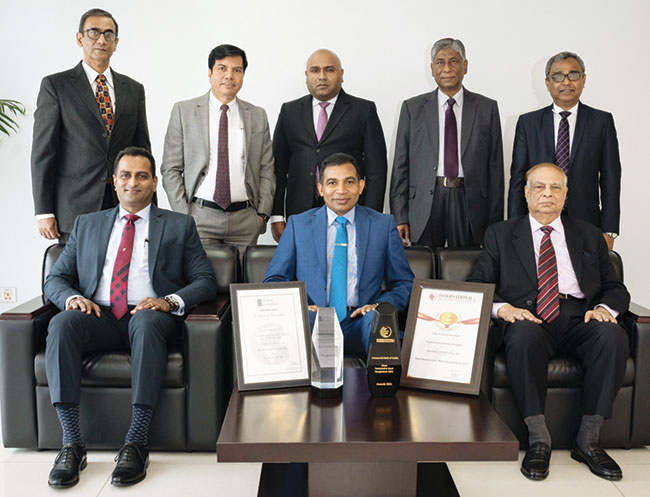
Commercial Bank Bangladesh, Commercial Bank of Ceylon’s largest overseas operation, has been adjudged the ‘Most Sustainable Bank in Bangladesh’ at the close of 2021, during which the Bank was named ‘Best Foreign Bank in Bangladesh’ by two independent bodies and retained its ‘AAA’ credit rating.
The ‘Most Sustainable Bank in Bangladesh’ award was presented at the Dubai-based International Business Magazine Awards 2021 that honoured best-in-class achievements of organisations across various spheres related to international business and finance. The title recognises the sustainable and stable growth that Commercial Bank Bangladesh has demonstrated over the years.
In 2021, Commercial Bank Bangladesh was also recognised with top awards by two UK-based institutions – the Global Business Outlook (GBO) magazine and Global Economics Limited, a financial publication that recognises best performers in various financial sectors, worldwide.
Both these publications crowned Commercial Bank Bangladesh the ‘Best Foreign Bank in Bangladesh’ – a title that acknowledges the Bank’s resilience in the face of competition from local and international banks, its service excellence and dedication towards serving customers.
The Bank’s prowess in 2021 was also underlined by its ‘AAA’ (Triple A) credit rating from Credit Rating Information and Services Ltd (CRISL). This was the 11th consecutive year that Commercial Bank Bangladesh was given a ‘AAA’ long term credit rating, which is the highest credit rating given to a financial institution in Bangladesh by CRISL. The latest rating is the outcome of an in-depth analysis of the operational and financial performance of the Bank along with an assessment of relevant quantitative and qualitative factors.
Commenting on the Bangladesh operation’s achievements in 2021, Commercial Bank Managing Director and Group CEO S. Renganathan said: “Despite the pandemic-caused decline in economic activity and other challenges, Commercial Bank Bangladesh has proven its mettle and stayed on the course charted for itself. The accolades and accreditations the Bank has received are affirmations of its stability, consistency in performance and service delivery. We would like to thank our stakeholders and customers in Bangladesh for their support as we celebrate the close of another successful year.”
Commercial Bank entered Bangladesh in July 2003 with the acquisition of the Bangladesh operations of Credit Agricole Indosuez (CAI), its first ever acquisition of a banking operation. The French multi-national bank operated two branches and two booths in Bangladesh at that time. Over the 18 years that followed, the Commercial Bank of Ceylon Bangladesh operation has established itself above other regional banks operating in the country with 11 branches, six SME Centres and two Offshore Banking Units.
Sri Lanka’s first 100% carbon neutral bank, the first Sri Lankan bank to be listed among the Top 1000 Banks of the World and the only Sri Lankan bank to be so listed for 11 years consecutively, Commercial Bank operates a network of 268 branches and 938 automated machines in Sri Lanka. Commercial Bank is the largest lender to Sri Lanka’s SME sector and is a leader in digital innovation in the country’s Banking sector. Besides Commercial Bank Bangladesh, the Bank’s overseas operations encompass Myanmar, where it has a Microfinance company in Nay Pyi Taw and the Maldives, where the Bank has a fully-fledged Tier I Bank with a majority stake.


During the quarter, macroeconomic conditions reflected selective cost pressures alongside areas of stability, with a moderated net impact on the Group’s performance.
The Sri Lankan Rupee depreciated by 2.4%, driven by higher import-related foreign exchange outflows and cyclone-related economic disruption. This created some pressure on imported inputs, particularly in Consumer Brands and Healthcare, which was partially mitigated through pricing actions, procurement discipline and cost optimisation initiatives.
Monetary conditions tightened, with the Average Weighted Prime Lending Rate (AWPLR) rising by 89 basis points to 8.94%. The impact on the Group was contained due to its strong balance sheet, negative net gearing and disciplined funding strategy, limiting the effect on finance costs.
Inflation remained low at 2.1%, helping to contain operating cost escalation and preserve consumer affordability. In parallel, softer global palm oil and crude oil prices provided relief on input and energy costs, partially offsetting currency pressures.
In December 2025, the IMF approved US$ 206 million in emergency financing to support Sri Lanka’s cyclone recovery. Sovereign credit ratings were maintained during the period, supporting overall macro stability and business confidence.
Impact from Cyclone Ditwah
Cyclone Ditwah, which struck Sri Lanka on 25 November, was one of the most severe natural disasters experienced by the country in recent decades. The cyclone resulted in an estimated US$ 4.1 billion in direct economic damage—approximately 4% of national GDP—impacting homes, agriculture, infrastructure and livelihoods, with nearly two million people affected nationwide.
The Group’s manufacturing and service facilities did not sustain any direct physical damage, reflecting the effectiveness of proactive preparedness measures and robust business continuity frameworks across our operations. However, in the affected areas, the broader business ecosystems were significantly disrupted due to damage to personal assets, commercial premises, inventory losses, and disruptions to public transportation & logistics infrastructure, adversely impacting our employees, distributors and retail partners, including pharmacies.
These factors led to temporary supply-chain and distribution disruption during November and December, alongside a short-term deterioration in consumer sentiment. As a result, demand softness was observed during the latter part of the third quarter, particularly within the Consumer Brands and Healthcare sectors. Demand has since stabilised, with encouraging recovery trends evident, entering the fourth quarter.
In parallel, the Group mobilised a coordinated, multi-sector disaster response, working closely with government authorities, community organisations and local stakeholders. The Group committed approximately Rs. 30 million in financial and in-kind humanitarian assistance, focused on immediate relief for vulnerable communities. In addition, the Group has factored in Rs. 200 million for targeted support to small and medium enterprises across our value chain through extended credit terms, stock replenishment and business restoration initiatives. (Hemas)

The CSE commenced on a positive note yesterday but later the All Share Price Index slumped due to corporate quarterly results not reaching expected levels, market analysts said.
Amid those developments both indices indicated mixed reactions. The All Share Price Index went down by 103.17 points, while the S and P SL20 rose by 2.48 points. Turnover stood at Rs 3.55 billion with seven crossings.
Those crossings were: Tokyo Cement 2.58 million shares crossed to the tune of Rs 268 million; its shares traded at Rs 104, ACL Cables one million shares crossed for Rs 100 million; its shares traded at Rs 100, Cargills Ceylon 75000 shares crossed for Rs 54.7 million; its shares traded at Rs 730, LB Finance 302000 shares crossed for Rs 49.5 million; its shares traded at Rs 164, Tokyo Cement (Non-Voting) 570,000 shares crossed for 49 million and its shares traded at Rs 85.90, Seylan Bank 430,000 shares crossed for Rs 47 million; its shares sold at Rs 109.50 and HNB (Non-Voting) 70600 shares crossed for Rs 28 million; its shares traded at Rs 369.
In the retail market top seven companies that mainly contributed to the turnover were; Cargills Rs 206.6 million (283,000 shares traded), Renuka Agri Rs 153.5 million (9.6 million shares traded), ACL Cables Rs 148 million (1.45 million shares traded), Easter Merchants Rs 140 million (8.11 million shares traded), TJ Lanka Rs 109 million (2.8 million shares traded), Ceylon Land and Equity Rs 106 million (4.9 million shares traded) and Colombo Dockyard Rs 76.6 million (517,000 shares traded). During the day 158 million share volumes changed hands in 34681 transactions.
It is said that construction related companies and manufacturing and financial services related companies performed well. Top negative contributors to the ASPI were Senkadagala Finance (down Rs 68.50 at 837), Cargills (Ceylon) (down Rs 21 at 730), and Dialog Axiata (down 60 cents at Rs 32.70).
Yesterday the rupee was quoted at Rs 309.50/55 to the US dollar in the spot market, from Rs 309.43/50 the previous day, dealers said, while bond yields dropped significantly.
A bond maturing on 15.12.2029 was quoted at 9.45/55 percent.
A bond maturing on 15.03.2031 was quoted at 9.82/87 percent.
A bond maturing on 01.10.2032 was quoted at 10.15/20 percent, down from 10.17/21 percent.
A bond maturing on 01.06.2033 was quoted at 10.45/50 percent, down from 10.50/54 percent.
A bond maturing on 01.11.2033 was quoted at 10.60/62 percent.
A bond maturing on 15.06.2034 was quoted at 10.65/70 percent, down from 10.77/81 percent.
A bond maturing on 15.06.2035 was quoted at 10.72/75 percent, down from 10.95/98 percent.
An auction of Rs. 90,000 million Treasury bills is scheduled to take place today and an auction of Rs 51,000 million Treasury bonds tomorrow.
By Hiran H Senewiratne
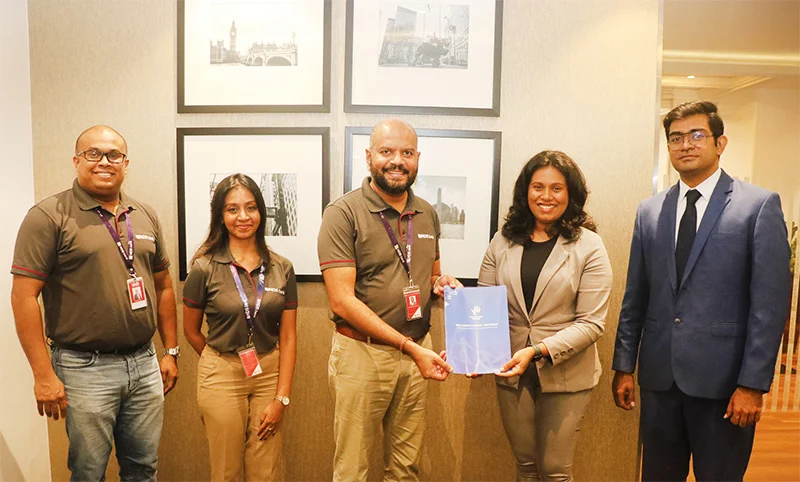
NDB Bank has renewed its membership with the Parenthood Global Association for the second consecutive year, reaffirming its strong commitment to fostering a workplace culture that supports, empowers, and understands the needs of working parents. This renewed partnership underscores NDB’s belief that an inclusive and equitable work environment must make space for the realities and responsibilities of modern parenthood.
The Parenthood Global Association is dedicated to helping organisations build family-friendly workplaces that nurture well-being, productivity, and work-life integration. NDB’s continued affiliation with this prestigious body reflects the Bank’s sustained efforts to enhance the support systems available to employees navigating both professional responsibilities and parental duties.
For NDB, supporting working parents goes beyond policy, it is an extension of the Bank’s human-centric philosophy and its commitment to creating an environment where every employee feels valued and understood. Through this partnership, the Bank continues to strengthen structures that enable parents to thrive, including flexibility initiatives, parental support mechanisms, wellness resources, and awareness-building across the organisation.
These efforts reinforce NDB’s broader Diversity & Inclusion agenda, which seeks to champion equality across all demographics while cultivating a workplace built on empathy, understanding, and opportunity. By renewing its membership with the Parenthood Global Association, NDB reiterates its dedication to ensuring that its employees—especially those juggling multiple roles—have access to the tools, support, and inclusive culture they need to succeed both at work and at home.

Police open fire on speeding van in Jaffna: 17-year-old driver killed

HRCSL employee protests demanding justice, takes swipe at Presidential Secretariat

SL-EU Jt. Commission meeting tomorrow

Sri Lanka’s ranking improves in global corruption index

Hemas posts resilient nine-month results

Shaky middle order a concern for Sri Lanka in World Cup

‘Dates have the highest sugar content to fight Coronavirus’

Sunday Island 27 December – Headlines

#SundayIsland 17th December – Headlines

Sunday Island – 28th March

Sunday Island Headlines – 21 March

Sunday Island – 21st February – Headlines
-

 Features3 days ago
My experience in turning around the Merchant Bank of Sri Lanka (MBSL) – Episode 3
-

 Business4 days ago
Zone24x7 enters 2026 with strong momentum, reinforcing its role as an enterprise AI and automation partner
-
 Business3 days ago
Remotely conducted Business Forum in Paris attracts reputed French companies
-

 Business3 days ago
Four runs, a thousand dreams: How a small-town school bowled its way into the record books
-
 Business3 days ago
ComBank and Hayleys Mobility redefine sustainable mobility with flexible leasing solutions
-
 Business4 days ago
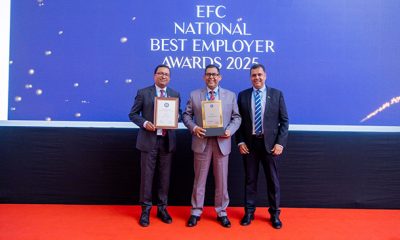
HNB recognized among Top 10 Best Employers of 2025 at the EFC National Best Employer Awards
-

 Editorial6 days ago
All’s not well that ends well?
-

 Business4 days ago
GREAT 2025–2030: Sri Lanka’s Green ambition meets a grid reality check