
News
Colombo Port City Bill frontal attack on working people T.M.R. Rasseedin


General Secretay, Ceylon Federation of Labour (CFL)
The Colombo Port City Bill establishes an all-powerful Colombo Port City Economic Commission (CPCEC) in the newly extended territory of Sri Lanka known as the Port City. The economic policy it seeks to pursue is directed first and foremost to the attraction to Sri Lanka in a major way of big foreign capital. The CPCEC would administer the territory and through exemptions and the power to modify laws would render them nugatory in the Port City. It will in effect be a separate government with its own legal, economic, administrative and political system functioning independently from the rest of the country.
What is worse is that there is provision for the Commission during the first five years, probably extendable if we look at past history, to permit companies operating outside the Port City area to become part of it and enjoy the benefits of the Bill. Laws which are or can be made inapplicable by the Bill or the Commission are those which private Capital, especially foreign, regards as being fetters on their super profit seeking activities. They include laws covering labour, citizenship, banking, exchange control, Inland Revenue Act, the Customs ordinance and the Monetary Law Act all of which can be made inapplicable, modified or provided with exemption by the Commission.
The right of unhindered exploitation of local labour and local resources; the right to take away their proceeds and when there is no more to be got to take away their capital. All this and more to mobilise foreign capital for economic development of Sri Lanka !
The Bill provides for a reduction in environmental safeguards, freedom from taxes, provisions for freehold sale of land to foreigners/foreign companies through a Land Grant by government of the area to the CPCEC, openings for money laundering through lax regulation for offshore companies and banking and for casinos and gaming. It allows loosely defined “businesses of strategic importance” to be identified by CPCEC and given tax and other benefits for 40 years on approval by Cabinet, not Parliament. It also requires all government institutions including courts to give priority to Port City work, hampering day-to-day requirements of our citizens, whose future access to resources will also be impacted by provision of water, electricity and garbage disposal facilities to meet Port City needs.
Policy of Hire and Fire
The Ceylon Federation of Labour (CFL) is particularly perturbed by the attempt being made to exempt such companies from the provisions of the Termination of Employment of Workmen (Special Provisions) Act No.45 of 1971 (TEWA). As the organization that successfully thwarted the attempt of the JR Government of 1978 to deprive workers of the Free Trade Zones of labour law protection through the Greater Colombo Economic Commission Bill, the CFL is alarmed by the attempt of the present government to follow the footsteps of JRJ and deny employees security of employment by singling out the TEWA for exemption. It is worth remembering that of the many protective labour laws operative in Sri Lanka, the TEWA is the singular piece of legislation for whose repeal, employers, the trade chambers and international lending institutions have been persistently agitating.
The TEWA was enacted at the behest of the JCTUO in which the CFL played no mean role by the SLFP-LSSP-CP United Front Government to counter the intentional termination of workmen on the grounds of lack of raw materials and business losses. Under its provisions, no employer was allowed to terminate any workman without (a) the prior consent in writing of the workman or (b) the prior written approval of the Commissioner-General of Labour, except on disciplinary grounds.
The provisions of TEWA taken in its entirety ensured security of service of employee by curtailing the employer’s right to terminate at his/her will and pleasure. The protection it affords against non-disciplinary termination is laudable. The critics of this protective net for workman have tried to make out that this is unique to Sri Lanka. It is not so. In fact the International Labour Organization (ILO) as far back as 1963 adopted Recommendation 119 laying down the basic criteria related to the requirement of a valid reason for terminating the employment of an employee. It suggested periods of notice, income assurance through severance allowance, etc and provided for the right of appeal against termination to bodies empowered to award appropriate relief when termination was not justified and for a certificate of service.
This position was greatly strengthened in 1982 with ILO Convention 158 and Recommendation 166. Today, most countries offer legislative protection against unjustified dismissals, lay-offs and retrenchment in one form or other. In most countries the authorities must be notified in advance of workplace reductions. Several countries require prior approval for dismissals, for whatever reason, by an authority external to the undertaking.
TEWA is essential from the standpoint of workers as it provides some relief in the present environment where employment is vulnerable to market forces and increased external trade through liberalisation of trade and investment. The present employment climate is such that the unilateral discretion of employers to dismiss employees must indeed be subject to neutral review.
This vital piece of labour protective legislation has come under threat in the territory coming under the CPCEC and to companies outside approved by it. Should this Bill be enacted, we will be going back to an era when “hire and fire” ruled employer-employee relationships. Investors appear to enjoy such an environment and the very fact that TEWA is the sole Labour law listed as being amenable to exemptions in Schedule II of the Bill suggests that the move has been made to placate their interests. Thus will begin a pincer movement against the labour laws of the country.
Labour attained its current level through a long march involving immense sacrifices, bitter fights, bloodshed and even loss of life but in actual practice, still remains relatively disadvantaged compared with employers. Meddling with the TEWA in the Port City will only intensify this inequality in employment relationship and should be defeated. The CFL succeeded against the JR regime in 1978 under conditions very different from today as the CFL petitioned the Constitutional Court created by the 1972 first Republican Constitution. Today, the objectives of the authoritarian JR regime are being facilitated by Rajapaksa’s 20th Amendment enabling a tighter grip over the affairs of the people, governance, defence, law and order and justice. In such an environment justice and fair play falls by the wayside.
The CFL calls on the workers of Sri Lanka to prepare for the worst, while struggling for the best. The last say will be with the people although the Government tries to persuade itself that the General Election result is for all time. The centre of politics has shifted from Parliament to the outside very much faster than perhaps anybody expected. This Government has shown itself to be incapable of finding a solution to our problems, but pandering to foreign capital will neither provide a solution nor contribute to enhancing its popularity.

Latest News
PM holds bilateral meetings in the Philippines to strengthen cooperation in Education, Skills Development, and Agricultural Research

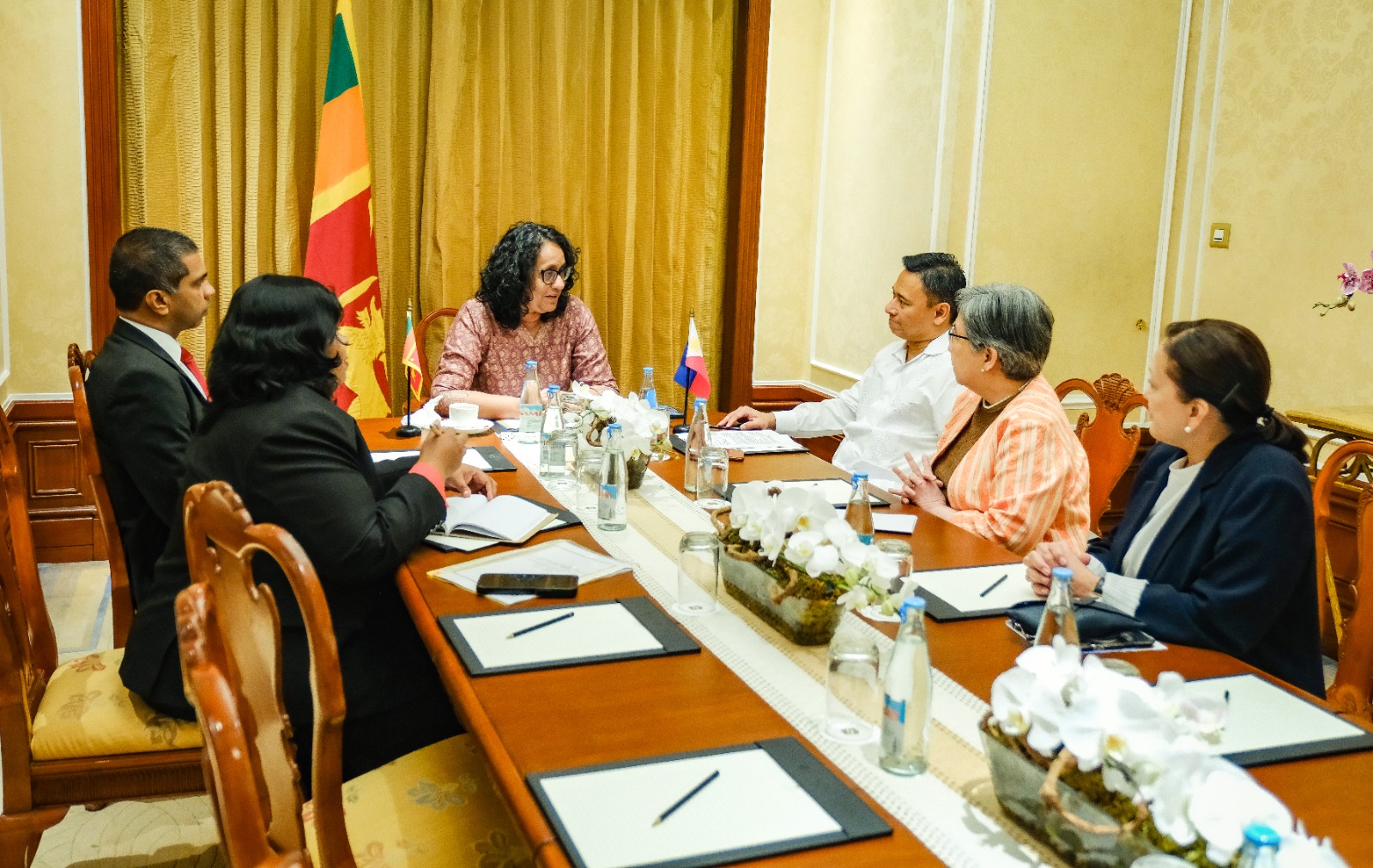
Prime Minister Dr. Harini Amarasuriya held a series of meetings with key Philippine institutions during her official visit to the Philippines from 09–11 March 2026, focusing on strengthening cooperation in education, higher education, technical skills development, and agricultural research.
On 09 March, the Prime Minister met with the Secretary of Education of the Philippines, Sonny Angara. Discussions focused on strengthening bilateral cooperation in the education sector, including sharing best practices in education policy, teacher training, curriculum reforms, and digital learning initiatives. The Prime Minister also briefed the Philippine delegation on Sri Lanka’s ongoing education reforms aimed at modernizing curricula and integrating technology into learning.
The Prime Minister also met with a delegation of the Commission on Higher Education of the Philippines (CHED), led by Chairperson Dr. Shirley C. Agrupis. Discussions centered on the development of higher education in both countries, with particular attention to research collaboration, academic partnerships between universities, student and faculty exchanges, and strengthening quality assurance frameworks.
In a separate meeting, the Prime Minister held talks with the Secretary and Director General of the Technical Education and Skills Development Authority (TESDA), Jose Francisco B. Benitez. The discussions focused on cooperation in technical and vocational education and training (TVET), including knowledge sharing, institutional partnerships, and possible alignment of qualifications frameworks to enhance skills recognition and workforce mobility.
The meetings reaffirmed the commitment of Sri Lanka and the Philippines, along with international research institutions, to strengthen collaboration in education, skills development, and agricultural research in support of sustainable development and human capital growth.
The Sri Lankan delegation included the Ambassador of Sri Lanka to the Philippines, Dr. Chanaka Talpahewa, and Senior Assistant Secretary to the Prime Minister, Ms. P.H. Piyumee Bandara.
[Prime Minister’s Media Division]
Latest News
Heat Index at Caution Level in the Western, Sabaragamuwa and North-western provinces and Monaragala district.

Warm Weather Advisory issued by the Natural Hazards Early Warning Centre of the Department of Meteorology at 3.30 p.m. on 09 March 2026, valid for 10 March 2026.
The public are warned that the Heat index, the temperature felt on the human body is likely to increase up to ‘Caution level’ at some places in Western, Sabaragamuwa and North-western provinces and in Monaragala district.
The Heat Index Forecast is calculated by using relative humidity and maximum temperature and this is the condition that is felt on your body.
This is not the forecast of maximum temperature. It is generated by the Department of Meteorology for the next day period and prepared by using global numerical weather prediction model data.

Effect of the heat index on the human body is mentioned in the above table and it is prepared on the advice of the Ministry of Health and Indigenous Medical Services.
ACTION REQUIRED
Job sites: Stay hydrated and takes breaks in the shade as often as possible.
Indoors: Check up on the elderly and the sick.
Vehicles: Never leave children unattended.
Outdoors: Limit strenuous outdoor activities, find shade and stay hydrated.
Dress: Wear lightweight and white or light-colored clothing.
Note:
In addition, please refer to advisories issued by the Disaster Preparedness & Response Division, Ministry of Health in this regard as well. For further clarifications please contact 011-7446491.

Prof. Priyanga Dunusinghe has warned that Sri Lanka could face a catastrophic situation due to a rapid and sharp drop in revenue caused by the escalating Gulf war.
Appearing on Derana ‘Big Focus’ yesterday, the Professor in Economics in the Department of Economics, and Head – Department of Information Technology, University of Colombo, Dunusinghe said that that drop in remittances from the Middle East, as well as exports, should be examined against the backdrop of runaway oil prices.
Dunusinghe said so responding to interviewer Pasan de Silva who sought expert opinion on the crisis. Referring to continuing Iranian retaliatory attacks on Gulf countries hosting US military bases, the academic pointed out that approximately one million Sri Lankans were employed in the region.
Global oil prices rose to over $100 per barrel on 08 March, for the first time since the Russia-Ukraine war erupted in February 2022. By noon prices were around USD 115 per barrel.
If a consensus couldn’t be reached soon, the consequences for Sri Lanka would be devastating, Dunusinghe said, suggesting that the government should seriously consider, what he called, a relatively small but immediate fuel hike to cushion the impact of future fuel price hikes.
Dunusinghe explained that in addition to the drop in remittances from the Middle East, Sri Lanka could lose employment opportunities in the war devastated region. Responding to the interviewer, the Prof said that if the situation further deteriorated the government would have to face the daunting challenge of evacuating Sri Lankans from the Middle East.
Referring to the devastating impact of Cyclone Ditwah, Dunusinghe pointed out that in terms of the agreement with the IMF, finalised in 2023, the debt repayment would have to be recommenced in 2028. The new Middle East war has placed the country in an extremely difficult situation, Dunusinghe said, while emphasising the responsibility on the part of the government to address the issues at hand immediately.
The rapidly changing oil markets indicated that regardless of optimism expressed by the US and Israel of swift victory, the ground realities were quite different, the academic said.
By Shamindra Ferdinando

Nepal election 2026: Counting continues with rapper Balendra Shah’s party close to super-majority

Madagascar military leader dissolves government in surprise move

ICC Board meetings in Doha called off due to West Asia conflict

Trump says some sanctions to be lifted on oil producers amid Iran war

PM holds bilateral meetings in the Philippines to strengthen cooperation in Education, Skills Development, and Agricultural Research

Heat Index at Caution Level in the Western, Sabaragamuwa and North-western provinces and Monaragala district.

‘Dates have the highest sugar content to fight Coronavirus’

Sunday Island 27 December – Headlines

#SundayIsland 17th December – Headlines

Sunday Island – 28th March

Sunday Island Headlines – 21 March

Sunday Island – 21st February – Headlines
-

 News4 days ago
University of Wolverhampton confirms Ranil was officially invited
-

 News5 days ago
Legal experts decry move to demolish STC dining hall
-

 News4 days ago
Female lawyer given 12 years RI for preparing forged deeds for Borella land
-

 News3 days ago
Peradeniya Uni issues alert over leopards in its premises
-

 Business6 days ago
Cabinet nod for the removal of Cess tax imposed on imported good
-
 News4 days ago
Library crisis hits Pera university
-

 News1 day ago
Repatriation of Iranian naval personnel Sri Lanka’s call: Washington
-

 Business6 days ago
Dialog partners with Ratmalana Audiology Centre for World Hearing Day 2026