
Features
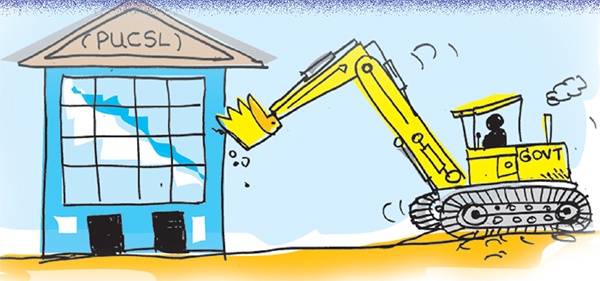
Closure of Public Utilities Commission – Cutting off the nose to spite the face?

by Dr Janaka Ratnasiri
A news item, in The Island of 03.12.2020, described an attempt being made by the Government to close down the Public Utilities Commission of Sri Lanka (PUCSL) and to absorb its technical staff to the Department of National Planning, Ministry of Power and to the Treasury, on a directive of a letter supposedly sent by the President’s Secretary to the Secretary to the Treasury.
BUDGET SPEECH 2021 AND LETTER OF PRESIDENT’S SECRETARY
The letter further says the decision was taken in line with the budget proposal referring to the PUCSL and the Ceylon Electricity Board (CEB) “to create an efficient work environment to implement power generation plans that have remained unimplemented for years”. Though the President’s letter says that this decision was taken, in line with the Budget Speech, what the Budget Speech says is, “I also propose to amend the Public Utilities Commission Act and the Ceylon Electricity Board Act, to allow the rapid implementation of projects”. There is no reference to closing down of the PUCSL in the Budget Speech.
The letter (circulated in social media, and tabled in the Parliament) says that “I am advised to instruct you to take necessary procedural steps to close down and consequent steps to absorb the technical staff to other relevant organizations”. A missing part of this letter is that it does not say who advised the President’s Secretary to send a letter instructing the Treasury’s Secretary to close down the PUCSL. It certainly cannot be the President to make such an unwise, illegal step. Does it mean that the proposal to close down the PUCSL is an initiative of the President’s Secretary or was there a hidden hand behind this move? If that is the case, the President should remove his Secretary rather than closing down the PUCSL.
DELAYS IN IMPLEMENTING POWER PROJECTS
While the Budget Speech wants the PUCSL and the CEB Acts to be amended to implement power projects rapidly, the President’s Secretary says the PUCSL has to be closed down to create an efficient work environment, to implement power generation plans, that have remained unimplemented for years. Both documents are trying to put the blame, for delays in implementing power projects and plans, on the PUCSL. In a country, any decisions taken at the highest level should be evidence-based. Otherwise, the country cannot progress. In this instance, both parties are misled and erred in their decisions.
The writer has published extensively on the status of our power sector, in particular on the role of the CEB in causing all these delays. The reader is referred to The Island of 27th and 28th December 2018, and of 28.03.2019, written on this topic. The CEB took over 10 years to finalize plans to build a 500 MW coal power plant, at Sampur, which eventually had to be aborted, partly because of this delay. Then, it took over four years to finalize, awarding a contract to build a 300 MW gas power plant, at Kerawalapitiya, on BOOT basis. The CEB is solely responsible for these delays and they have nothing to do with the PUCSL. The details of these delays are explained in the above two articles.
REQUIREMENTS TO BE MET BY GENERATION PLANS
The CEB also has to comply with the provisions in the original Sri Lanka Electricity Act No. 20 of 2009, according to which the Minister shall formulate general policy guidelines on generation expansion, taking into consideration the requirements for electricity in Sri Lanka in order to attain national targets for sustainable economic growth, among others. The current policy guidelines, on the Electricity Industry, approved by the Cabinet of Ministers, specifies that 50% of electricity generation has to be met from renewable sources. The National Electricity (Amendment) Act 31 of 2013 indicates that the PUCSL is required to approve the generation plans, prepared regularly by the CEB, before implementing.
The Amended Act also says that any proposals to build a new generation plant shall be based on the Least Cost Long Term Generation Expansion Plan and approved by the PUCSL. The “Least Cost Long-Term Generation Expansion Plan” has been interpreted in the Act as a plan prepared on the basis of least economic cost and meeting the technical and reliability requirements of the electricity network of Sri Lanka which is duly approved by the Commission. Here, the “economic cost” means cost taking into consideration the cost of damage to the environment and human health caused by the generating unit, which are referred to as cost of externalities.
DELAYS IN APPROVING THE CURRENT PLANS
When the generation plan is submitted for approval to the PUCSL, it is therefore necessary for it to verify whether the two above mentioned requirements, which are imposed by the Act, are satisfied. The Plan for 2018-37 submitted to the PUCSL for approval, had two cases, one based mostly on coal power and another a no-coal based case. The Plan had not accounted for cost of externalities. The PUCSL proposed to the CEB that it should consider a low-coal based case as it would reduce the cost of externalities, but the CEB was not willing to revise their Plan. The dispute dragged for nearly a year and the matter was resolved after the (former) President intervened who changed his earlier stance of “no-coal” to “yes-coal” just to accommodate the request of the CEB possibly for fear of action by the CEB Trade Unions.
The CEB’s current Plan for 2020-39 was submitted to the PUCSL, in May 2019, but yet to get approval. The correspondences that were exchanged between the PUCSL and the CEB, on approving the CEB’s Plan, is found in the PUCSL website https://www.pucsl.gov.lk/lcltgep-2020-2039/. The PUCSL has drawn the attention of the CEB, repeatedly, that the submitted Draft Plan does not conform to the Cabinet approved Guidelines with regard to having 50% of generation from renewable sources, and also it does included cost of externalities, which are the requirements of the Act.
The PUCSL sent its observations to the CEB, in October 2019, requesting them to revise it as described above, but the CEB sent a Plan, in March 2020, sans the revisions suggested by the PUCSL. Hence, the PUCSL repeated its request in May 2020, and to date, there is no information as to whether the CEB has responded. In a last weekend weekly paper, the Chairman of CEB was reported as saying that “a number of electricity projects were delayed due to the delay in getting a response from the PUCSL”. Instead of trying to blame the PUCSL for delaying electricity projects, without giving specifics, why doesn’t he pull up his officers for not revising the Plan, as requested by the PUCSL, under the powers vested in it, enabling it to conform with the Act?
Fundamentally, preparing least-cost a long-term generation plan, valid for 20 years, hence based on past prices of power plants and fuel, specifying the type of power plants that need to be installed at different time periods to generate electricity at least cost, is something not sound. This is because no one could say with reasonable accuracy what their prices will be and their availability in the future. What the Plan can forecast is the capacity of power plants to be installed year by year for meeting the future demand for electricity, during the next 20 years. The actual type of plant, and the fuel, should be determined only after calling for bids, keeping the type of plant and fuels open, but specifying the requirements for performance and environmental impacts in detail. Once the bids are evaluated, it will be possible to say which option provides the least cost generation, at the time of installing the plant.
PRESIDENT’S TARGET ON RENEWABLE ENERGY SHARE
It is noted that the renewable share, in total electricity generation, as given in the draft Plan, is only 36% by 2030. The CEB has a long way to go in reaching the President’s target of 70% for this by 2030. It appears that the PUCSL insisting that the CEB conforms to the requirements of the Act and trying to get the CEB to work towards achieving the President’s target, is the crime it has done to have it closed down. It is the responsibility of persons serving as advisors to the President, and the Prime Minister, to place before them the correct information rather than to mislead them. Otherwise, only the country will stand to lose its reputation when such wrong decisions get circulated, internationally, and the country becoming a laughing stock.


A prominent feature of the first year of the NPP government is that it has not engaged in the institutional reforms which was expected of it. This observation comes in the context of the extraordinary mandate with which the government was elected and the high expectations that accompanied its rise to power. When in opposition and in its election manifesto, the JVP and NPP took a prominent role in advocating good governance systems for the country. They insisted on constitutional reform that included the abolition of the executive presidency and the concentration of power it epitomises, the strengthening of independent institutions that overlook key state institutions such as the judiciary, public service and police, and the reform or repeal of repressive laws such as the PTA and the Online Safety Act.
The transformation of a political party that averaged between three to five percent of the popular vote into one that currently forms the government with a two thirds majority in parliament is a testament to the faith that the general population placed in the JVP/ NPP combine. This faith was the outcome of more than three decades of disciplined conduct in the aftermath of the bitter experience of the 1988 to 1990 period of JVP insurrection. The manner in which the handful of JVP parliamentarians engaged in debate with well researched critiques of government policy and actions, and their service in times of disaster such as the tsunami of 2004 won them the trust of the people. This faith was bolstered by the Aragalaya movement which galvanized the citizens against the ruling elites of the past.
In this context, the long delay to repeal the Prevention of Terrorism Act which has earned notoriety for its abuse especially against ethnic and religious minorities, has been a disappointment to those who value human rights. So has been the delay in appointing an Auditor General, so important in ensuring accountability for the money expended by the state. The PTA has a long history of being used without restraint against those deemed to be anti-state which, ironically enough, included the JVP in the period 1988 to 1990. The draft Protection of the State from Terrorism Act (PSTA), published in December 2025, is the latest attempt to repeal and replace the PTA. Unfortunately, the PSTA largely replicates the structure, logic and dangers of previous failed counter terrorism bills, including the Counter Terrorism Act of 2018 and the Anti Terrorism Act proposed in 2023.
Misguided Assumption
Despite its stated commitment to rule of law and fundamental rights, the draft PTSA reproduces many of the core defects of the PTA. In a preliminary statement, the Centre for Policy Alternatives has observed among other things that “if there is a Detention Order made against the person, then in combination, the period of remand and detention can extend up to two years. This means that a person can languish in detention for up to two years without being charged with a crime. Such a long period again raises questions of the power of the State to target individuals, exacerbated by Sri Lanka’s history of long periods of remand and detention, which has contributed to abuse and violence.” Human Rights lawyer Ermiza Tegal has warned against the broad definition of terrorism under the proposed law: “The definition empowers state officials to term acts of dissent and civil disobedience as ‘terrorism’ and will lawfully permit disproportionate and excessive responses.” The legitimate and peaceful protests against abuse of power by the authorities cannot be classified as acts of terror.
The willingness to retain such powers reflects the surmise that the government feels that keeping in place the structures that come from the past is to their benefit, as they can utilise those powers in a crisis. Due to the strict discipline that exists within the JVP/NPP at this time there may be an assumption that those the party appoints will not abuse their trust. However, the country’s experience with draconian laws designed for exceptional circumstances demonstrates that they tend to become tools of routine governance. On the plus side, the government has given two months for public comment which will become meaningful if the inputs from civil society actors are taken into consideration.
Worldwide experience has repeatedly demonstrated that integrity at the level of individual leaders, while necessary, is not sufficient to guarantee good governance over time. This is where the absence of institutional reform becomes significant. The aftermath of Cyclone Ditwah in particular has necessitated massive procurements of emergency relief which have to be disbursed at maximum speed. There are also significant amounts of foreign aid flowing into the country to help it deal with the relief and recovery phase. There are protocols in place that need to be followed and monitored so that a fiasco like the disappearance of tsunami aid in 2004 does not recur. To the government’s credit there are no such allegations at the present time. But precautions need to be in place, and those precautions depend less on trust in individuals than on the strength and independence of oversight institutions.
Inappropriate Appointments
It is in this context that the government’s efforts to appoint its own preferred nominees to the Auditor General’s Department has also come as a disappointment to civil society groups. The unsuitability of the latest presidential nominee has given rise to the surmise that this nomination was a time buying exercise to make an acting appointment. For the fourth time, the Constitutional Council refused to accept the president’s nominee. The term of the three independent civil society members of the Constitutional Council ends in January which would give the government the opportunity to appoint three new members of its choice and get its way in the future.
The failure to appoint a permanent Auditor General has created an institutional vacuum at a critical moment. The Auditor General acts as a watchdog, ensuring effective service delivery promoting integrity in public administration and providing an independent review of the performance and accountability. Transparency International has observed “The sequence of events following the retirement of the previous Auditor General points to a broader political inertia and a governance failure. Despite the clear constitutional importance of the role, the appointment process has remained protracted and opaque, raising serious questions about political will and commitment to accountability.”
It would appear that the government leadership takes the position they have been given the mandate to govern the country which requires implementation by those they have confidence in. This may explain their approach to the appointment (or non-appointment) at this time of the Auditor General. Yet this approach carries risks. Institutions are designed to function beyond the lifespan of any one government and to protect the public interest even when those in power are tempted to act otherwise. The challenge and opportunity for the NPP government is to safeguard independent institutions and enact just laws, so that the promise of system change endures beyond personalities and political cycles.
by Jehan Perera

 A new batch arrived at our Faculty again. Students representing almost all districts of the country remind me once again of the wonderful opportunity we have for promoting social and ethnic cohesion at our universities. Sadly, however, many students do not interact with each other during the first few semesters, not only because they do not speak each other’s language(s), but also because of the fear and distrust that still prevails among communities in our society.
General education reform presents an opportunity to explore ways to promote social and ethnic cohesion. A school curriculum could foster shared values, empathy, and critical thinking, through social studies and civics education, implement inclusive language policies, and raise critical awareness about our collective histories. Yet, the government’s new policy document, Transforming General Education in Sri Lanka 2025, leaves us little to look forward to in this regard.
The policy document points to several “salient” features within it, including: 1) a school credit system to quantify learning; 2) module-based formative and summative assessments to replace end-of-term tests; 3) skills assessment in Grade 9 consisting of a ‘literacy and numeracy test’ and a ‘career interest test’; 4) a comprehensive GPA-based reporting system spanning the various phases of education; 5) blended learning that combines online with classroom teaching; 6) learning units to guide students to select their preferred career pathways; 7) technology modules; 8) innovation labs; and 9) Early Childhood Education (ECE). Notably, social and ethnic cohesion does not appear in this list. Here, I explore how the proposed curriculum reforms align (or do not align) with the NPP’s pledge to inculcate “[s]afety, mutual understanding, trust and rights of all ethnicities and religious groups” (p.127), in their 2024 Election Manifesto.
Language/ethnicity in the present curriculum
The civil war ended over 15 years ago, but our general education system has done little to bring ethnic communities together. In fact, most students still cannot speak in the “second national language” (SNL) and textbooks continue to reinforce negative stereotyping of ethnic minorities, while leaving out crucial elements of our post-independence history.
Although SNL has been a compulsory subject since the 1990s, the hours dedicated to SNL are few, curricula poorly developed, and trained teachers few (Perera, 2025). Perhaps due to unconscious bias and for ideological reasons, SNL is not valued by parents and school communities more broadly. Most students, who enter our Faculty, only have basic reading/writing skills in SNL, apart from the few Muslim and Tamil students who schooled outside the North and the East; they pick up SNL by virtue of their environment, not the school curriculum.
Regardless of ethnic background, most undergraduates seem to be ignorant about crucial aspects of our country’s history of ethnic conflict. The Grade 11 history textbook, which contains the only chapter on the post-independence period, does not mention the civil war or the events that led up to it. While the textbook valourises ‘Sinhala Only’ as an anti-colonial policy (p.11), the material covering the period thereafter fails to mention the anti-Tamil riots, rise of rebel groups, escalation of civil war, and JVP insurrections. The words “Tamil” and “Muslim” appear most frequently in the chapter, ‘National Renaissance,’ which cursorily mentions “Sinhalese-Muslim riots” vis-à-vis the Temperance Movement (p.57). The disenfranchisement of the Malaiyaha Tamils and their history are completely left out.
Given the horrifying experiences of war and exclusion experienced by many of our peoples since independence, and because most students still learn in mono-ethnic schools having little interaction with the ‘Other’, it is not surprising that our undergraduates find it difficult to mix across language and ethnic communities. This environment also creates fertile ground for polarizing discourses that further divide and segregate students once they enter university.
More of the same?
How does Transforming General Education seek to address these problems? The introduction begins on a positive note: “The proposed reforms will create citizens with a critical consciousness who will respect and appreciate the diversity they see around them, along the lines of ethnicity, religion, gender, disability, and other areas of difference” (p.1). Although National Education Goal no. 8 somewhat problematically aims to “Develop a patriotic Sri Lankan citizen fostering national cohesion, national integrity, and national unity while respecting cultural diversity (p. 2), the curriculum reforms aim to embed values of “equity, inclusivity, and social justice” (p. 9) through education. Such buzzwords appear through the introduction, but are not reflected in the reforms.
Learning SNL is promoted under Language and Literacy (Learning Area no. 1) as “a critical means of reconciliation and co-existence”, but the number of hours assigned to SNL are minimal. For instance, at primary level (Grades 1 to 5), only 0.3 to 1 hour is allocated to SNL per week. Meanwhile, at junior secondary level (Grades 6 to 9), out of 35 credits (30 credits across 15 essential subjects that include SNL, history and civics; 3 credits of further learning modules; and 2 credits of transversal skills modules (p. 13, pp.18-19), SNL receives 1 credit (10 hours) per term. Like other essential subjects, SNL is to be assessed through formative and summative assessments within modules. As details of the Grade 9 skills assessment are not provided in the document, it is unclear whether SNL assessments will be included in the ‘Literacy and numeracy test’. At senior secondary level – phase 1 (Grades 10-11 – O/L equivalent), SNL is listed as an elective.
Refreshingly, the policy document does acknowledge the detrimental effects of funding cuts in the humanities and social sciences, and highlights their importance for creating knowledge that could help to “eradicate socioeconomic divisions and inequalities” (p.5-6). It goes on to point to the salience of the Humanities and Social Sciences Education under Learning Area no. 6 (p.12):
“Humanities and Social Sciences education is vital for students to develop as well as critique various forms of identities so that they have an awareness of their role in their immediate communities and nation. Such awareness will allow them to contribute towards the strengthening of democracy and intercommunal dialogue, which is necessary for peace and reconciliation. Furthermore, a strong grounding in the Humanities and Social Sciences will lead to equity and social justice concerning caste, disability, gender, and other features of social stratification.”
Sadly, the seemingly progressive philosophy guiding has not moulded the new curriculum. Subjects that could potentially address social/ethnic cohesion, such as environmental studies, history and civics, are not listed as learning areas at the primary level. History is allocated 20 hours (2 credits) across four years at junior secondary level (Grades 6 to 9), while only 10 hours (1 credit) are allocated to civics. Meanwhile, at the O/L, students will learn 5 compulsory subjects (Mother Tongue, English, Mathematics, Science, and Religion and Value Education), and 2 electives—SNL, history and civics are bunched together with the likes of entrepreneurship here. Unlike the compulsory subjects, which are allocated 140 hours (14 credits or 70 hours each) across two years, those who opt for history or civics as electives would only have 20 hours (2 credits) of learning in each. A further 14 credits per term are for further learning modules, which will allow students to explore their interests before committing to a A/L stream or career path.
With the distribution of credits across a large number of subjects, and the few credits available for SNL, history and civics, social/ethnic cohesion will likely remain on the back burner. It appears to be neglected at primary level, is dealt sparingly at junior secondary level, and relegated to electives in senior years. This means that students will be able to progress through their entire school years, like we did, with very basic competencies in SNL and little understanding of history.
Going forward
Whether the students who experience this curriculum will be able to “resist and respond to hegemonic, divisive forces that pose a threat to social harmony and multicultural coexistence” (p.9) as anticipated in the policy, is questionable. Education policymakers and others must call for more attention to social and ethnic cohesion in the curriculum. However, changes to the curriculum would only be meaningful if accompanied by constitutional reform, abolition of policies, such as the Prevention of Terrorism Act (and its proxies), and other political changes.
For now, our school system remains divided by ethnicity and religion. Research from conflict-ridden societies suggests that lack of intercultural exposure in mono-ethnic schools leads to ignorance, prejudice, and polarized positions on politics and national identity. While such problems must be addressed in broader education reform efforts that also safeguard minority identities, the new curriculum revision presents an opportune moment to move this agenda forward.
(Ramya Kumar is attached to the Department of Community and Family Medicine, Faculty of Medicine, University of Jaffna).
Kuppi is a politics and pedagogy happening on the margins of the lecture hall that parodies, subverts, and simultaneously reaffirms social hierarchies.
by Ramya Kumar

Certain songs become ever-present every December, and with Christmas just two days away, I thought of highlighting the Top 10 Most Popular Festive Songs.
The famous festive songs usually feature timeless classics like ‘White Christmas,’ ‘Silent Night,’ and ‘Jingle Bells,’ alongside modern staples like Mariah Carey’s ‘All I Want for Christmas Is You,’ Wham’s ‘Last Christmas,’ and Brenda Lee’s ‘Rockin’ Around the Christmas Tree.’
The following renowned Christmas songs are celebrated for their lasting impact and festive spirit:
* ‘White Christmas’ — Bing Crosby
The most famous holiday song ever recorded, with estimated worldwide sales exceeding 50 million copies. It remains the best-selling single of all time.
* ‘All I Want for Christmas Is You’ — Mariah Carey
A modern anthem that dominates global charts every December. As of late 2025, it holds an 18x Platinum certification in the US and is often ranked as the No. 1 popular holiday track.

Mariah Carey: ‘All I Want for Christmas Is You’
* ‘Silent Night’ — Traditional
Widely considered the quintessential Christmas carol, it is valued for its peaceful melody and has been recorded by hundreds of artistes, most famously by Bing Crosby.
* ‘Jingle Bells’ — Traditional
One of the most universally recognised and widely sung songs globally, making it a staple for children and festive gatherings.
* ‘Rockin’ Around the Christmas Tree’ — Brenda Lee
Recorded when Lee was just 13, this rock ‘n’ roll favourite has seen a massive resurgence in the 2020s, often rivaling Mariah Carey for the top spot on the Billboard Hot 100.
* ‘Last Christmas’ — Wham!
A bittersweet ’80s pop classic that has spent decades in the top 10 during the holiday season. It recently achieved 7x Platinum status in the UK.
* ‘Jingle Bell Rock’ — Bobby Helms
A festive rockabilly standard released in 1957 that remains a staple of holiday radio and playlists.
* ‘The Christmas Song (Chestnuts Roasting on an Open Fire)’— Nat King Cole
Known for its smooth, warm vocals, this track is frequently cited as the ultimate Christmas jazz standard.

Wham! ‘Last Christmas’
* ‘It’s the Most Wonderful Time of the Year’ — Andy Williams
Released in 1963, this high-energy big band track is famous for capturing the “hectic merriment” of the season.
* ‘Rudolph the Red-Nosed Reindeer’ — Gene Autry
A beloved narrative song that has sold approximately 25 million copies worldwide, cementing the character’s place in Christmas folklore.
Other perennial favourites often in the mix:
* ‘Feliz Navidad’ – José Feliciano
* ‘A Holly Jolly Christmas’ – Burl Ives
* ‘Let It Snow! Let It Snow! Let It Snow!’ – Frank Sinatra
Let me also add that this Thursday’s ‘SceneAround’ feature (25th December) will be a Christmas edition, highlighting special Christmas and New Year messages put together by well-known personalities for readers of The Island.

Implementation of the loan scheme, “Sustainable Agriculture Program”

Cabinet nod to implement ‘Suraksha’ Student Insurance Programme in the year 2025 / 26
Establishment of Consultancy Boards for strengthening and promoting local production industries.

Match fees more than doubled for women’s domestic cricketers in India

National progress can be achieved only when everyone fulfills the responsibilities entrusted to them with steadfast determination, unity of purpose and resilience in the face of any challenge – President

Indonesia’s Gede Priandana becomes first to pick five wickets in an over in T20Is

‘Dates have the highest sugar content to fight Coronavirus’

Sunday Island 27 December – Headlines

#SundayIsland 17th December – Headlines

Sunday Island – 28th March

Sunday Island Headlines – 21 March

Sunday Island – 21st February – Headlines
-

 Midweek Review7 days ago
How massive Akuregoda defence complex was built with proceeds from sale of Galle Face land to Shangri-La
-

 News16 hours ago
Members of Lankan Community in Washington D.C. donates to ‘Rebuilding Sri Lanka’ Flood Relief Fund
-
 News6 days ago
Pope fires broadside: ‘The Holy See won’t be a silent bystander to the grave disparities, injustices, and fundamental human rights violations’
-

 News6 days ago
Pakistan hands over 200 tonnes of humanitarian aid to Lanka
-

 Business5 days ago
Unlocking Sri Lanka’s hidden wealth: A $2 billion mineral opportunity awaits
-

 News7 days ago
Burnt elephant dies after delayed rescue; activists demand arrests
-

 Editorial7 days ago
Colombo Port facing strategic neglect
-

 News5 days ago
Army engineers set up new Nayaru emergency bridge