
Sports
Clinical England top group with crushing win over New Zealand

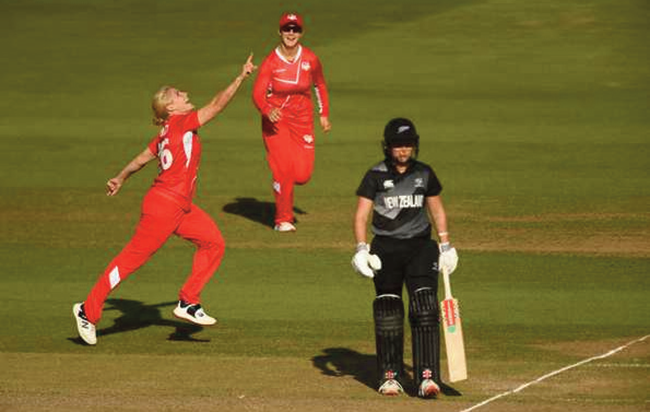
An impressive all-round bowling display by England helped them register a comfortable seven-wicket win over New Zealand and finish on top of Group B with three successive wins at the Commonwealth Games. Katherine Brunt, Issy Wong and Sarah Glenn bagged a brace each as New Zealand were restricted to 71 for 9 after opting to bat on Thursday. The batters had little difficulty in overhauling the small total as they took merely 11.4 overs.
With both England and New Zealand having already secured their places in the semifinals of CWG 2022, the final group stage encounter had little significance apart from deciding their opponents for the last four – India or Australia.
Brunt triggered New Zealand’s collapse with two strikes in her first two overs – cleaning up Sophie Devine and Amelia Kerr. From thereon, New Zealand could never take control of their innings as Maddy Green was bowled, Wong and Glenn picked two each, and errors in running cost them a couple of more wickets to be reduced to 57 for 9 in the 15th over.
A resolute last-wicket stand of 14 runs, the joint highest of the innings, between Hannah Rowe and Fran Jonas, helped New Zealand bat out their full quota of overs, even if it was to prove insignificant in the end.
England were in a slight spot of bother early on after losing opener Danni Wyatt in the first over, by Jonas. However, a counter-attacking start by the in-form Alice Capsey, which included five boundaries in 11 balls, put England firmly in control. Dunkley too picked up pace soon enough, cracking Kerr for two boundaries in the fifth over. However, the duo couldn’t continue their demolition job for too long. In successive overs, Kerr had both the batters sent back to the dugout. With only 26 runs needed from thereon, Amy Jones and Natalie Sciver wrapped up the formalities, setting up their semifinal date with India, while New Zealand will face favourites Australia.
Brief Scores:
New Zealand 71/9 in 20 overs (Maddy Green 19; Katherine Brunt 2-4, Issy Wong 2-10) lost to England 72/3 in 11.4 overs (Alice Capsey 23; Amelia Kerr 2-27) by 7 wickets
(Cricbuzz)






Peshawar Zalmi extended their lead at the top of the table and reestablished their credentials as title favourites with a trouncing eight wicket win over Quetta Gladiators that takes them to the brink of playoff qualification. Sufiyan Muqeem and Iftikhar Ahmed’s spin threat was comfortably enough to overwhelm an unimposing Gladiators’ batting line-up, restricted to 154 with few significant batting contributions. Zalmi wasted little time showing up its insufficiency as Babar Azam on his way to topscoring with an unbeaten 71 off 51 – strung together partnerships with Mohammad Haris and Kusal Mendis in a stroll that barely saw Zalmi move out of third gear, and gave them a fifth consecutive win for the first time in their history.
Gladiators sent their bowlers on a hiding to nowhere by tasking them to defend a total so far below par. Haris and Babar set the tone with a brisk start in the powerplay, which put them so far ahead of the game they could afford Babar’s customary slowdown in the next few overs. This, however, felt more of a deliberate controlling of the tempo than any Gladiators’ success in shackling him. When Gladiators captain Saud Shakeel drew Haris into holing out, Babar picked up the pace once more to ease Mendis into his innings.
There wasn’t so much as a whiff of pressure that entered the ether of the National Stadium Karachi as far as Zalmi were concerned. The last few overs were merely a stage to wrap up formalities rather than any realistic attempt to inject jeopardy into the game, and though it only officially concluded in the 19th over, the stage for the win had been set long before.
It was the Zalmi bowlers who set that stage. After Babar elected to field first, his bowlers backed him up right from the first over. Iftikhar, who is enjoying a dream of a tournament with the ball, struck in his the game’s first over. The partnership between Shakeel and Rilee Rossouw that followed was perhaps the Gladiators’ best passage of play all game, but it was all too brief. They put on 35 in 23 balls, but as the bowlers’ wavered briefly, the fielders helped them out. A pinpoint throw from Farhan Yousaf at point sent Shakeel back on his way, and Zalmi wrested control of the powerplay back.
The momentum shifted decisively with the introduction of Muqeem. He trapped Rossouw on the crease and forced him into a drag-on, before frustrating Shamyl Hussain, who ended up mistiming one ineffectually to long-on. The innings was more stop than start for the best part of what followed as Gladiators remained well out of the vicinity of what would be a competitive score, with seam bowler Mohammad Basit chipping in with middle order wickets.
Once Hasan Nawaz fell for a scratchy 35-ball 37, there wasn’t nearly enough firepower for the death. Zalmi rounded out the innings with a majestic final over from Ali Raza that conceded just two runs off the bat. It would set Zalmi with one of their more straightforward tasks, one they completed with aplomb for their sixth win in seven.
Brief scores:
Peshawar Zalmi 156 for 2 in 18.3 overs (Mohammed Haris 35, Babar Azam 71*, Kusal Mendis 21, Aaron Hardie 18*; Alzarri Joseph 1-32, Saud Shakeel 1-23) beat Quetta Gladiators 154 all out in 20 overs (Saud Shakeel 16, Rilee Rossouw 26, Hasan Nawaz 37, Shamil Hussain 12, Khawaja Nafay 20, Tom Currann15; Iftikhar Ahmed 1-20, Sufiyan Muqeem 3-25, Mohammad Basit 3-36) by 8 wickets
[Cricinfo]

Royal Challengers Bengaluru (RCB) bowled Lucknow Super Giants (LSG) out for 146 and chased it down with nearly five overs to spare as they moved to the top of the IPL 2026 points table.
This win was thanks to the defensive bowling skills of Josh Hazelwood and Krunal Pandya. They took three wickets between them. Others were more successful on the night but it was very much a case of pressure created at one end resulting in mistakes at the other. Rishabh Pant had a chastening night, taking a blow to his left elbow, retiring hurt in the fifth over, coming back in the 16th with LSG in dire straits and being dismissed for 1 off 6.
With Hazlewood back in the team, and bowling three of the first seven overs, RCB gained an early stranglehold over the game. On a pitch which was dry and holding up a bit, he made life extremely hard for the batters by never giving them a chance to free their arms. When Pant tried, he suffereed a blow on the left elbow and had to retire hurt. When Nicholas Pooran tried, he dragged the ball onto his stumps. RCB’s quicks conceded runs at just over seven an over in the first 10. When they focused on keeping the ball around the off stump, runs would only come at just over three an over during this same period. Hazlewood was running so hot he merited a slip and a short leg at one point.
There are now 12 spinners with 100 wickets in the IPL. It is a list dominated by wristspinners and mystery spinners. For Krunal to end up there shows just how well he works within his limitations though lately he has been pushing against them, bowling bouncers and, on Wednesday, a crouched, low-arm delivery that did for Mitchell Marsh. The Australian had made 40 of LSG’s 71 runs at that point and thought he had a short ball he could put away, but the change in Krunal’s action made sure it didn’t bounce as much as expected.
Marsh was bowled off an inside edge. Together, Hazlewood and Krunal bowled 23 dot balls. The pressure they put resulted in wickets for Rasikh Salam (4 for 24) and Bhuvneshwar Kumar (3 for 27). Pant came back to bat again with his left arm strapped up but was one of five wickets that fell in the death overs (17 to 20).
Playing for the first time in his IPL career as an Impact Sub, Virat Kohli hit six fours and a six in his first 14 balls, showing once again a willingness to manufacture shots and hitting in the air. LSG helped his cause as well by bowling too full. These were not the conditions to go searching for conventional help. RCB hit the deck. Even a swing bowler like Bhuvneshwar didn’t bother pitching the ball too far up.
LSG didn’t get the memo. They were a distant second in this game tactically. Kohli was 32 off 14 as RCB put on 60 in the powerplay. Once the field spread, and LSG hit better lengths, runs became harder to come by. Kohli made 17 off his last 20 balls and fell for 49 off 34.
Rajat Patidar came in and played a very sixy innings. He has cleared the boundary 21 times this season, more than anybody else. His balls-per-six ratio is under five. RCB could have knocked these runs over and taken the game. But they kept putting pressure on the LSG bowlers. They felt no need to take a backwards step. The win came in the end, at the cost of maybe one or two more wickets, which seems a reasonably price to pay to stay true to your identity.
Brief scores:
Royal Challengers Bengaluru 149 for 5 in 15.1 overs (Virat Kohli 49, Devudutt Padikkal 10, Rajat Patidar 27, Jitesh Sharma 23, Tim David 14*, Romario Shepherd 14*; Prince Yadav 3-32, Avesh Khan 2-23) beat Lucknow Super Giants 146 in 20 overs (Mitchell Marsh 40, Aiden Markram 12, Ayush Badoni 38, Mukul Choudhary 39; Bhuvneshwar Kumar 3-27, Josh Hazelwood 1-20, Rasikh Salam 4-24, Krunal Pandya 2-38) by five wickets
[Cricinfo]

Chennai Super Kings left the bottom of the table and joined four other teams on four points by achieving two successive wins for the first time in exactly two years. Despite losing the toss and bowling in heavy dew, CSK kept Kolkata Knight Riders winless this season by sealing a 32-run victory at Chepauk.
Sanju Samson, Dewald Brevis and Ayush Mhatre got CSK to 192 on a surface that was not easy to dominate on outside the powerplay, and then Anshul Kamboj and Khaleel Ahmed got the big wickets of Finn Allen and Sunil Narine inside the powerplay. Having scored double of KKR’s 36 in the first six overs, CSK slammed the door with their spinners bowling eight overs for 47 runs and four wickets.
Facing early elimination now, KKR’s bowling improved with the return of Varun Chakravarthy, but their batting continued to be lightweight for the modern T20 game even though they pushed Narine up to open the batting.
It was perhaps a blessing in disguise that CSK’s struggling captain Ruturaj Gaikwad didn’t hang around for too long, allowing Samson and Mhatre use of the field restrictions. Both of them hit Vaibhav Arora for a hat-trick of fours each to go with Mhatre’s successive sixes off Cameron Green, who opened the bowling, got some shape but couldn’t stick to plans. Arora came back to bounce Mhatre out at the end of the powerplay, but his 16-ball 38 had done the damage already. Both teams practically cancelled each other out on runs outside the powerplay, but CSK’s 72 to KKR’s 36 in the first six overs proved decisive.
Sunil Narine led the middle-overs slowdown as Samson decided to see him out without taking risks. Varun started well with only one boundary in his first two overs, but the surprise package was the high pace of Kartik Tyagi, who not only bowled Samson just short of his fifty but also possibly delayed the arrival of Shivam Dube, who could have likely broken up overs of spin. Narine, Anukul Roy and Varun continued to deny batters freedom as just 70 came in nine overs after the powerplay.
Struggling for fluency, Brevis managed to get the better of Arora in the 16th over, which went for 20 runs, but Narine and Tyagi again denied CSK a finishing kick. Narine conceded one boundary in the 17th, and Tyagi bowled overs 18 and 20 for just 14 runs, giving KKR hope as they went into the chase.
KKR finally opened with the ideal combination, but Khaleel and Kamboj got just enough movement off the pitch to frustrate Allen and Narine. Playing his fifth match, Allen was yet to make it out of the powerplay as he edged Kamboj to cover-point. Narine managed to hit two sixes and two fours, but Khaleel frustrated him with wide lines and the round-the-wicket angle. Khaleel eventually had him caught at short third, moments after he had been dropped off Kamboj.
Raghuvanshi and Rahane are not the most dynamic duo in T20 cricket, and CSK snuck in overs of fingerspin and rookie Gurjapneet Singh while they were in the middle. Two catches went down off Hosein before he finally had Raghuvanshi caught for 27 off 19. Despite hitting two sixes off Gurjapneet, Rahane managed just 28 off 22.
Rahane eventually fell to a wrong’un from Noor Ahmad, who had been held back for the more threatening KKR batters: Rovman Powell, Green and Rinku Singh. He followed it up by bowling Green for a golden duck with his quick stock ball. Noor went on to add Rinku to his haul as the asking rate went beyond reach. He ended up with 3 for 21 in his four to go with Hosein’s 1 for 26 collected in an unbroken spell of four overs. By the time the two were done, the game was all but over with KKR needing 86 off the last five overs.
Brief scores:
Chennai Super Kings 192 for 5 in 20 overs (Sanju Samson 48, Ayush Mhatre 38, Dewald Brevis 41, Sarfaraz Khan 23, Shivam Dube 13*; Vaibhav Arora 1-55, Anukul Roi 1-21, Kartik Tyagi 2-35) beat Kolkata Knight Riders 160 for 7 in 20 overs (Sunil Narine 24, Ajinkya Rahane 28, Angkrish Raghuvansi 27, Rovman Powell 31*, Ramandeep Singh 35; Khaleel Ahmed 1-24, Anshul Kamboj 2-32, Akeal Hosein 1-26, Noor Ahmed 3-21) by 32 runs
[Cricinfo]

Babar Azam 71* helps Peshawar Zalmi extend lead at top

Trump threatens to fire Fed chair Jerome Powell if he doesn’t leave in May

Royal Challengers Bengaluru top the table after bowlers help thump Lucknow Super Giants

Showers expected in the Western, Sabaragamuwa, Southern, Central, Uva and North-western provinces

Heat Index at Caution Level in the Northern, North-central, North-western, Western, Sabaragamuwa, Eastern and Southern provinces and in Monaragala district

Pakistani army chief in Tehran amid bid to restart US talks

‘Dates have the highest sugar content to fight Coronavirus’

Sunday Island 27 December – Headlines

#SundayIsland 17th December – Headlines

Sunday Island – 28th March

Sunday Island Headlines – 21 March

Sunday Island – 21st February – Headlines
-

 News4 days ago
CEB orders temporary shutdown of large rooftop solar systems
-
 Features4 days ago
From Royal College Platoon to National Cadet Corps: 145 years of discipline, leadership, and modern challenges
-

 Business6 days ago
Israeli attack on Lebanon triggers local stock market volatility
-

 Business6 days ago
HNB Assurance marks 25 years with strategic transformation to ‘HNB Life’
-

 Latest News4 days ago
PNS TAIMUR & ASLAT arrive in Colombo
-

 News5 days ago
Anura Solomons passes away
-

 Features4 days ago
CIA’s hidden weapon in Iran
-
 Latest News3 days ago
Prasidh, Buttler set up comfortable win for Gujarat Titans