
News
Chinese ‘debt trap’: President sets record straight

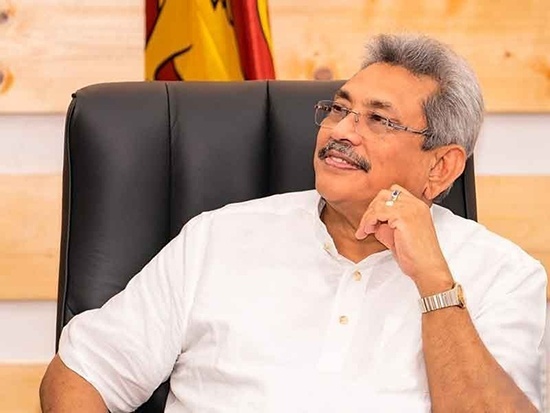
‘Independence and sovereignty won’t be compromised in foreign relations’
Pointing out that China had assisted in the development of Sri Lanka’s infrastructure since the end of the separatist war in May 2009, President Gotabaya Rajapaksa yesterday (28) insisted that Sri Lanka had not been caught in a debt trap as a result.
President Rajapaksa made his position clear as regards repeated US allegations that Sri Lanka is in a Chinese debt trap when he met US Secretary of State Michael Pompeo at the Presidential Secretariat.
Pompeo arrived at the BIA from New Delhi on Tuesday night (27). The visit took place in the wake of the high level Chinese delegation meeting President Gotabaya Rajapaksa where Beijing reiterated its commitment to Sri Lanka’s prosperity.
The President’s Office quoted the US Secretary of State Mike Pompeo as having assured President Gotabaya Rajapaksa that the United States was ready to continuously engage Sri Lanka in its strive to achieve economic development goals.
His country expects to further develop already existing strong bilateral relations between the two countries, the PO statement quoted Pompeo as having said.
The PO statement: During the cordial discussion between the two parties, views on a number of areas of bilateral and regional importance were exchanged.
Expressing the desire of the United States to continue to work closely with Sri Lanka in achieving a high level of economic development the American Secretary of State said priority will be given to promote US investments in the Island.
Tourism is a key sector that contributes to employment and income generation. USA is ready to give a helping hand to the development of this area under a carefully prepared action plan, Mr. Pompeo stated.
In response President Rajapaksa said what Sri Lanka wants is not obtaining loans continuously but to achieve a high level of economic growth by attracting more foreign investments.
“We have already begun to remove bureaucratic red tape that hinder foreign investment. Sri Lanka is a country that possesses necessary factors to achieve a high agricultural development. Our agriculture sector should be modernized. Scientific research should be conducted in order to reach this goal. We expect your assistance towards this end”, President Rajapaksa stressed.
Elaborating on the foreign policy of Sri Lanka, President said it is based on neutrality.
Relations between Sri Lanka and other nations are determined by several conditions. Historic and cultural relations, development cooperation are some of the priorities. President stressed that he is not ready to compromise the independence, sovereignty and territorial integrity of the nation in maintaining foreign relations whatever the circumstances may be. Noting that China assisted in the development of the country’s infrastructure since the end of the separatist war, the President reiterated that Sri Lanka is not caught in a debt trap as a result.
The two sides agreed to further strengthen the defence cooperation already established between Sri Lanka and the United States. These include training opportunities and material assistance from the United States to security forces personnel in Sri Lanka.
When President emphasized the need to strengthen the coast guard services to combat drug trafficking, the State Secretary said that the US could assist in this endeavor.
Mr. Pompeo said that the United States wishes to see that the Indian Ocean remains a zone of peace. He expressed satisfaction over the existing friendly ties between Sri Lanka and India. President Rajapaksa stated that Sri Lanka also hopes to see peace in the Indian Ocean.
Both parties also agreed to work together on human rights issues in international fora.
The US Ambassador to Sri Lanka Alaina Teplitz, Under Secretary of State Brian Bulatao, Chief Assistant Deputy Secretary at Bureau of South and Central Asian Affairs Dean Thompson, Senior Advisor to the State Secretary Mary Kissel were the other members of the US delegation.
Minister of Foreign Relations Dinesh Gunawardena, Secretary to the President P.B. Jayasundera, Secretary to the Ministry of Foreign Relations Admiral Jayanath Colombage, Principal Advisor to the President Lalith Weeratunga and Sri Lanka’s Ambassador – designate to the US Ravinatha Aryasinghe were also present during the discussion.






The Landslide Early Warning Center of the National Building Research Organisation [NBRO] has issued landslide early warnings to the districts of Kandy and Nuwara Eliya valid from 06:00 hrs on 13.02.2026 to 06:00 hrs on 14.02.2026
Accordingly,
Level II [AMBER] landslide early warnings have been issued to the Divisional Secretaries Divisions and surrounding areas of Walapane and Nildandahinna in the Nuwara Eliya district.
Level I [YELLOW] landslide early warnings have been issued to the Divisional Secretaries Divisions and surrounding areas of Pathahewheta in the Kandy district.
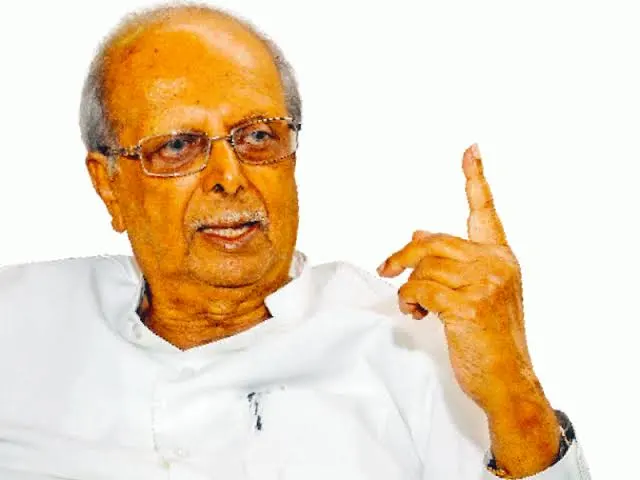
Former Minister Professor Tissa Vitharana has passed away at the age of 91, according to family sources

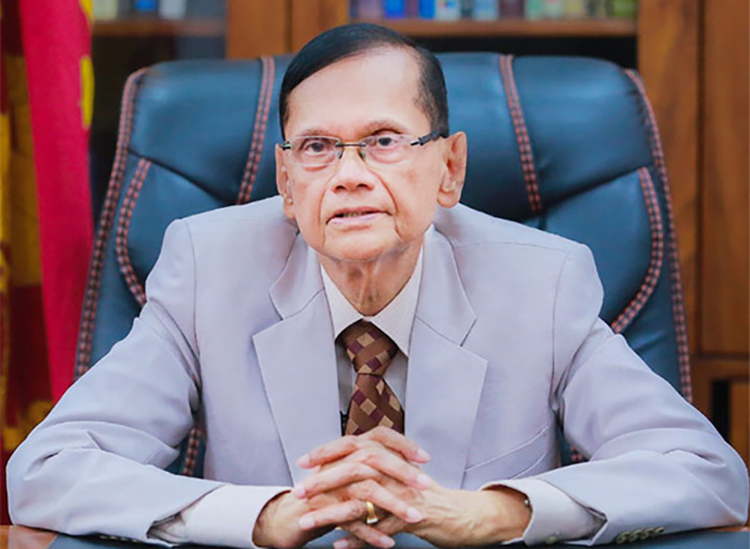
‘Media freedom will be in jeopardy’
Former Minister of Justice, Constitutional Affairs, National Integration and Foreign Affairs Prof. G. L. Peiris has warned that the proposed Protection of the State from Terrorism Act (PSTA) will deal a severe blow to civil liberties and democratic rights, particularly media freedom and the overall freedom of expression.
Addressing a press conference organised by the joint opposition alliance “Maha Jana Handa” (Voice of the People) in Colombo, Prof. Peiris said the proposed legislation at issue had been designed “not to protect people from terrorism but to protect the State.”
Prof. Peiris said that the proposed law would sound the death knell for the rights long enjoyed by citizens, with journalists and media institutions likely to be among those worst affected.
Prof. Peiris took exception to what he described as the generous use of the concept of “recklessness” in the draft, particularly in relation to the publication of statements and dissemination of material. He argued that recklessness was recognised in criminal jurisprudence as a state of mind distinct from intention and its scope was traditionally limited.
“In this draft, it becomes yet another lever for the expansion of liability well beyond the properly designated category of terrorist offences,” Prof. Peiris said, warning that the elasticity of the term could expose individuals to prosecution on tenuous grounds.
Prof. Peiris was particularly critical of a provision enabling a suspect already in judicial custody to be transferred to police custody on the basis of a detention order issued by the Defence Secretary.
According to the proposed laws such a transfer could be justified on the claim that the suspect had committed an offence prior to arrest of which police were previously unaware, he said.
“The desirable direction of movement is from police to judicial custody. Here, the movement is in the opposite direction,” Prof. Peiris said, cautioning that although the authority of a High Court Judge was envisaged, the pressures of an asserted security situation could render judicial oversight ineffective in practice.
Describing the draft as “a travesty rather than a palliative,” Prof. Peiris said the government had reneged on assurances that reform would address longstanding concerns about existing counter-terrorism legislation. Instead of removing objectionable features, he argued, the new bill introduced additional provisions not found in the current Prevention of Terrorism Act (PTA).
Among them is a clause empowering the Defence Secretary to designate “prohibited places”. That was a power not contained in the PTA but previously exercised, if at all, under separate legislation such as the Official Secrets Act of 1955. Entry into such designated places, as well as photographing, video recording, sketching or drawing them, would constitute an offence punishable by up to three years’ imprisonment or a fine of up to Rs. 3 million. Prof. Peiris said. Such provision would have a “particularly chilling effect” on journalists and media personnel, he noted.
The former minister and law professor also criticised the breadth of offences defined under the draft, noting that it sought to create 13 categories of acts carrying the label of terrorism. This, he said, blurred the critical distinction between ordinary criminal offences and acts of terrorism, which require “clear and unambiguous definition with no scope for elasticity of interpretation.”
He cited as examples offences such as serious damage to public property, robbery, extortion, theft, and interference with electronic or computerised systems—acts which, he argued, were already adequately covered under existing penal laws and did not necessarily amount to terrorism.
Ancillary offences, too, had been framed in sweeping terms, Prof. Peiris said. The draft legislation, dealing with acts ‘associated with terrorism,’ imposed liability on persons “concerned in” the commission of a terrorist offence. “This is a vague phrase and catch-all in nature.” he noted.
Similarly, under the subheading ‘Encouragement of Terrorism,’ with its reference to “indirect encouragement,” could potentially encompass a broad spectrum of protest activity, Prof. Peiris maintained, warning that the provision on “Dissemination of Terrorist Publications” could render liable any person who provides a service enabling others to access such material. “The whole range of mainstream and social media is indisputably in jeopardy,” Prof. Peiris said.
Former Minister Anura Priyadarshana Yapa and SLFP Chairman Nimal Siripala de Silva also addressed the media at the briefing.
by Saman Indrajith ✍️

Canada, UAE face each other for only the second time in T20Is

Landslide Early Warnings issued to the Districts of Kandy and Nuwara Eliya

Former Minister Professor Tissa Vitharana has passed away at the age of 91

Buoyant Zimbabwe plot massive upset against depleted Australia

Mexican ships arrive in Cuba with humanitarian cargo amid US oil blockade

Tarique Rahman’s BNP claims majority in Bangladesh election

‘Dates have the highest sugar content to fight Coronavirus’

Sunday Island 27 December – Headlines

#SundayIsland 17th December – Headlines

Sunday Island – 28th March

Sunday Island Headlines – 21 March

Sunday Island – 21st February – Headlines
-
 Features5 days ago
My experience in turning around the Merchant Bank of Sri Lanka (MBSL) – Episode 3
-

 Business6 days ago
Zone24x7 enters 2026 with strong momentum, reinforcing its role as an enterprise AI and automation partner
-
 Business5 days ago
Remotely conducted Business Forum in Paris attracts reputed French companies
-
 Business5 days ago
Four runs, a thousand dreams: How a small-town school bowled its way into the record books
-

 Business5 days ago
ComBank and Hayleys Mobility redefine sustainable mobility with flexible leasing solutions
-
 Business2 days ago
Autodoc 360 relocates to reinforce commitment to premium auto care
-
 Business6 days ago
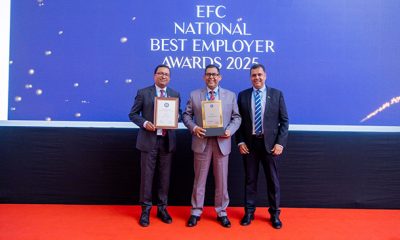
HNB recognized among Top 10 Best Employers of 2025 at the EFC National Best Employer Awards
-
 Midweek Review2 days ago
A question of national pride