
News
China poised for diplomatic windfall in Sri Lanka elections Beijing backs politicians and influential Buddhist leaders, expert says


MARWAAN MACAN-MARKAR, Asia regional correspondent, Nikkei Asian Review
BANGKOK — China is cultivating a wide swathe of political allies in Sri Lanka ahead of the nation’s general elections on Aug. 5, marking a break from throwing its lot in with one dominant political camp.
Foreign policy insiders in the small South Asian nation reckon the strategy fortifies the edge China has over geopolitical adversaries India, Japan and the U.S. when it comes to influencing a country that straddles an increasingly contested stretch of the Indian Ocean.
This diplomatic shift, the insiders say, has been marked by quiet, behind-the-scenes meetings between Chinese emissaries and the leading political parties vying for votes ahead of elections that in a little more than two weeks will determine parliament’s 225 lawmakers.
The coronavirus’s impact in Sri Lanka provided China with an opening to demonstrate its newly tuned diplomacy. Song Tao, minister of the international department of the Chinese Communist Party’s Central Committee, in June hosted a video conference with leaders of Sri Lanka’s major political parties to cultivate bipartisan bonds under the guise of fighting COVID-19.
The island nation has reported 2,674 infections and 11 deaths. According to Luo Chong, a spokesperson of the Chinese embassy in Colombo, the meeting was a goodwill gesture that has been repeated with other allies in the wake of the pandemic. “The International Department of the Communist Party of China conducted several joint-video conferences with different parties in Sri Lanka, Nepal, [the] Philippines, Indonesia and Arab counties, which is a common practice, especially under the current COVID-19 situation,” he told the Nikkei Asian Review.
The pandemic has boosted China’s influence in Sri Lanka, a veteran Sri Lankan diplomat said, referring to a $500 million loan President Gotabaya Rajapaksa desperately sought from China to help fight COVID-19.
“China is the only international player who has the funds to help with such emergencies,” the diplomat said. “Beijing was prompt because it knows which political players it is closer to in Sri Lanka — the Rajapaksas,” referring to the president and his elder brother Prime Minister Mahinda Rajapaksa, a former president.
But seasoned observers of Chinese diplomacy read more into Beijing’s preelection encounters with parties across Sri Lanka’s political spectrum.
Patrick Mendis, a visiting professor of global affairs at the National Chengchi University, based in Taiwan, said the CCP constantly adjusts its diplomacy based on previous outcomes. “It has remarkable agility to change as China learns from its past mistakes in Sri Lanka,” Mendis said. “Now, it supports not only political parties but influential Buddhist leaders, as China realizes the power of the Buddhist clergy in domestic politics.”
In 2015, China was perceived as backing then incumbent President Mahinda Rajapaksa. But Mahinda lost his reelection bid in a shock setback for the country’s most politically influential clan, the Rajapaksas, who had displayed signs of dynastic ambitions.
That 2015 poll, the second after the Rajapaksas presided over the end of a nearly 30-year Civil War, was marked by allegations that India, the regional power in South Asia, and China were bankrolling competing campaigns.
The Rajapaksa camp accused the Research and Analysis Wing, India’s spy agency, of pouring funds into a coalition of anti- Rajapaksa political parties to defeat Mahinda in his run for a third term.
Former President Maithripala Sirisena ended up winning, and his camp accused a Chinese company with investments in Sri Lanka of financing the Rajapaksa campaign.
Last year, in November, Gotabaya Rajapaksa, a former military lieutenant colonel, won a decisive mandate in the presidential poll, signaling voter appetite for a strongman leader after five years of a divisive and dysfunctional administration under an anti-Rajapaksa coalition.
While China burrowed deep into Sri Lankan politics — it has even commissioned local pollsters to gauge voter sentiment — it was also lavishing multibillion-dollar loans on the country for large infrastructure projects ranging from a new harbor and airport to highways. Not surprisingly, China accounts for 10% of Sri Lanka’s ballooning external debt of $55 billion. Compare that number to $88 billion, the size of the island’s economy
The China-funded projects have become a hot-button issue during election cycles as some Sri Lankan voters take a dislike to foreign money paying for strategic assets. “This was never the case before,” a senior South Asian diplomat said. “Foreign policy and foreign investment [used to have] bipartisan backing no matter which party won, but that has changed over the last few years, and strategic investments have become campaign fodder.”
As for Japan, for decades Sri Lanka’s largest bilateral lender and development partner, it now must deal with the Rajapaksa tilt toward China. Mere months into his first term, Gotabaya Rajapaksa has sent mixed messages to Japan about the fate of two multibillion-dollar infrastructure projects, both of which were championed by the previous coalition government.
One is an elevated light railway system through parts of Greater Colombo, the island’s largest commercial city. The new government says the rail will have to be delayed.
The other is an expanded container terminal in Colombo Port, which also has Indian and Sri Lankan backers. The tripartite agreement, signed in 2019 by the previous government, is also at the whim of the Rajapaksa government, which wants new terms. Japan appears unmoved for now. “There is no such fact that Japan and Sri Lanka have agreed to revise the plan of the LRT project,” an official at the Japanese Embassy in Colombo told Nikkei, referring to the Light Railway Transit project. “We understand that this project has so far been implemented as planned by the Sri Lankan implementing agency.”
But India’s government is fuming over the matter, especially now that the Rajapaksa camp is turning the Colombo Port container terminal project into an anti-India campaign issue.
Diplomatic sources in Colombo say India eyed a stake in the Colombo Port as a counterweight to China’s growing dominance in Sri Lanka’s maritime economy.
“The Indians don’t trust the Rajapaksas,” said a diplomat from a Western embassy in Sri Lanka’s former capital. “They see them as doubled-tongued. A reversal on the port project would see India returning to the pre-2015 days of distrusting Colombo.”
The U.S. faces a similar quandary. A $480 million grant under Washington’s so-called Millennium Challenge Corporation was partially meant to help upgrade Sri Lanka’s transport and logistics infrastructure, but it too has become an electoral football, as it was during the presidential election in November. Rajapaksa has profited from the anti-MCC campaign rhetoric of his ultranationalist constituency among the country’s Sinhala-Buddhist ethnic majority.
The U.S. may have to bite this political bullet to achieve its longer-termstrategic vision in the Indian Ocean, which includes Sri Lanka.
“Washington’s attention to Sri Lanka appears to be increasingly fueled by geostrategic concerns about China,” said Nilanthi Samaranayake, director for strategy and policy analysis at the Center for Naval Analysis, a Washington-based think tank. “[There is more] attention on Sri Lanka than ever before… [and there willbe] questions [after the elections] about which direction Sri Lankawill move in regarding its policies toward India, the U.S. and China.”




Bus fares have been increased by 12.19% with effect from midnight today [23rd March 2026].
The minimum fare will be increased from Rs 27 to Rs 30 while the maximum fare of Rs2159/- will be increased to 2422/-
Latest News
Public will not be served as Computer system failure at Department of Registration of Persons

The Acting Commissioner General of Registration of Persons has announced that due to an unexpected failure of the computer system of the Department of Registration of Persons, all services, including the one day service will not be held on Tuesday (24th March) at the Head Office and all Provincial offices.

Latest News
Heat Index at Caution Level in the Western, Sabaragamuwa, Southern and North-western provinces and in Anuradhapura, Mannar and Vavuniya districts
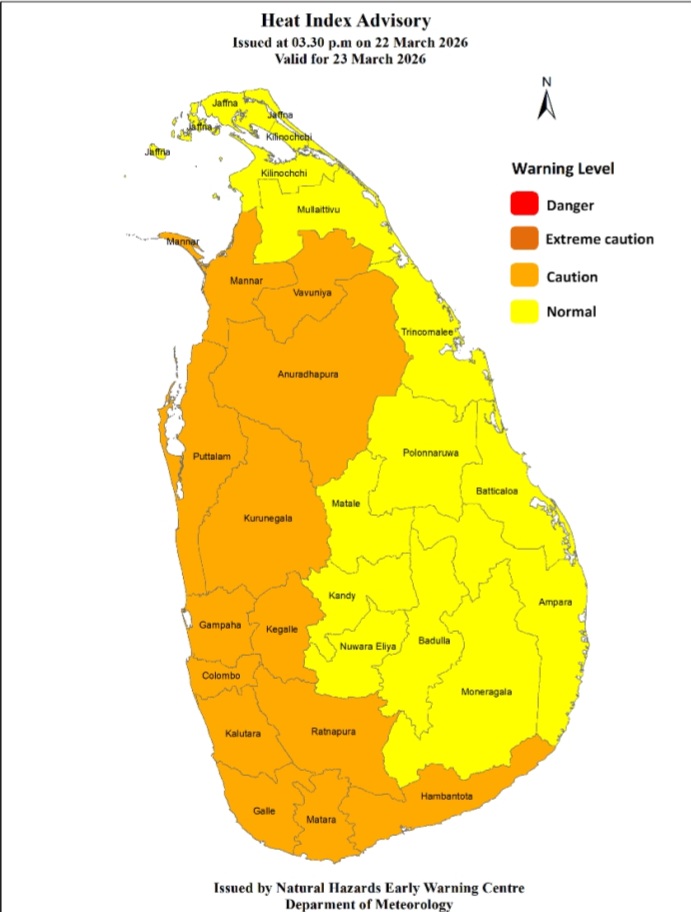
Warm Weather Advisory
Issued by the Natural Hazards Early Warning Centre of the Department of Meteorology
at 3.30 p.m. on 22 March 2026, valid for 23 March 2026.
The Heat index, the temperature felt on human body is likely to increase up to ‘Caution level’ at some places in the Western, Sabaragamuwa, Southern and North-western provinces and in
Anuradhapura, Mannar and Vavuniya districts.
The Heat Index Forecast is calculated by using relative humidity and maximum temperature and this is the condition that is felt on your body. This is not the forecast of maximum temperature. It is generated by the Department of Meteorology for the next day period and prepared by using global numerical weather prediction model data.

Effect of the heat index on human body is mentioned in the above table and it is prepared on the advice of the Ministry of Health and Indigenous Medical Services.
ACTION REQUIRED
Job sites: Stay hydrated and takes breaks in the shade as often as possible.
Indoors: Check up on the elderly and the sick.
Vehicles: Never leave children unattended.
Outdoors: Limit strenuous outdoor activities, find shade and stay hydrated.
Dress: Wear lightweight and white or light-colored clothing.
Note:
In addition, please refer to advisories issued by the Disaster Preparedness & Response Division, Ministry of Health in this regard as well. For further clarifications please contact 011-7446491.

Two killed when Air Canada jet hits fire truck at NYC’s LaGuardia Airport

Bus fares increased by 12.19% from midnight today [23]
Public will not be served as Computer system failure at Department of Registration of Persons

Trump says he is postponing strikes on Iran power plants after ‘productive’ talks on ending war

Asia stocks slide as US and Iran threaten to escalate war

Heat Index at Caution Level in the Western, Sabaragamuwa, Southern and North-western provinces and in Anuradhapura, Mannar and Vavuniya districts

‘Dates have the highest sugar content to fight Coronavirus’

Sunday Island 27 December – Headlines

#SundayIsland 17th December – Headlines

Sunday Island – 28th March

Sunday Island Headlines – 21 March

Sunday Island – 21st February – Headlines
-

 News6 days ago
CIABOC questions Ex-President GR on house for CJ’s maid
-

 News7 days ago
Sri Lankan marine scientist Asha de Vos honoured at UNGA opening
-

 News7 days ago
Australian HC debunks misleading travel risk claims for Sri Lanka
-

 News5 days ago
Bailey Bridge inaugurated at Chilaw
-

 News5 days ago
Pay hike demand: CEB workers climb down from 40 % to 15–20%
-

 News4 days ago
CIABOC tells court Kapila gave Rs 60 mn to MR and Rs. 20 mn to Priyankara
-

 Editorial6 days ago
Couple QR-based quota with odd-even rationing
-

 Features22 hours ago
Trincomalee oil tank farm: An engineering marvel