
News
Challenge for Sri Lanka demonstrates it is after economic benefits and not geopolitical mischief


– former Foreign Secy. Ambassador Palihakkara
Former Foreign Secretary, Ambassador H. M. G. S. Palihakkara, has said the overarching challenge that is faced by Sri Lanka in its foreign relations, is demonstrating that it is after tangible economic benefits and not “geopolitical mischief” in the Indian Ocean. He emphasized the need to harmonise domestic and foreign policies to effectively overcome the acute issues arising from the economic crisis, to deal with the Indian Ocean geopolitical “trilemma” between India, China, and the United States, and to address accountability and reconciliation at a system-wide level. Ambassador Palihakkara further suggested that Sri Lanka must re-establish its core principles for foreign policy to better navigate this ever-changing geopolitical climate, which includes a focus on avoiding involvement in great power rivalries, reciprocal engagement with all countries, and promoting a policy of international cooperation geared towards the Sustainable Development Goals (SDG).
Ambassador Palihakkara made these observations while participating in the inaugural ‘LKI Foreign Policy Forum’, titled “Changing Global Dynamics: Implications for Sri Lanka”, held on Wednesday, 9th August 2023, at the Lakshman Kadirgamar Institute of International Relations and Strategic Studies (LKI) Lighthouse Auditorium. The event, held to coincide with the 18th death anniversary of the Late Hon. Lakshman Kadirgamar, was inaugurated by Foreign Minister M.U.M. Ali Sabry, and attended by State Minister of Foreign Affairs Tharaka Balasuriya, as well as a representative gathering, comprising heads of diplomatic missions and international organisations, government officials, academics, business leaders, civil society, media practitioners, as well as students.
Earlier, LKI Executive Director Ambassador Ravinatha Aryasinha, who moderated the session, identified seven key trends in the changing global dynamics: volatile global power politics; emerging pressures on the global economy; power rivalries in the Indian Ocean; the increased significance of India; the crisis in multilateralism; the inconsistency of state voting in the United Nations system; and the changing role of non-state actors in a rapidly expanding public sphere.
Dr Harinda Vidanage, Director/International Relations and Director/Centre for Strategic Assessment, Kotelawala Defence University (KDU), discussed the current nature of global affairs with reference to great power and multilateral alliances, the pursuit of small state strategic autonomy in the Indian Ocean, and the preparedness of the defence industrial base to address present-day threats in the Indo-Pacific region. Referring to the future of small state strategic autonomy, he mentioned a probable ‘shaking of the established powers’ by emerging middle-range powers, such as India and France, and said Sri Lanka failed to benefit from foreign investments due to the binary oversimplification of complex situations. Dr. Vidanage emphasised that the way forward in the security sector requires strategic assessments of present-day and emerging threats that would effectively address the current challenges in the realm of security, including the spread of disinformation and the politicisation of these matters within Sri Lanka.
Dr Dushni Weerakoon, Executive Director, Institute of Policy Studies (IPS), recognised the growing importance of geopolitical and security strategies into economic policy, with trade and investment strategies no longer being built on purely economic principles. She described how trade policy has become a battleground and major economies are now focussing on building domestic capacity in crucial sectors, such as renewable energy and semiconductors, to reduce dependence on bilateral partners. In the question-and-answer session, she also questioned the sustainability of Sri Lanka’s non-aligned foreign policy, as it weakens their position in trade negotiations.
Dr. Jehan Perera, Executive Director, National Peace Council of Sri Lanka (NPC), emphasised the vital role of civil society organisations in guiding the “moral compass” of Sri Lanka and securing the people’s interests, particularly on the issues of human rights and good governance. Dr. Perera described the success of such moves in the past and how civil society can shape, endorse, and overturn questionable and discriminatory policies in the name of the people. He said that the need for timely elections, addressing requirements of the European Union’s GSP+, the proposed Anti-Terrorism Act, and the political will that is necessary to promote power sharing, could be issues that will influence the attitude towards Sri Lanka by the international community.
The panel discussion was followed by a thought-provoking question-and-answer session, where panellists responded to questions and comments from the audience. Topics included the contemporary relevance of the UN charter, Sri Lanka’s relationship with India, the establishment and expansion of Free Trade Agreements, the evolving role of non-state actors in foreign policy decisions, and the importance of Sri Lanka’s strategic location in the Indian Ocean. This provided a platform for new perspectives on relevant issues regarding Sri Lanka’s foreign policy and promoted further discussion.


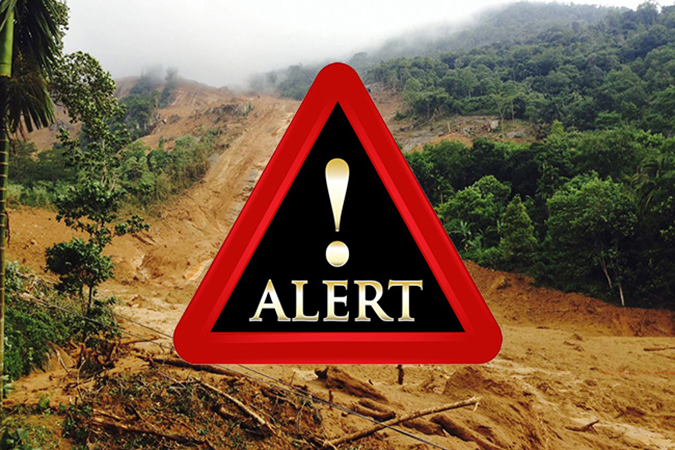
The landslide early warnings issued to the Districts of Kandy and Nuwara Eliya by the Landslide Early Warning Center of the National Building Research Organisation [NBRO] have been extended until 0600 hrs on the 14th of February 2026.
Accordingly,
The Level II [AMBER] landslide early warnings issued to the Divisional Secretaries Divisions and surrounding areas of Walapane and Nildandahinna in the Nuwara Eliya district and
the Level I [YELLOW] landslide early warnings issued to the Divisional Secretaries Division and surrounding areas of Pathahewaheta in the Kandy district have been extended till 0600AM on Saturday [14]
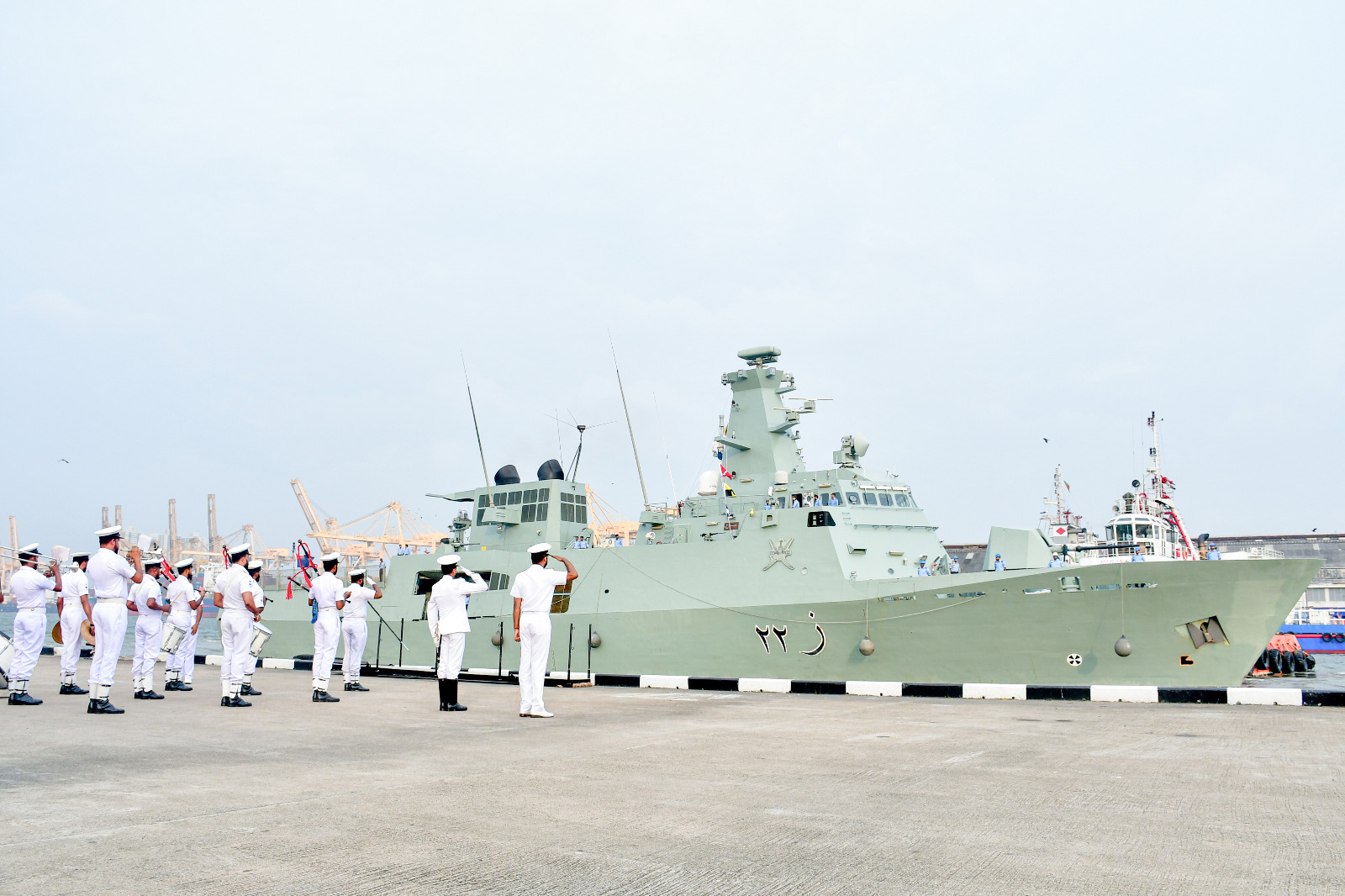
The Royal Navy of Oman Vessel “SADH” which arrived in Sri Lanka for replenishment purpose, departed the island on 12 Feb 26.
In accordance with naval tradition, the Sri Lanka Navy extended a customary farewell to the departing ship.

The Minister of Education, Higher Education and Vocational Education Prime Minister Dr. Harini Amarasuriya stated that aligning with the development activities carried out under the new education reforms, decisions at the rural level will not be taken from Colombo and plans should be sent based on the requirements of the rural level through the District Coordination Committees by structural committees. She further noted that all officials, from the Ministry of Education down to the school level, must commit to working efficiently and with a human-centered approach.
The Prime Minister made these remarks while addressing a discussion held with education authorities of the Hambantota District on Thursday [February 12] at the auditorium of the Hambantota District Secretariat regarding the new education reforms and prevailing issues in the education sector.
During the meeting, the Prime Minister provided an opportunity for education authorities including chief prelates of pirivenas, zonal education directors, teacher advisors, and principals to present the challenges they face and officials raised concerns including salary disparities among principals, developing school infrastructure, issues arising from the division between national and provincial schools, and uplifting pirivena education.
Further elaborating, Prime Minister stated:
“The new education reforms were initiated from 2025 through dialogue, consultations, and the collection of necessary data. As officials, you have extended your support to us during this process. We have embarked on a difficult and long journey, and we look forward to your continued cooperation.
We initiated these reforms in response to a strong social demand. Many have attempted such reforms at different times. Within our political vision, we understood clearly that if this country is to be rebuilt, an educational transformation is essential. The human resource is the most valuable resource of this country and it should be nurtured properly.
Solutions to many of the crises our country faces lie within the education system. Addressing the issues in economic challenges, social issues, drug abuse, violence, the breakdown of political culture, corruption, waste, and even the deterioration of human relationships all lie within the education.
In order to achieve the transformation we envision as a government, that an education transformation is necessary.
This education system should focus on reducing the pressures within the system, minimize school dropouts, increase employability, and instill confidence in children about their future.
There are disparities within the school system, between rural and urban schools, national and provincial schools, and difficult schools. This should not happen. All children must have equal opportunities.
Decisions regarding the establishment of schools or expansion of classes should not be political decisions. They must be decisions taken through Structural Committees. Those representatives understand their divisions, village economies, and population dynamics. Based on your decisions and assessments of needs, prepare the plans, discuss them with the District Coordination Committees, and submit them to us. We will then take steps to provide the necessary allocations and other support. We will not make decisions for the rural level while sitting in Colombo.
We are taking steps to minimize salary disparities. A Cabinet paper regarding the salary anomalies of principals has already been prepared for submission. Steps are also being taken to introduce new reforms in pirivena education through the Pirivena Committee of the Ministry of Education. We require the support of the chief prelates in this regard.
A significant number of teachers turn to human rights due to delays caused by inefficiency. Therefore, all officials from the Ministry of Education down to the schools must commit to working efficiently and in a humane manner”
The discussion was attended by Chief prelates of pirivenas, deputy ministers, Members of Parliament, zonal directors, principals, and other education sector officials.


[Prime Minister’s Media Division]

France probes baby formula producers over contamination recalls

Stirling-less Ireland hope the catches stick against fellow strugglers Oman

Mukkamalla 79, Harmeet four-for lead USA’s trouncing of Netherlands

Landslide Early Warnings issued to the Districts of Kandy and Nuwara Eliya extended

Aryansh Sharma, Sohaib Khan power UAE to thrilling win over Canada

Royal Navy of Oman Vessel “SADH” departs island

‘Dates have the highest sugar content to fight Coronavirus’

Sunday Island 27 December – Headlines

#SundayIsland 17th December – Headlines

Sunday Island – 28th March

Sunday Island Headlines – 21 March

Sunday Island – 21st February – Headlines
-
 Features6 days ago
My experience in turning around the Merchant Bank of Sri Lanka (MBSL) – Episode 3
-

 Business7 days ago
Zone24x7 enters 2026 with strong momentum, reinforcing its role as an enterprise AI and automation partner
-
 Business6 days ago
Remotely conducted Business Forum in Paris attracts reputed French companies
-
 Business6 days ago
Four runs, a thousand dreams: How a small-town school bowled its way into the record books
-

 Business6 days ago
ComBank and Hayleys Mobility redefine sustainable mobility with flexible leasing solutions
-
 Business3 days ago
Autodoc 360 relocates to reinforce commitment to premium auto care
-
 Midweek Review3 days ago
A question of national pride
-
 Business7 days ago
HNB recognized among Top 10 Best Employers of 2025 at the EFC National Best Employer Awards